PUBLISHER: Mordor Intelligence | PRODUCT CODE: 2156870

PUBLISHER: Mordor Intelligence | PRODUCT CODE: 2156870
Micromanipulator - Market Share Analysis, Industry Trends & Statistics, Growth Forecasts (2026 - 2031)
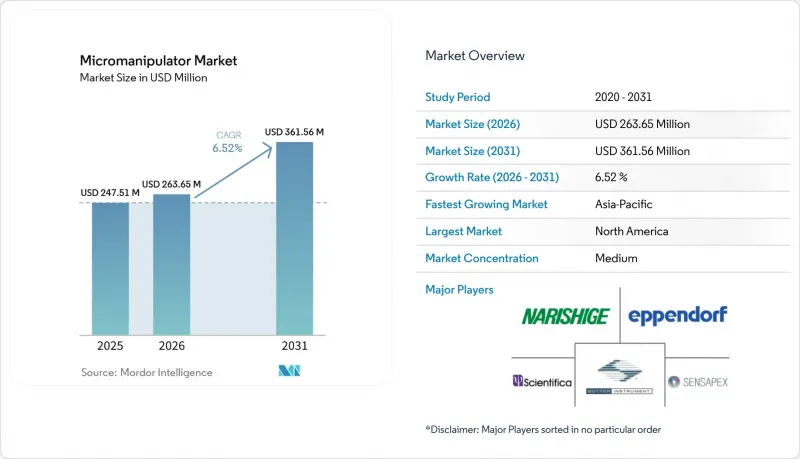
According to Mordor Intelligence, the micromanipulator market size is projected to expand from USD 247.51 million in 2025 and USD 263.65 million in 2026 to USD 361.56 million by 2031, registering a CAGR of 6.52% between 2026 and 2031.
Global Micromanipulator Market Trends and Insights
Rising Intracytoplasmic Sperm Injection and Assisted Reproductive Procedures
The micromanipulator market benefits from the broader clinical use of ICSI in fertility care. The American Society for Reproductive Medicine stated in 2026 that ICSI is used in oocyte cryopreservation thaw, PGT cycles, and in vitro maturation. However, benefits in non-male-factor cases require consideration of added cost and complexity. These procedures require precise handling during sperm injection and related laboratory steps. More varied treatment indications can increase demand for motorized platforms when manual control does not provide consistent performance across different oocyte conditions. The IFFS reported that 59 of 112 surveyed countries provided insurance or government funding coverage for ICSI in 2025. This policy support can expand procedure volumes and the installed base for the micromanipulator market in emerging countries.
Expansion of Cell Biology, Stem Cell, and Gene-Editing Research
The micromanipulator market is also linked to cell biology, stem cell, and gene-editing work. Cell manipulation supports delivery optimization and functional validation in gene-editing research. iPSC-derived tissue models require precise single-cell transfer, nuclear injection, and morphological verification during research workflows. Their wider use in pharmaceutical discovery can extend the use of micromanipulator assets beyond fertility and neuroscience laboratories. Gene-editing programs generally have multiyear development timelines, which supports sustained instrument utilization instead of one-time procedural demand. The micromanipulator market can therefore gain from laboratories that combine cell models, gene-editing workflows, and functional testing within the same research setting.
High Capital Cost of Motorized and Integrated Micromanipulation Workstations
The cost of integrated motorized workstations constrains the micromanipulator market. A complete system with a motorized manipulator, piezo impact drive, microinjector, inverted microscope, and anti-vibration platform can exceed USD 80,000 per station. Multi-probe electrophysiology rigs can reach more than USD 100,000 when headstages, amplifiers, and data acquisition hardware are included. The expense creates a purchasing barrier for emerging-market fertility programs, publicly funded academic laboratories, and hospital research centers. Long authorization processes can delay clinical upgrades even when higher precision is needed. High upfront cost can concentrate advanced capacity in larger laboratories and reduce equipment access for mid-tier institutions.
Other drivers and restraints analyzed in the detailed report include:
- Demand for High-Stability Electrophysiology and Neuropixels Recordings
- Automated Pipette Cleaning and Closed-Loop Positioning Enabling Higher Throughput
- Shortage of Skilled Embryologists and Electrophysiology Operators
For complete list of drivers and restraints, kindly check the Table Of Contents.
Segment Analysis
Electric and motorized micromanipulators held 49.31% of revenue in 2025 and are forecast to grow at a 7.65% CAGR through 2031. This product group held the leading micromanipulator market share because it supports closed-loop feedback control, digital position logging, and automated pipette exchange. These functions are increasingly relevant in neuroscience and high-quality ICSI procedures. Memory positions and controlled motion can reduce the operating gap between newer and experienced users. This can make advanced workflows easier to standardize within busy laboratories.
Manual micromanipulators retain demand in cost-sensitive fertility clinics and teaching institutions. Hydraulic systems remain useful in low-noise electrophysiology work because battery-operated hydraulic units avoid electrical interference. Pneumatic systems serve a smaller industrial niche where cleanroom compatibility and spark-free operation are required. The micromanipulator industry is moving toward motorized solutions as dense neural probes require more repeatable insertion. Manual and hydraulic systems, therefore, remain most relevant where budgets are constrained or a specialized requirement outweighs automation. The micromanipulator market retains space for each product type, although the technical gap between motorized and legacy platforms is widening.
Cell micromanipulation held 41.24% of revenue in 2025. It is the largest application because ICSI, CRISPR delivery, and iPSC-based discovery programs require controlled single-cell transfer and injection. Its revenue base is supported by recurring laboratory activity in fertility and cell research. Electrophysiology and neuroscience are forecast to grow at an 8.42% CAGR through 2031. This micromanipulator market size opportunity is supported by the renewal of rigs for Neuropixels Ultra, 2.0 Quad Base, and Opto protocols.
Industrial micromanipulation is another relevant application within the micromanipulator market. Advanced packaging inspection needs nanometer-class repeatability as trace and bump pitches become smaller. Materials science, nanofabrication, graphene transfer, and biosensor fabrication also use precision manipulation equipment. These uses contribute less than cell manipulation and electrophysiology, but they broaden the set of laboratory and industrial buyers. The premium growth in electrophysiology reflects the purchasing capacity of well-funded neuroscience institutions in the United States, Europe, and Japan. These institutions can replace hardware faster when newer probes require higher stability.
Complete Report Scope:
- By Product Type
- Manual Micromanipulators
- Hydraulic Micromanipulators
- Electric and Motorized Micromanipulators
- Pneumatic Micromanipulators
- By Application
- Cell Micromanipulation
- Electrophysiology and Neuroscience
- Industrial Micromanipulation
- Other Applications
- By End User
- Hospitals and Fertility Centers
- Research Laboratories and Diagnostic Centers
- Academic and Government Research Institutes
- Pharmaceutical and Biotechnology Companies
- Other End Users
- By Axis Configuration
- Single-Axis Systems
- Two-Axis Systems
- Three-Axis Systems
- Multi-Axis Systems
- By Geography
- North America
- United States
- Canada
- Mexico
- Europe
- Germany
- United Kingdom
- France
- Italy
- Spain
- Rest of Europe
- Asia-Pacific
- China
- Japan
- India
- Australia
- South Korea
- Rest of Asia-Pacific
- Middle East and Africa
- GCC
- South Africa
- Rest of Middle East and Africa
- South America
- Brazil
- Argentina
- Rest of South America
- North America
Geography Analysis
North America held 38.61% of revenue in 2025. Its leading micromanipulator market share reflects NIH-funded neuroscience and reproductive medicine programs, a mature private IVF sector, and proximity to semiconductor design and advanced packaging activity. The United States leads regional demand through dense fertility clinic networks and well-funded academic neuroscience laboratories. BRAIN Initiative programs provide continuing support for neural recording tools. Canada also contributes through university research and established ART networks.
Europe is the second-largest region in the micromanipulator market. Germany, the United Kingdom, and France benefit from biomedical infrastructure, Horizon Europe programs, and high IVF use. ESHRE reported more than 923,000 ART cycles across 41 European countries in 2020, forming a clinical base that continued to grow through 2025. Multi-probe rigs are also being integrated into Human Brain Project successor programs. Standardized interfaces for Neuropixels recordings support coordinated laboratory equipment purchases. Italy and Spain provide additional regional demand.
Asia-Pacific is forecast to grow at an 8.25% CAGR through 2031. South Korea and Japan are investing in next-generation semiconductor packaging that requires precise positioning for inspection and failure analysis. China's expanding IVF access adds a separate source of demand for the micromanipulator market. India generates compliance-led demand as the ART Act 2021 requires qualified embryologists and accredited IVF laboratories. Australia contributes through academic research, while South Korea also benefits from semiconductor leadership. The Middle East and Africa are early-stage markets for high-end motorized systems, with IVF access expanding in the UAE and Saudi Arabia. South America is centered on Brazil and Argentina, where rising IVF demand is moderated by public budget limits and import costs. Manual and hydraulic systems remain relevant in these regions, while Brazil's biotechnology research activity adds a separate need for cell manipulation infrastructure.
- ALA Scientific Instruments, Inc.
- APOLLO WAVE Corporation
- Applied Scientific Instrumentation, Inc.
- Burleigh Instruments, Inc. (Thorlabs)
- Campden Instruments Ltd.
- Carl Zeiss
- Danaher
- Harvard Apparatus
- Danaher
- Luigs and Neumann GmbH
- MCI TEC
- Molecular Devices, LLC
- Narishige Co., Ltd.
- NeoBiosystems
- Nikon
- Prior Scientific Instruments Ltd.
- RWD Life Science Co., Ltd.
- Scientifica Ltd.
- Sensapex Oy
- Siskiyou Corporation
- Sutter Instrument Company
- The Micromanipulator Company
- World Precision Instruments, Inc.
- Zaber Technologies Inc.
Additional Benefits:
- The market estimate (ME) sheet in Excel format
- 3 months of analyst support
TABLE OF CONTENTS
1 Introduction
- 1.1 Study Assumptions and Market Definition
- 1.2 Scope of the Study
2 Research Methodology
3 Executive Summary
4 Market Landscape
- 4.1 Market Overview
- 4.2 Market Drivers
- 4.2.1 Rising Intracytoplasmic Sperm Injection and Assisted Reproductive Procedures
- 4.2.2 Expansion of Cell Biology, Stem Cell, and Gene-Editing Research
- 4.2.3 Increasing Demand for High-Stability Electrophysiology and Neuropixels Recordings
- 4.2.4 Growth of Semiconductor Miniaturization and Microelectronic Inspection
- 4.2.5 Automated Pipette Cleaning and Closed-Loop Positioning Enabling Higher Throughput
- 4.2.6 Integration of Micromanipulators With Digital Twins and Experiment-Level Position Tracking
- 4.3 Market Restraints
- 4.3.1 High Capital Cost of Motorized and Integrated Micromanipulation Workstations
- 4.3.2 Shortage of Skilled Embryologists and Electrophysiology Operators
- 4.3.3 Application-Specific Compatibility Constraints Across Microscopes, Holders, and Headstages
- 4.3.4 Reproducibility Risk From Vibration, Thermal Drift, and Calibration Variability
- 4.4 Supply-Chain Analysis
- 4.5 Regulatory Landscape
- 4.6 Technological Outlook
- 4.7 Porter's Five Forces Analysis
- 4.7.1 Competitive Rivalry
- 4.7.2 Threat of New Entrants
- 4.7.3 Bargaining Power of Suppliers
- 4.7.4 Bargaining Power of Buyers
- 4.7.5 Threat of Substitutes
5 Market Size & Growth Forecasts (Value, USD)
- 5.1 By Product Type
- 5.1.1 Manual Micromanipulators
- 5.1.2 Hydraulic Micromanipulators
- 5.1.3 Electric and Motorized Micromanipulators
- 5.1.4 Pneumatic Micromanipulators
- 5.2 By Application
- 5.2.1 Cell Micromanipulation
- 5.2.2 Electrophysiology and Neuroscience
- 5.2.3 Industrial Micromanipulation
- 5.2.4 Other Applications
- 5.3 By End User
- 5.3.1 Hospitals and Fertility Centers
- 5.3.2 Research Laboratories and Diagnostic Centers
- 5.3.3 Academic and Government Research Institutes
- 5.3.4 Pharmaceutical and Biotechnology Companies
- 5.3.5 Other End Users
- 5.4 By Axis Configuration
- 5.4.1 Single-Axis Systems
- 5.4.2 Two-Axis Systems
- 5.4.3 Three-Axis Systems
- 5.4.4 Multi-Axis Systems
- 5.5 By Geography
- 5.5.1 North America
- 5.5.1.1 United States
- 5.5.1.2 Canada
- 5.5.1.3 Mexico
- 5.5.2 Europe
- 5.5.2.1 Germany
- 5.5.2.2 United Kingdom
- 5.5.2.3 France
- 5.5.2.4 Italy
- 5.5.2.5 Spain
- 5.5.2.6 Rest of Europe
- 5.5.3 Asia-Pacific
- 5.5.3.1 China
- 5.5.3.2 Japan
- 5.5.3.3 India
- 5.5.3.4 Australia
- 5.5.3.5 South Korea
- 5.5.3.6 Rest of Asia-Pacific
- 5.5.4 Middle East and Africa
- 5.5.4.1 GCC
- 5.5.4.2 South Africa
- 5.5.4.3 Rest of Middle East and Africa
- 5.5.5 South America
- 5.5.5.1 Brazil
- 5.5.5.2 Argentina
- 5.5.5.3 Rest of South America
- 5.5.1 North America
6 Competitive Landscape
- 6.1 Market Concentration
- 6.2 Market Share Analysis
- 6.3 Company Profiles (includes Global Level Overview, Market Level Overview, Core Segments, Financials as available, Strategic Information, Market Rank/Share, Products and Services, Recent Developments)
- 6.3.1 ALA Scientific Instruments, Inc.
- 6.3.2 APOLLO WAVE Corporation
- 6.3.3 Applied Scientific Instrumentation, Inc.
- 6.3.4 Burleigh Instruments, Inc. (Thorlabs)
- 6.3.5 Campden Instruments Ltd.
- 6.3.6 Carl Zeiss AG
- 6.3.7 Danaher Corporation
- 6.3.8 Harvard Apparatus
- 6.3.9 Leica Microsystems GmbH
- 6.3.10 Luigs and Neumann GmbH
- 6.3.11 MCI TEC
- 6.3.12 Molecular Devices, LLC
- 6.3.13 Narishige Co., Ltd.
- 6.3.14 NeoBiosystems
- 6.3.15 Nikon Corporation
- 6.3.16 Prior Scientific Instruments Ltd.
- 6.3.17 RWD Life Science Co., Ltd.
- 6.3.18 Scientifica Ltd.
- 6.3.19 Sensapex Oy
- 6.3.20 Siskiyou Corporation
- 6.3.21 Sutter Instrument Company
- 6.3.22 The Micromanipulator Company
- 6.3.23 World Precision Instruments, Inc.
- 6.3.24 Zaber Technologies Inc.
7 Market Opportunities and Future Outlook
- 7.1 White-Space and Unmet-Need Assessment

