PUBLISHER: Mordor Intelligence | PRODUCT CODE: 2156879

PUBLISHER: Mordor Intelligence | PRODUCT CODE: 2156879
Singapore Travel Insurance - Market Share Analysis, Industry Trends & Statistics, Growth Forecasts (2026 - 2031)
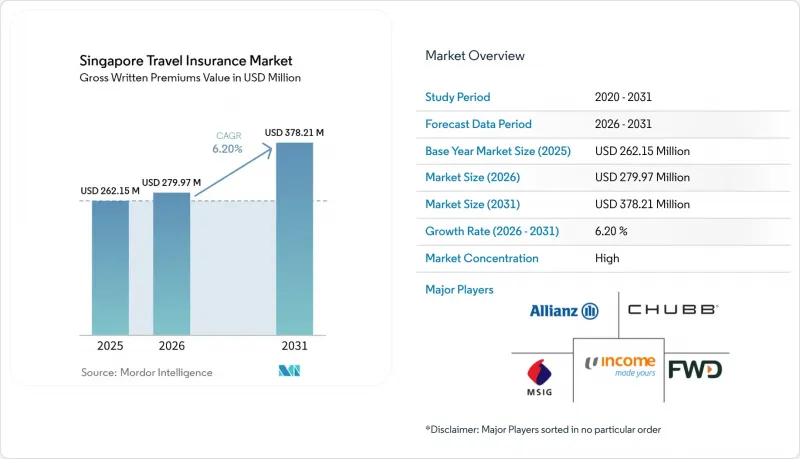
According to Mordor Intelligence, the Singapore travel insurance market size in terms of gross written premiums value is projected to expand from USD 262.15 million in 2025 and USD 279.97 million in 2026 to USD 378.21 million by 2031, registering a CAGR of 6.20% between 2026 and 2031.
Singapore Travel Insurance Market Trends and Insights
Growth In Overseas Travel By Singapore Residents
Singapore residents made 10.6 million overseas trips in 2025, compared with 10.3 million in 2024. This travel volume supports demand for policies that cover medical events, cancellations, baggage loss, and travel delays. More frequent departures create more occasions for insurers and intermediaries to offer coverage. The Singapore travel insurance market also benefits when repeat travelers see insurance as a routine travel purchase. Higher travel activity does not automatically mean a similar rise in policy count because some travelers move to annual cover. It nevertheless supports demand for policies with broader limits and repeat-use features.
Rising Overseas Medical Emergency And Evacuation Exposure
Medical cost inflation in Japan, Australia, and the United States reduces the value of older coverage limits. Chubb enhanced TravellerShield Plus from 30 April 2026 with new benefit categories, reflecting the need to keep protection relevant to changing travel risks. The General Insurance Association of Singapore reported that net incurred travel claims rose 14.6% in 2025, while travel gross written premiums grew 8.6%. This difference places pressure on underwriting margins and policy pricing. Insurers need destination-level risk information to assess medical exposure and update coverage limits. Clear communication of limits, exclusions, and claim requirements remains important when policyholders compare plans.
Price Competition And Low Premiums For Short-Duration Trips
Single-trip insurance held 59.67% of the Singapore travel insurance market in 2025, making it the main area of price competition. Buyers often compare short-duration regional plans mainly on price when the policy benefits appear similar. This can limit insurers' ability to raise premiums even as claims costs increase. The General Insurance Association of Singapore reported that travel underwriting profit fell 23.8% to SGD 29.7 million (USD 22 million) in 2025. The decline occurred despite growth in travel gross written premiums and reflects the pressure created by rising claims. Smaller insurers may face added costs when they cannot spread compliance and operating investments across a large policy base.
Other drivers and restraints analyzed in the detailed report include:
- Preference For Flexible And Comprehensive Coverage
- Expansion Of Digital And Travel-Intermediary Distribution
- Policy Exclusions And Complexity
For complete list of drivers and restraints, kindly check the Table Of Contents.
Segment Analysis
Single-trip insurance held 59.67% of the Singapore travel insurance market share in 2025. It remains the default option for travelers who take 1 or 2 overseas holidays each year. Short-haul travel within the Association of Southeast Asian Nations and medium-haul travel in Northeast Asia support this pattern. Per-trip premiums are often easier to justify when a traveler does not expect to travel repeatedly. The segment, therefore, gives insurers a broad base of policyholders, although it also faces strong price competition. Its large volume makes claims service and policy clarity important points of competition.
Annual multi-trip insurance is the fastest-growing trip type at a 7.62% CAGR through 2031. The Singapore travel insurance market size for annual multi-trip insurance is supported by frequent travelers who take 3 or more overseas trips. Higher medical costs in Japan, the United States, and Australia have lifted annual-plan premiums by 8-12% in 2026 from 2024 levels. Income Insurance's annual policy covers unlimited trips of up to 90 calendar days per journey and includes its "cancel for any reason" benefit. The Insurance Act 1966 and related policy-owner protection arrangements support confidence among retail policyholders. Insurers can use broader benefits and repeat-use convenience to distinguish annual products from single-trip cover.
Complete Report Scope:
- By Trip Type
- Single-Trip Insurance
- Annual Multi-Trip Insurance
- By Distribution Channel
- Direct Insurer Channels
- Insurance Agents and Brokers
- Banks
- Other Channels
- By Buyer Type
- Retail
- Corporate
- By Geography
- Central Region
- East Region
- North Region
- North-East Region
- West Region
List of Companies Covered in this Report:
- Income Insurance Limited
- FWD Singapore Pte. Ltd.
- MSIG Insurance (Singapore) Pte. Ltd.
- Allianz Insurance Singapore Pte. Ltd.
- Chubb Insurance Singapore Limited
- AIG Asia Pacific Insurance Pte. Ltd.
- Singapore Life Ltd. (Singlife)
- Etiqa Insurance Pte. Ltd.
- Great Eastern General Insurance Limited
- HL Assurance Pte. Ltd.
- DirectAsia Insurance (Singapore) Pte. Ltd.
- EQ Insurance Company Limited
- Sompo Insurance Singapore Pte. Ltd.
- Starr International Insurance (Singapore) Pte. Ltd.
- United Overseas Insurance Limited
- Zurich Insurance Company Ltd. (Singapore Branch)
- AIA Singapore Private Limited
- China Taiping Insurance (Singapore) Pte. Ltd.
- Tokio Marine Insurance Singapore Ltd.
- QBE Insurance (Singapore) Pte. Ltd.
Additional Benefits:
- The market estimate (ME) sheet in Excel format
- 3 months of analyst support
TABLE OF CONTENTS
1 INTRODUCTION
- 1.1 Study Assumptions and Market Definition
- 1.2 Scope of the Study
2 RESEARCH METHODOLOGY
3 EXECUTIVE SUMMARY
4 MARKET LANDSCAPE
- 4.1 Market Overview
- 4.2 Market Drivers
- 4.2.1 Growth in Overseas Travel by Singapore Residents
- 4.2.2 High Frequency of Regional and Long-Haul Travel from Singapore
- 4.2.3 Rising Financial Exposure to Overseas Medical Emergencies and Evacuation
- 4.2.4 Growing Demand for Protection Against Trip Cancellation and Travel Disruptions
- 4.2.5 Increasing Preference for Flexible and Comprehensive Travel Coverage
- 4.2.6 Expansion of Digital and Travel-Intermediary Insurance Distribution
- 4.3 Market Restraints
- 4.3.1 Intense Price Competition and Low Premiums for Short-Duration Trips
- 4.3.2 Policy Exclusions and Complexity Limiting Consumer Understanding
- 4.3.3 Increasing Claims Costs from Medical and Travel Disruptions
- 4.3.4 High Claims Documentation and Verification Requirements
- 4.4 Value Chain Analysis
- 4.4.1 Travel Insurance Underwriting and Reinsurance Support
- 4.4.2 Multi-Channel Distribution Through Insurers, Intermediaries and Digital Platforms
- 4.4.3 Global Assistance, Medical Support and Claims Management Networks
- 4.5 Regulatory Landscape
- 4.5.1 MAS Regulation and Insurance Act Requirements
- 4.5.2 Insurance Intermediary and Travel-Agent Distribution Requirements
- 4.5.3 Consumer Protection, Data Privacy and Financial Crime Compliance Requirements
- 4.6 Technological Outlook
- 4.6.1 Digital and Mobile-First Travel Insurance Distribution
- 4.6.2 Embedded Insurance and API-Based Travel Partnerships
- 4.6.3 Automation and AI in Claims Processing and Fraud Detection
- 4.7 Porter's Five Forces Analysis
- 4.7.1 Threat of New Entrants
- 4.7.2 Bargaining Power of Suppliers
- 4.7.3 Bargaining Power of Buyers
- 4.7.4 Threat of Substitutes
- 4.7.5 Competitive Rivalry
5 MARKET SIZE AND GROWTH FORECASTS
- 5.1 By Trip Type
- 5.1.1 Single-Trip Insurance
- 5.1.2 Annual Multi-Trip Insurance
- 5.2 By Distribution Channel
- 5.2.1 Direct Insurer Channels
- 5.2.2 Insurance Agents and Brokers
- 5.2.3 Banks
- 5.2.4 Other Channels
- 5.3 By Buyer Type
- 5.3.1 Retail
- 5.3.2 Corporate
- 5.4 By Geography
- 5.4.1 Central Region
- 5.4.2 East Region
- 5.4.3 North Region
- 5.4.4 North-East Region
- 5.4.5 West Region
6 COMPETITIVE LANDSCAPE
- 6.1 Market Concentration
- 6.2 Strategic Moves
- 6.3 Market Share Analysis (Top 5-6 players)
- 6.4 Company Profiles (includes Global Level Overview, Market Level Overview, Core Segments, Financials as available, Strategic Information, Market Rank/Share, Products and Services, Recent Developments)
- 6.4.1 Income Insurance Limited
- 6.4.2 FWD Singapore Pte. Ltd.
- 6.4.3 MSIG Insurance (Singapore) Pte. Ltd.
- 6.4.4 Allianz Insurance Singapore Pte. Ltd.
- 6.4.5 Chubb Insurance Singapore Limited
- 6.4.6 AIG Asia Pacific Insurance Pte. Ltd.
- 6.4.7 Singapore Life Ltd. (Singlife)
- 6.4.8 Etiqa Insurance Pte. Ltd.
- 6.4.9 Great Eastern General Insurance Limited
- 6.4.10 HL Assurance Pte. Ltd.
- 6.4.11 DirectAsia Insurance (Singapore) Pte. Ltd.
- 6.4.12 EQ Insurance Company Limited
- 6.4.13 Sompo Insurance Singapore Pte. Ltd.
- 6.4.14 Starr International Insurance (Singapore) Pte. Ltd.
- 6.4.15 United Overseas Insurance Limited
- 6.4.16 Zurich Insurance Company Ltd. (Singapore Branch)
- 6.4.17 AIA Singapore Private Limited
- 6.4.18 China Taiping Insurance (Singapore) Pte. Ltd.
- 6.4.19 Tokio Marine Insurance Singapore Ltd.
- 6.4.20 QBE Insurance (Singapore) Pte. Ltd.
7 MARKET OPPORTUNITIES AND FUTURE OUTLOOK
- 7.1 White-Space and Unmet-Need Assessment
- 7.1.1 Broader and More Affordable Coverage for Seniors and Pre-Existing Medical Conditions
- 7.1.2 Greater Flexibility for Trip Cancellation, Changes and Long-Stay Travel
- 7.1.3 Expanded Protection for Regional Transport, Experiences and Emerging Travel Disruptions
- 7.2 Future Product and Distribution Outlook
- 7.2.1 Embedded and Connected Travel Insurance Ecosystems
- 7.2.2 Real-Time Assistance and Automated Event-Triggered Claims
- 7.2.3 AI-Enabled Personalisation and Digital Claims Automation

