PUBLISHER: Mordor Intelligence | PRODUCT CODE: 2156896

PUBLISHER: Mordor Intelligence | PRODUCT CODE: 2156896
Nano Calcium Carbonate - Market Share Analysis, Industry Trends & Statistics, Growth Forecasts (2026 - 2031)
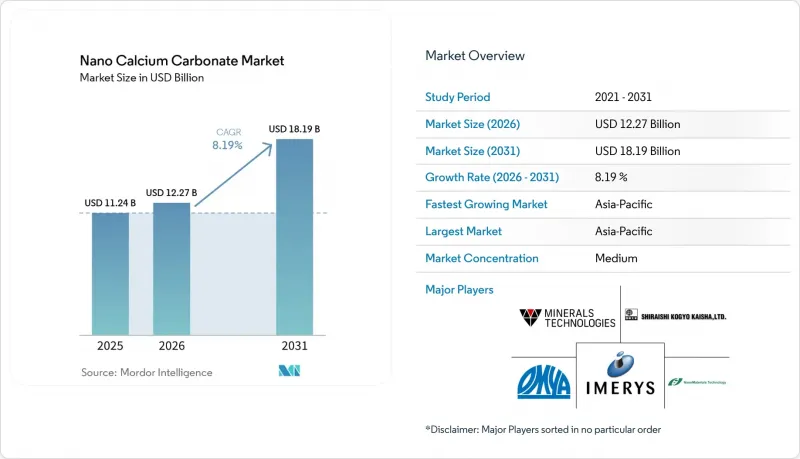
According to Mordor Intelligence, the nano calcium carbonate market size was valued at USD 11.24 billion in 2025 and is estimated to grow from USD 12.27 billion in 2026 to USD 18.19 billion by 2031, at a CAGR of 8.19% during the forecast period (2026-2031).
Global Nano Calcium Carbonate Market Trends and Insights
Plastics Lightweighting and Filler Optimization
Surface-modified nano CaCO3 is a key functional filler in plastics, and its role is expanding as engineers replace metal and glass-fiber parts in automotive and consumer electronics products. Nano grades can enable filler loading that is 30-50% higher by weight than micro-grade alternatives while keeping the material processable. A 2025 study found that adding 4.0 wt% nanoparticulate CaCO3 increased the polypropylene heat deflection temperature by 12°C relative to the neat polymer. The same study found that a 0.48 wt% loading reduced oxygen transmission by 52% in a nanocomposite.
Expansion of Surface-Modified Nano Grades
Stearic acid, silane coupling agents, and titanate esters can modify the surfaces of nano CaCO3 for specific polymer and coating formulations. These modified grades cost 40-60% more than unmodified material, but they meet dispersion requirements in automotive coatings, pharmaceutical excipients, and electronics applications. A 2026 study showed that targeted surface modification allowed high-proportion filling of Acrylonitrile Butadiene Styrene (ABS) copolymer that unmodified nano CaCO3 could not achieve. This distinction is relevant for manufacturers selecting filler grades for demanding processing conditions, where dispersion consistency directly affects end-product quality.
Higher Production Costs Versus Conventional Calcium Carbonate
Nano CaCO3 production involves controlled carbonation, surface modification, and energy-intensive drying or jet milling. These steps raise production costs by 40%-60% above conventional precipitated calcium carbonate at equivalent output levels. Electronics and pharmaceutical grades can cost 5-8 times more due to strict purity requirements, including iron content at 5 ppm or less and particle Coefficient of Variation (CV) of 3% or less. Low- and mid-range nano CaCO3 prices fell 4.80% to USD 612 per ton in 2025-2026, while specialty-grade prices remained materially higher. This price difference limits substitution in cost-sensitive packaging and rubber applications, as specialty producers maintain margins through higher-value grades.
Other drivers and restraints analyzed in the detailed report include:
- High-Performance Packaging and Film Down-Gauging
- Construction Sealant and Composite Performance Requirements
- Nanomaterial Safety and Regulatory Compliance Burden
For complete list of drivers and restraints, kindly check the Table Of Contents.
Segment Analysis
Precipitated nano calcium carbonate held 60.43% of the nano calcium carbonate market share by product type in 2025. Its position reflects controlled particle size, engineered crystal morphology, and uniform surface area. Carbonation of calcium hydroxide under controlled CO2 flow and temperature allows producers to create scalenohedral, acicular, and calcitic forms to meet specific rheological and mechanical requirements. This production route is difficult to match through ground methods at a similar cost. Minerals Technologies announced in January 2026 that it had launched three new satellite Precipitated Calcium Carbonate (PCC) plants in Asia during 2025, including two in China and one in India, and doubled the capacity at an existing satellite in India.
Ground nano calcium carbonate is forecast to register the fastest product-type CAGR of 8.72% through 2031. Process improvements are narrowing the morphology gap with precipitated material, particularly where customers need reliable particle distribution but do not require the highest pharmaceutical or electronics specifications. Omya received U.S. Patent 12668499 in June 2026 for a dry sandmill process to produce nano precipitated calcium carbonate, illustrating how dry processing and precipitation technologies are beginning to converge in their performance objectives. Ground grades can use existing limestone quarry infrastructure and established raw-material logistics, which support competitive pricing for construction compounds, rubber products, and standard packaging applications. The lower logistics burden is most relevant where material cost is central to purchasing decisions and precision requirements are less demanding. Other formats, including colloidal dispersions, aqueous slurries, and pre-dispersed masterbatches, are gaining use in films and textiles because dust-free handling and pre-dispersed delivery can reduce the agglomeration challenges associated with powder products.
Complete Report Scope:
- By Product Type
- Precipitated
- Ground
- Others
- By Application
- Plastics
- Rubber
- Building and Construction
- Paper and Board
- Paints and Coatings
- Adhesives and Sealants
- Other Applications
- By Geography
- Asia-Pacific
- China
- India
- Japan
- South Korea
- ASEAN Countries
- Rest of Asia-Pacific
- North America
- United States
- Canada
- Mexico
- Europe
- Germany
- United Kingdom
- France
- Italy
- NORDIC Countries
- Rest of Europe
- South America
- Brazil
- Argentina
- Rest of South America
- Middle East and Africa
- Saudi Arabia
- South Africa
- Rest of Middle East and Africa
- Asia-Pacific
Geography Analysis
Asia-Pacific accounted for 45.07% of the nano calcium carbonate market share in 2025 and is forecast to grow at a 9.25% CAGR through 2031. China held more than 62% of global production capacity and consumed more than 986,000 tons in 2026, equal to 41.2% of global consumption. India is seeing rising demand for sealants and construction-grade materials as urbanization advances and specialty chemical producers adopt client-integrated supply agreements. South Korea and Japan represent smaller markets but influence electronics and automotive specifications and pricing benchmarks.
North America is driven by demand for pharmaceutical-grade, food-contact-certified, and high-performance polymer materials. The additional 12% U.S. tariff on China-origin nano CaCO3, effective November 2025, shifted procurement toward Indian, Southeast Asian, and European suppliers and continues to influence regional sourcing decisions. Omya and Domtar commissioned a PCC satellite plant in Nekoosa, Wisconsin, in September 2024, with an annual capacity of 27,500 dry tons. The plant reduced the risk of supply disruption, eliminated the need for long-haul transport, and addressed a regional supply gap following an earlier plant closure. Europe is centered on automotive coatings, construction sealants, and specialty paper, where EU REACH nanomaterial provisions act as a practical entry filter. These requirements favor suppliers that can provide complete registration dossiers, including particle morphology data, specific surface area measurements, and inhalation toxicology information.
South America remains an emerging demand area for coatings- and sealants-grade nano CaCO3, supported by construction activity in Brazil, Argentina, and Chile. Imerys completed the acquisition of Brazilian ground calcium carbonate producer SB Mineracao in July 2026, and the business generated USD 30 million in 2025 revenue. The Middle East and Africa primarily consume the material in construction coatings, polymer piping, and infrastructure sealants, with imports supplying much of the region's nano-grade demand. These regions continue to consume more total CaCO3 than nano-specific products, but urbanization and industrial investment are expected to support longer-term adoption of higher-specification grades.
- Fimatec Ltd.
- Fujian Sanmu Nano Calcium Carbonate Co., Ltd.
- Guangdong Qiangda New Materials Technology Co., Ltd.
- Gulshan Polyols Limited
- Huber Engineered Materials
- Imerys S.A.
- MARUO CALCIUM CO.,LTD.
- Minerals Technologies Inc.
- NanoMaterials Technology Co., Ltd.
- Nordkalk Corporation
- Okutama Kogyo Co., Ltd.
- Omya International AG
- SCHAEFER KALK GmbH & Co. KG
- Shanghai YaoHua Nano-Tech Co., Ltd.
- SHIRAISHI KOGYO KAISHA, LTD.
Additional Benefits:
- The market estimate (ME) sheet in Excel format
- 3 months of analyst support
TABLE OF CONTENTS
1 Introduction
- 1.1 Study Assumptions and Market Definition
- 1.2 Scope of the Study
2 Research Methodology
3 Executive Summary
4 Market Landscape
- 4.1 Market Overview
- 4.2 Market Drivers
- 4.2.1 Plastics Lightweighting and Filler Optimization
- 4.2.2 Construction Sealant and Composite Performance Requirements
- 4.2.3 High-Performance Packaging and Film Down-Gauging
- 4.2.4 Expansion of Surface-Modified Nano Grades
- 4.2.5 On-Site and Just-in-Time PCC Supply Models
- 4.3 Market Restraints
- 4.3.1 Higher Production Costs Versus Conventional Calcium Carbonate
- 4.3.2 Nanomaterial Safety and Regulatory Compliance Burden
- 4.3.3 Batch-to-Batch Dispersion and Morphology Variability
- 4.4 Value Chain Analysis
- 4.5 Porter's Five Forces Analysis
- 4.5.1 Threat of New Entrants
- 4.5.2 Bargaining Power of Suppliers
- 4.5.3 Bargaining Power of Buyers
- 4.5.4 Threat of Substitutes
- 4.5.5 Competitive Rivalry
5 Market Size and Growth Forecasts (Value)
- 5.1 By Product Type
- 5.1.1 Precipitated
- 5.1.2 Ground
- 5.1.3 Others
- 5.2 By Application
- 5.2.1 Plastics
- 5.2.2 Rubber
- 5.2.3 Building and Construction
- 5.2.4 Paper and Board
- 5.2.5 Paints and Coatings
- 5.2.6 Adhesives and Sealants
- 5.2.7 Other Applications
- 5.3 By Geography
- 5.3.1 Asia-Pacific
- 5.3.1.1 China
- 5.3.1.2 India
- 5.3.1.3 Japan
- 5.3.1.4 South Korea
- 5.3.1.5 ASEAN Countries
- 5.3.1.6 Rest of Asia-Pacific
- 5.3.2 North America
- 5.3.2.1 United States
- 5.3.2.2 Canada
- 5.3.2.3 Mexico
- 5.3.3 Europe
- 5.3.3.1 Germany
- 5.3.3.2 United Kingdom
- 5.3.3.3 France
- 5.3.3.4 Italy
- 5.3.3.5 NORDIC Countries
- 5.3.3.6 Rest of Europe
- 5.3.4 South America
- 5.3.4.1 Brazil
- 5.3.4.2 Argentina
- 5.3.4.3 Rest of South America
- 5.3.5 Middle East and Africa
- 5.3.5.1 Saudi Arabia
- 5.3.5.2 South Africa
- 5.3.5.3 Rest of Middle East and Africa
- 5.3.1 Asia-Pacific
6 Competitive Landscape
- 6.1 Market Concentration
- 6.2 Strategic Moves
- 6.3 Market Share (%)/Ranking Analysis
- 6.4 Company Profiles (includes Global Overview, Market Overview, Core Segments, Financials as available, Strategic Information, Products and Services, and Recent Developments)
- 6.4.1 Fimatec Ltd.
- 6.4.2 Fujian Sanmu Nano Calcium Carbonate Co., Ltd.
- 6.4.3 Guangdong Qiangda New Materials Technology Co., Ltd.
- 6.4.4 Gulshan Polyols Limited
- 6.4.5 Huber Engineered Materials
- 6.4.6 Imerys S.A.
- 6.4.7 MARUO CALCIUM CO.,LTD.
- 6.4.8 Minerals Technologies Inc.
- 6.4.9 NanoMaterials Technology Co., Ltd.
- 6.4.10 Nordkalk Corporation
- 6.4.11 Okutama Kogyo Co., Ltd.
- 6.4.12 Omya International AG
- 6.4.13 SCHAEFER KALK GmbH & Co. KG
- 6.4.14 Shanghai YaoHua Nano-Tech Co., Ltd.
- 6.4.15 SHIRAISHI KOGYO KAISHA, LTD.
7 Market Opportunities and Future Outlook
- 7.1 White-Space and Unmet-Need Assessment

