PUBLISHER: Mordor Intelligence | PRODUCT CODE: 2156902

PUBLISHER: Mordor Intelligence | PRODUCT CODE: 2156902
Copper Alloy Foils - Market Share Analysis, Industry Trends & Statistics, Growth Forecasts (2026 - 2031)
According to Mordor Intelligence, the copper alloy foils market size was valued at USD 727.67 million in 2025 and is estimated to grow from USD 755.69 million in 2026 to reach USD 985.31 million by 2031, at a CAGR of 5.45% during the forecast period (2026-2031).
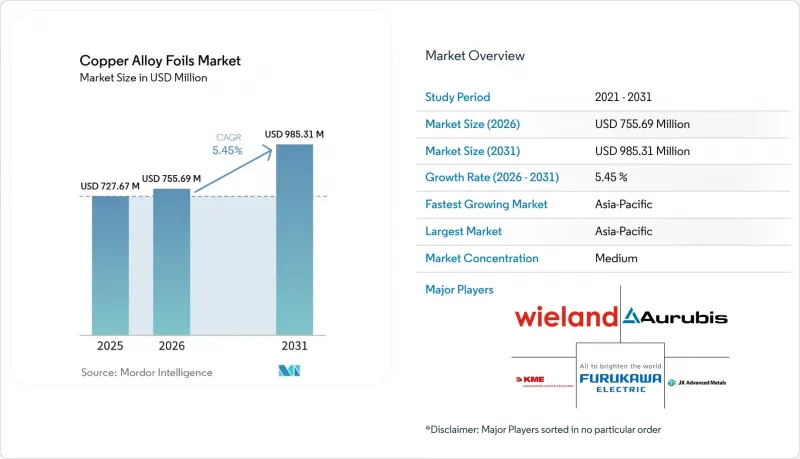
Global Copper Alloy Foils Market Trends and Insights
Electrification and Rising Copper Intensity per Vehicle
Electrification is changing copper requirements in vehicle electrical systems and battery assemblies, particularly for components that handle higher currents, undergo repeated thermal cycling, and have limited installation space. A battery electric vehicle uses 80-91 kg of copper, compared with 22-24 kg in a comparable internal combustion engine vehicle, giving electrical materials a larger role in vehicle design. Alloy foil is used in battery current collectors, busbars, and inverter shielding where strength, consistent forming behavior, or corrosion resistance is required. These applications demand tighter dimensional control and surface finishing than conventional automotive copper products, as performance depends on uniform material behavior across finished components. The copper alloy foils market, therefore, favors producers that can roll, anneal, and qualify advanced grades for vehicle programs while maintaining stable quality at a commercial scale. Suppliers with traditional automotive product mixes face pressure to adapt their portfolios as electric platforms gain importance and customer specifications become more specialized.
Expansion of High-Density and Flexible Electronics
Thinner, lighter, and foldable devices are increasing performance demands on interconnect materials in products where available space is limited, and component reliability is critical. Rolled-annealed alloy foils can withstand repeated flexing better than rigid copper laminates in certain applications, making them suitable for flexible circuits and compact connector assemblies. Phosphor bronze is used in connector applications that require high fatigue resistance during repeated bending, including small components that must retain reliable contact over extended use. Modern data centers also use large amounts of copper in power delivery, cooling, and high-speed circuit boards, placing greater emphasis on reliable materials in supporting systems. These requirements shift demand toward ultra-low-profile alloy formats rather than commodity electrodeposited products, as surface characteristics matter for advanced circuit performance. The copper alloy foils market benefits when qualified producers can meet the reliability requirements of flexible circuits and electronic connectors without compromising properties needed for high-scale manufacturing.
Copper and Nickel Price Volatility
Copper and nickel costs can change rapidly, creating immediate pressure on the economics of alloy foil and complicating commercial planning for producers. Copper-nickel grades are exposed to both inputs, and nickel may account for 10-30% of alloy weight, making the cost impact more pronounced for these specialty compositions. Fixed-fee contracts can limit a producer's ability to pass higher metal costs to customers when those costs rise during the contract period. This mismatch can reduce margins during periods of price volatility and make short-term procurement decisions more difficult. This pressure is particularly relevant for suppliers without long-term offtake arrangements that provide more stable access to material. The copper alloy foils market remains exposed because metal costs affect both standard grades and specialized products, while many end-use applications continue to require a dependable supply.
Other drivers and restraints analyzed in the detailed report include:
- Growth of AI Data Centers and Advanced Semiconductor Packaging
- Demand for Corrosion-Resistant Foils in Marine and Offshore Systems
- Energy-Intensive Rolling, Annealing, and Surface-Treatment Processes
For complete list of drivers and restraints, kindly check the Table Of Contents.
Segment Analysis
Brass foils accounted for 42.56% of the copper alloy foils market share in 2025, supported by established supply chains and their suitability for high-volume connector, terminal, and electromagnetic interference shielding applications. Brass provides tensile strength above 380 MPa and conductivity near 28% International Annealed Copper Standard (IACS), a combination that supports parts requiring both mechanical integrity and electrical performance. These characteristics make brass suitable for flex-circuit ground planes and radio-frequency shielding in telecommunications equipment, where producers require dependable material specifications. Construction also uses thin brass strips in architectural trim, decorative panels, and precision lock components, while infrastructure investment in Asia and the Middle East supports demand from these applications. The broad application base keeps brass relevant where cost competitiveness and performance requirements coexist.
Bronze foils are projected to expand at a 6.12% CAGR through 2031, making them the fastest-growing type in the copper alloy foils market. Phosphor-bronze is used in high-pin-count semiconductor sockets, SIM card contacts, and micro-spring interconnects, where its fatigue resistance enables repeated bending without premature performance loss. This positions bronze within increasingly compact electronic designs that rely on small, reliable contacts. Copper-nickel foil is used in marine heat exchangers, desalination condensers, and offshore piping applications, while other specialty copper alloy foils, including beryllium copper, are used in aerospace connectors that require conductivity and spring temper. The copper alloy foils market size for bronze grades is supported by connector designs that prioritize long-term mechanical reliability and stable electrical contact.
Complete Report Scope:
- By Type
- Brass Foils
- Bronze Foils
- Copper-Nickel Foils
- Other Copper Alloy Foils
- By End-User Industry
- Electrical and Electronics
- Automotive
- Construction
- Industrial Machinery
- Aerospace
- Others
- By Geography
- Asia-Pacific
- China
- India
- Japan
- South Korea
- ASEAN Countries
- Rest of Asia-Pacific
- North America
- United States
- Canada
- Mexico
- Europe
- Germany
- United Kingdom
- France
- Italy
- NORDIC Countries
- Rest of Europe
- South America
- Brazil
- Argentina
- Rest of South America
- Middle East and Africa
- Saudi Arabia
- South Africa
- Rest of Middle East and Africa
- Asia-Pacific
Geography Analysis
Asia-Pacific accounted for 45.72% of the copper alloy foil market share in 2025 and is projected to grow at a 6.27% CAGR through 2031. China, Japan, and South Korea form the main regional production and demand base, creating a close link between foil production and end-use manufacturing. China provides strong end-use demand for electronics and electric vehicles. Japan and South Korea contribute rolled-annealed foil capacity for semiconductor and automotive applications. Vietnam and Thailand are gaining electronics assembly activity, supporting demand for flex-circuit and connector materials and extending the regional customer base beyond the three core countries.
North America and Europe represent the second tier of demand, though their demand drivers differ. The United States is expanding capacity for electric vehicle assembly, battery-cell production, and semiconductor fabrication. Wieland Group strengthened its North American footprint by integrating the Buffalo facility with operations in East Alton, Illinois, and Shelbyville, Kentucky. Germany, the Nordic countries, and Italy are Europe's key demand centers for automotive supply chains, precision machinery, and offshore energy systems. Registration, Evaluation, Authorization, and Restriction of Chemicals (REACH) requirements affect the chemicals used in metal surface treatments for automotive and aerospace applications.
South America and the Middle East and Africa account for a smaller portion of global demand. Brazil supports brass and bronze foil consumption in electrical equipment and plumbing fittings. Argentina and Chile use these materials in mining instrumentation and energy infrastructure. Copper-nickel grades are relevant to condenser tubes, heat exchangers, and cooling circuits in offshore and desalination projects, supporting a position for certified marine-grade suppliers in the copper alloy foils market.
- A.J. Oster, LLC
- Amari Copper Alloys
- Arcotech Ltd.
- Aurubis AG
- Carl Schlenk AG
- FURUKAWA ELECTRIC CO., LTD.
- JX Advanced Metals Corporation
- KME GERMANY GMBH
- Mitsubishi Materials Corporation
- Ningbo Boway Alloy Material Co., Ltd.
- poongsan corporation
- Proterial Metals, Ltd.
- Revere Copper Products Inc.
- Shanghai Metal Corporation
- Wieland-Werke AG
Additional Benefits:
- The market estimate (ME) sheet in Excel format
- 3 months of analyst support
TABLE OF CONTENTS
1 Introduction
- 1.1 Study Assumptions and Market Definition
- 1.2 Scope of the Study
2 Research Methodology
3 Executive Summary
4 Market Landscape
- 4.1 Market Overview
- 4.2 Market Drivers
- 4.2.1 Electrification and Rising Copper Intensity per Vehicle
- 4.2.2 Expansion of High-Density and Flexible Electronics
- 4.2.3 Growth of AI Data Centers and Advanced Semiconductor Packaging
- 4.2.4 Demand for Corrosion-Resistant Foils in Marine and Offshore Systems
- 4.2.5 Ultra-Thin Foil Adoption in Battery and Miniaturized Electronics Designs
- 4.3 Market Restraints
- 4.3.1 Copper and Nickel Price Volatility
- 4.3.2 Energy-Intensive Rolling, Annealing, and Surface-Treatment Processes
- 4.3.3 Qualification Cycles for New Alloys and Ultra-Thin Foil Grades
- 4.4 Value Chain Analysis
- 4.5 Porter's Five Forces Analysis
- 4.5.1 Threat of New Entrants
- 4.5.2 Bargaining Power of Suppliers
- 4.5.3 Bargaining Power of Buyers
- 4.5.4 Threat of Substitutes
- 4.5.5 Competitive Rivalry
5 Market Size and Growth Forecasts (Value)
- 5.1 By Type
- 5.1.1 Brass Foils
- 5.1.2 Bronze Foils
- 5.1.3 Copper-Nickel Foils
- 5.1.4 Other Copper Alloy Foils
- 5.2 By End-User Industry
- 5.2.1 Electrical and Electronics
- 5.2.2 Automotive
- 5.2.3 Construction
- 5.2.4 Industrial Machinery
- 5.2.5 Aerospace
- 5.2.6 Others
- 5.3 By Geography
- 5.3.1 Asia-Pacific
- 5.3.1.1 China
- 5.3.1.2 India
- 5.3.1.3 Japan
- 5.3.1.4 South Korea
- 5.3.1.5 ASEAN Countries
- 5.3.1.6 Rest of Asia-Pacific
- 5.3.2 North America
- 5.3.2.1 United States
- 5.3.2.2 Canada
- 5.3.2.3 Mexico
- 5.3.3 Europe
- 5.3.3.1 Germany
- 5.3.3.2 United Kingdom
- 5.3.3.3 France
- 5.3.3.4 Italy
- 5.3.3.5 NORDIC Countries
- 5.3.3.6 Rest of Europe
- 5.3.4 South America
- 5.3.4.1 Brazil
- 5.3.4.2 Argentina
- 5.3.4.3 Rest of South America
- 5.3.5 Middle East and Africa
- 5.3.5.1 Saudi Arabia
- 5.3.5.2 South Africa
- 5.3.5.3 Rest of Middle East and Africa
- 5.3.1 Asia-Pacific
6 Competitive Landscape
- 6.1 Market Concentration
- 6.2 Strategic Moves
- 6.3 Market Share (%)/Ranking Analysis
- 6.4 Company Profiles (includes Global Overview, Market Overview, Core Segments, Financials as available, Strategic Information, Products and Services, and Recent Developments)
- 6.4.1 A.J. Oster, LLC
- 6.4.2 Amari Copper Alloys
- 6.4.3 Arcotech Ltd.
- 6.4.4 Aurubis AG
- 6.4.5 Carl Schlenk AG
- 6.4.6 FURUKAWA ELECTRIC CO., LTD.
- 6.4.7 JX Advanced Metals Corporation
- 6.4.8 KME GERMANY GMBH
- 6.4.9 Mitsubishi Materials Corporation
- 6.4.10 Ningbo Boway Alloy Material Co., Ltd.
- 6.4.11 poongsan corporation
- 6.4.12 Proterial Metals, Ltd.
- 6.4.13 Revere Copper Products Inc.
- 6.4.14 Shanghai Metal Corporation
- 6.4.15 Wieland-Werke AG
7 Market Opportunities and Future Outlook
- 7.1 White-Space and Unmet-Need Assessment

