PUBLISHER: Mordor Intelligence | PRODUCT CODE: 2156904

PUBLISHER: Mordor Intelligence | PRODUCT CODE: 2156904
Transparent Plastics - Market Share Analysis, Industry Trends & Statistics, Growth Forecasts (2026 - 2031)
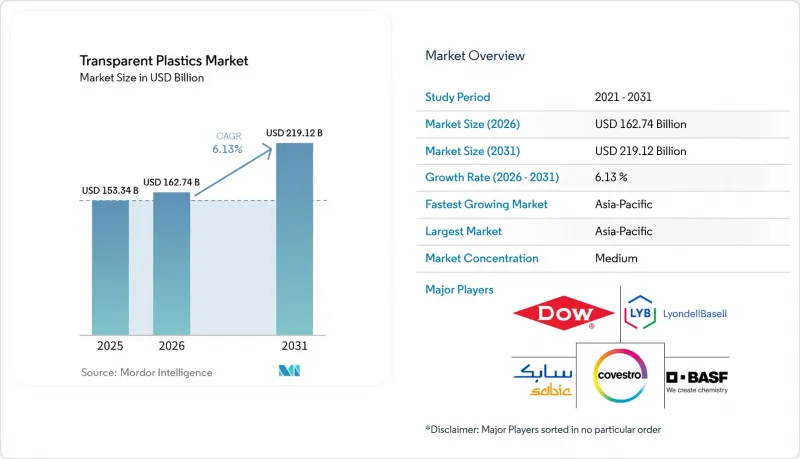
According to Mordor Intelligence, the transparent plastics market size was valued at USD 153.34 billion in 2025 and is estimated to grow from USD 162.74 billion in 2026 to reach USD 219.12 billion by 2031, at a CAGR of 6.13% during the forecast period (2026-2031).
Global Transparent Plastics Market Trends and Insights
E-commerce and Premium Packaging Adoption
E-commerce has changed packaging requirements for the transparent plastics market across fast-moving distribution networks. Clear packaging now supports product visibility, tamper evidence, and physical protection during repeated handling, rather than serving only shelf-display needs. Demand is especially strong for high-clarity PET and copolyester formats that withstand multistep logistics while maintaining a clear view of the product. Retailers also use clear packaging to support private-label products that need a premium appearance and a closer visual match to branded goods. This requirement raises the minimum clarity standard even in packaging formats that were previously treated as commodity products. Eastman Chemical Company and PepsiCo have a multiyear arrangement for molecularly recycled PET in Gatorade bottles available in 2026. This example shows that recycled content and the optical quality expected in branded packaging can be pursued together.
Lightweighting and Glass Replacement in Automotive Applications
Automotive programs are expanding the use of PC beyond lamp lenses into structural glazing, panoramic roofs, and sensor housings. PC glazing can reduce window weight by up to 50% compared with glass of equivalent thickness. The material can reduce vehicle mass and support electric vehicle range and efficiency objectives. PCQ Technologies stated that full PC glazing could save 40 kg in a typical passenger vehicle as the technology moves toward series-produced electric vehicles. Functional glazing can also incorporate color-changing surfaces, photovoltaic layers, and head-up display films, changing glazing from a passive surface into an integrated vehicle component. Covestro AG and Anko Optics signed a September 2025 cooperation memorandum to develop functional automotive transparent plastic glazing. Hard-coated PC systems have demonstrated abrasion and weathering performance in testing, although movable side windows remain an important commercial qualification step.
Plastic Waste, Collection Gaps, and Low Recycling Yields
Collection systems do not yet provide enough high-quality, clear recyclate for regulated packaging uses. Circular plastics production in Europe grew 1.2% in 2024, while more than 70% of collected plastic waste was directed to incineration or landfill. Europe also relies on trade flows where collected material is recycled outside the region, and converter demand is met through imports. The available material can lose clarity through contamination, which limits food-contact and pharmaceutical applications. Brand owners face recycled-content requirements while converters need material that preserves the optical properties of clear packaging. These gaps slow the transition of the transparent plastics market toward more circular product portfolios.
Other drivers and restraints analyzed in the detailed report include:
- Demand for Recyclable and Bio-Based Transparent Polymers
- Growth of Medical, Diagnostic, and Pharmaceutical Packaging
- Crude Oil-Linked Feedstock Price Volatility
For complete list of drivers and restraints, kindly check the Table Of Contents.
Segment Analysis
Rigid held 60.13% of the market revenue in 2025. Rigid formats serve pharmaceutical containers, beverage bottles, automotive lenses, and building glazing panels. These applications require dimensional stability, barrier performance, and optical clarity through production, distribution, and end use. PET, PC, Polymethyl Methacrylate (PMMA), and high-clarity polypropylene grades support the rigid format category. Food and beverage packaging uses this format because bottles, trays, and containers require consistent shapes and product visibility. Tooling investment and qualification cycles make switching established rigid packages difficult for both material suppliers and converters. Consumer acceptance testing also extends the time needed for a format change when packaging is visible to the buyer. Existing filling lines and downstream collection systems further support continued use of established rigid formats. These conditions preserve the role of rigid products in the transparent plastics industry. Their position also reflects the need for dependable barrier and structural performance in applications where failures can affect product safety or quality.
Flexible is projected to grow at a 6.87% CAGR through 2031. Its expansion reflects e-commerce packaging, agricultural films, and flexible electronics substrates. Multilayer structures with transparent PET and PMMA layers are used for fresh food, dairy products, and pharmaceutical blister packs. Anti-fog performance and product visibility can support their use in premium packaging, where product appearance remains part of the purchase decision. Transparent conductive PET films are also used as substrate layers in foldable smartphones and wearable devices. This creates demand beyond conventional packaging uses and links flexible materials with changing consumer-electronics designs. Flexible structures can meet different product needs through the selection and arrangement of barrier, sealant, and surface layers. High-clarity mono-PET and mono-polypropylene structures are being developed to improve end-of-life recyclability. These design requirements direct research activity toward flexible materials in the transparent plastics market. The segment must still protect products and maintain clarity while meeting increasingly important recycling requirements.
Complete Report Scope:
- By Form
- Rigid
- Flexible
- By Polymer Type
- Polyethylene Terephthalate (PET)
- Polyvinyl Chloride (PVC)
- Polypropylene (PP)
- Polystyrene (PS)
- Polycarbonate (PC)
- Polymethyl Methacrylate (PMMA)
- Other Polymer Types
- By Application
- Packaging
- Building and Construction
- Electrical and Electronics
- Automotive
- Consumer Goods
- Other Applications
- By Geography
- Asia-Pacific
- China
- India
- Japan
- South Korea
- ASEAN Countries
- Rest of Asia-Pacific
- North America
- United States
- Canada
- Mexico
- Europe
- Germany
- United Kingdom
- France
- Italy
- NORDIC Countries
- Rest of Europe
- South America
- Brazil
- Argentina
- Rest of South America
- Middle East and Africa
- Saudi Arabia
- South Africa
- Rest of Middle East and Africa
- Asia-Pacific
Geography Analysis
Asia-Pacific held 43.09% of the transparent plastics market share in 2025 and is projected to grow at a 7.04% CAGR through 2031. China supports regional demand through large packaging, consumer electronics, and automotive production networks, while circular-economy policies support requirements for recycled-content PET and polypropylene grades across regional supply chains. India has growing requirements for pharmaceutical packaging, transparent food-processing containers, and medical conversion capacity near pharmaceutical clusters. Japan and South Korea use optical-grade PC, PMMA lighting materials, and specialty PET films in technology-intensive applications, while ASEAN countries remain import-reliant for high-clarity PC and PMMA grades.
North America has demand from pharmaceutical packaging, premium food and beverage containers, and automotive lightweighting programs. The United States has substantial requirements for recycled-content PET and high-clarity copolyesters, while Mexico supports additional demand through consumer goods and automotive manufacturing for regional and export supply. Europe is shaped by quality and sustainability requirements under the Packaging and Packaging Waste Regulation, which creates a defined demand signal for circular clear resins and encourages the use of documented environmental performance. Eastman Chemical Company expanded Saflex LiteCarbon Clear PVB interlayer availability across Europe in January 2026. The product offers up to 37% lower embodied carbon than standard Saflex Clear, based on Environmental Product Declarations, while Germany and the UK remain important locations for automotive and packaging research and development.
South America centers on Brazil and Argentina for food, beverage, and transparent packaging demand, with Brazil using clear PET bottles, APET trays, and flexible packaging across its food-processing and organized retail sectors. Argentina has domestic PS and polypropylene capacity but relies on imports for some high-performance PC and PMMA grades, creating exposure to exchange-rate and global resin-price movements. Saudi Arabia and the United Arab Emirates are expanding packaging capacity through industrial diversification programs, while GCC cities are using transparent polymers in bus shelters, light-emitting diode fixtures, and smart-city structures. Recycling gaps and fragmented regulation remain constraints across the Middle East and Africa.
- Arkema
- Asahi Kasei Corporation
- BASF
- Covestro AG
- Dow
- DuPont
- Eastman Chemical Company
- Evonik Industries AG
- INEOS
- LANXESS
- LG Chem
- LyondellBasell Industries Holdings B.V.
- SABIC
- Teijin Limited
Additional Benefits:
- The market estimate (ME) sheet in Excel format
- 3 months of analyst support
TABLE OF CONTENTS
1 Introduction
- 1.1 Study Assumptions and Market Definition
- 1.2 Scope of the Study
2 Research Methodology
3 Executive Summary
4 Market Landscape
- 4.1 Market Overview
- 4.2 Market Drivers
- 4.2.1 E-commerce and Premium Packaging Adoption
- 4.2.2 Lightweighting and Glass Replacement in Automotive Applications
- 4.2.3 Demand for Recyclable and Bio-Based Transparent Polymers
- 4.2.4 Growth of Medical, Diagnostic, and Pharmaceutical Packaging
- 4.2.5 Transparent Materials for Energy-Efficient Buildings and Electronics
- 4.3 Market Restraints
- 4.3.1 Plastic Waste, Collection Gaps, and Low Recycling Yields
- 4.3.2 Crude Oil-Linked Feedstock Price Volatility
- 4.3.3 Clarity Loss and Contamination in Recycled Transparent Resins
- 4.4 Value Chain Analysis
- 4.5 Porter's Five Forces Analysis
- 4.5.1 Threat of New Entrants
- 4.5.2 Bargaining Power of Suppliers
- 4.5.3 Bargaining Power of Buyers
- 4.5.4 Threat of Substitutes
- 4.5.5 Competitive Rivalry
5 Market Size and Growth Forecasts (Value)
- 5.1 By Form
- 5.1.1 Rigid
- 5.1.2 Flexible
- 5.2 By Polymer Type
- 5.2.1 Polyethylene Terephthalate (PET)
- 5.2.2 Polyvinyl Chloride (PVC)
- 5.2.3 Polypropylene (PP)
- 5.2.4 Polystyrene (PS)
- 5.2.5 Polycarbonate (PC)
- 5.2.6 Polymethyl Methacrylate (PMMA)
- 5.2.7 Other Polymer Types
- 5.3 By Application
- 5.3.1 Packaging
- 5.3.2 Building and Construction
- 5.3.3 Electrical and Electronics
- 5.3.4 Automotive
- 5.3.5 Consumer Goods
- 5.3.6 Other Applications
- 5.4 By Geography
- 5.4.1 Asia-Pacific
- 5.4.1.1 China
- 5.4.1.2 India
- 5.4.1.3 Japan
- 5.4.1.4 South Korea
- 5.4.1.5 ASEAN Countries
- 5.4.1.6 Rest of Asia-Pacific
- 5.4.2 North America
- 5.4.2.1 United States
- 5.4.2.2 Canada
- 5.4.2.3 Mexico
- 5.4.3 Europe
- 5.4.3.1 Germany
- 5.4.3.2 United Kingdom
- 5.4.3.3 France
- 5.4.3.4 Italy
- 5.4.3.5 NORDIC Countries
- 5.4.3.6 Rest of Europe
- 5.4.4 South America
- 5.4.4.1 Brazil
- 5.4.4.2 Argentina
- 5.4.4.3 Rest of South America
- 5.4.5 Middle East and Africa
- 5.4.5.1 Saudi Arabia
- 5.4.5.2 South Africa
- 5.4.5.3 Rest of Middle East and Africa
- 5.4.1 Asia-Pacific
6 Competitive Landscape
- 6.1 Market Concentration
- 6.2 Strategic Moves
- 6.3 Market Share (%)/Ranking Analysis
- 6.4 Company Profiles (includes Global Overview, Market Overview, Core Segments, Financials as available, Strategic Information, Products and Services, and Recent Developments)
- 6.4.1 Arkema
- 6.4.2 Asahi Kasei Corporation
- 6.4.3 BASF
- 6.4.4 Covestro AG
- 6.4.5 Dow
- 6.4.6 DuPont
- 6.4.7 Eastman Chemical Company
- 6.4.8 Evonik Industries AG
- 6.4.9 INEOS
- 6.4.10 LANXESS
- 6.4.11 LG Chem
- 6.4.12 LyondellBasell Industries Holdings B.V.
- 6.4.13 SABIC
- 6.4.14 Teijin Limited
7 Market Opportunities and Future Outlook
- 7.1 White-Space and Unmet-Need Assessment

