PUBLISHER: Mordor Intelligence | PRODUCT CODE: 2156905

PUBLISHER: Mordor Intelligence | PRODUCT CODE: 2156905
Nordic Dietary Supplements - Market Share Analysis, Industry Trends & Statistics, Growth Forecasts (2026 - 2031)
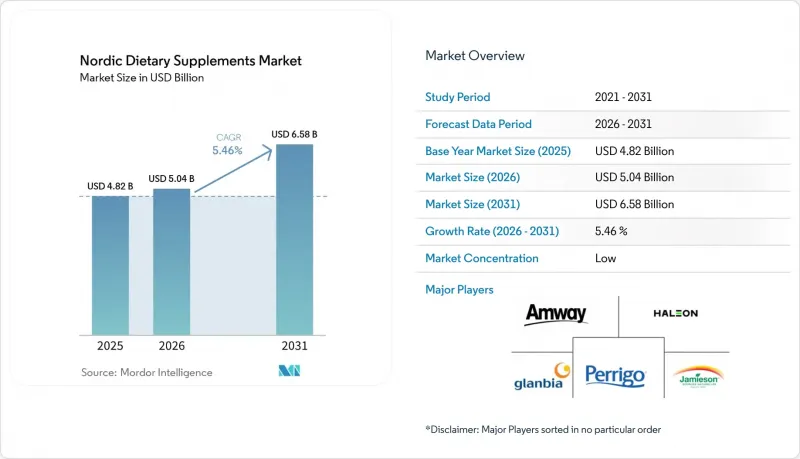
According to Mordor Intelligence, the Nordic dietary supplements market is expected to grow from USD 4.82 billion in 2025 to USD 5.04 billion in 2026, and is forecast to reach USD 6.58 billion by 2031 at a 5.46% CAGR over 2026-2031.
Nordic Dietary Supplements Market Trends and Insights
Aging Population Driving Bone, Joint, and Healthy Aging Supplements
The Nordic dietary supplements market benefits from a large and growing base of older consumers with daily nutritional needs. Products such as vitamin D, calcium, magnesium, collagen, and omega-3 address requirements related to bone health, mobility, and general health. In 2024, the Nordic Nutrition Recommendations advised a vitamin D intake of 20 µg per day for people over 75. Limited sun exposure during Nordic winters makes this recommendation particularly relevant for regular supplementation. Consumers who start with vitamin D for bone health may also consider collagen products for joint support and skin concerns. Orkla Health supports this demand through brands such as Moller's and Sana-Sol, while its Q1 2026 presentation retained medium-term revenue growth guidance of 7- 9%.
Sports Nutrition and Active Lifestyle Participation
Sports nutrition remains a key segment of the Nordic dietary supplements market, with active consumers regularly using protein, creatine, and recovery products. The category has expanded beyond competitive athletes to include runners, cyclists, gym users, and older adults seeking to maintain muscle function. This expansion supports demand for brands that offer broad retail availability and consistent product quality. The growing overlap between sports nutrition and healthy aging continues to broaden the addressable audience for performance-related formulations. Increasing interest in strength training, muscle preservation, and active lifestyles further encourages consumers to incorporate performance-focused supplements into their daily wellness routines.
Stringent Regulatory Approval and Compliance Requirements
Regulatory requirements can delay product launches in the Nordic dietary supplements market, particularly for smaller businesses. Denmark's food authority, the Danish Veterinary and Food Administration, inspected 131 supplement businesses in 2024 and identified unauthorized health claims; 61% were sanctioned for using health or disease claims that were in breach of the rules . Norway revised its food supplement rules in September 2025 through amendments incorporating European Union Regulation 2025/352. Companies must ensure substantiated messaging, accurate labeling, and processes that comply with country-specific requirements. Larger firms can distribute these costs across broader portfolios and dedicated compliance teams. As a result, the Nordic dietary supplements market may become more difficult to enter for brands that rely on loosely defined wellness claims.
Other drivers and restraints analyzed in the detailed report include:
- Rising Consumer Focus on Preventive Healthcare and Daily Wellness
- Growing Demand for Clinically Supported Functional Ingredients
- Consumer Skepticism Toward Unsubstantiated Health Claims
For complete list of drivers and restraints, kindly check the Table Of Contents.
Segment Analysis
Vitamins and minerals accounted for 28.48% of the Nordic dietary supplements market share in 2025. This position reflects long-standing pharmacy distribution and strong household familiarity. Vitamin D remains especially relevant, as Nordic dietary guidance identifies limited seasonal sunlight as a risk factor. Fatty acids, led by fish oil and cod liver oil, are expected to remain another major product group. Orkla noted elevated cod liver oil input costs in Q1 2026, highlighting the exposure of volume-oriented omega-3 brands to ingredient cost fluctuations. Herbal products and probiotics hold smaller but established positions in the Nordic dietary supplements market.
Collagen is forecasted to grow at a CAGR of 7.01% from 2026 to 2031. Demand is driven by consumers seeking skin, hair, and nail support, as well as older consumers looking for bone and joint support. This gives collagen a broader consumer base than many narrowly positioned beauty products. The same product can fit different health routines without requiring a change in format. Brands can therefore target women focused on skin elasticity and older consumers focused on mobility. The Nordic dietary supplements market size for collagen benefits from this overlap across consumer needs.
Tablets accounted for 36.80% of the Nordic dietary supplements market share in 2025, supported by cost efficiency, product stability, and strong placement on pharmacy shelves. Manufacturers commonly use tablets for vitamins, minerals, CoQ10, and selenium products. Consumers also associate this format with a pharmaceutical-style presentation. Capsules and softgels remain important formats for omega-3 and other fat-soluble ingredients, while powders serve sports nutrition and protein-related purchases.
Gummies are forecasted to register a CAGR of 6.89% from 2026 to 2031. Adults are increasingly choosing gummies for collagen, biotin, immunity, and other daily-use products. Parents also value gummies because they can improve product acceptance among children. Advances in formulation technologies have reduced some stability challenges for sensitive ingredients, supporting premium gummy products in vitamin and probiotic-related applications. In the Nordic dietary supplements market, format choice is becoming an increasingly important factor in product selection.
Complete Report Scope:
- By Product Type
- Vitamins and Minerals
- Fatty Acids
- Collagen
- Prebiotic and Probiotic Supplements
- Herbal Supplements
- Others
- By Form
- Tablets
- Capsules and Softgels
- Powders
- Gummies
- Liquids
- Others
- By Consumer Group
- Men
- Women
- Kids/Children
- By Health Application
- General Health and Wellness
- Immunity Enhancement
- Skin, Hair, and Nail Care
- Bone and Joint Health
- Gastrointestinal and Gut Health
- Energy and Weight Management
- Other Health Applications
- By Distribution Channel
- Supermarkets/Hypermarkets
- Pharmacy/Drugstores
- Online Retail Channels
- Other Distribution Channel
- By Country
- Sweden
- Denmark
- Norway
- Iceland
- Finland
List of Companies Covered in this Report:
- Orkla Health
- Pharma Nord Inc
- Haleon PLC
- Amway Corporation
- Glanbia Plc
- Jamieson Wellness Inc.
- Idna Group
- Midsona
- NutraQ AS
- Danish Pharmaceautical Industry
- Natur Drogreit
- Nordic Naturals
- STR Nordic Oy
- Robust Nordic
- Perrigo Company plc
- Bayer AG
- BioGaia AB
- Nestle S.A.
- Nature's Bounty
- Now Health Foods
Additional Benefits:
- The market estimate (ME) sheet in Excel format
- 3 months of analyst support
TABLE OF CONTENTS
1 INTRODUCTION
- 1.1 Study Assumptions and Market Definition
- 1.2 Scope of the Study
2 RESEARCH METHODOLOGY
3 EXECUTIVE SUMMARY
4 MARKET LANDSCAPE
- 4.1 Market Overview
- 4.2 Market Drivers
- 4.2.1 Aging population driving bone, joint, and healthy aging supplements
- 4.2.2 Sports nutrition and active lifestyle participation
- 4.2.3 Rising consumer focus on preventive healthcare and daily wellness
- 4.2.4 Growing demand for clinically supported functional ingredients
- 4.2.5 Government nutrition recommendations supporting supplement consumption
- 4.2.6 Increasing popularity of gut health and microbiome nutrition
- 4.3 Market Restraints
- 4.3.1 Stringent regulatory approval and compliance requirements
- 4.3.2 Consumer skepticism toward unsubstantiated health claims
- 4.3.3 Premium product pricing limiting mass market penetration
- 4.3.4 Increasing competition from functional foods and fortified beverages
- 4.4 Consumer Behaviour Analysis
- 4.5 Regulatory Outlook
- 4.6 Porter's Five Forces Analysis
- 4.6.1 Threat of New Entrants
- 4.6.2 Bargaining Power of Buyers/Consumers
- 4.6.3 Bargaining Power of Suppliers
- 4.6.4 Threat of Substitute Products
- 4.6.5 Intensity of Competitive Rivalry
5 MARKET SIZE AND GROWTH FORECASTS (VALUE)
- 5.1 By Product Type
- 5.1.1 Vitamins and Minerals
- 5.1.2 Fatty Acids
- 5.1.3 Collagen
- 5.1.4 Prebiotic and Probiotic Supplements
- 5.1.5 Herbal Supplements
- 5.1.6 Others
- 5.2 By Form
- 5.2.1 Tablets
- 5.2.2 Capsules and Softgels
- 5.2.3 Powders
- 5.2.4 Gummies
- 5.2.5 Liquids
- 5.2.6 Others
- 5.3 By Consumer Group
- 5.3.1 Men
- 5.3.2 Women
- 5.3.3 Kids/Children
- 5.4 By Health Application
- 5.4.1 General Health and Wellness
- 5.4.2 Immunity Enhancement
- 5.4.3 Skin, Hair, and Nail Care
- 5.4.4 Bone and Joint Health
- 5.4.5 Gastrointestinal and Gut Health
- 5.4.6 Energy and Weight Management
- 5.4.7 Other Health Applications
- 5.5 By Distribution Channel
- 5.5.1 Supermarkets/Hypermarkets
- 5.5.2 Pharmacy/Drugstores
- 5.5.3 Online Retail Channels
- 5.5.4 Other Distribution Channel
- 5.6 By Country
- 5.6.1 Sweden
- 5.6.2 Denmark
- 5.6.3 Norway
- 5.6.4 Iceland
- 5.6.5 Finland
6 COMPETITIVE LANDSCAPE
- 6.1 Market Concentration
- 6.2 Strategic Moves
- 6.3 Market Share Analysis
- 6.4 Company Profiles (includes Global-level Overview, Market-level Overview, Core Segments, Financials (if available), Strategic Information, Market Rank/Share, Products and Services, Recent Developments)
- 6.4.1 Orkla Health
- 6.4.2 Pharma Nord Inc
- 6.4.3 Haleon PLC
- 6.4.4 Amway Corporation
- 6.4.5 Glanbia Plc
- 6.4.6 Jamieson Wellness Inc.
- 6.4.7 Idna Group
- 6.4.8 Midsona
- 6.4.9 NutraQ AS
- 6.4.10 Danish Pharmaceautical Industry
- 6.4.11 Natur Drogreit
- 6.4.12 Nordic Naturals
- 6.4.13 STR Nordic Oy
- 6.4.14 Robust Nordic
- 6.4.15 Perrigo Company plc
- 6.4.16 Bayer AG
- 6.4.17 BioGaia AB
- 6.4.18 Nestle S.A.
- 6.4.19 Nature's Bounty
- 6.4.20 Now Health Foods
7 MARKET OPPORTUNITIES AND FUTURE OUTLOOK

