PUBLISHER: Mordor Intelligence | PRODUCT CODE: 2156914

PUBLISHER: Mordor Intelligence | PRODUCT CODE: 2156914
Fermented Plant-Based Milk - Market Share Analysis, Industry Trends & Statistics, Growth Forecasts (2026 - 2031)
According to Mordor Intelligence, the fermented plant-based milk market size is expected to grow from USD 2.31 billion in 2025 to USD 2.48 billion in 2026, and is forecast to reach USD 3.57 billion by 2031 at a 7.55% CAGR over 2026-2031.
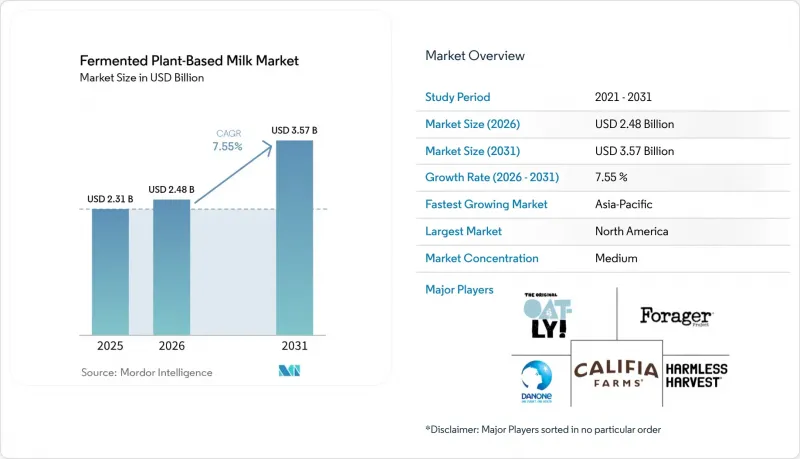
Global Fermented Plant-Based Milk Market Trends and Insights
Rising Consumer Focus on Gut Health and Digestive Wellness
Consumer interest in digestive health supports routine demand in the fermented plant-based milk market, moving purchases beyond occasional trials. The International Food Information Council reported that 37% of Americans seek digestive health benefits from food and beverages in 2025. In 2025, the Biocodex Microbiota Institute also reported that 67% of United States respondents recognize microbiota, while 49% consume probiotics at least monthly. This familiarity reduces the consumer education required when brands position products as cultured dairy-free beverages. Interest in probiotic-enriched beverages also favors brands that clearly explain the role of their cultures. Expanding refrigerated functional beverage sets give these brands more opportunities to reach shoppers near other health-oriented chilled products.
Growing Demand for Dairy-Free Alternatives Among Lactose-Intolerant Consumers
High lactose malabsorption rates create sustained demand for dairy-free cultured beverages. Fermentation can reduce lactose in dairy products, but it does not make every dairy format suitable for consumers who avoid lactose entirely. As a result, fully plant-based fermented products address both dietary requirements and demand for digestive functionality. This relationship is particularly important in Asia-Pacific, South America, and the Middle East and Africa, where retail modernization can convert established dietary needs into regular purchases. The fermented plant-based milk market can benefit when manufacturers adapt flavors, package sizes, and distribution strategies to local consumption patterns.
High Production Complexity and Processing Costs
Production in the fermented plant-based milk market requires greater process control and quality assurance than dairy-based fermentation. Fiber, phytates, tannins, and variable pH levels can affect microbial activity and culture survival. Producers may need controlled fermentation equipment, direct-vat-set culture dosing, and testing procedures that conventional plant milk producers do not use. These requirements can increase unit costs and make it harder for smaller manufacturers to match the prices of non-fermented plant beverages. The need for specialized cultures, fermentation monitoring, and refrigerated handling can further raise manufacturing and distribution costs. Competition from conventional plant milk remains strongest when consumers perceive little difference in function, taste, or ingredient quality.
Other drivers and restraints analyzed in the detailed report include:
- Demand for Clean-Label and Naturally Processed Functional Foods
- Product Innovation Across Plant Sources and Fermentation Technologies
- Shorter Shelf Life and Strict Cold-Chain Requirements
For complete list of drivers and restraints, kindly check the Table Of Contents.
Segment Analysis
Nut-based products represented a 41.24% category share in 2025. Almond and cashew bases benefit from strong consumer familiarity and sensory profiles that suit cultured beverages. Cashew creates a creamy texture in yogurt-style products, and Forager Project uses organic cashew and coconut milk in its cultured dairy-free products. Soy remains important because its protein composition supports fermentation and probiotic survival, with a March 2025 study reporting viability above 7 log CFU/mL after four weeks of refrigerated storage. Coconut serves a smaller niche in the fermented plant-based milk market, where its natural fat content supports texture and richness.
The fermented plant-based milk market size for oat-based products is projected to grow at a CAGR of 8.33% through 2031. Japanese companies, including Kikkoman and Asahi Group Holdings, are developing fermented oat and soy beverages that align with regional taste preferences. Hemp, rice, and emerging biomass-derived protein formats remain smaller segments of the fermented plant-based milk market. A broader plant-source portfolio can reduce exposure to volatility in nut and imported cashew inputs.
Complete Report Scope:
- By Plant Source
- Nut-based
- Almond
- Cashew
- Soy
- Oat
- Coconut
- Others
- Nut-based
- By Fermentation Type
- Lactic Acid Fermentation
- Probiotic Fermentation
- Yeast Fermentation
- Other Fermentation Types
- By Distribution Channel
- Hypermarkets and Supermarkets
- Convenience/Grocery Stores
- Online Retail
- Other Distribution Channels
- By Geography
- North America
- United States
- Canada
- Mexico
- Rest of North America
- Europe
- Germany
- United Kingdom
- Italy
- France
- Spain
- Netherlands
- Poland
- Belgium
- Sweden
- Rest of Europe
- Asia-Pacific
- China
- India
- Japan
- Australia
- Indonesia
- South Korea
- Thailand
- Singapore
- Rest of Asia-Pacific
- South America
- Brazil
- Argentina
- Colombia
- Chile
- Peru
- Rest of South America
- Middle East and Africa
- South Africa
- Saudi Arabia
- United Arab Emirates
- Nigeria
- Egypt
- Morocco
- Turkey
- Rest of Middle East and Africa
- North America
Geography Analysis
North America held a 34.12% category share in 2025. The region benefits from established natural food retail networks, strong demand for cultured products, and widespread consumer familiarity with dairy-free alternatives. Whole Foods Market, Sprouts, and major club retailers provide channels for plant-based brands to expand from specialty placement to broader distribution. Organic certification and clean ingredient lists can support premium shelf placement in the fermented plant-based milk market. The expansion of refrigerated functional beverage offerings also provides fermented plant-based milk brands with additional opportunities to reach health-focused consumers through mainstream retail channels.
Europe remains an important regional base for the fermented plant-based milk market and other functional chilled products. Germany, the United Kingdom, France, and the Nordic countries show established demand for transparent ingredients and regulated health-related communication. The European Union's Novel Food Regulation provides a framework for novel foods, while scientific and regulatory scrutiny raises the standard for culture-related claims. Oat-based offerings link established plant beverage consumption with fermentation and barista-led foodservice demand. Poland, Sweden, and the Netherlands offer further growth opportunities for refrigerated products beyond specialty stores.
Asia-Pacific is projected to record the fastest growth, with a CAGR of 8.66% through 2031. High lactose malabsorption prevalence provides a structural basis for dairy-free products, while urban retail and digital commerce improve access to refrigerated beverages. China's digital retail environment can accelerate product discovery through live commerce and instant delivery, while Japan offers demand for chilled oat and soy beverages tailored to local preferences. India, Indonesia, Thailand, and Singapore provide longer-term demand opportunities as modern retail networks and cold-chain capabilities expand.
- Danone S.A.
- Oatly AB
- Chobani, LLC
- Forager Project
- Califia Farms, LLC
- Kite Hill Store
- Cocojune
- Harmless Harvest
- The Icelandic Milk and Skyr Corporation
- Lifeway Foods, Inc.
- Minor Figures
- Vitasoy International Holdings Ltd.
- Mooala Organic
- Halsa Foods
- Rude Health
- Lava
- AAK
- Kotaji
- Novonesis Group
- The Perfect Plant Milk
Additional Benefits:
- The market estimate (ME) sheet in Excel format
- 3 months of analyst support
TABLE OF CONTENTS
1 INTRODUCTION
- 1.1 Study Assumptions and Market Definition
- 1.2 Scope of the Study
2 RESEARCH METHODOLOGY
3 EXECUTIVE SUMMARY
4 MARKET LANDSCAPE
- 4.1 Market Overview
- 4.2 Market Drivers
- 4.2.1 Rising consumer focus on gut health and digestive wellness
- 4.2.2 Growing demand for dairy-free alternatives among lactose-intolerant consumers
- 4.2.3 Demand for clean-label and naturally processed functional foods
- 4.2.4 Product innovation across plant sources and fermentation technologies
- 4.2.5 Increasing interest in probiotic-enriched beverages
- 4.2.6 Expansion of refrigerated functional beverage categories
- 4.3 Market Restraints
- 4.3.1 High production complexity and processing costs
- 4.3.2 Shorter shelf life and strict cold-chain requirements
- 4.3.3 Competition from conventional plant-based milk and dairy alternatives
- 4.3.4 Unfamiliarity and limited consumer awareness
- 4.4 Supply Chain Analysis
- 4.5 Regulatory Outlook
- 4.6 Porter's Five Forces Analysis
- 4.6.1 Threat of New Entrants
- 4.6.2 Bargaining Power of Buyers/Consumers
- 4.6.3 Bargaining Power of Suppliers
- 4.6.4 Threat of Substitute Products
- 4.6.5 Intensity of Competitive Rivalry
5 MARKET SIZE AND GROWTH FORECASTS (VALUE)
- 5.1 By Plant Source
- 5.1.1 Nut-based
- 5.1.1.1 Almond
- 5.1.1.2 Cashew
- 5.1.2 Soy
- 5.1.3 Oat
- 5.1.4 Coconut
- 5.1.5 Others
- 5.1.1 Nut-based
- 5.2 By Fermentation Type
- 5.2.1 Lactic Acid Fermentation
- 5.2.2 Probiotic Fermentation
- 5.2.3 Yeast Fermentation
- 5.2.4 Other Fermentation Types
- 5.3 By Distribution Channel
- 5.3.1 Hypermarkets and Supermarkets
- 5.3.2 Convenience/Grocery Stores
- 5.3.3 Online Retail
- 5.3.4 Other Distribution Channels
- 5.4 By Geography
- 5.4.1 North America
- 5.4.1.1 United States
- 5.4.1.2 Canada
- 5.4.1.3 Mexico
- 5.4.1.4 Rest of North America
- 5.4.2 Europe
- 5.4.2.1 Germany
- 5.4.2.2 United Kingdom
- 5.4.2.3 Italy
- 5.4.2.4 France
- 5.4.2.5 Spain
- 5.4.2.6 Netherlands
- 5.4.2.7 Poland
- 5.4.2.8 Belgium
- 5.4.2.9 Sweden
- 5.4.2.10 Rest of Europe
- 5.4.3 Asia-Pacific
- 5.4.3.1 China
- 5.4.3.2 India
- 5.4.3.3 Japan
- 5.4.3.4 Australia
- 5.4.3.5 Indonesia
- 5.4.3.6 South Korea
- 5.4.3.7 Thailand
- 5.4.3.8 Singapore
- 5.4.3.9 Rest of Asia-Pacific
- 5.4.4 South America
- 5.4.4.1 Brazil
- 5.4.4.2 Argentina
- 5.4.4.3 Colombia
- 5.4.4.4 Chile
- 5.4.4.5 Peru
- 5.4.4.6 Rest of South America
- 5.4.5 Middle East and Africa
- 5.4.5.1 South Africa
- 5.4.5.2 Saudi Arabia
- 5.4.5.3 United Arab Emirates
- 5.4.5.4 Nigeria
- 5.4.5.5 Egypt
- 5.4.5.6 Morocco
- 5.4.5.7 Turkey
- 5.4.5.8 Rest of Middle East and Africa
- 5.4.1 North America
6 COMPETITIVE LANDSCAPE
- 6.1 Market Concentration
- 6.2 Strategic Moves
- 6.3 Market Positioning Analysis
- 6.4 Company Profiles (includes Global-level Overview, Market-level Overview, Core Segments, Financials (if available), Strategic Information, Market Rank/Share, Products and Services, Recent Developments)
- 6.4.1 Danone S.A.
- 6.4.2 Oatly AB
- 6.4.3 Chobani, LLC
- 6.4.4 Forager Project
- 6.4.5 Califia Farms, LLC
- 6.4.6 Kite Hill Store
- 6.4.7 Cocojune
- 6.4.8 Harmless Harvest
- 6.4.9 The Icelandic Milk and Skyr Corporation
- 6.4.10 Lifeway Foods, Inc.
- 6.4.11 Minor Figures
- 6.4.12 Vitasoy International Holdings Ltd.
- 6.4.13 Mooala Organic
- 6.4.14 Halsa Foods
- 6.4.15 Rude Health
- 6.4.16 Lava
- 6.4.17 AAK
- 6.4.18 Kotaji
- 6.4.19 Novonesis Group
- 6.4.20 The Perfect Plant Milk
7 MARKET OPPORTUNITIES AND FUTURE OUTLOOK

