PUBLISHER: Mordor Intelligence | PRODUCT CODE: 2156918

PUBLISHER: Mordor Intelligence | PRODUCT CODE: 2156918
Nephrology Drugs - Market Share Analysis, Industry Trends & Statistics, Growth Forecasts (2026 - 2031)
According to Mordor Intelligence, the nephrology drugs market size is expected to increase from USD 39.60 billion in 2025 to USD 42.40 billion in 2026 and reach USD 64.62 billion by 2031, growing at a CAGR of 8.75% over 2026-2031.
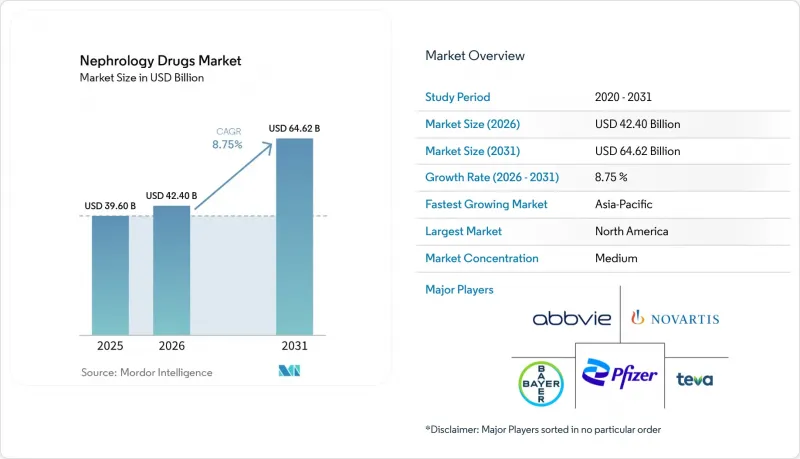
Global Nephrology Drugs Market Trends and Insights
Rising Chronic Kidney Disease and End-Stage Renal Disease Burden
Chronic kidney disease affected 788 million adults globally in 2023, compared with 378 million adults in 1990. China had 152 million cases and India had 138 million cases, creating the largest national patient pools. Around 30% of affected people lacked a confirmed diagnosis in clinical records during 2023. Broader detection can therefore increase treatment demand without requiring a rise in disease incidence. CKD caused 1.48 million deaths in 2023 and ranked as the ninth leading global cause of death. Impaired kidney function also contributed to 11.5% of cardiovascular mortality, supporting drug development across related conditions.
Expansion of Renal-Protective SGLT2 Inhibitor Use Beyond Diabetes
KDIGO gave SGLT2 inhibitors a Grade 1A recommendation for adults with CKD who meet its eGFR criteria. The recommendation applies regardless of diabetes status, expanding the relevant prescribing population. Use among people without diabetes has remained beyond the scope of the guideline recommendation. This gap leaves room for prescription growth as primary care, cardiology, and nephrology practices adopt the guidance. The CONFIDENCE trial found that finerenone plus empagliflozin reduced urinary albumin-to-creatinine ratios 29% more than either medicine alone. Combination treatment can raise use of complementary medicines within the nephrology drugs market.
High Cost and Reimbursement Friction for Novel Renal Therapies
Medicare's ESRD Prospective Payment System bundles most dialysis-related medicines into a fixed daily payment. Facilities can face costs above the bundled payment when they use newer treatments. The Transitional Drug Add-on Payment Adjustment provides support for 2 years before payment returns to bundled levels. This change can make prescribing difficult for providers despite an established patient need. A 2025 analysis found that costs restrict novel biological and targeted renal medicines largely to high-income countries. The access gap limits the nephrology drugs market in regions with substantial CKD burdens.
Other drivers and restraints analyzed in the detailed report include:
- Earlier Detection Through eGFR and Albuminuria Screening
- Aging, Diabetes, Hypertension and Obesity Comorbidity Load
- Long and Complex Kidney-Outcome Trial Requirements
For complete list of drivers and restraints, kindly check the Table Of Contents.
Segment Analysis
RAS inhibitors held 31.8% of the nephrology drugs market share in 2025. Their position reflected long-standing guideline use and broad generic availability in hypertensive and diabetic nephropathy. SGLT2 inhibitors are projected to grow at a 10.8% CAGR from 2026 to 2031. KDIGO's Grade 1A recommendation supports their use in eligible adults with CKD, regardless of diabetes status. Slower adoption among patients without diabetes leaves a clear route for higher treatment use. The nephrology drugs industry is therefore moving beyond a landscape centered on RAS therapy alone.
The CONFIDENCE trial showed a 29% greater reduction in proteinuria from finerenone and empagliflozin together than from either therapy alone. The result supports multi-class protocols and increases medicine use per treated patient. Anemia therapies include erythropoiesis-stimulating agents and HIF-prolyl hydroxylase inhibitors. Vafseo became commercially available in the United States in January 2025 after FDA approval in March 2024. Phosphate binders, potassium binders, immunosuppressants, and complement inhibitors remain important in other renal conditions. Targeted biologics for rare kidney diseases are also entering restricted distribution programs.
CKD accounted for 38.5% of the nephrology drugs market size in 2025, making it the largest indication. Diabetic kidney disease is forecast to grow at a 10.6% CAGR from 2026 to 2031. High fasting plasma glucose contributed 31.9% of CKD disability-adjusted life years in 2023. This disease burden explains the strong development focus on diabetic kidney disease. Novo Nordisk is extending semaglutide into renal outcome indications within this therapeutic area.
CKD has an established treatment population and well-defined pharmacotherapy approaches across several clinical guidelines. Modest gains in drug penetration can therefore create substantial volume because of this patient base. Glomerular and autoimmune diseases include IgAN, FSGS, primary membranous nephropathy, and lupus nephritis. Treatment is moving from broad immunosuppression toward targeted biologics and BTK-inhibitor approaches. Proteinuria as an FDA-accepted surrogate endpoint in IgAN supported approvals for sparsentan and Tarpeyo. Acute kidney injury remains centered on supportive care, although biomarker-guided early intervention is under development. ESRD and CKD complications remain linked to anemia and mineral-metabolism management through dialysis programs.
Complete Report Scope:
- By Drug Class
- Renin-Angiotensin System (RAS) Inhibitors (ACE Inhibitors, ARBs)
- SGLT2 Inhibitors
- Mineralocorticoid Receptor Antagonists & Endothelin Receptor Antagonists
- Anemia Management Therapies (ESAs, HIF-PH Inhibitors)
- Other Nephrology Drugs (Phosphate Binders, Potassium Binders, Immunosuppressants, Complement Inhibitors, Others)
- By Indication
- Chronic Kidney Disease (CKD)
- Diabetic Kidney Disease (DKD)
- Glomerular & Autoimmune Kidney Diseases
- Acute Kidney Injury (AKI)
- CKD-Associated Complications & End-Stage Renal Disease (ESRD)
- By Route of Administration
- Oral
- Injectable/Parenteral
- Intravenous
- Subcutaneous
- Other Routes
- By Distribution Channel
- Hospital Pharmacies
- Retail Pharmacies
- Online Pharmacies
- Specialty Pharmacies
- Other Distribution Channels
- By Geography
- North America
- United States
- Canada
- Mexico
- Europe
- Germany
- United Kingdom
- France
- Italy
- Spain
- Rest of Europe
- Asia-Pacific
- China
- Japan
- India
- South Korea
- Australia
- Rest of Asia-Pacific
- Middle East and africa
- GCC
- South Africa
- Rest of Middle East and Africa
- South America
- Brazil
- Argentina
- Rest of South America
- North America
Geography Analysis
North America held 41.3% of the nephrology drugs market share in 2025. The region benefits from established renal specialists, Medicare ESRD coverage, and early uptake of recommended therapies. The United States remains the largest national market because post-approval use can develop quickly within its health care system. Kerendia generated EUR 829 million, equivalent to USD 936 million, in global sales during 2025. Canada showed similar prescribing patterns, while Mexico is growing with urban obesity and diabetes. Medicare's bundled ESRD payment structure remains an important constraint on novel dialysis medicines.
Europe follows North America, supported by integrated renal care pathways in Germany, the United Kingdom, and France. Guideline adoption has supported SGLT2 inhibitor use across CKD and heart failure care. Asia-Pacific is projected to grow at a 10.9% CAGR from 2026 to 2031. China and India had 152 million and 138 million CKD cases, respectively, in the 2023 dataset. Japan has an established dialysis system and was an early adopter of HIF-PH inhibitors for renal anemia treatment.
Japan recorded 2.5 million diagnosed CKD patients, while South Korea and Australia are expanding screening initiatives. SGLT2 use in non-diabetic CKD has further room to develop across Asia-Pacific. IgA nephropathy drug development also has regional relevance because prevalence is higher than in Western populations. Middle East and Africa, and South America, remain lower-penetration areas constrained by affordability and specialist access. Latin America recorded an age-standardized CKD prevalence of 15.4% in 2023. Lower-cost SGLT2 generics may support a volume-led pathway as exclusivities expire.
- AstraZeneca
- Boehringer Ingelheim
- Eli Lilly and Company
- Bayer
- Amgen
- Novartis
- Novo Nordisk
- Pfizer
- Roche
- Abbvie
- Johnson & Johnson
- CSL Vifor
- Akebia Therapeutics
- Ardelyx, Inc.
- Travere Therapeutics, Inc.
- Calliditas Therapeutics AB
- Otsuka
- Takeda Pharmaceuticals
- Kyowa Kirin
- Alnylam Pharmaceuticals
Additional Benefits:
- The market estimate (ME) sheet in Excel format
- 3 months of analyst support
TABLE OF CONTENTS
1 INTRODUCTION
- 1.1 Study Assumptions and Market Definition
- 1.2 Scope of the Study
2 RESEARCH METHODOLOGY
3 EXECUTIVE SUMMARY
4 MARKET LANDSCAPE
- 4.1 Market Overview
- 4.2 Market Drivers
- 4.2.1 Rising Chronic Kidney Disease and End-Stage Renal Disease Burden
- 4.2.2 Expansion of Renal-Protective SGLT2 Inhibitor Use Beyond Diabetes
- 4.2.3 Earlier Detection Through eGFR and Albuminuria Screening
- 4.2.4 Aging, Diabetes, Hypertension and Obesity Comorbidity Load
- 4.2.5 Increasing Investment in Precision Nephrology and Rare Kidney Disease Therapies
- 4.2.6 Digitally Enabled Home and Outpatient Medication Management
- 4.3 Market Restraints
- 4.3.1 High Cost and Reimbursement Friction for Novel Renal Therapies
- 4.3.2 Long and Complex Kidney-Outcome Trial Requirements
- 4.3.3 Renal-Dose Errors and Medication-Management Complexity
- 4.3.4 Late Diagnosis, Low Awareness and Uneven Specialist Access
- 4.4 Supply-Chain Analysis
- 4.5 Regulatory Landscape
- 4.6 Technological Outlook
- 4.7 Porters Five Forces Analysis
- 4.7.1 Threat of New Entrants
- 4.7.2 Bargaining Power of Suppliers
- 4.7.3 Bargaining Power of Buyers
- 4.7.4 Threat of Substitutes
- 4.7.5 Competitive Rivalry
5 MARKET SIZE AND GROWTH FORECASTS
- 5.1 By Drug Class
- 5.1.1 Renin-Angiotensin System (RAS) Inhibitors (ACE Inhibitors, ARBs)
- 5.1.2 SGLT2 Inhibitors
- 5.1.3 Mineralocorticoid Receptor Antagonists & Endothelin Receptor Antagonists
- 5.1.4 Anemia Management Therapies (ESAs, HIF-PH Inhibitors)
- 5.1.5 Other Nephrology Drugs (Phosphate Binders, Potassium Binders, Immunosuppressants, Complement Inhibitors, Others)
- 5.2 By Indication
- 5.2.1 Chronic Kidney Disease (CKD)
- 5.2.2 Diabetic Kidney Disease (DKD)
- 5.2.3 Glomerular & Autoimmune Kidney Diseases
- 5.2.4 Acute Kidney Injury (AKI)
- 5.2.5 CKD-Associated Complications & End-Stage Renal Disease (ESRD)
- 5.3 By Route of Administration
- 5.3.1 Oral
- 5.3.2 Injectable/Parenteral
- 5.3.3 Intravenous
- 5.3.4 Subcutaneous
- 5.3.5 Other Routes
- 5.4 By Distribution Channel
- 5.4.1 Hospital Pharmacies
- 5.4.2 Retail Pharmacies
- 5.4.3 Online Pharmacies
- 5.4.4 Specialty Pharmacies
- 5.4.5 Other Distribution Channels
- 5.5 By Geography
- 5.5.1 North America
- 5.5.1.1 United States
- 5.5.1.2 Canada
- 5.5.1.3 Mexico
- 5.5.2 Europe
- 5.5.2.1 Germany
- 5.5.2.2 United Kingdom
- 5.5.2.3 France
- 5.5.2.4 Italy
- 5.5.2.5 Spain
- 5.5.2.6 Rest of Europe
- 5.5.3 Asia-Pacific
- 5.5.3.1 China
- 5.5.3.2 Japan
- 5.5.3.3 India
- 5.5.3.4 South Korea
- 5.5.3.5 Australia
- 5.5.3.6 Rest of Asia-Pacific
- 5.5.4 Middle East and africa
- 5.5.4.1 GCC
- 5.5.4.2 South Africa
- 5.5.4.3 Rest of Middle East and Africa
- 5.5.5 South America
- 5.5.5.1 Brazil
- 5.5.5.2 Argentina
- 5.5.5.3 Rest of South America
- 5.5.1 North America
6 COMPETITIVE LANDSCAPE
- 6.1 Market Concentration
- 6.2 Market Share Analysis
- 6.3 Company Profiles (includes Global Level Overview, Market Level Overview, Core Segments, Financials as available, Strategic Information, Market Rank/Share, Products and Services, Recent Developments)
- 6.3.1 AstraZeneca
- 6.3.2 Boehringer Ingelheim International GmbH
- 6.3.3 Eli Lilly and Company
- 6.3.4 Bayer AG
- 6.3.5 Amgen Inc.
- 6.3.6 Novartis AG
- 6.3.7 Novo Nordisk A/S
- 6.3.8 Pfizer Inc.
- 6.3.9 F. Hoffmann-La Roche Ltd
- 6.3.10 AbbVie Inc.
- 6.3.11 Johnson & Johnson
- 6.3.12 CSL Vifor
- 6.3.13 Akebia Therapeutics, Inc.
- 6.3.14 Ardelyx, Inc.
- 6.3.15 Travere Therapeutics, Inc.
- 6.3.16 Calliditas Therapeutics AB
- 6.3.17 Otsuka Pharmaceutical Co., Ltd.
- 6.3.18 Takeda Pharmaceutical Company Limited
- 6.3.19 Kyowa Kirin Co., Ltd.
- 6.3.20 Alnylam Pharmaceuticals, Inc.
7 MARKET OPPORTUNITIES AND FUTURE OUTLOOK
- 7.1 White-Space and Unmet-Need Assessment

