PUBLISHER: Mordor Intelligence | PRODUCT CODE: 2156921

PUBLISHER: Mordor Intelligence | PRODUCT CODE: 2156921
Indonesia Manufacturing Logistics - Market Share Analysis, Industry Trends & Statistics, Growth Forecasts (2026 - 2031)
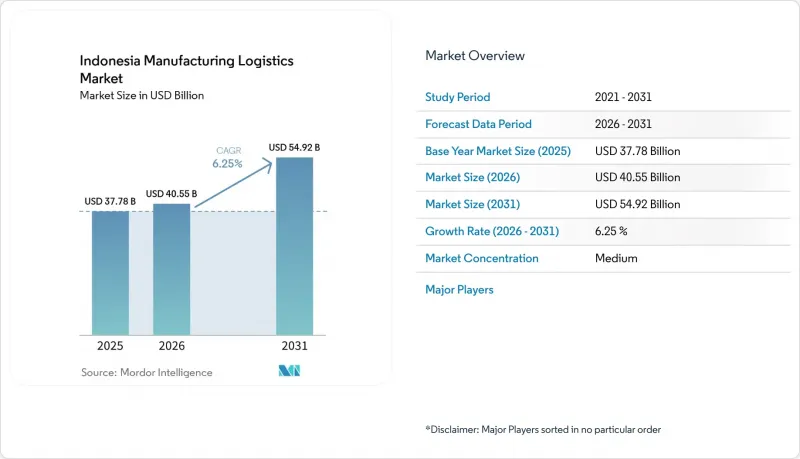
According to Mordor Intelligence, the Indonesia manufacturing logistics market size was valued at USD 37.78 billion in 2025 and is estimated to grow from USD 40.55 billion in 2026 to reach USD 54.92 billion by 2031, registering at a CAGR of 6.25% from 2026 to 2031.
Indonesia Manufacturing Logistics Market Trends and Insights
Manufacturing Export and Industrial Corridor Expansion
Indonesia recorded USD 187.8 billion in non-oil and gas manufacturing exports from January through October 2025, equal to 80.3% of national exports and 15.8% higher than the prior year. Manufacturing investment reached IDR 182 trillion (USD 10.86 billion) in the first quarter of 2026, or 36.5% of national investment. Special economic zones recorded IDR 44 trillion (USD 2.63 billion) in exports during 2025. Alumina, oleochemicals, and processed copper require more specialized handling than basic bulk cargo. Regulation No. 26 of 2025 promotes logistics integration within accredited industrial estates from January 2026. These conditions raise demand for freight forwarding, customs support, and warehouse services close to production sites.
National Logistics Ecosystem Digitalization
The National Logistics Ecosystem was deployed at 46 seaports and 6 airports by October 2024, covering 97% of sea cargo and 98% of air cargo volume. A survey cited by the World Customs Organization found that implementation reduced clearance processing time by 57.7% and processing costs by 37.6%. Shared submission systems, tracking tools, and port gates support more predictable handoffs between customs, quarantine, and shipping processes. The presidential instruction supporting the program expired at the end of 2025. The government had prepared a regulation covering connectivity, service digitalization, and workforce development. The regulatory gap may delay investment in interoperable logistics systems.
Inter-Island Infrastructure and Transshipment Complexity
Empty container repositioning and low return-voyage utilization increase round-trip costs for manufacturers outside Java and Sumatra. A 2025 assessment ranked West Kalimantan's physical infrastructure second lowest nationally. While only 58.7% of Sea Toll program ports met basic infrastructure requirements, westbound backhaul utilization remained below 25%. Research on eastern Indonesian ports found that deeper basins could lift vessel carrying capacity by up to 35% and reduce regional logistics costs by 22% to 28%. These upgrades need long-term public funding and execution. Uneven enforcement of service requirements across Sea Toll ports also limits consistent operating conditions.
Other drivers and restraints analyzed in the detailed report include:
- Toll Road, Port, and Airport Capacity Expansion
- Battery, EV, and Electronics Supply-Chain Localization
- Fragmented Regulation and Digital Interoperability
For complete list of drivers and restraints, kindly check the Table Of Contents.
Segment Analysis
Freight transportation held 58.65% of the Indonesia manufacturing logistics market share in 2025. The position reflects road-based movements within Java's industrial corridors. Trucking supports factory-to-port and interstate distribution in the country's largest production areas. Sea and inland waterway freight connects manufacturing centers across the islands. Rail freight remains limited outside Java and Sumatra. The government's 2025 to 2029 rail agenda includes track development on islands without rail service. Air freight serves high-value and time-sensitive electronics and pharmaceutical shipments. These modes give manufacturers different options based on cargo value, delivery needs, and location.
Warehousing and distribution are forecast to grow at a 7.50% CAGR through 2031. Manufacturers are moving from in-house storage toward outsourced and system-managed distribution. Supply Chain Management and Value-Added Logistics is smaller, but it is gaining demand from global original equipment manufacturers. These companies require inbound sequencing, kitting, and vendor-managed inventory. Regulation No. 26 of 2025 requires logistics integration in accredited industrial zones from January 2026. This requirement can encourage third-party warehouse partnerships. KION Group established a direct warehouse automation entity in Jakarta in 2025. The Indonesia manufacturing logistics industry is consequently seeing more demand for integrated storage and handling capabilities.
Food and beverage accounted for 37.39% of the Indonesia manufacturing logistics market size in 2025. A domestic population of 280 million supports broad replenishment needs across the islands. Food and beverage output grew 5.1% in 2025, supporting 5.3 million food and beverage service businesses. Perishable goods increase the need for frequent distribution and suitable storage. Textiles and Apparel, Wood and Furniture, and Rubber and Plastics remain mid-tier contributors. Some lower-value textile production has moved toward Central Java locations, including Solo and Semarang. Metals, Fabrication, Machinery, and Equipment demand depends on domestic construction and export activity.
Electronics and electrical is forecast to expand at a 9.56% CAGR between 2026 and 2031. Global original equipment manufacturers are diversifying production locations in Southeast Asia. Batam's special economic zone has become a beneficiary of this shift. DHL Express established a customs gateway in Semarang in early 2026. It also operates daily cargo services on the Batam to Singapore route for electronics manufacturers. Automotive logistics is also changing as electric-vehicle platforms require careful handling of batteries and power electronics. Chemicals and Pharmaceuticals add demand for secure and temperature-controlled services. These needs raise the value of specialized logistics contracts.
Complete Report Scope:
- By Logistics Function
- Freight Transportation
- Road Freight
- Rail Freight
- Air Freight
- Sea and Inland Waterway Freight
- Warehousing and Distribution
- Supply Chain Management and Value-Added Logistics
- Freight Transportation
- By Manufacturing Industry
- Food and Beverage
- Textiles and Apparel
- Wood and Furniture
- Chemicals and Pharmaceuticals
- Rubber and Plastics
- Metals and Fabrication
- Electronics and Electrical
- Machinery and Equipment
- Automotive and Transportation Equipment
- Other Manufacturing Industries
- By Cargo Handling
- General Cargo
- Temperature-Controlled Cargo
- Hazardous Cargo
- High-Value / Sensitive Cargo
- By Destination
- Domestic
- International / Cross-Border
- By Region
- Java (Jakarta & BOD)
- Sumatra
- Kalimantan
- Sulawesi
- Bali and Nusa Tenggara
- Papua Region and Maluku Islands
List of Companies Covered in this Report:
- DHL Group
- DSV A/S
- Kuehne+Nagel International AG
- CEVA Logistics
- NX Group / PT NX Lemo Indonesia Logistik
- A.P. Moller - Maersk
- PT Yusen Logistics Indonesia
- PT Samudera Indonesia Tbk
- APL Logistics
- PT LOGISTEED Indonesia
- PT CJ Logistics Indonesia
- GEODIS
- Meratus Group
- PT Puninar Logistics
- PT Kamadjaja Logistics
- PT Cipta Krida Bahari (CKB Logistics)
- Rhenus Logistics Indonesia
- PT YCH Indonesia
- PT Siba Surya
- PT TEMAS Tbk
- PT BGR Logistik Indonesia
- Kargo Technologies / PT Kargo Online System
Additional Benefits:
- The market estimate (ME) sheet in Excel format
- 3 months of analyst support
TABLE OF CONTENTS
1 INTRODUCTION
- 1.1 Study Assumptions and Market Definition
- 1.2 Scope of the Study
2 RESEARCH METHODOLOGY
3 EXECUTIVE SUMMARY
- 3.1 Indonesia Manufacturing Logistics Market Size and Forecast
- 3.2 Key Manufacturing Logistics Demand and Growth Trends
- 3.3 Major Industry Segments and Logistics Demand Patterns
- 3.4 Competitive Landscape and Strategic Market Outlook
4 MARKET LANDSCAPE
- 4.1 Market Overview and Importance of Manufacturing Logistics
- 4.2 Market Drivers
- 4.2.1 Manufacturing Export and Industrial Corridor Expansion
- 4.2.2 National Logistics Ecosystem Digitalization
- 4.2.3 Toll-Road, Port, and Airport Capacity Expansion
- 4.2.4 Cold-Chain Demand from Food, Seafood, and Pharmaceuticals
- 4.2.5 Factory Automation and Real-Time Inventory Visibility
- 4.2.6 Battery, EV, and Electronics Supply-Chain Localization
- 4.3 Market Restraints
- 4.3.1 Inter-Island Infrastructure and Transshipment Complexity
- 4.3.2 Port Congestion and Urban Trucking Delays
- 4.3.3 Fragmented Regulation and Digital Interoperability
- 4.3.4 Skilled Logistics Labor and Alternative-Fuel Infrastructure Gaps
- 4.4 Value Chain and Distribution Channel Architecture Analysis
- 4.5 Regulatory Framework and Compliance Requirements Overview
- 4.6 Technology Adoption and Digitalization Trends Outlook
- 4.7 Plant Logistics and In-Factory Handling Service Analysis
- 4.8 Manufacturing Investment and Logistics Capacity Expansion Analysis
- 4.9 Inbound and Outbound Logistics Flow Pattern Analysis
- 4.10 Porter's Five Forces Analysis
- 4.10.1 Threat of New Entrants
- 4.10.2 Bargaining Power of Buyers and Consumers
- 4.10.3 Bargaining Power of Suppliers
- 4.10.4 Threat of Substitute Services
- 4.10.5 Intensity of Competitive Rivalry
- 4.11 Impact of Geo-Political Events on Supply Chain Shifts
5 MARKET SIZE AND GROWTH FORECASTS
- 5.1 By Logistics Function
- 5.1.1 Freight Transportation
- 5.1.1.1 Road Freight
- 5.1.1.2 Rail Freight
- 5.1.1.3 Air Freight
- 5.1.1.4 Sea and Inland Waterway Freight
- 5.1.2 Warehousing and Distribution
- 5.1.3 Supply Chain Management and Value-Added Logistics
- 5.1.1 Freight Transportation
- 5.2 By Manufacturing Industry
- 5.2.1 Food and Beverage
- 5.2.2 Textiles and Apparel
- 5.2.3 Wood and Furniture
- 5.2.4 Chemicals and Pharmaceuticals
- 5.2.5 Rubber and Plastics
- 5.2.6 Metals and Fabrication
- 5.2.7 Electronics and Electrical
- 5.2.8 Machinery and Equipment
- 5.2.9 Automotive and Transportation Equipment
- 5.2.10 Other Manufacturing Industries
- 5.3 By Cargo Handling
- 5.3.1 General Cargo
- 5.3.2 Temperature-Controlled Cargo
- 5.3.3 Hazardous Cargo
- 5.3.4 High-Value / Sensitive Cargo
- 5.4 By Destination
- 5.4.1 Domestic
- 5.4.2 International / Cross-Border
- 5.5 By Region
- 5.5.1 Java (Jakarta & BOD)
- 5.5.2 Sumatra
- 5.5.3 Kalimantan
- 5.5.4 Sulawesi
- 5.5.5 Bali and Nusa Tenggara
- 5.5.6 Papua Region and Maluku Islands
6 COMPETITIVE LANDSCAPE
- 6.1 Market Concentration
- 6.2 Strategic Moves
- 6.3 Market Share Analysis
- 6.4 Company Profiles (includes Global Level Overview, Market Level Overview, Core Segments, Financials as available, Strategic Information, Geographic Coverage, Products and Services, Recent Developments)
- 6.4.1 DHL Group
- 6.4.2 DSV A/S
- 6.4.3 Kuehne+Nagel International AG
- 6.4.4 CEVA Logistics
- 6.4.5 NX Group / PT NX Lemo Indonesia Logistik
- 6.4.6 A.P. Moller - Maersk
- 6.4.7 PT Yusen Logistics Indonesia
- 6.4.8 PT Samudera Indonesia Tbk
- 6.4.9 APL Logistics
- 6.4.10 PT LOGISTEED Indonesia
- 6.4.11 PT CJ Logistics Indonesia
- 6.4.12 GEODIS
- 6.4.13 Meratus Group
- 6.4.14 PT Puninar Logistics
- 6.4.15 PT Kamadjaja Logistics
- 6.4.16 PT Cipta Krida Bahari (CKB Logistics)
- 6.4.17 Rhenus Logistics Indonesia
- 6.4.18 PT YCH Indonesia
- 6.4.19 PT Siba Surya
- 6.4.20 PT TEMAS Tbk
- 6.4.21 PT BGR Logistik Indonesia
- 6.4.22 Kargo Technologies / PT Kargo Online System
7 MARKET OPPORTUNITIES AND FUTURE OUTLOOK
- 7.1 White-Space and Unmet-Need Assessment
- 7.2 Expansion of Inter-Island Manufacturing Fulfillment Networks
- 7.3 Growth in Secure Logistics for High-Value Manufacturing Cargo
- 7.4 Emerging Opportunities in Green and Reverse Logistics Networks
- 7.5 Future Outlook for Manufacturing Logistics Network Expansion
8 APPENDIX

