PUBLISHER: Mordor Intelligence | PRODUCT CODE: 2156929

PUBLISHER: Mordor Intelligence | PRODUCT CODE: 2156929
Multimodal Remote Inspection Systems - Market Share Analysis, Industry Trends & Statistics, Growth Forecasts (2026 - 2031)
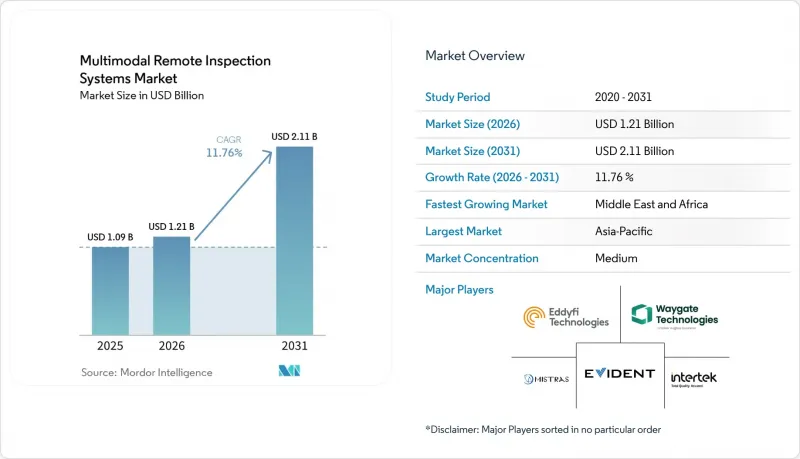
According to Mordor Intelligence, the multimodal remote inspection systems market size was USD 1.09 billion in 2025 and is projected to reach USD 2.11 billion by 2031, at a CAGR of 11.76% from 2026 to 2031.
Global Multimodal Remote Inspection Systems Market Trends and Insights
Rising Adoption of AI, Robotics, and Digital Twin Workflows
The multimodal remote inspection systems market is moving inspection from a periodic compliance task toward a continuous operating practice. Boston Dynamics integrated Google Gemini Robotics-ER 1.6 into its Orbit AIVI-Learning platform in April 2026. The update raised analog gauge reading accuracy on the Spot robot from 23% to 98%. This result supports more autonomous routine rounds and reduces reliance on experienced technicians for basic readings. A February 2026 trial by NTT Group, 1Finity, and Mitsubishi Chemical also confirmed that IOWN APN and 60 GHz wireless LAN could support real-time data collection and analysis by autonomous robots and digital twins at the Mizushima Coastal Industrial Zone. A 2026 peer-reviewed study found that digital twin frameworks support mission planning and real-time adjustments for inspection robots in difficult settings.
Increasing Safety Demand for Hazardous and Inaccessible Inspections
The multimodal remote inspection systems market is supported by safety requirements in confined, elevated, and hazardous locations. OSHA recorded 30,273 federal inspections in fiscal year 2025. Construction and manufacturing accounted for more than 62% of that activity. This enforcement activity increases the cost of noncompliance for asset owners. Copel used Flyability's Elios 3 drone inside hydroelectric plant conduits in September 2025. The deployment removed fall-from-height exposure, reduced downtime by at least 1 day per generating unit, and lowered operating cost by 30% against conventional methods.
High Initial System and Brownfield Retrofit Costs
Entry into the multimodal remote inspection systems market can require substantial spending on platforms, sensors, edge computing, docking stations, and software. Brownfield projects also require facility mapping, safety validation, workforce training, and integration with existing asset systems. These requirements can create a barrier for mid-sized industrial users and facilities not designed for robotic access. ANYbotics' ATEX Zone 1-certified ANYmal robot illustrates the challenge because a refinery deployment may also need docking infrastructure, wireless upgrades, and digital twin architecture. A short payback assessment can overlook savings from fewer unplanned shutdowns in later years. ISO 17020 inspection-body requirements can also add validation work and extend approval timelines.
Other drivers and restraints analyzed in the detailed report include:
- Expansion of Predictive Maintenance and Asset Integrity Programs
- Aging Infrastructure and Stricter Quality and Compliance Requirements
- Integration, Interoperability, and Data-Governance Complexity
For complete list of drivers and restraints, kindly check the Table Of Contents.
Segment Analysis
Hardware accounted for 58.63% of revenue in 2025 within the multimodal remote inspection systems market. The category includes aerial drones, ground robots, subsea vehicles, fixed camera systems, sensor payloads, docking equipment, and rugged edge computing modules. These assets support site-level data capture and sensor fusion across inspection missions. Services in the multimodal remote inspection systems market were the second-largest component because buyers increasingly require deployment support, maintenance contracts, and managed programs with predictable outcomes.
Software is projected to expand at an 11.93% CAGR from 2026 to 2031. Operators are adding analytics, digital twin synchronization, and AI defect detection over their installed hardware. DroneDeploy reported in 2026 that its visual dataset exceeded 20 trillion square feet and that autonomous ground robot missions increased by 160% year over year. Panasonic Connect began sales of the Bead Eye M edition in June 2026, combining 3D sensing and proprietary AI for weld inspection. Panasonic stated that the system reduced setup labor by 90%, showing how hardware and software value are becoming less distinct.
Aerial systems held 34.72% of revenue in 2025 within the multimodal remote inspection systems market. Their position reflects mature drone hardware, clearer visual line-of-sight rules, and their use across power lines, tanks, and bridge decks. Ground robots serve confined spaces and high-radiation settings, while fixed systems provide continuous monitoring on manufacturing lines and critical infrastructure. This platform mix lets operators select equipment based on site access and inspection frequency.
Underwater and subsea systems are projected to expand at a 12.22% CAGR from 2026 to 2031. In the multimodal remote inspection systems market, aging offshore assets, deepwater development, and required pipeline and riser surveys support demand. Elsa Energy secured a July 2026 contract to deploy autonomous underwater vehicle systems for offshore structure inspections in East and West Malaysia. Work was scheduled to begin in the third quarter of 2026. FAA proposed Part 108 rules in January 2026 that could establish a framework for scalable beyond-visual-line-of-sight operations and widen aerial inspections across long corridors.
Complete Report Scope:
- By Component
- Hardware
- Software
- Services
- By Inspection Platform
- Aerial Inspection Systems
- Ground Inspection Robots
- Underwater and Subsea Inspection Systems
- Fixed/Stationary Remote Inspection Systems
- By Inspection Capability
- Visual and Video Inspection
- Thermal and Infrared Inspection
- 3D/LiDAR and Spatial Inspection
- NDT and Subsurface Inspection
- Acoustic and Vibration Inspection
- Multimodal Fusion Inspection
- By End-User Industry
- Industrial Manufacturing
- Oil and Gas
- Energy and Utilities
- Infrastructure and Construction
- Transportation and Marine
- Aerospace and Defense
- Mining and Metals
- Government and Public Safety
- Inspection, Testing and Certification Service Providers
- Other End-User Industries
- By Geography
- North America
- United States
- Canada
- Mexico
- South America
- Brazil
- Argentina
- Rest of South America
- Europe
- Germany
- United Kingdom
- France
- Italy
- Spain
- Rest of Europe
- Asia-Pacific
- China
- Japan
- India
- South Korea
- ASEAN
- Rest of Asia-Pacific
- Middle East and Africa
- Middle East
- Saudi Arabia
- United Arab Emirates
- Turkey
- Rest of the Middle East
- Africa
- South Africa
- Nigeria
- Rest of Africa
- Middle East
- North America
Geography Analysis
Asia-Pacific held 35.27% of revenue in 2025 within the multimodal remote inspection systems market. The region combines major electronics, semiconductor, automotive, refinery, and petrochemical assets across China, India, South Korea, Japan, and the ASEAN countries. Hitachi announced edge AI semiconductor work in April 2026 for simultaneous processing of image, acoustic, and vibration data, supporting device-level sensor integration. India's production-linked incentive programs and wider production-line certification in Vietnam, Malaysia, and Thailand are increasing demand for traceable automated inspection. China's refinery and pipeline network supports ground and aerial robotics, while supply-chain separation favors more domestic platform vendors.
North America and Europe were the second- and third-largest revenue pools in the multimodal remote inspection systems market. The United States held the largest country-level position in North America, supported by a USD 2.6 trillion infrastructure funding gap through 2029 that sustains inspection demand. FAA authorization for simultaneous Skydio X10 operations and the July 2026 Blue UAS certification widened access to US inspection-drone procurement. European demand is supported by aging rail bridges, industrial safety requirements, and wind-energy construction. Endesa deployed 17 long-range drones in Spain in April 2026 to create power-line digital twins using LiDAR, thermal, and visual data.
The Middle East and Africa segment of the multimodal remote inspection systems market is projected to expand at a 12.64% CAGR from 2026 to 2031. Saudi Arabia's Public Investment Fund approved its 2026-2030 strategy for six domestic ecosystems, including advanced manufacturing and clean energy infrastructure. These projects will create inspection requirements across petrochemical, power, and construction assets. Africa is at an earlier stage, with additional demand linked to infrastructure projects funded by Gulf investors.
- Baker Hughes Company, including Waygate Technologies
- MISTRAS Group, Inc.
- Intertek Group plc
- Eddyfi Technologies Inc.
- Evident Corporation
- General Electric Company
- Cognex Corporation
- KEYENCE CORPORATION
- Hexagon AB
- Teledyne Technologies Incorporated
- Boston Dynamics, Inc.
- ANYbotics AG
- Flyability SA
- Skydio, Inc.
- Terra Drone Corporation
- DroneDeploy, Inc.
- Gecko Robotics, Inc.
- Percepto Ltd.
- Invert Robotics Limited
- Oceaneering International, Inc.
- Deep Trekker Inc.
- Subsea 7 S.A.
- KUKA AG
- FARO Technologies, Inc.
- Basler AG
Additional Benefits:
- The market estimate (ME) sheet in Excel format
- 3 months of analyst support
TABLE OF CONTENTS
1 INTRODUCTION
- 1.1 Study Assumptions and Market Definition
- 1.2 Scope of the Study
2 RESEARCH METHODOLOGY
3 EXECUTIVE SUMMARY
4 MARKET LANDSCAPE
- 4.1 Market Overview
- 4.2 Market Drivers
- 4.2.1 Increasing Safety Demand for Hazardous and Inaccessible Inspections
- 4.2.2 Expansion of Predictive Maintenance and Asset Integrity Programs
- 4.2.3 Rising Adoption of AI, Robotics, and Digital Twin Workflows
- 4.2.4 Aging Infrastructure and Stricter Quality and Compliance Requirements
- 4.2.5 Sensor-Fusion Advantage in Detecting Surface, Subsurface, and Geometric Defects
- 4.2.6 Inspection Data Scarcity for Multimodal Model Training
- 4.3 Market Restraints
- 4.3.1 High Initial System and Brownfield Retrofit Costs
- 4.3.2 Integration, Interoperability, and Data-Governance Complexity
- 4.3.3 Limited Bandwidth, Battery Endurance, and Payload Capacity in Remote Sites
- 4.3.4 Unclear Liability for AI-Generated Inspection Decisions
- 4.4 Industry Value Chain Analysis
- 4.5 Regulatory Landscape
- 4.6 Technological Outlook
- 4.7 Porter's Five Forces Analysis
- 4.7.1 Bargaining Power of Suppliers
- 4.7.2 Bargaining Power of Buyers
- 4.7.3 Threat of New Entrants
- 4.7.4 Threat of Substitutes
- 4.7.5 Competitive Rivalry
5 MARKET SIZE AND GROWTH FORECASTS (VALUE)
- 5.1 By Component
- 5.1.1 Hardware
- 5.1.2 Software
- 5.1.3 Services
- 5.2 By Inspection Platform
- 5.2.1 Aerial Inspection Systems
- 5.2.2 Ground Inspection Robots
- 5.2.3 Underwater and Subsea Inspection Systems
- 5.2.4 Fixed/Stationary Remote Inspection Systems
- 5.3 By Inspection Capability
- 5.3.1 Visual and Video Inspection
- 5.3.2 Thermal and Infrared Inspection
- 5.3.3 3D/LiDAR and Spatial Inspection
- 5.3.4 NDT and Subsurface Inspection
- 5.3.5 Acoustic and Vibration Inspection
- 5.3.6 Multimodal Fusion Inspection
- 5.4 By End-User Industry
- 5.4.1 Industrial Manufacturing
- 5.4.2 Oil and Gas
- 5.4.3 Energy and Utilities
- 5.4.4 Infrastructure and Construction
- 5.4.5 Transportation and Marine
- 5.4.6 Aerospace and Defense
- 5.4.7 Mining and Metals
- 5.4.8 Government and Public Safety
- 5.4.9 Inspection, Testing and Certification Service Providers
- 5.4.10 Other End-User Industries
- 5.5 By Geography
- 5.5.1 North America
- 5.5.1.1 United States
- 5.5.1.2 Canada
- 5.5.1.3 Mexico
- 5.5.2 South America
- 5.5.2.1 Brazil
- 5.5.2.2 Argentina
- 5.5.2.3 Rest of South America
- 5.5.3 Europe
- 5.5.3.1 Germany
- 5.5.3.2 United Kingdom
- 5.5.3.3 France
- 5.5.3.4 Italy
- 5.5.3.5 Spain
- 5.5.3.6 Rest of Europe
- 5.5.4 Asia-Pacific
- 5.5.4.1 China
- 5.5.4.2 Japan
- 5.5.4.3 India
- 5.5.4.4 South Korea
- 5.5.4.5 ASEAN
- 5.5.4.6 Rest of Asia-Pacific
- 5.5.5 Middle East and Africa
- 5.5.5.1 Middle East
- 5.5.5.1.1 Saudi Arabia
- 5.5.5.1.2 United Arab Emirates
- 5.5.5.1.3 Turkey
- 5.5.5.1.4 Rest of the Middle East
- 5.5.5.2 Africa
- 5.5.5.2.1 South Africa
- 5.5.5.2.2 Nigeria
- 5.5.5.2.3 Rest of Africa
- 5.5.5.1 Middle East
- 5.5.1 North America
6 COMPETITIVE LANDSCAPE
- 6.1 Market Concentration
- 6.2 Strategic Moves
- 6.3 Market Share Analysis
- 6.4 Company Profiles (includes Global Level Overview, Market Level Overview, Core Segments, Financials as available, Strategic Information, Market Rank/Share, Products and Services, Recent Developments)
- 6.4.1 Baker Hughes Company, including Waygate Technologies
- 6.4.2 MISTRAS Group, Inc.
- 6.4.3 Intertek Group plc
- 6.4.4 Eddyfi Technologies Inc.
- 6.4.5 Evident Corporation
- 6.4.6 General Electric Company
- 6.4.7 Cognex Corporation
- 6.4.8 KEYENCE CORPORATION
- 6.4.9 Hexagon AB
- 6.4.10 Teledyne Technologies Incorporated
- 6.4.11 Boston Dynamics, Inc.
- 6.4.12 ANYbotics AG
- 6.4.13 Flyability SA
- 6.4.14 Skydio, Inc.
- 6.4.15 Terra Drone Corporation
- 6.4.16 DroneDeploy, Inc.
- 6.4.17 Gecko Robotics, Inc.
- 6.4.18 Percepto Ltd.
- 6.4.19 Invert Robotics Limited
- 6.4.20 Oceaneering International, Inc.
- 6.4.21 Deep Trekker Inc.
- 6.4.22 Subsea 7 S.A.
- 6.4.23 KUKA AG
- 6.4.24 FARO Technologies, Inc.
- 6.4.25 Basler AG
7 MARKET OPPORTUNITIES AND FUTURE OUTLOOK
- 7.1 White-Space and Unmet-Need Assessment

