PUBLISHER: Mordor Intelligence | PRODUCT CODE: 2156941

PUBLISHER: Mordor Intelligence | PRODUCT CODE: 2156941
Dysphagia Management - Market Share Analysis, Industry Trends & Statistics, Growth Forecasts (2026 - 2031)
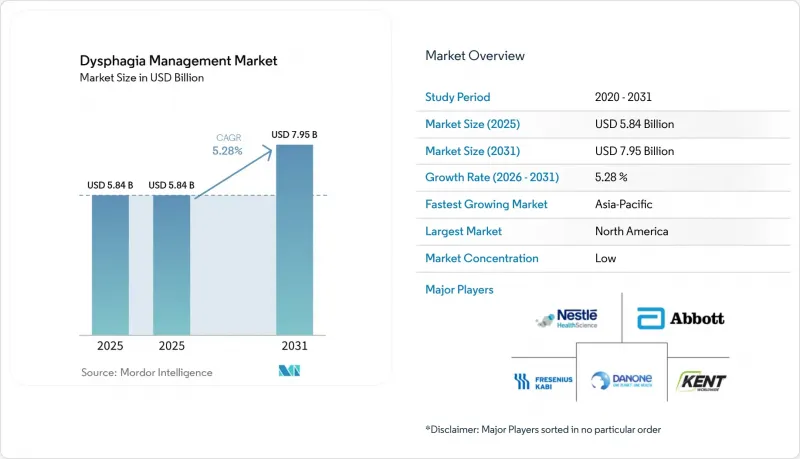
According to Mordor Intelligence, the dysphagia management market size is expected to grow from USD 5.84 billion in 2025 to USD 6.14 billion in 2026 and is forecast to reach USD 7.95 billion by 2031 at 5.28% CAGR over 2026-2031.
Global Dysphagia Management Market Trends and Insights
Aging and Neurological Disease Burden
Aging populations provide a stable demand base for the dysphagia management market, as swallowing impairments often require ongoing clinical and nutritional support. Inpatient rehabilitation evidence published in 2024 found that 33% of older patients with dysphagia developed aspiration pneumonia. The same evidence reported malnutrition rates of 25% to 45% among dysphagia patients across the reviewed cohorts. Sarcopenia was associated with dysphagia, with a corrected odds ratio of 4.1 and a 95% confidence interval of 2.3 to 7.3. In 2025, low-income countries had up to 82 times fewer neurologists per 100,000 residents than high-income countries, which can delay diagnosis and treatment. Therefore, the dysphagia management market benefits from integrated nutritional rehabilitation and swallowing care for older patients with neurological diseases.
Earlier Dysphagia Screening and Instrumental Assessment
Hospitals are placing greater emphasis on instrumental assessment because bedside reviews can fail to identify silent aspiration. A 2025 review found continued gaps in psychometric evidence for dysphagia screening tools used with older adults. This limitation supports demand for sensor-based and AI-assisted alternatives to water swallowing tests within the Dysphagia management market. The 2025 UEG and ESGNM clinical recommendations identified videofluoroscopic swallow study and fiberoptic endoscopic evaluation of swallowing as first-line assessments for oropharyngeal and esophageal dysphagia. A 2025 survey found that 81.4% of U.S. speech-language pathologists had access to imaging assessments, although protocol use varied among younger clinicians. Hospitals also have a financial reason to improve screening, where pneumonia readmissions can affect performance under federal payment programs.
Reimbursement and Coverage Variability
Coverage differences across Medicare contractors, Medicare Advantage plans, and state Medicaid programs can limit the use of newer assessment tools and specialist services. ASHA reported in 2025 that speech-language pathologists faced delayed or inconsistent Medicare Advantage payments, while utilization management practices reduced access for some beneficiaries. The dysphagia management market also faces supplier pressure in home enteral nutrition. The number of Medicare suppliers offering home enteral nutrition kits declined 31% from 2014 to 2023 under competitive bidding pressure. Texture-modified retail nutrition is not uniformly reimbursed across Europe, and several health systems cap speech therapy reimbursement. Coverage requirements for swallowing studies add administrative work that is harder for smaller providers to manage. These conditions favor organizations with broader clinical networks and established reimbursement capabilities.
Other drivers and restraints analyzed in the detailed report include:
- Expansion of Home-Based and Post-Acute Dysphagia Care
- IDDSI Standardization of Texture and Liquid Consistency
- Shortage of Trained Dysphagia Specialists
For complete list of drivers and restraints, kindly check the Table Of Contents.
Segment Analysis
Nutritional solutions held 41.22% of the dysphagia management market share in 2025, reflecting the use of thickeners, texture-modified foods, and enteral formulas in institutional and home settings. A 2026 study found that starch-based products lost more than 99% of viscosity within 5 seconds of salivary alpha-amylase exposure, whereas xanthan gum products showed a 1% to 20% reduction. This distinction can affect aspiration risk and clinical purchasing decisions. Fresenius Kabi expanded its Fresubin plant-based range during 2025 and 2026.
Feeding tubes and devices were the second-largest category, supported by nasogastric and gastrostomy placement in hospitals and nutrition centers. Drugs were the fastest-growing category through 2031 as pharmacological protocols expanded for esophageal dysphagia. Proton pump inhibitors, corticosteroids, and antimicrobials were included in the supplied treatment scope.
Oropharyngeal dysphagia held 62.18% of the dysphagia management market share in 2025, consistent with its prevalence in stroke, neurodegenerative disease, and age-related swallowing decline. It requires nutritional modification, assessment, and rehabilitation across several care settings. A June 2026 study in Catalonia identified polypharmacy and poor baseline nutritional status as independent risk factors in older adults. These findings extend the relevant patient group beyond conventional stroke and dementia cohorts.
Esophageal dysphagia has a separate pathway that involves endoscopy, dilation, and pharmacological treatment. The 2025 UEG and ESGNM recommendations included proton pump inhibitors, calcium-channel blockers, and phosphodiesterase inhibitors for specific subtypes. Mixed and multifactorial dysphagia was the fastest-growing indication through 2031 as overlapping oral, pharyngeal, and esophageal dysfunction became more recognized. A July 2026 study compared the Medtronic ManoScan ESO and Laborie LMT systems for standardized swallow pressure measurement.
Complete Report Scope:
- By Product Type
- Drugs
- Proton Pump Inhibitors
- Antimicrobials
- Corticosteroids and Other Drugs
- Feeding Tubes and Devices
- Nasogastric Tubes
- Gastrostomy and PEG Tubes
- Jejunostomy and PEJ Tubes
- Enteral Feeding Pumps
- Feeding Accessories and ENFit Components
- Nutritional Solutions
- Thickening Agents
- Pre-Thickened Beverages
- Texture-Modified Foods and Purees
- Oral Nutritional Supplements
- Enteral Nutrition Formulas
- Others
- Drugs
- By Indication
- Oropharyngeal Dysphagia
- Esophageal Dysphagia
- Mixed and Multifactorial Dysphagia
- By Age Group
- Pediatric
- Adult
- Geriatric
- By End User
- Hospitals and Ambulatory Surgical Centers
- Rehabilitation Centers
- Long-Term Care Facilities
- Outpatient Clinics
- Homecare Settings
- Others
- By Geography
- North America
- United States
- Canada
- Mexico
- Europe
- Germany
- United Kingdom
- France
- Italy
- Spain
- Rest of Europe
- Asia-Pacific
- China
- Japan
- India
- Australia
- South Korea
- Rest of Asia-Pacific
- Middle East and Africa
- GCC
- South Africa
- Rest of Middle East and Africa
- South America
- Brazil
- Argentina
- Rest of South America
- North America
Geography Analysis
North America held 41.21% of global revenue in 2025, supported by established speech-language pathology networks and hospital formulary systems. The United States had 61.9 certified speech-language pathologists per 100,000 residents in 2025. Availability ranged from 33.4 per 100,000 in Nevada to 101.0 per 100,000 in Arkansas. Canada broadly reimburses speech therapy and enteral nutrition for diagnosed patients. Mexico is expanding as private hospital networks increase geriatric care capacity.
Europe was the second-largest region, with Germany, the United Kingdom, France, Italy, and Spain as major institutional markets. Germany's statutory insurance system supports hospital and home enteral nutrition reimbursement. The United Kingdom's NHS procurement model emphasizes clinical evidence and pricing compliance. UEG and ESGNM recommendations are supporting endoscopy investment, while structured IDDSI programs in Sweden and Austria create validation needs. Brazil is expanding with geriatric population growth and urban hospital capacity, though screening remains uneven outside major centers.
Asia-Pacific was the fastest-growing region at a 6.55% CAGR through 2031, supporting growth in the Dysphagia management market size. Japan's long-term care insurance supports eligible older patients using texture-modified nutrition. China is expanding rehabilitation and geriatric facilities, while South Korea is developing remote monitoring-based home feeding. India is building specialist capacity, and Australia has adopted IDDSI early with acute stroke screening protocols. GCC investment supports Middle East and Africa growth, but specialist shortages and import costs restrict wider adoption in Sub-Saharan Africa.
- Abbott Laboratories
- Avanos Medical
- Beckton Dickinson
- Boston Scientific
- Cardinal Health
- Cook Group
- Danone
- Flavour Creations Pty Ltd
- Fresenius
- Hormel Health Labs
- Karl Storz
- Kent Precision Foods Group, Inc.
- Medline Industries
- Medtrition, Inc.
- Medtronic
- Nestle Health Science
- Nutricia Advanced Medical Nutrition
- Olympus
- RTH Nutrition
- SimplyThick, LLC
Additional Benefits:
- The market estimate (ME) sheet in Excel format
- 3 months of analyst support
TABLE OF CONTENTS
1 INTRODUCTION
- 1.1 Study Assumptions and Market Definition
- 1.2 Scope of the Study
2 RESEARCH METHODOLOGY
3 EXECUTIVE SUMMARY
4 MARKET LANDSCAPE
- 4.1 Market Overview
- 4.2 Market Drivers
- 4.2.1 Aging and Neurological Disease Burden
- 4.2.2 Earlier Dysphagia Screening and Instrumental Assessment
- 4.2.3 Expansion of Home-Based and Post-Acute Dysphagia Care
- 4.2.4 IDDSI Standardization of Texture and Liquid Consistency
- 4.2.5 Salivary-Amylase-Resistant Texture-Modified Nutrition
- 4.2.6 Portable, Discharge-Ready Feeding and Monitoring Workflows
- 4.3 Market Restraints
- 4.3.1 Reimbursement and Coverage Variability
- 4.3.2 Shortage of Trained Dysphagia Specialists
- 4.3.3 Palatability, Stigma, and Adherence Losses
- 4.3.4 Cross-Border Product Classification and Raw-Material Variability
- 4.4 Supply Chain Analysis
- 4.5 Regulatory Landscape
- 4.6 Technological Outlook
- 4.7 Porter's Five Forces Analysis
- 4.7.1 Bargaining Power of Suppliers
- 4.7.2 Bargaining Power of Buyers
- 4.7.3 Threat of New Entrants
- 4.7.4 Threat of Substitutes
- 4.7.5 Competitive Rivalry
5 MARKET SIZE AND GROWTH FORECASTS (VALUE, USD)
- 5.1 By Product Type
- 5.1.1 Drugs
- 5.1.1.1 Proton Pump Inhibitors
- 5.1.1.2 Antimicrobials
- 5.1.1.3 Corticosteroids and Other Drugs
- 5.1.2 Feeding Tubes and Devices
- 5.1.2.1 Nasogastric Tubes
- 5.1.2.2 Gastrostomy and PEG Tubes
- 5.1.2.3 Jejunostomy and PEJ Tubes
- 5.1.2.4 Enteral Feeding Pumps
- 5.1.2.5 Feeding Accessories and ENFit Components
- 5.1.3 Nutritional Solutions
- 5.1.3.1 Thickening Agents
- 5.1.3.2 Pre-Thickened Beverages
- 5.1.3.3 Texture-Modified Foods and Purees
- 5.1.3.4 Oral Nutritional Supplements
- 5.1.3.5 Enteral Nutrition Formulas
- 5.1.4 Others
- 5.1.1 Drugs
- 5.2 By Indication
- 5.2.1 Oropharyngeal Dysphagia
- 5.2.2 Esophageal Dysphagia
- 5.2.3 Mixed and Multifactorial Dysphagia
- 5.3 By Age Group
- 5.3.1 Pediatric
- 5.3.2 Adult
- 5.3.3 Geriatric
- 5.4 By End User
- 5.4.1 Hospitals and Ambulatory Surgical Centers
- 5.4.2 Rehabilitation Centers
- 5.4.3 Long-Term Care Facilities
- 5.4.4 Outpatient Clinics
- 5.4.5 Homecare Settings
- 5.4.6 Others
- 5.5 By Geography
- 5.5.1 North America
- 5.5.1.1 United States
- 5.5.1.2 Canada
- 5.5.1.3 Mexico
- 5.5.2 Europe
- 5.5.2.1 Germany
- 5.5.2.2 United Kingdom
- 5.5.2.3 France
- 5.5.2.4 Italy
- 5.5.2.5 Spain
- 5.5.2.6 Rest of Europe
- 5.5.3 Asia-Pacific
- 5.5.3.1 China
- 5.5.3.2 Japan
- 5.5.3.3 India
- 5.5.3.4 Australia
- 5.5.3.5 South Korea
- 5.5.3.6 Rest of Asia-Pacific
- 5.5.4 Middle East and Africa
- 5.5.4.1 GCC
- 5.5.4.2 South Africa
- 5.5.4.3 Rest of Middle East and Africa
- 5.5.5 South America
- 5.5.5.1 Brazil
- 5.5.5.2 Argentina
- 5.5.5.3 Rest of South America
- 5.5.1 North America
6 COMPETITIVE LANDSCAPE
- 6.1 Market Concentration
- 6.2 Market Share Analysis
- 6.3 Company Profiles (includes Global Level Overview, Market Level Overview, Core Segments, Financials as available, Strategic Information, Market Rank/Share, Products and Services, Recent Developments)
- 6.3.1 Abbott Laboratories
- 6.3.2 Avanos Medical, Inc.
- 6.3.3 Becton, Dickinson and Company
- 6.3.4 Boston Scientific Corporation
- 6.3.5 Cardinal Health
- 6.3.6 Cook Medical Inc.
- 6.3.7 Danone Nutricia
- 6.3.8 Flavour Creations Pty Ltd
- 6.3.9 Fresenius Kabi
- 6.3.10 Hormel Health Labs
- 6.3.11 KARL STORZ SE and Co. KG
- 6.3.12 Kent Precision Foods Group, Inc.
- 6.3.13 Medline Industries, LP
- 6.3.14 Medtrition, Inc.
- 6.3.15 Medtronic plc
- 6.3.16 Nestle Health Science
- 6.3.17 Nutricia Advanced Medical Nutrition
- 6.3.18 Olympus Corporation
- 6.3.19 RTH Nutrition
- 6.3.20 SimplyThick, LLC
7 MARKET OPPORTUNITIES AND FUTURE OUTLOOK
- 7.1 White-Space and Unmet-Need Assessment

