PUBLISHER: Mordor Intelligence | PRODUCT CODE: 2156944

PUBLISHER: Mordor Intelligence | PRODUCT CODE: 2156944
Industrial Noise Control - Market Share Analysis, Industry Trends & Statistics, Growth Forecasts (2026 - 2031)
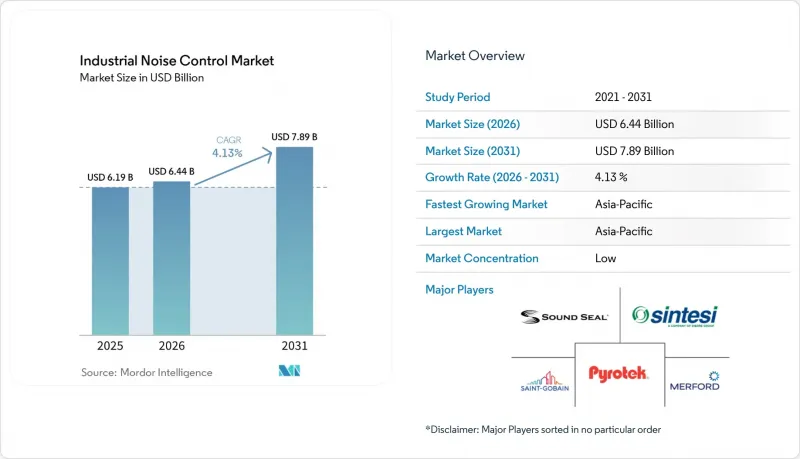
According to Mordor Intelligence, the industrial noise control market size was valued at USD 6.19 billion in 2025 and is estimated to grow from USD 6.44 billion in 2026 to reach USD 7.89 billion by 2031, at a CAGR of 4.13% during the forecast period (2026-2031).
Global Industrial Noise Control Market Trends and Insights
Tightening Occupational and Environmental Noise Regulations
Regulatory requirements provide a stable base of demand for the industrial noise control market. OSHA requires feasible engineering or administrative controls when employee exposure exceeds 90 dBA over an 8-hour period. The 2025 federal notice showed that 3,935,792 workers were above the 85 dBA action level, compared with 3,802,698 in the earlier review cycle. The European Environment Agency reported an annual economic cost of EUR 100 billion from noise exposure and noted that the region was not on track for its 2030 reduction target. The EU Publications Office published updated technical support for noise action plans in March 2026. These frameworks direct facilities toward enclosures, barriers, and isolation systems when personal protection alone is not sufficient.
Industrial Facility Modernization and Capacity Expansion
Plant modernization places acoustic requirements in project design instead of treating them as later upgrades. U.S. Steel announced in June 2026 that it plans to invest up to USD 2.5 billion in Mon Valley Works, including a hot strip mill at Edgar Thomson. The company expects construction to begin in 2026 and production to start in the second half of 2029. Tenaris announced a USD 90 million modernization program for its Koppel and Ambridge facilities in June 2026. Reheat furnaces, casting lines, and rolling equipment can produce noise levels that require supplementary acoustic engineering. This supports earlier engagement between suppliers and plant engineering teams in the industrial noise control market.
High Upfront Cost of Engineered Noise Control Systems
Custom enclosures, barrier installations, and active systems require a larger initial investment than hearing protection programs. This difference is most significant for smaller manufacturers and facilities in emerging economies. Operators may defer an enclosure or barrier when local enforcement is intermittent. Payback periods for engineered systems can extend from 5 years to 10 years in some markets, making capital recovery a significant consideration. Capital reviews may then favor production equipment over noise control upgrades. This can limit penetration in the industrial noise control market even where long-term worker protection benefits are clear.
Other drivers and restraints analyzed in the detailed report include:
- Manufacturing, Mining, Construction, and Utility Investment
- Electrification-Driven Demand for Broadband and Tonal Noise Management
- Raw-Material Price Volatility and Supply Concentration
For complete list of drivers and restraints, kindly check the Table Of Contents.
Segment Analysis
Rigid noise control products held 39.4% of the industrial noise control market size in 2025. These systems include machine enclosures, acoustic rooms, and structural barriers for compressors and power equipment. Permanent installations are widely used where operator noise levels regularly exceed occupational limits. Their value rests on long service life and predictable compliance performance. Rigid solutions can reduce the need for recurring responses when a facility has a stable source of high noise. Carbon fiber reinforced polymer structures with acoustic metamaterial features achieved a sound insulation bandwidth approaching 1,000 Hz in 2025 research. The study also reported performance above the classical mass-law insulation limit. Such work may support more capable rigid panel designs where weight and acoustic performance must be balanced.
Flexible products serve applications that need portability or regular access to equipment. They include curtains, quilted blankets, pipe wraps, and removable barriers. These products are used where permanent rigid structures are difficult to install. Vibration isolation is forecast to grow at a 4.6% CAGR through 2031. It addresses tonal vibration from electrified drivetrains and industrial motors. Standard engine mounts may not control the discrete excitation frequencies created by electric motors. Suppliers can therefore differentiate through frequency-specific damping and isolation performance. This product shift adds a specialized layer to the industrial noise control industry.
Complete Report Scope:
- By Product Type
- Rigid
- Flexible
- Vibration Isolation
- By Material
- Polymers and Composites
- Metal
- Fabric
- Glass
- Others
- By End-Use Industry
- Automotive
- Metal Processing and Mining
- Power Generation and Utilities
- Oil and Gas
- Food and Beverage
- Textile
- Pharmaceutical and Healthcare Manufacturing
- Chemical and Petrochemical
- Paper and Pulp
- Other Industries
- By Geography
- North America
- United States
- Canada
- Mexico
- Europe
- Germany
- France
- Italy
- Spain
- United Kingdom
- Poland
- Russia
- Rest of Europe
- Asia-Pacific
- China
- India
- Japan
- South Korea
- Australia
- Indonesia
- Vietnam
- Thailand
- Rest of Asia-Pacific
- South America
- Brazil
- Argentina
- Chile
- Rest of South America
- Middle East and Africa
- Saudi Arabia
- United Arab Emirates
- Egypt
- South Africa
- Morocco
- Rest of Middle East and Africa
- North America
Geography Analysis
Asia-Pacific held 38.5% of the industrial noise control market share in 2025 and is forecast to grow at a 5.3% CAGR through 2031. The region's position reflects manufacturing investment in China, India, and Southeast Asia. India recorded INR 3.6 trillion in manufacturing-linked capacity additions during FY2026. Semiconductor fabrication, automobile supply chains, and appliance production support demand for plant-level acoustic treatment. China's 15th Five-Year Plan places manufacturing modernization and industrial robotics at the center of policy. Automated lines can generate structural vibration that requires isolation systems as well as conventional enclosures. Vietnam, Indonesia, and Thailand also attract electronics and automotive supply-chain investment.
In North America, demand is anchored in OSHA requirements and large modernization projects. The industrial noise control market benefits when compliance is included in greenfield construction and plant expansion. U.S. Steel's Mon Valley Works program and Tenaris's Pennsylvania modernization program illustrate this type of project activity. Nearshoring creates further demand because new facilities require acoustic controls from the beginning of operation. This can generate first-purchase demand instead of replacement demand. Suppliers that work with engineering, procurement, and construction teams can benefit from this shift.
In Europe, the demand base is shaped by the Environmental Noise Directive and five-year noise action plan cycles. Updated technical support published in March 2026 may reinforce compliance activity through the end of the decade. Poland, Germany, France, Italy, and the United Kingdom are the leading European countries. South America is supported by automotive and mining activity, especially in Brazil. The Middle East and Africa benefit from industrial diversification, industrial parks, and power infrastructure development. These projects create longer-term opportunities for the industrial noise control market.
- Acoustical Solutions Inc.
- ArtUSA Industries Inc.
- BBM Akustik Technologie GmbH
- Durr Universal Inc.
- Eckel Industries Inc.
- eNoiseControl Inc.
- Envirotech Systems Limited
- IAC Acoustics Holdings Inc.
- Industrial Noise Control Inc.
- Kinetics Noise Control Inc.
- Merford Holding B.V.
- Noise Barriers LLC
- Noise Control Engineering LLC
- Pyrotek Inc.
- R. Kohlhauer GmbH
- Saint-Gobain
- Sintesi PLC
- Sound Seal Inc.
- Ventac Co. Ltd.
- Vibro-Acoustics A Swegon Group Company
Additional Benefits:
- The market estimate (ME) sheet in Excel format
- 3 months of analyst support
TABLE OF CONTENTS
1 INTRODUCTION
- 1.1 Study Assumptions and Market Definition
- 1.2 Scope of the Study
2 RESEARCH METHODOLOGY
3 EXECUTIVE SUMMARY
4 MARKET LANDSCAPE
- 4.1 Market Overview
- 4.2 Market Drivers
- 4.2.1 Tightening Occupational and Environmental Noise Regulations
- 4.2.2 Industrial Facility Modernization and Capacity Expansion
- 4.2.3 Manufacturing, Mining, Construction, and Utility Investment
- 4.2.4 Rising Adoption of Engineered Noise Control in New Industrial Projects
- 4.2.5 Nearshoring and Regionalization of Manufacturing Supply Chains
- 4.2.6 Electrification-Driven Demand for Broadband and Tonal Noise Management
- 4.3 Market Restraints
- 4.3.1 High Upfront Cost of Engineered Noise Control Systems
- 4.3.2 Raw-Material Price Volatility and Supply Concentration
- 4.3.3 Industrial Downtime and Retrofit Integration Constraints
- 4.3.4 Pressure-Drop, Thermal, Fire, and Acoustic Performance Trade-Offs
- 4.4 Supply-Chain Analysis
- 4.5 Porter's Five Forces Analysis
- 4.5.1 Bargaining Power of Suppliers
- 4.5.2 Bargaining Power of Buyers
- 4.5.3 Threat of New Entrants
- 4.5.4 Threat of Substitutes
- 4.5.5 Competitive Rivalry
- 4.6 Technology Outlook
- 4.7 Regulatory Landscape
- 4.8 Investment Analysis
5 MARKET SIZE AND GROWTH FORECASTS
- 5.1 By Product Type
- 5.1.1 Rigid
- 5.1.2 Flexible
- 5.1.3 Vibration Isolation
- 5.2 By Material
- 5.2.1 Polymers and Composites
- 5.2.2 Metal
- 5.2.3 Fabric
- 5.2.4 Glass
- 5.2.5 Others
- 5.3 By End-Use Industry
- 5.3.1 Automotive
- 5.3.2 Metal Processing and Mining
- 5.3.3 Power Generation and Utilities
- 5.3.4 Oil and Gas
- 5.3.5 Food and Beverage
- 5.3.6 Textile
- 5.3.7 Pharmaceutical and Healthcare Manufacturing
- 5.3.8 Chemical and Petrochemical
- 5.3.9 Paper and Pulp
- 5.3.10 Other Industries
- 5.4 By Geography
- 5.4.1 North America
- 5.4.1.1 United States
- 5.4.1.2 Canada
- 5.4.1.3 Mexico
- 5.4.2 Europe
- 5.4.2.1 Germany
- 5.4.2.2 France
- 5.4.2.3 Italy
- 5.4.2.4 Spain
- 5.4.2.5 United Kingdom
- 5.4.2.6 Poland
- 5.4.2.7 Russia
- 5.4.2.8 Rest of Europe
- 5.4.3 Asia-Pacific
- 5.4.3.1 China
- 5.4.3.2 India
- 5.4.3.3 Japan
- 5.4.3.4 South Korea
- 5.4.3.5 Australia
- 5.4.3.6 Indonesia
- 5.4.3.7 Vietnam
- 5.4.3.8 Thailand
- 5.4.3.9 Rest of Asia-Pacific
- 5.4.4 South America
- 5.4.4.1 Brazil
- 5.4.4.2 Argentina
- 5.4.4.3 Chile
- 5.4.4.4 Rest of South America
- 5.4.5 Middle East and Africa
- 5.4.5.1 Saudi Arabia
- 5.4.5.2 United Arab Emirates
- 5.4.5.3 Egypt
- 5.4.5.4 South Africa
- 5.4.5.5 Morocco
- 5.4.5.6 Rest of Middle East and Africa
- 5.4.1 North America
6 COMPETITIVE LANDSCAPE
- 6.1 Market Concentration
- 6.2 Strategic Moves
- 6.3 Market Share Analysis
- 6.4 Company Profiles (includes Global Level Overview, Market Level Overview, Core Segments, Financials as available, Strategic Information, Products and Services, Recent Developments)
- 6.4.1 Acoustical Solutions Inc.
- 6.4.2 ArtUSA Industries Inc.
- 6.4.3 BBM Akustik Technologie GmbH
- 6.4.4 Durr Universal Inc.
- 6.4.5 Eckel Industries Inc.
- 6.4.6 eNoiseControl Inc.
- 6.4.7 Envirotech Systems Limited
- 6.4.8 IAC Acoustics Holdings Inc.
- 6.4.9 Industrial Noise Control Inc.
- 6.4.10 Kinetics Noise Control Inc.
- 6.4.11 Merford Holding B.V.
- 6.4.12 Noise Barriers LLC
- 6.4.13 Noise Control Engineering LLC
- 6.4.14 Pyrotek Inc.
- 6.4.15 R. Kohlhauer GmbH
- 6.4.16 Saint-Gobain
- 6.4.17 Sintesi PLC
- 6.4.18 Sound Seal Inc.
- 6.4.19 Ventac Co. Ltd.
- 6.4.20 Vibro-Acoustics A Swegon Group Company
7 MARKET OPPORTUNITIES AND FUTURE OUTLOOK
- 7.1 White-Space and Unmet-Need Assessment

