PUBLISHER: Mordor Intelligence | PRODUCT CODE: 2156966

PUBLISHER: Mordor Intelligence | PRODUCT CODE: 2156966
Orthotic Devices - Market Share Analysis, Industry Trends & Statistics, Growth Forecasts (2026 - 2031)
According to Mordor Intelligence, the orthotic devices market size is projected to expand from USD 6.66 billion in 2025 and USD 7.08 billion in 2026 to USD 10.28 billion by 2031, registering a CAGR of 7.75% between 2026 and 2031.
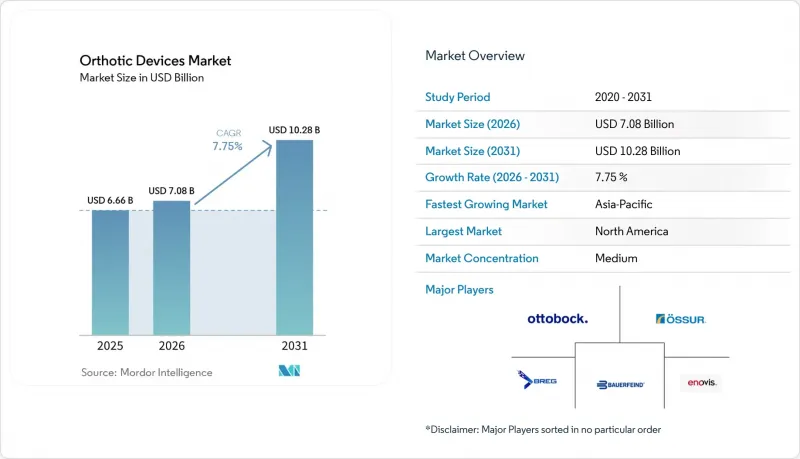
Global Orthotic Devices Market Trends and Insights
Rising Burden of Musculoskeletal and Neuromuscular Disorders
Global musculoskeletal disorder prevalence reached 1.686 billion cases in 2021 and is projected to reach 2.161 billion by 2035. Musculoskeletal disorders also created USD 2,099.84 billion in lost work value during 2021, equal to 1.41% of global GDP. Better preventive care may lower age-standardized rates in developed countries, yet absolute caseloads continue to rise in South Asia and Southeast Asia. Case counts in those subregions rose 135% and 132%, respectively, between 1990 and 2021. In 2023, Asia had 999 million prevalent musculoskeletal cases and USD 419.6 billion in direct healthcare costs, while high body mass index was an increasingly important modifiable risk factor. Stroke, multiple sclerosis, and cerebral palsy often require long-term orthotic support, which can create recurring replacement needs rather than a single acute-care purchase.
Expansion of Rehabilitation and Non-Surgical Mobility Care
Health systems in North America and Europe are placing greater emphasis on rehabilitation and non-surgical mobility support. This approach extends the period in which patients may use fitted orthoses, monitoring services, and adjusted devices in the orthotic devices market. Medicare prior authorization requirements for certain knee, thoracolumbosacral, and upper-limb orthoses take effect on October 28, 2026. The policy places advanced orthoses more clearly within formal clinical and payment pathways. A 2025 systematic review found improvements in pain, alignment, and patient satisfaction across ankle-foot, spinal, and upper-limb orthoses. These findings support the use of prescription-grade devices in longer rehabilitation plans, especially where clinicians can document functional outcomes.
High Cost of Custom Devices and Advanced Materials
Custom carbon-fiber ankle-foot orthoses, powered knee-ankle-foot orthoses, and sensor-enabled braces can cost USD 500 to USD 5,000. These prices can limit access where insurance coverage is absent or incomplete. Carbon fiber and engineering polymers can also expose manufacturers to material cost changes and concentrated supply sources. NCOPE projected a demand-to-supply ratio of 1.6 for orthotic and prosthetic professionals by 2030. This indicates that the credentialed workforce would need to grow by 60% to meet projected demand. The U.S. training route includes a master's degree, at least 1,900 residency hours, and 3 board examinations, which restricts how quickly fitting capacity can expand.
Other drivers and restraints analyzed in the detailed report include:
- Digital Scanning, CAD/CAM, and 3D-Printed Custom Orthoses
- Aging Population and Mobility Preservation Demand
- Uneven Reimbursement and Affordability in Emerging Markets
For complete list of drivers and restraints, kindly check the Table Of Contents.
Segment Analysis
Lower-limb devices held 52.1% revenue share in the orthotic devices market in 2025. Ankle-foot orthoses, knee orthoses, and knee-ankle-foot orthoses are used across musculoskeletal, neurological, and diabetic foot-care pathways. Their large installed base reflects frequent prescriptions for osteoarthritis, stroke-related gait impairment, and foot protection in the orthotic devices market. These devices may also require periodic replacement as patients' functional needs change. Sports injuries contribute to acute bracing demand, particularly for knee and ankle injuries. The product group therefore combines chronic-care demand with short-cycle rehabilitation use.
Spinal devices are forecast to grow at a 7.8% CAGR through 2031. Scoliosis treatment, cervical conditions, and lumbar degeneration support demand for this category. A systematic review covering 62 studies and 3,815 participants found Cobb angle reductions in each of the 5 spinal orthosis intervention studies reviewed. The review also reported shorter fabrication times for 3D-printed designs than for thermoplastic alternatives. Digital fabrication can help providers offer custom spinal bracing with shorter lead times. Upper-limb orthoses remain relevant for stroke rehabilitation, cerebral palsy, and wrist fracture management. Their clinical role broadens when lighter designs improve comfort during daily use.
Conventional orthoses held 68.3% revenue share in the orthotic devices market in 2025. Thermoplastic and prefabricated braces remain widely used because they cover a range of clinical needs at more accessible price points. Their availability supports use across insured, partly insured, and direct-pay patient groups. Conventional devices also fit established clinical workflows in hospitals, clinics, and rehabilitation settings. This foundation keeps conventional products central to the orthotic devices industry, even as digital features enter selected categories in the orthotic devices market. Their broad reach is likely to remain important where advanced reimbursement is limited.
Powered and smart devices are forecast to grow at an 11.5% CAGR through 2031. Dynamic orthoses sit between passive support and powered solutions by enabling controlled movement during rehabilitation. Functional electrical stimulation and sensor features can support gait training and neurological care. A 2025 study described a modular smart foot orthosis with plantar-pressure sensing, vibrotactile feedback, and a smartphone application for gait monitoring. Ottobock signed an agreement in July 2026 to acquire Fesia Technology, adding functional electrical stimulation orthoses to its neuro-orthotics portfolio. Strong clinical validation remains necessary for these products to gain durable reimbursement and clinician acceptance.
Complete Report Scope:
- By Product Type
- Lower-Limb Orthotic Devices
- Upper-Limb Orthotic Devices
- Spinal Orthotic Devices
- By Functionality
- Conventional Orthotic Devices
- Dynamic Orthotic Devices
- Powered / Smart Orthotic Devices
- By Application
- Musculoskeletal Disorders
- Neuromuscular Disorders
- Sports Injuries & Trauma Rehabilitation
- Diabetic Foot & Neuropathy
- Post-Surgical & Age-Related Mobility Disorders
- By Age Group
- Pediatric
- Adult
- Geriatric
- By End User
- Hospitals & Clinics
- Orthotics & Prosthetics Clinics
- Rehabilitation Centers
- Homecare Settings
- Sports & Specialized Care Centers
- By Geography
- North America
- United States
- Canada
- Mexico
- Europe
- Germany
- United Kingdom
- France
- Italy
- Spain
- Rest of Europe
- Asia-Pacific
- China
- Japan
- India
- South Korea
- Australia
- Rest of Asia-Pacific
- Middle East and africa
- GCC
- South Africa
- Rest of Middle East and Africa
- South America
- Brazil
- Argentina
- Rest of South America
- North America
Geography Analysis
North America held 41% of the orthotic devices market share in 2026. Medicare's DMEPOS framework and demand for clinically advanced devices support the region's position. CMS applied a 2% fee schedule update factor to prosthetics and orthotics effective January 1, 2026. The agency also added prior authorization requirements for selected knee, thoracolumbosacral, and upper-limb orthoses beginning October 28, 2026. Coverage for eligible diabetic footwear and orthotic items reduces patient cost for an important clinical group. The Hanger and Numotion combination is expected to expand the regional patient-care network and strengthen homecare access.
Europe remains a mature region with active product development and established reimbursement systems in the orthotic devices market. Germany is the world's second-largest orthotics and prosthetics market, according to Embla Medical's investor disclosures. GKV spending on orthopedic technology reached EUR 3.49 billion in 2024, while orthoses represented 39.8% of related revenue in 2025. MEDI launched the SmartFit OA knee orthosis in 2025 with the BOA Fit System for individualized compression adjustment. It also expanded its modular Lumbamed spinal range during 2025. Workforce shortages in the United Kingdom may limit access despite underlying National Health Service demand.
Asia-Pacific is forecast to grow at an 8.8% CAGR through 2031, the fastest regional rate in the orthotic devices market. Asia accounted for 54.6% of 372 million annual incident musculoskeletal cases and USD 419.6 billion in modeled direct healthcare costs during 2023. Japan's older population and China's high national musculoskeletal caseload support demand for established clinical services. Embla Medical completed a majority investment in Streifeneder ortho.production GmbH in September 2025 to broaden its full-range offering and patient-care reach. Middle East and Africa and South America remain developing contributor regions. Investment in sports medicine infrastructure in the Gulf can support premium orthotic uptake, while workforce shortages and reimbursement limits can restrict access elsewhere. Brazil is expanding reimbursement for selected orthotic devices, while currency constraints in Argentina favor locally manufactured elastic supports over imported advanced devices.
List of Companies Covered in this Report:
- Ottobock
- Ossur
- Enovis Corporation
- Hanger, Inc.
- Bauerfeind
- Breg
- Fillauer
- Thuasne Group
- Blatchford
- DeRoyal Industries
- Trulife Group Limited
- Proteor SAS
- Steeper Group
- The Ohio Willow Wood Company
- Orthomerica Products, Inc.
- Beckton Dickinson
- Aspen Medical Products, LLC
- Allard International
- SureStep LLC
- medi
- Tynor Orthotics Private Limited
- Basko Healthcare
- Aetrex Worldwide
- Acor Orthopaedic, Inc.
Additional Benefits:
- The market estimate (ME) sheet in Excel format
- 3 months of analyst support
TABLE OF CONTENTS
1 INTRODUCTION
- 1.1 Study Assumptions and Market Definition
- 1.2 Scope of the Study
2 RESEARCH METHODOLOGY
3 EXECUTIVE SUMMARY
4 MARKET LANDSCAPE
- 4.1 Market Overview
- 4.2 Market Drivers
- 4.2.1 Rising Burden of Musculoskeletal and Neuromuscular Disorders
- 4.2.2 Expansion of Rehabilitation and Non-Surgical Mobility Care
- 4.2.3 Digital Scanning, CAD/CAM, and 3D-Printed Custom Orthoses
- 4.2.4 Aging Population and Mobility-Preservation Demand
- 4.2.5 Growth of Sports Injury Prevention and Recovery Programs
- 4.2.6 Clinically Integrated Smart Orthoses and Gait Analytics
- 4.3 Market Restraints
- 4.3.1 High Cost of Custom Devices and Advanced Materials
- 4.3.2 Uneven Reimbursement and Affordability in Emerging Markets
- 4.3.3 Shortage of Certified Orthotists and Fitting Specialists
- 4.3.4 Commoditization and Patient Adherence Challenges
- 4.4 Value Chain and Supply-Chain Analysis
- 4.5 Regulatory Landscape
- 4.6 Technological Outlook
- 4.7 Porters Five Forces Analysis
- 4.7.1 Bargaining Power of Suppliers Analysis
- 4.7.2 Bargaining Power of Buyers Analysis
- 4.7.3 Threat of New Entrants Analysis
- 4.7.4 Threat of Substitutes Analysis
- 4.7.5 Competitive Rivalry Analysis
5 MARKET SIZE AND GROWTH FORECASTS
- 5.1 By Product Type
- 5.1.1 Lower-Limb Orthotic Devices
- 5.1.2 Upper-Limb Orthotic Devices
- 5.1.3 Spinal Orthotic Devices
- 5.2 By Functionality
- 5.2.1 Conventional Orthotic Devices
- 5.2.2 Dynamic Orthotic Devices
- 5.2.3 Powered / Smart Orthotic Devices
- 5.3 By Application
- 5.3.1 Musculoskeletal Disorders
- 5.3.2 Neuromuscular Disorders
- 5.3.3 Sports Injuries & Trauma Rehabilitation
- 5.3.4 Diabetic Foot & Neuropathy
- 5.3.5 Post-Surgical & Age-Related Mobility Disorders
- 5.4 By Age Group
- 5.4.1 Pediatric
- 5.4.2 Adult
- 5.4.3 Geriatric
- 5.5 By End User
- 5.5.1 Hospitals & Clinics
- 5.5.2 Orthotics & Prosthetics Clinics
- 5.5.3 Rehabilitation Centers
- 5.5.4 Homecare Settings
- 5.5.5 Sports & Specialized Care Centers
- 5.6 By Geography
- 5.6.1 North America
- 5.6.1.1 United States
- 5.6.1.2 Canada
- 5.6.1.3 Mexico
- 5.6.2 Europe
- 5.6.2.1 Germany
- 5.6.2.2 United Kingdom
- 5.6.2.3 France
- 5.6.2.4 Italy
- 5.6.2.5 Spain
- 5.6.2.6 Rest of Europe
- 5.6.3 Asia-Pacific
- 5.6.3.1 China
- 5.6.3.2 Japan
- 5.6.3.3 India
- 5.6.3.4 South Korea
- 5.6.3.5 Australia
- 5.6.3.6 Rest of Asia-Pacific
- 5.6.4 Middle East and africa
- 5.6.4.1 GCC
- 5.6.4.2 South Africa
- 5.6.4.3 Rest of Middle East and Africa
- 5.6.5 South America
- 5.6.5.1 Brazil
- 5.6.5.2 Argentina
- 5.6.5.3 Rest of South America
- 5.6.1 North America
6 COMPETITIVE LANDSCAPE
- 6.1 Market Concentration
- 6.2 Market Share Analysis
- 6.3 Company Profiles (includes Global Level Overview, Market Level Overview, Core Segments, Financials as available, Strategic Information, Market Rank/Share, Products and Services, Recent Developments)
- 6.3.1 Ottobock SE & Co. KGaA
- 6.3.2 Ossur hf.
- 6.3.3 Enovis Corporation
- 6.3.4 Hanger, Inc.
- 6.3.5 Bauerfeind AG
- 6.3.6 Breg, Inc.
- 6.3.7 Fillauer LLC
- 6.3.8 Thuasne Group
- 6.3.9 Blatchford Limited
- 6.3.10 DeRoyal Industries, Inc.
- 6.3.11 Trulife Group Limited
- 6.3.12 Proteor SAS
- 6.3.13 Steeper Group
- 6.3.14 The Ohio Willow Wood Company
- 6.3.15 Orthomerica Products, Inc.
- 6.3.16 Becker Orthopedic
- 6.3.17 Aspen Medical Products, LLC
- 6.3.18 Allard International
- 6.3.19 SureStep LLC
- 6.3.20 medi GmbH & Co. KG
- 6.3.21 Tynor Orthotics Private Limited
- 6.3.22 Basko Healthcare
- 6.3.23 Aetrex Worldwide, Inc.
- 6.3.24 Acor Orthopaedic, Inc.
7 MARKET OPPORTUNITIES AND FUTURE OUTLOOK
- 7.1 White-Space and Unmet-Need Assessment

