PUBLISHER: Mordor Intelligence | PRODUCT CODE: 2156969

PUBLISHER: Mordor Intelligence | PRODUCT CODE: 2156969
Healthcare Reimbursement - Market Share Analysis, Industry Trends & Statistics, Growth Forecasts (2026 - 2031)
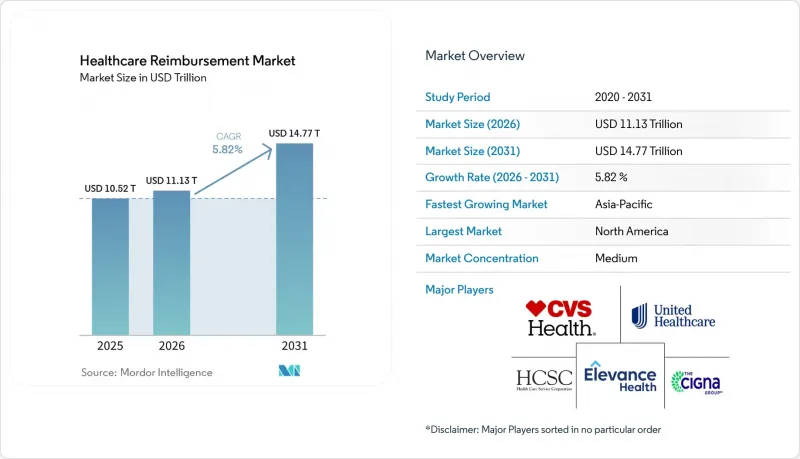
According to Mordor Intelligence, the healthcare reimbursement market size is projected to expand from USD 10.52 trillion in 2025 and USD 11.13 trillion in 2026 to USD 14.77 trillion by 2031, registering a CAGR of 5.82% between 2026 and 2031.
Global Healthcare Reimbursement Market Trends and Insights
Expansion of Value-Based Care Models
Value-based care is changing how healthcare reimbursement market participants measure, submit, and reconcile payments. The CMS Shared Savings Program included 511 Accountable Care Organizations serving 12.6 million traditional Medicare beneficiaries in January 2026. Participation increased 12.3% from 2025, which expanded the number of organizations working under shared-savings arrangements. These arrangements require quality reporting, attribution management, and payment reconciliation beyond routine fee-for-service billing. CMS set the CY2026 qualifying Alternative Payment Model conversion factor at USD 33.57 per relative value unit, a 3.77% increase from 2025. Providers, therefore, need payment systems that can support both established billing processes and outcomes-linked contracts.
Rising Healthcare Service and Treatment Costs
Higher care costs increase pressure on providers to collect the full payment allowed under their contracts. Hospital expenses increased 7.5% in 2025, while drug expenses rose 13.6% and supply expenses rose 9.9%. The American Hospital Association reported that 56% of hospital costs were connected to service lines where reimbursement did not cover the cost of care. This gap makes timely charge capture, correct coding, and denial follow-up more important across the healthcare reimbursement market. Drug spending and outpatient treatment also add claims that often need prior authorization or more supporting documentation. Providers are responding by placing greater attention on payment integrity and revenue recovery workflows.
Complex Reimbursement Policies and Coding Requirements
Payer-specific rules and changing coding edits make it harder for providers to identify and recover every payment due. U.S. hospitals spent USD 43 billion in 2025 trying to collect insurer payments for care already delivered. The American Hospital Association linked this burden to prior authorization, claim denials, repeated documentation requests, and changing billing rules. Providers must manage different coverage criteria and coding standards across public and private payer contracts. This can delay payment and create contractual adjustments that are difficult to separate from valid adjudications. The resulting workload can limit the efficiency gains expected from healthcare reimbursement market technology.
Other drivers and restraints analyzed in the detailed report include:
- Chronic Disease and Aging-Related Utilization Growth
- Public and Private Insurance Coverage Expansion
- Fiscal Pressure on Public Payers and Reimbursement Rates
For complete list of drivers and restraints, kindly check the Table Of Contents.
Segment Analysis
Underpaid claims held 80.43% of the healthcare reimbursement market share in 2025. Their position reflects the persistent difference between billed amounts, contracted rates, and payments received in multi-payer systems. Providers must review remittances and contractual adjustments to determine whether a payment was correct. This requires claim-level data, payer-specific rules, and staff time. Payment shortfalls are often difficult to identify when they are processed as routine adjustments. These operational gaps support continued demand for payment accuracy tools.
Fully paid claims are forecast to grow at a 7.43% CAGR through 2031. Their growth is linked to earlier identification of documentation and coding gaps before a claim reaches the payer. Eligibility verification and prior authorization automation can also reduce preventable rework. These tools can help claims move toward first-pass resolution. Payers are similarly using automated review to apply coverage and coding rules more consistently. The healthcare reimbursement market, therefore, serves both recovery after an underpayment and prevention before claim submission.
Complete Report Scope:
- By Claim
- Underpaid Claims
- Fully Paid Claims
- By Payer
- Private Payers
- Public Payers
- By Service Provider
- Hospitals
- Physician Offices and Clinics
- Diagnostic Laboratories
- Other Service Providers
- Geography
- North America
- United States
- Canada
- Mexico
- Europe
- Germany
- United Kingdom
- France
- Italy
- Spain
- Rest of Europe
- Asia-Pacific
- China
- Japan
- India
- Australia
- South Korea
- Rest of Asia-Pacific
- Middle East and Africa
- GCC
- South Africa
- Rest of Middle East and Africa
- South America
- Brazil
- Argentina
- Rest of South America
- North America
Geography Analysis
North America held 42.54% of the healthcare reimbursement market share in 2025. The region has a large multi-payer system, high service utilization, and detailed payment rules. U.S. providers must work with federal programs, state requirements, and commercial insurer policies. CMS continues to update provider payment rules and accountable care participation structures in 2026. Hospital cost pressures also reinforce demand for payment recovery tools. The American Hospital Association reported USD 43 billion in collection costs for insurer payments in 2025.
Europe remains an important healthcare reimbursement market because national systems are updating hospital payment and digital health pathways. Public payer systems shape provider reimbursement rules across the region. The need to connect clinical documentation with payment requirements remains central as reimbursement categories change. CMS payment developments in the United States also illustrate the wider shift toward different payment methods for qualifying value-based participants. European providers face similar needs for accurate billing and consistent evidence for reimbursable services. These requirements support the adoption of payment administration tools.
Asia-Pacific is forecast to grow at a 6.43% CAGR through 2031. The region combines expanding insurance participation with a growing need for claims administration capacity. China and India are important volume markets because of their large populations and broader access to health services. New employer and public coverage arrangements increase the need for eligibility and claims processes. The Middle East and Africa and South America are earlier-stage markets with growing insurance and provider infrastructure. The healthcare reimbursement market has an opening in these regions where payment platforms can be established as coverage programs develop.
- United Health Group
- Elevance Health, Inc.
- CVS Health
- The Cigna Group
- Health Care Service Corporation
- Humana Inc.
- Kaiser Foundation Health Plan, Inc.
- Centene Corporation
- Blue Cross Blue Shield Association
- Allianz Care
- Aviva plc
- Wellcare Health Plans, Inc.
- Waystar Holding Corp.
- Optum
- R1 RCM
- Experian Health
- FinThrive, Inc.
- Zelis Healthcare, Inc.
- Availity, LLC
- Quadax, Inc.
- Flywire Corporation
- Evolent Health, Inc.
- Agilon Health, Inc.
Additional Benefits:
- The market estimate (ME) sheet in Excel format
- 3 months of analyst support
TABLE OF CONTENTS
1 Introduction
- 1.1 Study Assumptions & Market Definition
- 1.2 Scope Of The Study
2 Research Methodology
3 Executive Summary
4 Market Landscape
- 4.1 Market Overview
- 4.2 Market Drivers
- 4.2.1 Expansion of Value-Based Care Models
- 4.2.2 Rising Healthcare Service and Treatment Costs
- 4.2.3 Chronic Disease and Aging-Related Utilization Growth
- 4.2.4 Public and Private Insurance Coverage Expansion
- 4.2.5 Embedded Reimbursement Pathways for Digital Therapeutics and Medical AI
- 4.2.6 Payer Demand for Interoperable Real-World Evidence at the Point of Payment
- 4.3 Market Restraints
- 4.3.1 Complex Reimbursement Policies and Coding Requirements
- 4.3.2 Fiscal Pressure on Public Payers and Reimbursement Rates
- 4.3.3 Fragmented Clinical Data Ownership Across Provider Networks
- 4.3.4 Provider Exposure to Dual Fee-for-Service and Downside-Risk Contracts
- 4.4 Regulatory Landscape
- 4.5 Technological Outlook
- 4.6 Porter's Five Forces Analysis
- 4.6.1 Threat Of New Entrants
- 4.6.2 Bargaining Power Of Buyers
- 4.6.3 Bargaining Power Of Suppliers
- 4.6.4 Threat Of Substitutes
- 4.6.5 Competitive Rivalry
5 Market Size & Growth Forecasts (Value, USD)
- 5.1 By Claim
- 5.1.1 Underpaid Claims
- 5.1.2 Fully Paid Claims
- 5.2 By Payer
- 5.2.1 Private Payers
- 5.2.2 Public Payers
- 5.3 By Service Provider
- 5.3.1 Hospitals
- 5.3.2 Physician Offices and Clinics
- 5.3.3 Diagnostic Laboratories
- 5.3.4 Other Service Providers
- 5.4 Geography
- 5.4.1 North America
- 5.4.1.1 United States
- 5.4.1.2 Canada
- 5.4.1.3 Mexico
- 5.4.2 Europe
- 5.4.2.1 Germany
- 5.4.2.2 United Kingdom
- 5.4.2.3 France
- 5.4.2.4 Italy
- 5.4.2.5 Spain
- 5.4.2.6 Rest of Europe
- 5.4.3 Asia-Pacific
- 5.4.3.1 China
- 5.4.3.2 Japan
- 5.4.3.3 India
- 5.4.3.4 Australia
- 5.4.3.5 South Korea
- 5.4.3.6 Rest of Asia-Pacific
- 5.4.4 Middle East and Africa
- 5.4.4.1 GCC
- 5.4.4.2 South Africa
- 5.4.4.3 Rest of Middle East and Africa
- 5.4.5 South America
- 5.4.5.1 Brazil
- 5.4.5.2 Argentina
- 5.4.5.3 Rest of South America
- 5.4.1 North America
6 Competitive Landscape
- 6.1 Market Concentration
- 6.2 Market Share Analysis
- 6.3 Company Profiles {(Includes Global Level Overview, Market Level Overview, Core Segments, Financials As Available, Strategic Information, Market Rank/Share For Key Companies, Products & Services, And Recent Developments)}
- 6.3.1 UnitedHealth Group Incorporated
- 6.3.2 Elevance Health, Inc.
- 6.3.3 CVS Health Corporation
- 6.3.4 The Cigna Group
- 6.3.5 Health Care Service Corporation
- 6.3.6 Humana Inc.
- 6.3.7 Kaiser Foundation Health Plan, Inc.
- 6.3.8 Centene Corporation
- 6.3.9 Blue Cross Blue Shield Association
- 6.3.10 Allianz Care
- 6.3.11 Aviva plc
- 6.3.12 Wellcare Health Plans, Inc.
- 6.3.13 Waystar Holding Corp.
- 6.3.14 Optum, Inc.
- 6.3.15 R1 RCM Inc.
- 6.3.16 Experian Health
- 6.3.17 FinThrive, Inc.
- 6.3.18 Zelis Healthcare, Inc.
- 6.3.19 Availity, LLC
- 6.3.20 Quadax, Inc.
- 6.3.21 Flywire Corporation
- 6.3.22 Evolent Health, Inc.
- 6.3.23 Agilon Health, Inc.
7 Market Opportunities & Future Outlook
- 7.1 White-Space & Unmet-Need Assessment

