PUBLISHER: Mordor Intelligence | PRODUCT CODE: 2156972

PUBLISHER: Mordor Intelligence | PRODUCT CODE: 2156972
Polyglycerol Ester - Market Share Analysis, Industry Trends & Statistics, Growth Forecasts (2026 - 2031)
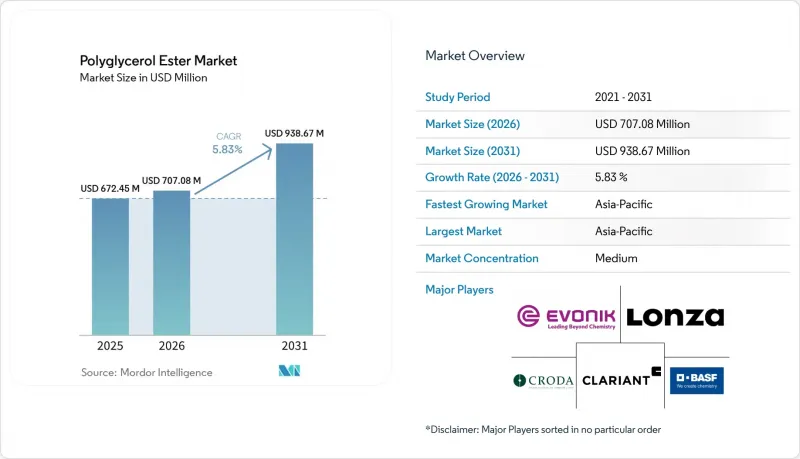
According to Mordor Intelligence, the polyglycerol ester market size was valued at USD 672.45 million in 2025 and is estimated to grow from USD 707.08 million in 2026 to USD 938.67 million by 2031, at a CAGR of 5.83% during the forecast period (2026-2031).
Global Polyglycerol Ester Market Trends and Insights
Rising Demand for Clean-Label and Naturally Derived Emulsifiers
Consumer product manufacturers are reformulating ingredient lists to reduce the use of synthetic additives, supporting demand in the polyglycerol ester market. Polyglycerol esters are derived from glycerol and fatty acids sourced from vegetable oils, allowing them to meet requirements for both recognizable ingredients and reliable emulsification. Unlike PEG-based alternatives, which can generate 1,4-dioxane during ethoxylation, polyglycerol ester (PGE) synthesis does not involve this process. California Assembly Bill 1264, enacted in October 2025, established a statutory definition of ultra-processed food and identified emulsifiers and emulsifier salts as substances relevant to school-meal requirements beginning in July 2029. This legislation has drawn greater attention to ingredient selection among food manufacturers and has increased interest in plant-derived emulsifiers within the polyglycerol ester market.
Expansion of Processed, Convenience, and Plant-Based Foods
Growth in packaged and convenience food consumption across Asia-Pacific and the Middle East is sustaining demand for food-grade emulsifiers. Plant-based dairy alternatives require systems that replicate the stability and mouthfeel associated with fat globules. Higher hydrophilic-lipophilic balance (HLB) grades of polyglycerol esters can form stable oil-in-water emulsions to meet this need. Research has shown that at a concentration of 0.1%, PGEs reduced interfacial tension between corn oil and water from 23.9 mN/m to 1.7 mN/m, enabling formulators to maintain stability with a lower total emulsifier load. Food-grade PGEs can also support fat-reduction objectives while preserving texture, which is relevant to reformulation activity among bakery producers in India.
Feedstock Price Volatility and Dependence on Vegetable Oils
Polyglycerol ester production depends mainly on palm, rapeseed, and sunflower oil feedstocks, exposing the polyglycerol ester market to changes in vegetable oil availability and prices. The Food and Agriculture Organization (FAO) Vegetable Oil Price Index averaged 166.8 points in July 2025, a 3-year high linked to demand from biofuel programs and weaker rapeseed and sunflower growing conditions. A USD 1,000-per-ton increase in palm oil raises finished polyglycerol ester (PGE) costs by USD 75 to USD 90 per ton under the cited cost model. Quarterly pricing practices can pass these movements through to finished products after a 1- to 2-quarter lag. Producers with integrated feedstock positions or long-term supply arrangements with Roundtable on Sustainable Palm Oil (RSPO)-certified mills are better placed to manage this pressure than smaller regional suppliers.
Other drivers and restraints analyzed in the detailed report include:
- Increasing Adoption of PEG-Free and Biodegradable Personal Care Ingredients
- Growth of Pharmaceutical and Nutraceutical Formulation Applications
- Regulatory Divergence Across Food, Cosmetic, and Pharmaceutical Applications
For complete list of drivers and restraints, kindly check the Table Of Contents.
Segment Analysis
Food grade held 61.67% of the Polyglycerol Ester Market share in 2025. This position reflects long-standing use in bakery, confectionery, dairy, margarine, and edible oil processing. Food-grade polyglycerol esters (PGEs) modify crystallization behavior, a key functional requirement across these applications. Palsgaard PGE 1105 and PGE 1117 accelerate palm-olein crystallization, while PGE 1155 delays crystallization in margarines and spreads. This ability to support different crystallization outcomes makes substitution with alternative ingredients difficult at a comparable cost.
Food-grade also benefits from established regulatory frameworks in the United States and Europe. U.S. food-use listings include polyglycerol esters of fatty acids, and the European framework identifies E475 for polyglycerol esters of fatty acids. Cosmetic grade occupies a middle position between pharmaceutical and industrial grades, as brands require International Nomenclature of Cosmetic Ingredients (INCI)-listed emulsifiers that meet applicable cosmetic regulations. Pharmaceutical grade is forecast to grow at a CAGR of 6.43% through 2031, making it the fastest-growing grade in the Polyglycerol Ester Market. This growth is driven by demand for solubilization strategies for Biopharmaceutics Classification System (BCS) Class II and IV compounds. Industrial grade remains the smallest grade by value, though it is used in lubricants and agrochemical applications where biodegradable materials are increasingly specified.
Complete Report Scope:
- By Grade
- Food Grade
- Pharmaceutical Grade
- Industrial Grade
- Cosmetic Grade
- By Application
- Food and Beverages
- Personal Care and Cosmetics
- Lubricants
- Surfactants and Detergents
- Pharmaceuticals
- Other Applications
- By Geography
- Asia-Pacific
- China
- India
- Japan
- South Korea
- ASEAN Countries
- Rest of Asia-Pacific
- North America
- United States
- Canada
- Mexico
- Europe
- Germany
- United Kingdom
- France
- Italy
- NORDIC Countries
- Rest of Europe
- South America
- Brazil
- Argentina
- Rest of South America
- Middle East and Africa
- Saudi Arabia
- South Africa
- Rest of Middle East and Africa
- Asia-Pacific
Geography Analysis
Asia-Pacific held 40.86% of the Polyglycerol Ester Market share in 2025 and is forecast to expand at a CAGR of 6.51% through 2031. China serves as a regional manufacturing base, combining glycerol from biodiesel byproducts with soybean and palm feedstocks. This supply position supports competitive production of food-grade and cosmetic-grade PGEs. India represents a high-growth market, driven by rising demand for packaged food through modern retail channels. Food labeling requirements are also directing attention toward identifiable and functional ingredients in packaged foods.
Japan and South Korea support demand for higher-purity grades. Riken Vitamin, Nisshin Oilio, Sakamoto Yakuhin Kogyo, and Taiyo Kagaku supply precision-specified emulsifiers to confectionery and cosmetic supply chains in Japan. South Korea's cosmetics producers use Polyglyceryl-10 grades in microbiome-friendly and sensitive-skin product lines. ASEAN countries offer further potential as modern retail becomes more widely available and processed-food consumption rises with urbanization. These conditions keep the Asia-Pacific central to the Polyglycerol Ester Market.
North America and Europe are mature regions with active reformulation activity and regulatory requirements. North American demand is driven by clean-label packaged foods and pharmaceutical excipient needs, while the FDA's August 2026 Generally Recognized as Safe (GRAS) proposal adds regulatory complexity. Europe applies the strictest regional requirements through the E475 review process and Regulation 2023/1329. BASF, Evonik, Stearinerie Dubois, and Oleon operate production facilities in Germany, France, and the Netherlands. South America is emerging as a production base through Oleon's presence in Brazil. At the same time, the Middle East and Africa remain the smallest region, with Gulf countries expanding processed-food manufacturing and Saudi Arabia and South Africa emerging as demand centers.
- Ataman Kimya
- BASF
- CLARIANT
- Croda International Plc
- Evonik Industries AG
- Foodchem International Corporation
- Gattefosse
- Lonza
- Nisshin Oillio Group Ltd.
- Oleon NV
- Palsgaard
- Riken Vitamin Co., Ltd.
- Sakamoto Yakuhin Kogyo Co., Ltd.
- Stearinerie Dubois
- Taiyo Kagaku
Additional Benefits:
- The market estimate (ME) sheet in Excel format
- 3 months of analyst support
TABLE OF CONTENTS
1 Introduction
- 1.1 Study Assumptions and Market Definition
- 1.2 Scope of the Study
2 Research Methodology
3 Executive Summary
4 Market Landscape
- 4.1 Market Overview
- 4.2 Market Drivers
- 4.2.1 Rising Demand for Clean-Label and Naturally Derived Emulsifiers
- 4.2.2 Expansion of Processed, Convenience, and Plant-Based Foods
- 4.2.3 Growth of Pharmaceutical and Nutraceutical Formulation Applications
- 4.2.4 Increasing Adoption of PEG-Free and Biodegradable Personal Care Ingredients
- 4.2.5 Enzymatic and Low-Temperature Esterification Enabling Specialty-Grade Products
- 4.3 Market Restraints
- 4.3.1 Feedstock Price Volatility and Dependence on Vegetable Oils
- 4.3.2 Regulatory Divergence Across Food, Cosmetic, and Pharmaceutical Applications
- 4.3.3 Batch-to-Batch Performance Variation From Polymerization and Esterification Profiles
- 4.4 Value Chain Analysis
- 4.5 Porter's Five Forces Analysis
- 4.5.1 Bargaining Power of Suppliers
- 4.5.2 Bargaining Power of Buyers
- 4.5.3 Threat of New Entrants
- 4.5.4 Threat of Substitutes
- 4.5.5 Competitive Rivalry
5 Market Size and Growth Forecasts (Value)
- 5.1 By Grade
- 5.1.1 Food Grade
- 5.1.2 Pharmaceutical Grade
- 5.1.3 Industrial Grade
- 5.1.4 Cosmetic Grade
- 5.2 By Application
- 5.2.1 Food and Beverages
- 5.2.2 Personal Care and Cosmetics
- 5.2.3 Lubricants
- 5.2.4 Surfactants and Detergents
- 5.2.5 Pharmaceuticals
- 5.2.6 Other Applications
- 5.3 By Geography
- 5.3.1 Asia-Pacific
- 5.3.1.1 China
- 5.3.1.2 India
- 5.3.1.3 Japan
- 5.3.1.4 South Korea
- 5.3.1.5 ASEAN Countries
- 5.3.1.6 Rest of Asia-Pacific
- 5.3.2 North America
- 5.3.2.1 United States
- 5.3.2.2 Canada
- 5.3.2.3 Mexico
- 5.3.3 Europe
- 5.3.3.1 Germany
- 5.3.3.2 United Kingdom
- 5.3.3.3 France
- 5.3.3.4 Italy
- 5.3.3.5 NORDIC Countries
- 5.3.3.6 Rest of Europe
- 5.3.4 South America
- 5.3.4.1 Brazil
- 5.3.4.2 Argentina
- 5.3.4.3 Rest of South America
- 5.3.5 Middle East and Africa
- 5.3.5.1 Saudi Arabia
- 5.3.5.2 South Africa
- 5.3.5.3 Rest of Middle East and Africa
- 5.3.1 Asia-Pacific
6 Competitive Landscape
- 6.1 Market Concentration
- 6.2 Strategic Moves
- 6.3 Market Share (%)/Ranking Analysis
- 6.4 Company Profiles (includes Global Overview, Market Overview, Core Segments, Financials as available, Strategic Information, Products and Services, and Recent Developments)
- 6.4.1 Ataman Kimya
- 6.4.2 BASF
- 6.4.3 CLARIANT
- 6.4.4 Croda International Plc
- 6.4.5 Evonik Industries AG
- 6.4.6 Foodchem International Corporation
- 6.4.7 Gattefosse
- 6.4.8 Lonza
- 6.4.9 Nisshin Oillio Group Ltd.
- 6.4.10 Oleon NV
- 6.4.11 Palsgaard
- 6.4.12 Riken Vitamin Co., Ltd.
- 6.4.13 Sakamoto Yakuhin Kogyo Co., Ltd.
- 6.4.14 Stearinerie Dubois
- 6.4.15 Taiyo Kagaku
7 Market Opportunities and Future Outlook
- 7.1 White-Space and Unmet-Need Assessment

