PUBLISHER: Mordor Intelligence | PRODUCT CODE: 2157007

PUBLISHER: Mordor Intelligence | PRODUCT CODE: 2157007
Fuel Card - Market Share Analysis, Industry Trends & Statistics, Growth Forecasts (2026 - 2031)
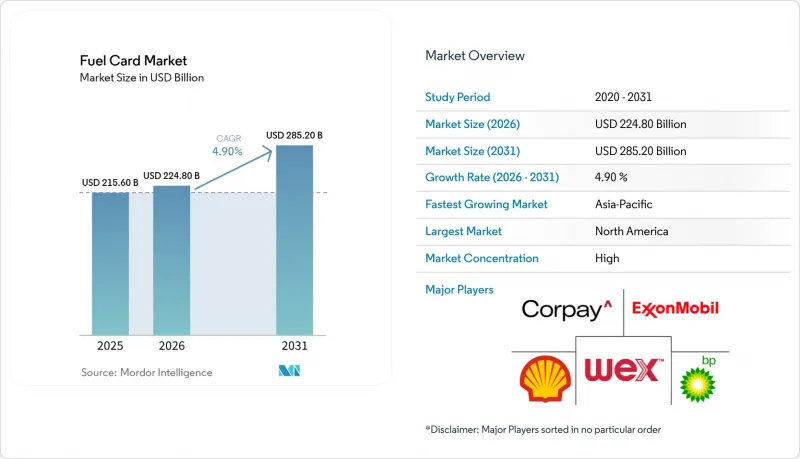
According to Mordor Intelligence, the fuel card market size was valued at USD 215.6 billion in 2025 and is estimated to grow from USD 224.8 billion in 2026 to reach USD 285.2 billion by 2031, at a CAGR of 4.9% during the forecast period (2026-2031).
Global Fuel Card Market Trends and Insights
Growth of Commercial Fleets and Road-Based Logistics Activity
Road freight activity and organized logistics remain a central source of demand for the fuel card market. Larger commercial fleets create more frequent fuel transactions and increase the need for controlled payment processes. India's commercial vehicle sector is expected to reach 12.4 lakh units in fiscal 2027, supported by freight activity, easing interest rates, and improved purchase affordability after the September 2025 goods and services tax change. In emerging markets, first-time adoption can occur when small operators move from cash spending to managed cards. This pattern gives the fuel card market access to new users rather than only replacement demand from existing cardholders.
Increasing Need for Fleet Fuel Spend Control and Cost Visibility
Fuel spending controls are a major reason that mid-sized fleets adopt card-based payment systems. Operators that rely on receipts and manual reconciliation have limited visibility into when, where, and how fuel was purchased. Transaction controls can include gallon limits, permitted purchase times, vehicle identification matching, and blocks on non-fuel spending. Shell stated that its Safer Payments system combines chip-enabled cards with real-time pattern recognition and AES and TLS encryption to identify suspicious activity before losses become systemic. As these features become more common, the fuel card market is serving fleet-management needs as well as payment needs.
Cybersecurity, Data Privacy and Payment-Data Risks
Fuel card networks hold payment information, vehicle data, and fleet-system records, which makes them a target for skimming, account takeover, and data theft. PCI DSS 4.0 became the active compliance standard for fuel retailers on March 31, 2025, with requirements that include multi-factor authentication and timely failure detection. Large providers can often absorb these requirements more easily than small issuers and independent fuel stations. Some smaller operators may move to hosted payment tools rather than fund their own compliant infrastructure. This can concentrate transaction data in fewer platforms and leave the fuel card market exposed to larger breach targets.
Other drivers and restraints analyzed in the detailed report include:
- Integration of Fuel Cards With Telematics and Fleet Management Systems
- Increasing Demand for Integrated Fuel, Electric Vehicle Charging, and Mobility Payments
- Integration Complexity Across Payment, Fuel-Station and Fleet Systems
For complete list of drivers and restraints, kindly check the Table Of Contents.
Segment Analysis
Independent and bank fleet cards captured 54.8% of segment revenue in 2025 and are forecast to grow at a 5.6% CAGR through 2031. Their position reflects fleet demand for broad acceptance and the ability to choose refueling locations by price and route requirements. Open and semi-open payment models give fleet managers more choice than restricted oil-major networks. AtoB offers a Mastercard-based fuel card that it says delivers an average diesel saving of USD 0.42 per gallon and is accepted wherever Mastercard is accepted in the United States. These offers target small and medium-sized fleets and owner-operators that were less well served by legacy closed-loop products.
Oil majors and retailer-branded cards remain important because they can pair loyalty programs with established station networks. In March 2025, Shell and WEX launched redesigned Shell Card Business products that covered 95% of United States gas stations and included access to several electric vehicle charging networks. Government programs are a smaller but durable part of the fuel card industry because public procurement creates multiyear contract structures. The United Kingdom Government Commercial Agency's Fuel Cards and Associated Services VII framework runs from February 2026 to February 2030 and is available to central government, health authorities, local bodies, and emergency services. Security and data-sharing requirements may reduce differences between card types on compliance, while preserving an advantage for providers with strong transaction data.
Complete Report Scope:
- By Card Type
- Oil-Major/Retailer-Branded
- Independent & Bank Fleet Cards
- Government Programmes
- By Vehicle
- Heavy Trucks and Buses
- Light Commercial Vehicles (Vans, Pickups)
- Company Cars/Grey Fleet
- By Customer
- Transport & Logistics Operators
- Other Commercial Fleets (Construction, Industry, Distribution, Utilities, Agriculture)
- Public Sector
- By Geography
- North America
- United States
- Canada
- Mexico
- South America
- Brazil
- Argentina
- Rest of South America
- Europe
- United Kingdom
- Germany
- France
- Italy
- Spain
- Rest of Europe
- Asia-Pacific
- China
- Japan
- India
- South Korea
- Australia
- Indonesia
- Thailand
- Malaysia
- Singapore
- Vietnam
- Rest of Asia-Pacific
- Middle East and Africa
- Saudi Arabia
- United Arab Emirates
- Turkey
- South Africa
- Egypt
- Rest of Middle East and Africa
- North America
Geography Analysis
North America captured 56.5% of the fuel card market share in 2025. Its position rests on a large commercial fleet base, high fleet card penetration, and specialist payment networks. The United States General Services Administration uses WEX Fleet Cards across agencies, including Commerce, State, Homeland Security, and Agriculture. This form of institutional procurement reinforces the position of established providers in the United States. Canada and Mexico add demand through cross-border freight corridors and regional fleet operations.
Europe is a high-value part of the fuel card market because dense cross-border trucking creates demand for tax recovery, toll services, and multicurrency billing. Fleet operators often assess card offerings on these functions as well as fuel discounts. The region also has a strong need for payment security and fraud intelligence sharing across national borders. The European Payments Council identified cross-border fraud intelligence sharing as an issue that the proposed Payment Services Regulation seeks to address. Integrated providers can benefit when they combine fuel payments with tax, toll, and fleet-management functions.
Asia-Pacific is forecast to grow at a 7.8% CAGR from 2026 to 2031, making it the fastest-growing regional part of the fuel card market. China, India, and Southeast Asia each support demand through commercial vehicle activity and growing logistics networks. India's fiscal 2027 commercial vehicle outlook points to 12.4 lakh units, which supports a wider base for organized fleet purchasing. The Middle East and Africa include developed fleet payment markets in Saudi Arabia and the United Arab Emirates, where logistics hubs and government-linked fleets support usage. Network limitations in sub-Saharan Africa and some cross-border corridors still limit wider penetration.
- Corpay, Inc.
- WEX Inc.
- Shell plc
- BP p.l.c.
- Exxon Mobil Corporation
- DKV Mobility
- UTA Edenred
- TotalEnergies SE
- Chevron Corporation
- World Kinect Corporation
- Repsol S.A.
- Radius Limited
- Eurowag
- U.S. Bancorp
- AtoB, Inc.
- Coast
- Allstar Business Solutions
- Puma Energy
- Sunoco LP
- Valero Energy Corporation
Additional Benefits:
- The market estimate (ME) sheet in Excel format
- 3 months of analyst support
TABLE OF CONTENTS
1 INTRODUCTION
- 1.1 Study Assumptions and Market Definition
- 1.2 Scope of the Study
2 RESEARCH METHODOLOGY
3 EXECUTIVE SUMMARY
4 MARKET LANDSCAPE
- 4.1 Market Overview
- 4.2 Market Drivers
- 4.2.1 Growth of Commercial Fleets and Road-Based Logistics Activity
- 4.2.2 Increasing Need for Fleet Fuel Spend Control and Cost Visibility
- 4.2.3 Expansion of Multi-Brand Fuel Card Acceptance Networks
- 4.2.4 Integration of Fuel Cards With Telematics and Fleet Management Systems
- 4.2.5 Increasing Demand for Integrated Fuel, EV Charging and Mobility Payments
- 4.2.6 Growing Adoption of Real-Time Transaction Controls and Fraud Prevention
- 4.3 Market Restraints
- 4.3.1 Cybersecurity, Data Privacy and Payment-Data Risks
- 4.3.2 Integration Complexity Across Payment, Fuel-Station and Fleet Systems
- 4.3.3 Limited Network Coverage in Certain Geographic and Cross-Border Corridors
- 4.3.4 Competitive and Margin Pressure From Alternative Payment and Fuel-Purchasing Channels
- 4.4 Value Chain Analysis
- 4.4.1 Fuel Suppliers, Refiners and Fuel Retailers
- 4.4.2 Fuel Card Issuers and Fleet Payment Networks
- 4.4.3 Fuel Station/Merchant Acceptance Networks and Acquirers
- 4.4.4 Fleet Operators, Telematics Providers and Enterprise Software Platforms
- 4.5 Regulatory Landscape
- 4.5.1 Payment Services, Commercial Card and Electronic Payment Regulations
- 4.5.2 Data Protection, Privacy and Cross-Border Data Transfer Requirements
- 4.5.3 Fuel Tax, VAT Recovery, and Electronic Invoicing Requirements
- 4.5.4 Payment Security, Authentication and Fraud-Prevention Requirements
- 4.6 Technological Outlook
- 4.6.1 Digital Fuel Cards, Mobile Payments and Contactless Authentication
- 4.6.2 Telematics, GPS and Vehicle-Level Transaction Integration
- 4.6.3 AI-Based Fraud Detection, Anomaly Detection and Spend Controls
- 4.6.4 Open APIs and Multi-Energy Payment Integration Across Fuel, EV Charging and Alternative Fuels
- 4.7 Porter's Five Forces Analysis
- 4.7.1 Threat of New Entrants
- 4.7.2 Bargaining Power of Suppliers
- 4.7.3 Bargaining Power of Buyers
- 4.7.4 Threat of Substitutes
- 4.7.5 Competitive Rivalry
5 MARKET SIZE AND GROWTH FORECASTS
- 5.1 By Card Type
- 5.1.1 Oil-Major/Retailer-Branded
- 5.1.2 Independent & Bank Fleet Cards
- 5.1.3 Government Programmes
- 5.2 By Vehicle
- 5.2.1 Heavy Trucks and Buses
- 5.2.2 Light Commercial Vehicles (Vans, Pickups)
- 5.2.3 Company Cars/Grey Fleet
- 5.3 By Customer
- 5.3.1 Transport & Logistics Operators
- 5.3.2 Other Commercial Fleets (Construction, Industry, Distribution, Utilities, Agriculture)
- 5.3.3 Public Sector
- 5.4 By Geography
- 5.4.1 North America
- 5.4.1.1 United States
- 5.4.1.2 Canada
- 5.4.1.3 Mexico
- 5.4.2 South America
- 5.4.2.1 Brazil
- 5.4.2.2 Argentina
- 5.4.2.3 Rest of South America
- 5.4.3 Europe
- 5.4.3.1 United Kingdom
- 5.4.3.2 Germany
- 5.4.3.3 France
- 5.4.3.4 Italy
- 5.4.3.5 Spain
- 5.4.3.6 Rest of Europe
- 5.4.4 Asia-Pacific
- 5.4.4.1 China
- 5.4.4.2 Japan
- 5.4.4.3 India
- 5.4.4.4 South Korea
- 5.4.4.5 Australia
- 5.4.4.6 Indonesia
- 5.4.4.7 Thailand
- 5.4.4.8 Malaysia
- 5.4.4.9 Singapore
- 5.4.4.10 Vietnam
- 5.4.4.11 Rest of Asia-Pacific
- 5.4.5 Middle East and Africa
- 5.4.5.1 Saudi Arabia
- 5.4.5.2 United Arab Emirates
- 5.4.5.3 Turkey
- 5.4.5.4 South Africa
- 5.4.5.5 Egypt
- 5.4.5.6 Rest of Middle East and Africa
- 5.4.1 North America
6 COMPETITIVE LANDSCAPE
- 6.1 Market Concentration
- 6.2 Strategic Moves
- 6.3 Market Share Analysis (Top 5-6 players)
- 6.4 Company Profiles (includes Global Level Overview, Market Level Overview, Core Segments, Financials as available, Strategic Information, Market Rank/Share, Products and Services, Recent Developments)
- 6.4.1 Corpay, Inc.
- 6.4.2 WEX Inc.
- 6.4.3 Shell plc
- 6.4.4 BP p.l.c.
- 6.4.5 Exxon Mobil Corporation
- 6.4.6 DKV Mobility
- 6.4.7 UTA Edenred
- 6.4.8 TotalEnergies SE
- 6.4.9 Chevron Corporation
- 6.4.10 World Kinect Corporation
- 6.4.11 Repsol S.A.
- 6.4.12 Radius Limited
- 6.4.13 Eurowag
- 6.4.14 U.S. Bancorp
- 6.4.15 AtoB, Inc.
- 6.4.16 Coast
- 6.4.17 Allstar Business Solutions
- 6.4.18 Puma Energy
- 6.4.19 Sunoco LP
- 6.4.20 Valero Energy Corporation
7 MARKET OPPORTUNITIES AND FUTURE OUTLOOK
- 7.1 White-Space and Unmet-Need Assessment
- 7.1.1 Interoperable Fuel and EV-Charging Acceptance Across Fragmented and Emerging Markets
- 7.1.2 Cross-Border Fuel, Tax, Toll and Mobility-Expense Consolidation
- 7.1.3 Affordable Digital Fuel-Card Solutions for Small and Mid-Sized Fleets
- 7.2 Future Outlook
- 7.2.1 Transition From Traditional Fuel Cards to Multi-Energy Mobility Payment Accounts
- 7.2.2 AI-Driven Fraud Detection and Predictive Fleet Spend Management
- 7.2.3 Expansion of Virtual, App-Based and Tokenized Fleet Payments

