PUBLISHER: Mordor Intelligence | PRODUCT CODE: 2157015

PUBLISHER: Mordor Intelligence | PRODUCT CODE: 2157015
Medical Injection Molding Machine - Market Share Analysis, Industry Trends & Statistics, Growth Forecasts (2026 - 2031)
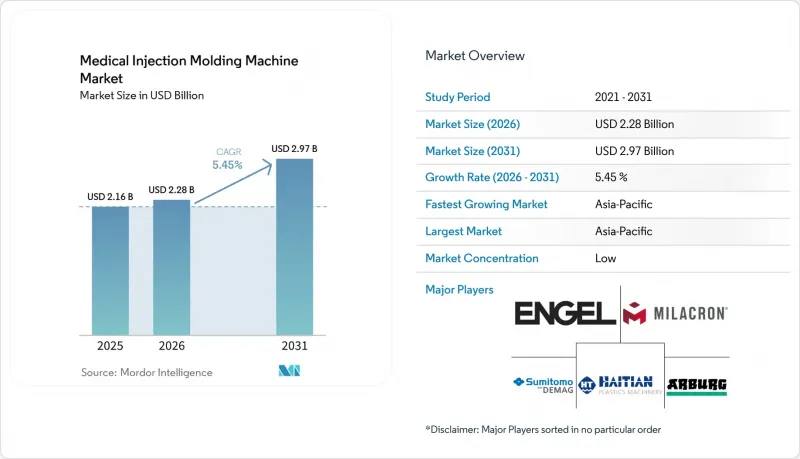
According to Mordor Intelligence, the medical injection molding machine market size was valued at USD 2.16 billion in 2025 and is estimated to grow from USD 2.28 billion in 2026 to reach USD 2.97 billion by 2031, at a CAGR of 5.45% during the forecast period (2026-2031).
Global Medical Injection Molding Machine Market Trends and Insights
Demand for Single-Use and Minimally Invasive Devices
Single-use medical products are supporting sustained purchases of high cavity machines for syringes, intravenous connectors, catheter assemblies, and pen injector components. Infection control needs, immunization programs, and injectable biologic therapies support this production base. Pen injector manufacturers are expanding molding capacity on shorter schedules as demand for glucagon-like peptide-1 delivery devices grows. Jiangsu Wanhai Medical Instruments Co., Ltd. began construction of a CNY 390 million investment (approximately USD 54 million) pen injector facility in Changzhou in July 2025, with annual capacity targeted at 310 million units, including autoinjectors. The company is also pursuing U.S. Food and Drug Administration 510(k) clearance for its next-generation systems. Within the medical injection molding machine market, ISO 10993 biocompatibility needs and material traceability requirements favor electric presses because they eliminate hydraulic oil from classified production areas.
Precision Production of Diagnostic and Drug-Delivery Components
Microfluidic chips, prefillable syringe barrels, and drug-delivery pen bodies require tight dimensional control. Servo-driven electric and hybrid machines can provide consistent injection velocity, while oil-temperature variation can affect hydraulic production runs. A 2026 Journal of Process Control study reported that model-predictive cavity-pressure control kept part-mass deviation within 0.21% when manufacturers switched between virgin and recycled polymer batches. Per-cavity data logging is becoming more important in regulated programs because manufacturers must document process performance. Wearable drug-delivery products and point-of-care diagnostic devices are also reducing shot weights below 0.1 g. These applications require dedicated micro-injection units and can require new capital equipment in the medical injection molding machine market, even when an existing molding fleet remains operational.
High Capital and Total Cost of Ownership
All-electric medical injection molding equipment with cleanroom features can carry a 30%-50% price premium over comparable hydraulic equipment. The acquisition decision also includes cleanroom infrastructure, temperature-control units, material drying and conveying systems, automation, and preventive maintenance. These annual operating requirements can add 15%-20% of the machine purchase cost. Smaller contract manufacturers face greater difficulty when volumes are uncertain or production runs are short. The challenge is particularly relevant in South America and Middle East and Africa, where cost recovery can take longer. Longer delivery times from European and Japanese suppliers can further increase financing exposure for medical injection molding machine market buyers when device programs face regulatory delays.
Other drivers and restraints analyzed in the detailed report include:
- Shift Toward Electric, Cleanroom-Compatible Presses
- Expansion of Medical-Device Manufacturing in Asia-Pacific
- Validation and Qualification Burden
For complete list of drivers and restraints, kindly check the Table Of Contents.
Segment Analysis
Electric held 42.45% of the medical injection molding machine market size in 2025. Its cleanroom compatibility and repeatable output support use in validated production for North American and European device programs. Hydraulic machines remain relevant for orthopedic component housings and structural device parts that require high clamping force. Their position is declining across the medical injection molding machine market as cleanroom mandates expand across more applications. ARBURG GmbH + Co KG presented its NextGen Medical Solution with Sanofi in October 2025, using an all-electric ALLROUNDER 570 A and an 8-cavity mold for injector pen caps.
Hybrid is projected to advance at a 6.06% CAGR through 2031. It combines electric cleanliness with the force needed for thicker-wall and higher-pressure medical parts. Haitian Plastics Machinery launched the MA5/Ultra at CHINAPLAS 2026 for multi-cavity precision and medical applications. ARBURG GmbH + Co KG began worldwide sales of the ALLROUNDER 475 V in January 2026 for medical insert molding, with energy use up to 60% lower than conventional hydraulic vertical presses.
Hot runner held 58.11% of the medical injection molding machine market size in 2025 and is projected to advance at a 6.23% CAGR through 2031. It eliminates cold runner scrap that cannot be reused in many single-use medical applications. The technology also helps preserve cavity-to-cavity balance in high-cavity molds. Top Clean Packaging Group reported that its shut-off hot runner system for medical-grade polyether ether ketone molding eliminated sprues and improved project profitability. Needle-valve gating is used where a low gate vestige is required for patient-contact parts.
Cold runner systems continue to suit multi-material, insert-molded, and lower-volume development programs. They can be appropriate where heated-manifold investment is not supported by production economics. Sumitomo (SHI) Demag Plastics Machinery GmbH demonstrated its PAC-E 420 clean-toggle press at K 2025 with a 48-cavity hot runner mold, a 3-second cycle time, and an annual output of 432 million medical cup components. Japanese suppliers have historically used hot runner integration to differentiate precision platforms in the medical injection molding machine market.
Complete Report Scope:
- By Product Type
- Electric
- Hydraulic
- Hybrid
- By System Type
- Hot Runner
- Cold Runner
- By Material
- Plastics
- Metals
- Other Materials
- By Application
- Consumables
- Medical Equipment Components
- Patient Aids
- Orthopedic Instruments
- Dental Products
- Other Applications
- By Geography
- Asia-Pacific
- China
- India
- Japan
- South Korea
- ASEAN Countries
- Rest of Asia-Pacific
- North America
- United States
- Canada
- Mexico
- Europe
- Germany
- United Kingdom
- France
- Italy
- NORDIC Countries
- Rest of Europe
- South America
- Brazil
- Argentina
- Rest of South America
- Middle East and Africa
- Saudi Arabia
- South Africa
- Rest of Middle East and Africa
- Asia-Pacific
Geography Analysis
Asia-Pacific held 30.72% of the market share in 2025 and is projected to advance at a 6.37% CAGR through 2031. Domestic contract development and manufacturing organizations and original equipment manufacturers are updating electric and hybrid fleets for export programs. India's Production Linked Incentive Scheme for medical devices covers 4 dedicated medical device parks. Lubrizol and Polyhose India opened an ISO 13485-certified medical tubing facility in Chennai in 2025.
Japan retains substantial precision manufacturing capability through NISSEI PLASTIC INDUSTRIAL CO., LTD., TOYO INNOVEX Co., Ltd., Shibaura Machine, FANUC Corporation, and The Japan Steel Works, LTD. NISSEI PLASTIC INDUSTRIAL CO., LTD. and TOYO INNOVEX Co., Ltd. completed their business integration under GMS Group Co., Ltd. on April 1, 2026. South Korea, Thailand, Vietnam, and Malaysia are attracting activity from device companies diversifying supply chains. North America concentrates on Class II and Class III device production. The Quality Management System Regulation is prompting equipment audits among molders serving U.S.-regulated programs.
Europe has sophisticated demand across Germany, the United Kingdom, France, Italy, and the Nordic countries. Regulatory documentation needs and energy-efficiency requirements support electric equipment in the region. South America and Middle East and Africa have smaller demand bases tied to healthcare investment and import substitution. Brazil, Argentina, Saudi Arabia, and South Africa support targeted activity, while currency volatility and limited technical support can favor accessible hybrid and servo-hydraulic platforms. The medical injection molding machine market offers suppliers distinct opportunities across high-specification and cost-sensitive geographies.
- ARBURG GmbH + Co KG
- Chen Hsong CO.,LTD
- ENGEL
- FANUC Corporation
- Haitian Plastics Machinery
- Husky Technologies
- KraussMaffei Group GmbH
- Milacron Holdings, LLC
- NISSEI PLASTIC INDUSTRIAL CO., LTD.
- Shibaura Machine
- Sumitomo (SHI) Demag Plastics Machinery GmbH
- The Japan Steel Works, LTD.
- TOYO INNOVEX Co., Ltd.
- UBE Machinery Inc.
- WITTMANN Technology GmbH
Additional Benefits:
- The market estimate (ME) sheet in Excel format
- 3 months of analyst support
TABLE OF CONTENTS
1 Introduction
- 1.1 Study Assumptions and Market Definition
- 1.2 Scope of the Study
2 Research Methodology
3 Executive Summary
4 Market Landscape
- 4.1 Market Overview
- 4.2 Market Drivers
- 4.2.1 Demand for Single-Use and Minimally Invasive Devices
- 4.2.2 Precision Production of Diagnostic and Drug-Delivery Components
- 4.2.3 Shift Toward Electric, Cleanroom-Compatible Presses
- 4.2.4 Expansion of Medical-Device Manufacturing in Asia-Pacific
- 4.2.5 Cavity-Level Digital Control for Faster Validation
- 4.3 Market Restraints
- 4.3.1 High Capital and Total Cost of Ownership
- 4.3.2 Validation and Qualification Burden
- 4.3.3 Shortage of Specialized Tooling and Process Engineers
- 4.4 Value Chain Analysis
- 4.5 Porter's Five Forces Analysis
- 4.5.1 Threat of New Entrants
- 4.5.2 Bargaining Power of Suppliers
- 4.5.3 Bargaining Power of Buyers
- 4.5.4 Threat of Substitutes
- 4.5.5 Competitive Rivalry
5 Market Size and Growth Forecasts (Value)
- 5.1 By Product Type
- 5.1.1 Electric
- 5.1.2 Hydraulic
- 5.1.3 Hybrid
- 5.2 By System Type
- 5.2.1 Hot Runner
- 5.2.2 Cold Runner
- 5.3 By Material
- 5.3.1 Plastics
- 5.3.2 Metals
- 5.3.3 Other Materials
- 5.4 By Application
- 5.4.1 Consumables
- 5.4.2 Medical Equipment Components
- 5.4.3 Patient Aids
- 5.4.4 Orthopedic Instruments
- 5.4.5 Dental Products
- 5.4.6 Other Applications
- 5.5 By Geography
- 5.5.1 Asia-Pacific
- 5.5.1.1 China
- 5.5.1.2 India
- 5.5.1.3 Japan
- 5.5.1.4 South Korea
- 5.5.1.5 ASEAN Countries
- 5.5.1.6 Rest of Asia-Pacific
- 5.5.2 North America
- 5.5.2.1 United States
- 5.5.2.2 Canada
- 5.5.2.3 Mexico
- 5.5.3 Europe
- 5.5.3.1 Germany
- 5.5.3.2 United Kingdom
- 5.5.3.3 France
- 5.5.3.4 Italy
- 5.5.3.5 NORDIC Countries
- 5.5.3.6 Rest of Europe
- 5.5.4 South America
- 5.5.4.1 Brazil
- 5.5.4.2 Argentina
- 5.5.4.3 Rest of South America
- 5.5.5 Middle East and Africa
- 5.5.5.1 Saudi Arabia
- 5.5.5.2 South Africa
- 5.5.5.3 Rest of Middle East and Africa
- 5.5.1 Asia-Pacific
6 Competitive Landscape
- 6.1 Market Concentration
- 6.2 Strategic Moves
- 6.3 Market Share (%)/Ranking Analysis
- 6.4 Company Profiles (includes Global Overview, Market Overview, Core Segments, Financials as available, Strategic Information, Products and Services, and Recent Developments)
- 6.4.1 ARBURG GmbH + Co KG
- 6.4.2 Chen Hsong CO.,LTD
- 6.4.3 ENGEL
- 6.4.4 FANUC Corporation
- 6.4.5 Haitian Plastics Machinery
- 6.4.6 Husky Technologies
- 6.4.7 KraussMaffei Group GmbH
- 6.4.8 Milacron Holdings, LLC
- 6.4.9 NISSEI PLASTIC INDUSTRIAL CO., LTD.
- 6.4.10 Shibaura Machine
- 6.4.11 Sumitomo (SHI) Demag Plastics Machinery GmbH
- 6.4.12 The Japan Steel Works, LTD.
- 6.4.13 TOYO INNOVEX Co., Ltd.
- 6.4.14 UBE Machinery Inc.
- 6.4.15 WITTMANN Technology GmbH
7 Market Opportunities and Future Outlook
- 7.1 White-Space and Unmet-Need Assessment

