PUBLISHER: Mordor Intelligence | PRODUCT CODE: 2157065

PUBLISHER: Mordor Intelligence | PRODUCT CODE: 2157065
Europe Hydraulic Presses - Market Share Analysis, Industry Trends & Statistics, Growth Forecasts (2026 - 2031)
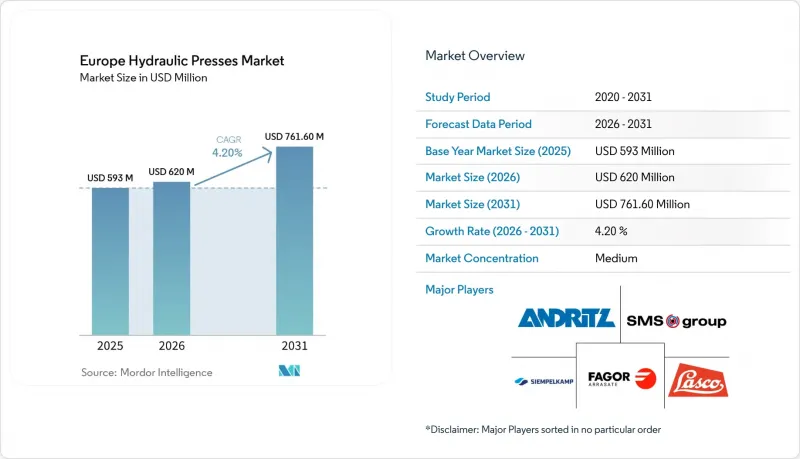
According to Mordor Intelligence, the Europe hydraulic presses market size was valued at USD 593.0 million in 2025, and is estimated to grow from USD 620.0 million in 2026 to reach USD 761.6 million by 2031, at a CAGR of 4.20% during the forecast period (2026-2031).
Europe Hydraulic Presses Market Trends and Insights
EV Battery, Lightweighting, and Structural-Component Replatforming
Platform electrification is increasing demand for hydraulic press investment across European automotive supply chains. PowerCo commissioned its Salzgitter unified-cell facility in 2025, creating local requirements for battery housing and structural underbody trays that need new tooling and forming processes. Large-format prismatic cells and cell-to-pack designs require battery structures with different geometries from those used in internal-combustion vehicles. Aluminum closure panels and high-strength-steel rocker structures also require different force, bed size, and blank-holder settings. Press shops cannot always address those requirements through simple changes to existing tooling. Hydraulic systems provide programmable force and speed over the working stroke, which supports the forming of complex structural parts. This gives the Europe hydraulic presses market a durable replacement opportunity beyond normal changes in vehicle production volumes.
Industry 4.0 Press-Shop Automation and Predictive Maintenance
Digital systems became more established in European press shops during 2025. Smart Press Shop in Halle uses Metris Visual Die Protection to monitor tools with cameras and stop lines when it detects foreign objects, scrap accumulation, or cracks. The system helps prevent die damage before it leads to a longer production interruption. The SEAT and CUPRA facility in Martorell generates 3,000 data points during each stamping cycle and uses them to support production monitoring as the plant prepares for full battery electric vehicle output from 2026. Research published in 2026 showed that hybrid models using press sensor data can estimate the remaining useful life of critical forming components. These capabilities are making die protection, automated die change, and connected monitoring more important in new press specifications. They also increase the value of suppliers that can combine machinery, controls, and ongoing support.
High Capital Cost and Long Replacement Cycles
Industrial hydraulic presses require substantial capital commitments across all tonnage classes. Mid-range systems cost hundreds of thousands of euros, while aerospace and forging systems can require investments in the tens of millions of euros. Safran's EUR 150 million (USD 176.45 million) Gennevilliers commitment illustrates the scale of spending possible for strategically important forging capacity. Regulation (EU) 2023/1230 applies from January 20, 2027, and identifies cold-metalworking presses among the high-risk machinery categories subject to conformity assessment requirements.Compliance can add engineering work, certification costs, and commissioning time to new projects. Small and medium-sized manufacturers often delay replacement when acquisition costs and qualification requirements rise together. Hydraulic presses can remain in service for 20-30 years, which limits demand based solely on normal replacement cycles.
Other drivers and restraints analyzed in the detailed report include:
- Reshoring and Central and Eastern European Capacity Investment
- Aerospace, Defense, and High-Integrity Forging Demand
- Skilled Hydraulic, Controls, and Maintenance Labor Shortage
For complete list of drivers and restraints, kindly check the Table Of Contents.
Segment Analysis
C-frame and gap-frame presses held 31.5% of the Europe hydraulic presses market size in 2025. Their open, three-sided access supports general stamping, assembly work, automotive body panels, and other applications that require efficient material handling. This layout also supports fast die changes in plants with frequent production changes. H-frame and straight-side presses serve work that needs greater rigidity and repeatable platen alignment. They are used for precision blanking, deep drawing, and electric-motor lamination stacking. Four-post and four-column presses distribute force across larger platens for forging and composite molding. Two-post and benchtop systems remain relevant for toolrooms, assembly work, and lower-force production.
Other specialized configurations are forecast to grow at a 5.1% CAGR through 2031 within the Europe hydraulic presses industry. These systems include custom multi-axis transfer presses, hybrid hydraulic-electric equipment, and hot-platen designs for aerospace work. Their growth reflects rising part complexity instead of the highest unit volumes. Specialized presses help users manage complex materials, different production sequences, and application-specific quality requirements. Composite and advanced-material programs need controlled temperature, closing speed, and pressure across the full forming cycle. That need supports custom press designs that standard catalog systems cannot always provide. Suppliers with application engineering expertise are better placed to compete for these projects. The Europe hydraulic presses market, therefore, has a growing premium segment alongside its broader general-purpose press base.
The 101-500 ton class held 34% of the Europe hydraulic presses market size in 2025. This range covers automotive body panels, structural components, industrial machinery parts, and general fabrication. It serves the broadest set of production volumes within European manufacturing. Presses up to 100 tons support smaller stamping, electrical components, and laboratory operations. The 501-1,000 ton and 1,001-2,000 ton classes serve heavier vehicle structures, rail components, and construction-equipment parts. Buyers in these ranges balance force requirements with footprint, cycle time, and tooling needs. The range also matches demand from growing suppliers in Central and Eastern Europe.
Presses above 2,000 tons are forecast to expand at a 5.2% CAGR through 2031 in the Europe hydraulic presses industry. Demand comes from aerospace forging, large composite parts, and other applications that require substantial force and platen capacity. Safran's planned 30,000-ton press demonstrates the value concentrated in these larger projects. These purchases involve long lead times, technical specifications, and extended service arrangements. Customers also expect material traceability and established quality systems. Engineering-to-order manufacturers have an advantage because catalog systems do not meet every high-force requirement. This makes the high-force segment more dependent on a limited group of qualified suppliers. It also gives the Europe hydraulic presses market a source of value growth even when order volumes remain limited.
Complete Report Scope:
- By Frame / Structural Configuration
- C-Frame / Gap-Frame Hydraulic Presses
- H-Frame / Straight-Side / Gib-Guided Hydraulic Presses
- Four-Post / Four-Column Hydraulic Presses
- Two-Post / Column Hydraulic Presses
- Benchtop / Workshop Hydraulic Presses
- Other Specialized Hydraulic Press Configurations
- By Tonnage / Press Force
- Up to 100 Tons
- 101-500 Tons
- 501-1,000 Tons
- 1,001-2,000 Tons
- Above 2,000 Tons
- By Application / Forming Process
- Sheet Metal Forming and Deep Drawing
- Forging
- Bending and Straightening
- Punching, Blanking, and Coining
- Compression Molding
- Powder Compaction
- Hydroforming
- Assembly, Press-Fitting, and General Pressing
- Other Specialized Applications
- By End-Use Industry
- Automotive and Transportation
- Aerospace and Defense
- Industrial Machinery and General Manufacturing
- Electrical and Electronics
- Plastics, Rubber, and Composites
- Construction and Heavy Equipment
- Energy and Power Equipment
- Rail and Marine
- Powder Metallurgy, Ceramics, and Advanced Materials
- Other End-Use Industries
- By Geography
- Germany
- Italy
- France
- United Kingdom
- Spain
- Russia
- Finland
- Rest of Europe
List of Companies Covered in this Report:
- ANDRITZ Schuler Group
- SMS group GmbH
- Siempelkamp
- Fagor Arrasate
- LASCO Umformtechnik GmbH
- DORST Technologies GmbH & Co. KG
- Mecolpress S.p.A.
- Enerpac Tool Group Corp.
- Aida Engineering, Ltd.
- Komatsu Ltd.
- Gasbarre Products, Inc.
- Beckwood Press Company
- French Oil Mill Machinery Company
- Neff Press, Inc.
- Dake Corporation
- Grabener Pressensysteme GmbH
- Hidraulica y Mecanica S.A.
- Hare Press Services
- Mecomec F.P. srl
- Mitsubishi Heavy Industries, Ltd.
- Jier Machine-Tool Group Co., Ltd.
Additional Benefits:
- The market estimate (ME) sheet in Excel format
- 3 months of analyst support
TABLE OF CONTENTS
1 INTRODUCTION
- 1.1 Study Assumptions and Market Definition
- 1.2 Scope of the Study
2 RESEARCH METHODOLOGY
3 EXECUTIVE SUMMARY
4 MARKET LANDSCAPE
- 4.1 Market Overview
- 4.2 Market Drivers
- 4.2.1 EV Battery, Lightweighting, and Structural-Component Replatforming
- 4.2.2 Industry 4.0 Press-Shop Automation and Predictive Maintenance
- 4.2.3 Reshoring and Central and Eastern European Capacity Investment
- 4.2.4 Aerospace, Defense, and High-Integrity Forging Demand
- 4.2.5 Energy-Efficient Servo-Hydraulic Upgrades Driven by Decarbonization
- 4.2.6 Composite and Advanced-Material Compression Molding
- 4.3 Market Restraints
- 4.3.1 High Capital Cost and Long Replacement Cycles
- 4.3.2 Skilled Hydraulic, Controls, and Maintenance Labor Shortage
- 4.3.3 CNC, Power-Electronics, and High-Grade Steel Supply Exposure
- 4.3.4 Competition from Servo-Mechanical, Electric, and Alternative Forming Technologies
- 4.4 Value and Supply-Chain Analysis
- 4.4.1 Hydraulic Power Unit and Cylinder Suppliers
- 4.4.2 Controls, Sensors, Drives, and Software
- 4.4.3 Press Builder and Systems Integrator Economics
- 4.4.4 Tooling, Die, Automation, and Material-Handling Ecosystem
- 4.4.5 Aftermarket Modernization, Service, and Spare Parts
- 4.5 Regulatory Landscape
- 4.5.1 Machinery Regulation (EU) 2023/1230 and CE Conformity
- 4.5.2 EN and ISO Safety Standards for Presses
- 4.5.3 Ecodesign, Motor Efficiency, and Industrial Energy Management
- 4.5.4 Occupational Safety, Guarding, and Functional Safety
- 4.5.5 Circular Economy, Product Traceability, and Sustainability Reporting
- 4.6 Technological Outlook
- 4.6.1 Servo-Hydraulic and Variable-Speed Pump Systems
- 4.6.2 CNC, Multi-Axis, and Closed-Loop Force and Position Control
- 4.6.3 Robotics, Transfer Systems, and Automated Loading
- 4.6.4 IIoT, Digital Twins, and Predictive Maintenance
- 4.6.5 Low-Emission Hydraulic Fluids and Leak Monitoring
- 4.6.6 Hybrid Hydraulic-Electric Press Architectures
- 4.7 Impact of Geopolitical and Trade Developments
- 4.7.1 Tariffs and Import Restrictions
- 4.7.2 Supply-Chain Risks for Hydraulic and Control Components
- 4.7.3 Localization of Hydraulic Press Manufacturing
- 4.8 Industry and Manufacturing Trends
- 4.9 Sustainability and Energy Efficiency
5 MARKET SIZE AND GROWTH FORECASTS (VALUE, IN USD MILLION)
- 5.1 By Frame / Structural Configuration
- 5.1.1 C-Frame / Gap-Frame Hydraulic Presses
- 5.1.2 H-Frame / Straight-Side / Gib-Guided Hydraulic Presses
- 5.1.3 Four-Post / Four-Column Hydraulic Presses
- 5.1.4 Two-Post / Column Hydraulic Presses
- 5.1.5 Benchtop / Workshop Hydraulic Presses
- 5.1.6 Other Specialized Hydraulic Press Configurations
- 5.2 By Tonnage / Press Force
- 5.2.1 Up to 100 Tons
- 5.2.2 101-500 Tons
- 5.2.3 501-1,000 Tons
- 5.2.4 1,001-2,000 Tons
- 5.2.5 Above 2,000 Tons
- 5.3 By Application / Forming Process
- 5.3.1 Sheet Metal Forming and Deep Drawing
- 5.3.2 Forging
- 5.3.3 Bending and Straightening
- 5.3.4 Punching, Blanking, and Coining
- 5.3.5 Compression Molding
- 5.3.6 Powder Compaction
- 5.3.7 Hydroforming
- 5.3.8 Assembly, Press-Fitting, and General Pressing
- 5.3.9 Other Specialized Applications
- 5.4 By End-Use Industry
- 5.4.1 Automotive and Transportation
- 5.4.2 Aerospace and Defense
- 5.4.3 Industrial Machinery and General Manufacturing
- 5.4.4 Electrical and Electronics
- 5.4.5 Plastics, Rubber, and Composites
- 5.4.6 Construction and Heavy Equipment
- 5.4.7 Energy and Power Equipment
- 5.4.8 Rail and Marine
- 5.4.9 Powder Metallurgy, Ceramics, and Advanced Materials
- 5.4.10 Other End-Use Industries
- 5.5 By Geography
- 5.5.1 Germany
- 5.5.2 Italy
- 5.5.3 France
- 5.5.4 United Kingdom
- 5.5.5 Spain
- 5.5.6 Russia
- 5.5.7 Finland
- 5.5.8 Rest of Europe
6 COMPETITIVE LANDSCAPE
- 6.1 Market Concentration
- 6.2 Strategic Moves
- 6.3 Market Share Analysis
- 6.4 Company Profiles (includes Global Level Overview, Market Level Overview, Core Segments, Financials as available, Strategic Information, Products and Services, Recent Developments)
- 6.4.1 ANDRITZ Schuler Group
- 6.4.2 SMS group GmbH
- 6.4.3 Siempelkamp
- 6.4.4 Fagor Arrasate
- 6.4.5 LASCO Umformtechnik GmbH
- 6.4.6 DORST Technologies GmbH & Co. KG
- 6.4.7 Mecolpress S.p.A.
- 6.4.8 Enerpac Tool Group Corp.
- 6.4.9 Aida Engineering, Ltd.
- 6.4.10 Komatsu Ltd.
- 6.4.11 Gasbarre Products, Inc.
- 6.4.12 Beckwood Press Company
- 6.4.13 French Oil Mill Machinery Company
- 6.4.14 Neff Press, Inc.
- 6.4.15 Dake Corporation
- 6.4.16 Grabener Pressensysteme GmbH
- 6.4.17 Hidraulica y Mecanica S.A.
- 6.4.18 Hare Press Services
- 6.4.19 Mecomec F.P. srl
- 6.4.20 Mitsubishi Heavy Industries, Ltd.
- 6.4.21 Jier Machine-Tool Group Co., Ltd.
7 MARKET OPPORTUNITIES AND FUTURE OUTLOOK
- 7.1 White-Space and Unmet-Need Assessment
- 7.1.1 Energy-Efficient and Servo-Hydraulic Presses
- 7.1.2 Retrofit and Modernization of Legacy Presses
- 7.1.3 Automated and Connected Hydraulic Press Systems
- 7.1.4 Emerging-Market Manufacturing Expansion
- 7.1.5 High-Tonnage Applications
- 7.1.6 Advanced Materials and Composite Forming
- 7.1.7 Replacement vs. New-Capacity Demand Outlook

