PUBLISHER: Mordor Intelligence | PRODUCT CODE: 2157086

PUBLISHER: Mordor Intelligence | PRODUCT CODE: 2157086
Vision-Guided Welding Robots - Market Share Analysis, Industry Trends & Statistics, Growth Forecasts (2026 - 2031)
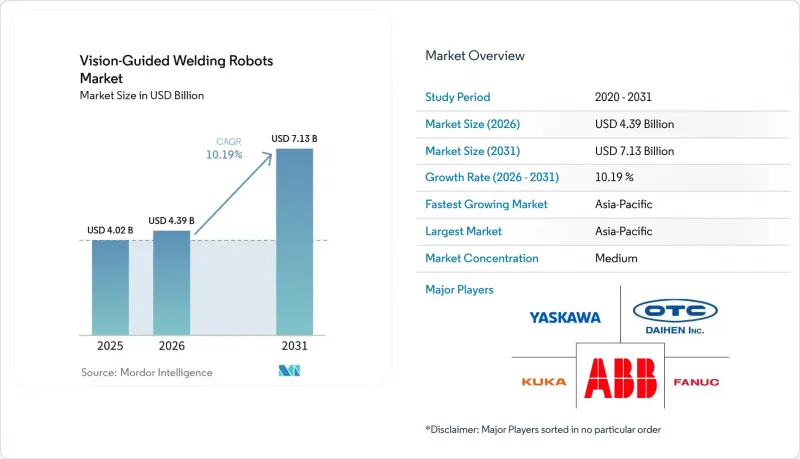
According to Mordor Intelligence, the vision-guided welding robots market size is projected to expand from USD 4.02 billion in 2025 to USD 4.39 billion in 2026, and to USD 7.13 billion by 2031, registering a CAGR of 10.19% between 2026 and 2031.
Global Vision-Guided Welding Robots Market Trends and Insights
Skilled Welder Shortages and Throughput Pressure
The shortage of skilled welders makes automated welding a capacity issue rather than solely an efficiency decision. A substantial portion of the US welding workforce is nearing retirement, while the industry requires a significant influx of new professionals to maintain capacity. The active US welder workforce is aging, even as infrastructure, vehicle, and fabrication activities continue to require welding capacity. Manufacturers can use vision-guided cells to reduce dependence on manual path teaching and maintain repeatable work across shifts. The vision-guided welding robots market therefore benefits when factories need reliable output but cannot recruit enough certified welders.
EV Battery Enclosure and Lightweight-Material Welding
Electric vehicle battery enclosures require accurate control of heat input, joint position, and sealing performance. Aluminum battery components can be up to 50% lighter than comparable steel components, but they require careful welding due to aluminum's thermal behavior. Vision-guided laser and resistance welding can support seam positioning where battery designs and material combinations change across vehicle programs. Fiber laser systems can reduce heat input compared with traditional MIG welding in aluminum battery enclosure work. Cell-to-pack battery designs also reduce the value of fixed tooling because seam paths can vary across model lines. These requirements support the Vision-guided welding robots market, where precision joining, porosity control, and enclosure sealing are production priorities.
High Cell Investment and Integration Costs
A vision-guided welding cell may require investment in the robot, fixturing, sensors, calibration, engineering, safety interlocks, and training. Turnkey articulated robot cells with integrated vision systems can involve substantial upfront costs. These costs can extend payback periods for lower-throughput welding operations. Integration also requires compatibility among robot software, sensor interfaces, welding power sources, and PLC safety systems. Smaller fabricators often lack dedicated automation teams to manage this work. The Vision-guided welding robots market faces slower adoption outside high-volume plants until modular cells and flexible financing reduce these barriers.
Other drivers and restraints analyzed in the detailed report include:
- Industry 4.0 Traceability and Closed-Loop Quality Control
- Falling Vision-Sensor and Edge-Compute Costs
- Shortage of Robot-Programming and Welding-Integration Skills
For complete list of drivers and restraints, kindly check the Table Of Contents.
Segment Analysis
Articulated robots held 48.11% of the Vision-guided welding robots market share in 2025. Their six-axis movement, payload range, and long use in automotive body-in-white and structural fabrication support this position. Manufacturers that already use articulated cells can often expand the same layout during replacement cycles. This installed base reduces the need to redesign fixtures, safety areas, and material handling around a new robot type. Collaborative robots are the next large conventional category in many applications. They are used where redeployment across part families is more valuable than maximum throughput.
Mobile and autonomous welding robots are projected to expand at a 17.32% CAGR through 2031. They move the robot to large, heavy, or complex workpieces that cannot enter a fixed cell. This approach is relevant in shipbuilding, energy infrastructure, and large structural fabrication. FANUC launched the CRX-3iA in May 2026 as an 11-kg collaborative robot for structural and shipbuilding applications. One operator can carry the product between weld seams. Mobile systems must also meet the requirements of ISO 10218-1 when robotic arms operate near people.
2D vision systems held 53.45% of the market in 2025. Their cost, simpler operation, and established role in controlled lighting conditions support continued use. High-volume automotive body shops use 2D systems in which panel geometry is predictable, and camera contrast can be managed. These systems are well-suited to resistance spot welding and many arc welding lines. The Vision-guided welding robots market size for 2D systems remains tied to standardized production environments. 3D systems are gaining use where joint geometry, material interfaces, and surface reflectivity make 2D contrast less reliable.
Multimodal vision systems are projected to expand at a 14.65% CAGR through 2031. These systems combine sensing methods for applications where a single camera or sensor cannot provide sufficient control. Battery welding, titanium aerospace joining, and electronics assembly are key uses. Cognex launched the In-Sight 3900 high-performance AI vision system in May 2026 for high-speed edge inspection. The system supports the edge-processing infrastructure needed for real-time production inspection. The shift toward multimodal systems reflects the need to track seam geometry, weld-pool conditions, and spatter simultaneously.
Complete Report Scope:
- By Robot Type
- Articulated Robots
- Collaborative Robots
- Cartesian / Gantry Robots
- SCARA Robots
- Mobile / Autonomous Welding Robots
- Other Robot Types
- By Vision Technology
- 2D Vision Systems
- 3D Vision Systems
- Multimodal Vision Systems
- By Welding Process
- Arc Welding
- Resistance Spot Welding
- Laser Welding
- TIG and Plasma Welding
- Other Welding Processes
- By Payload Capacity
- Up to 10 kg
- 10-20 kg
- 20-50 kg
- Above 50 kg
- By Application
- Body and Structural Welding
- Component and Subassembly Welding
- Pipe and Tube Welding
- Sheet Metal Welding
- Heavy Fabrication Welding
- Precision / Micro-Welding
- Other Applications
- By End-User Industry
- Automotive and Transportation
- Metals and Machinery
- Electrical and Electronics
- Aerospace and Defense
- Shipbuilding, Energy, and Infrastructure
- Contract Manufacturing and Job Shops
- Other End-User Industries
- By Geography
- North America
- United States
- Canada
- Mexico
- South America
- Brazil
- Argentina
- Rest of South America
- Europe
- Germany
- United Kingdom
- France
- Italy
- Spain
- Rest of Europe
- Asia-Pacific
- China
- Japan
- India
- South Korea
- ASEAN
- Rest of Asia-Pacific
- Middle East and Africa
- Middle East
- Saudi Arabia
- United Arab Emirates
- Rest of the Middle East
- Africa
- South Africa
- Nigeria
- Rest of Africa
- Middle East
- North America
Geography Analysis
Asia-Pacific accounted for the largest share of the regional total and is projected to grow rapidly through the forecast period. China accounted for more than half of the global operational industrial robot fleet and saw increased robot installations. Electrical and electronics-led robot installations in China, ahead of automotive. Japan supports demand for high-specification systems through its automotive and electronics production base. South Korea has the highest robot density globally and uses vision-integrated spot welding in semiconductor and automotive supply chains.
India recorded an increase in industrial robot installations and ranked among the leading countries globally, making it an important regional opportunity through the forecast period. The country's expanding automotive, electronics, metal fabrication, and general manufacturing industries are expected to support further adoption of industrial robots, including vision-guided welding systems. Asia accounted for the majority of global robot installations, with regional installations increasing as manufacturers expanded automation to address labor constraints, improve production consistency, and support high-volume manufacturing operations. China, Japan, South Korea, and India continue to drive regional demand through their established manufacturing bases and growing investments in advanced automation technologies.
Canada and Mexico support North American demand through automotive supply chains. Mexico recorded a decline in industrial robot installations, reflecting near-term uncertainty. Europe remains centered on Germany, Italy, and Sweden for automotive body-in-white welding. European industrial robot installations declined, although Germany retained demand for high-specification cells. South America has a demand for agricultural equipment and oil and gas applications. The Middle East and Africa have demand in Saudi Arabia, the United Arab Emirates, and South Africa, with autonomous systems suited to energy, infrastructure, mining equipment, and large structural work.
- ABB Ltd.
- FANUC Corporation
- Yaskawa Electric Corporation
- KUKA AG
- OTC DAIHEN Inc.
- Kawasaki Heavy Industries, Ltd.
- Panasonic Holdings Corporation
- Comau S.p.A.
- Lincoln Electric Holdings, Inc.
- Trumpf GmbH and Co. KG
- Fronius International GmbH
- Cognex Corporation
- KEYENCE CORPORATION
- SICK AG
- Servo-Robot Inc.
- ESAB Corporation
- Novarc Technologies Inc.
- Inrotech A/S
- Universal Robots A/S
- Nachi-Fujikoshi Corporation
Additional Benefits:
- The market estimate (ME) sheet in Excel format
- 3 months of analyst support
TABLE OF CONTENTS
1 INTRODUCTION
- 1.1 Study Assumptions and Market Definition
- 1.2 Scope of the Study
2 RESEARCH METHODOLOGY
3 EXECUTIVE SUMMARY
4 MARKET LANDSCAPE
- 4.1 Market Overview
- 4.2 Market Drivers
- 4.2.1 Skilled Welder Shortages and Throughput Pressure
- 4.2.2 EV Battery Enclosure and Lightweight-Material Welding
- 4.2.3 Industry 4.0 Traceability and Closed-Loop Quality Control
- 4.2.4 Falling Vision-Sensor and Edge-Compute Costs
- 4.2.5 Vision-Guided Automation for High-Mix, Low-Volume Fabrication
- 4.2.6 Autonomous Welding of Large and Unstructured Workpieces
- 4.3 Market Restraints
- 4.3.1 High Cell Investment and Integration Costs
- 4.3.2 Shortage of Robot-Programming and Welding-Integration Skills
- 4.3.3 Optical Interference from Arc Glare, Spatter, Smoke, and Reflective Metals
- 4.3.4 Inconsistent Fit-Up and Limited Training Data for Adaptive Welding Models
- 4.4 Impact of Macroeconomic Factors on the Market
- 4.5 Industry Value and Supply-Chain Analysis
- 4.6 Regulatory Landscape
- 4.7 Technological Outlook
- 4.8 Porter's Five Forces Analysis
- 4.8.1 Threat of New Entrants
- 4.8.2 Bargaining Power of Suppliers
- 4.8.3 Bargaining Power of Buyers
- 4.8.4 Threat of Substitutes
- 4.8.5 Intensity of Competitive Rivalry
5 MARKET SIZE AND GROWTH FORECASTS (VALUE)
- 5.1 By Robot Type
- 5.1.1 Articulated Robots
- 5.1.2 Collaborative Robots
- 5.1.3 Cartesian / Gantry Robots
- 5.1.4 SCARA Robots
- 5.1.5 Mobile / Autonomous Welding Robots
- 5.1.6 Other Robot Types
- 5.2 By Vision Technology
- 5.2.1 2D Vision Systems
- 5.2.2 3D Vision Systems
- 5.2.3 Multimodal Vision Systems
- 5.3 By Welding Process
- 5.3.1 Arc Welding
- 5.3.2 Resistance Spot Welding
- 5.3.3 Laser Welding
- 5.3.4 TIG and Plasma Welding
- 5.3.5 Other Welding Processes
- 5.4 By Payload Capacity
- 5.4.1 Up to 10 kg
- 5.4.2 10-20 kg
- 5.4.3 20-50 kg
- 5.4.4 Above 50 kg
- 5.5 By Application
- 5.5.1 Body and Structural Welding
- 5.5.2 Component and Subassembly Welding
- 5.5.3 Pipe and Tube Welding
- 5.5.4 Sheet Metal Welding
- 5.5.5 Heavy Fabrication Welding
- 5.5.6 Precision / Micro-Welding
- 5.5.7 Other Applications
- 5.6 By End-User Industry
- 5.6.1 Automotive and Transportation
- 5.6.2 Metals and Machinery
- 5.6.3 Electrical and Electronics
- 5.6.4 Aerospace and Defense
- 5.6.5 Shipbuilding, Energy, and Infrastructure
- 5.6.6 Contract Manufacturing and Job Shops
- 5.6.7 Other End-User Industries
- 5.7 By Geography
- 5.7.1 North America
- 5.7.1.1 United States
- 5.7.1.2 Canada
- 5.7.1.3 Mexico
- 5.7.2 South America
- 5.7.2.1 Brazil
- 5.7.2.2 Argentina
- 5.7.2.3 Rest of South America
- 5.7.3 Europe
- 5.7.3.1 Germany
- 5.7.3.2 United Kingdom
- 5.7.3.3 France
- 5.7.3.4 Italy
- 5.7.3.5 Spain
- 5.7.3.6 Rest of Europe
- 5.7.4 Asia-Pacific
- 5.7.4.1 China
- 5.7.4.2 Japan
- 5.7.4.3 India
- 5.7.4.4 South Korea
- 5.7.4.5 ASEAN
- 5.7.4.6 Rest of Asia-Pacific
- 5.7.5 Middle East and Africa
- 5.7.5.1 Middle East
- 5.7.5.1.1 Saudi Arabia
- 5.7.5.1.2 United Arab Emirates
- 5.7.5.1.3 Rest of the Middle East
- 5.7.5.2 Africa
- 5.7.5.2.1 South Africa
- 5.7.5.2.2 Nigeria
- 5.7.5.2.3 Rest of Africa
- 5.7.5.1 Middle East
- 5.7.1 North America
6 COMPETITIVE LANDSCAPE
- 6.1 Market Concentration
- 6.2 Strategic Moves
- 6.3 Market Share Analysis
- 6.4 Company Profiles (includes Global Level Overview, Market Level Overview, Core Segments, Financials as available, Strategic Information, Market Rank/Share, Products and Services, Recent Developments)
- 6.4.1 ABB Ltd.
- 6.4.2 FANUC Corporation
- 6.4.3 Yaskawa Electric Corporation
- 6.4.4 KUKA AG
- 6.4.5 OTC DAIHEN Inc.
- 6.4.6 Kawasaki Heavy Industries, Ltd.
- 6.4.7 Panasonic Holdings Corporation
- 6.4.8 Comau S.p.A.
- 6.4.9 Lincoln Electric Holdings, Inc.
- 6.4.10 Trumpf GmbH and Co. KG
- 6.4.11 Fronius International GmbH
- 6.4.12 Cognex Corporation
- 6.4.13 KEYENCE CORPORATION
- 6.4.14 SICK AG
- 6.4.15 Servo-Robot Inc.
- 6.4.16 ESAB Corporation
- 6.4.17 Novarc Technologies Inc.
- 6.4.18 Inrotech A/S
- 6.4.19 Universal Robots A/S
- 6.4.20 Nachi-Fujikoshi Corporation
7 MARKET OPPORTUNITIES AND FUTURE OUTLOOK
- 7.1 White-Space and Unmet-Need Assessment

