PUBLISHER: Mordor Intelligence | PRODUCT CODE: 2157095

PUBLISHER: Mordor Intelligence | PRODUCT CODE: 2157095
United States Hydraulic Presses - Market Share Analysis, Industry Trends & Statistics, Growth Forecasts (2026 - 2031)
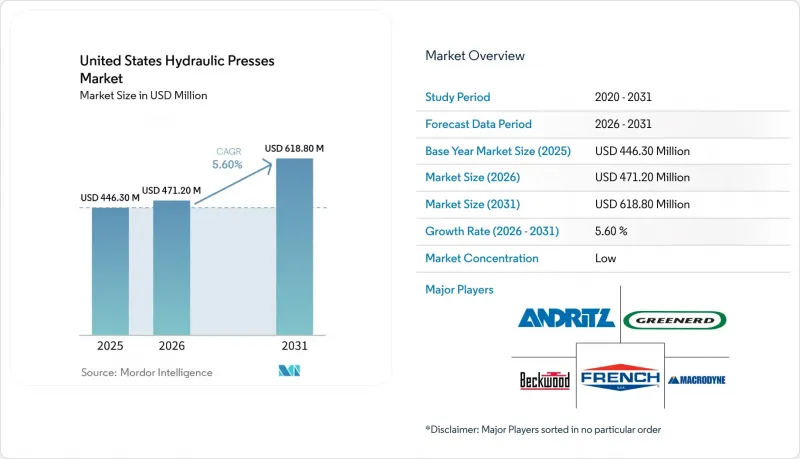
According to Mordor Intelligence, the United States hydraulic presses market size was valued at USD 446.3 million in 2025 and is estimated to grow from USD 471.2 million in 2026 to reach USD 618.8 million by 2031, at a CAGR of 5.6% during the forecast period 2026-2031.
Reshoring, factory investment, and aerospace and defense production are supporting demand for new forming and forging capacity. This report is Segmented by Frame (C-Frame, H-Frame, Four-Post, Two-Post, Other), by Tonnage (Up To 100, 101-500, 501-1, 000, and More), by Application (Sheet Metal, Forging, Bending, Compression Molding, Powder Compaction, Hydroforming, Assembly, Other), and by End-Use (Aerospace/Defense, Automotive, Machinery, Electronics, and More). The Market Forecasts are Provided in Terms of Value (USD).
United States Hydraulic Presses Market Trends and Insights
Reshoring and Domestic Manufacturing Capacity Expansion
Domestic capacity expansion is increasing the need for hydraulic presses across stamping, forming, and forging operations. The 2026 Reshoring Survey found that 63% of original equipment manufacturer respondents planned capital expenditures in 2026 or 2027 for reshoring or domestic expansion. Tariffs were identified by 65% of respondents and geopolitical risk by 60% as major catalysts for those plans. NIST reported that supply chain resilience and proximity between manufacturing and engineering operations were among the leading reshoring considerations for original equipment manufacturers. These priorities suit equipment with long operating lives, including presses that can be rebuilt or upgraded as production programs change. The United States hydraulic presses market benefits when both replacement projects and new capacity projects proceed at the same time.
Automation, Robotics, and Smart-Press Integration
Automation is changing the value placed on the press system rather than the press frame alone. Greenerd presented automated multi-station hydraulic press systems that combine straightening, shearing, dimpling, hole formation, chamfering, and shuttle transfer for an output of 60 parts per minute. Integrated cells often need larger beds for robotic end effectors, coil feed systems, and multi-die layouts. That requirement can favor H-frame and four-post equipment even when a smaller standalone press could form the part. Macrodyne supplied automated hydraulic press lines for UNION's 155mm artillery shell factory in Texas, showing the increasing importance of turnkey systems in defense production. Connected force and displacement monitoring can also support quality control and maintenance planning over the life of the asset.
High Initial Investment and Long Equipment Payback
Production-grade hydraulic press systems require significant initial capital, which can limit orders from smaller manufacturers. Equipment loans and leases are common funding methods for firms buying major machinery. The Internal Revenue Service allows qualifying businesses to claim a Section 179 deduction of USD 1.2 million for 2026, which can reduce after-tax equipment costs. The benefit is less useful for buyers with limited taxable income or limited access to credit. Lockout and machine guarding requirements can add engineering, installation, and commissioning costs to projects. These factors may postpone replacement decisions, especially when firms can extend the life of an existing press through service work.
Other drivers and restraints analyzed in the detailed report include:
- Demand for High-Force Forming in Aerospace and Defense
- Automotive Lightweighting and Advanced Material Forming
- Skilled Workforce Shortage and Technician Availability Constraints
For complete list of drivers and restraints, kindly check the Table Of Contents.
Segment Analysis
H-frame and straight-side hydraulic presses held 41% of revenue in 2025, giving them the largest position by frame type. Their guided ram design supports precision progressive-die stamping, aerospace sheet forming, and heavy forging where parallelism is important. Automotive Tier-1 stampers and aerospace forming shops have a large installed base of these presses. Long service lives create a recurring need for rebuilding, control upgrades, and hydraulic system replacement. This established installed base gives H-frame equipment a durable role in the United States hydraulic presses market.
C-frame and gap-frame hydraulic presses are forecast to grow at an 8.05% CAGR through 2031. Their front-access arrangement supports robotic loading, coil feeding, and work in job shops where production layouts need flexibility. Four-post presses remain important for rubber-pad forming, wide-panel composite molding, and deep drawing because they distribute force over a larger bed area. Two-post and benchtop presses serve maintenance, laboratory, and light assembly work that needs lower force and a smaller footprint. Greenerd's multi-station systems presented at FABTECH 2025 combined different ram and tonnage configurations in a single production cell.
The 101-500 tons band held 46% of revenue in 2025, the largest share of the United States hydraulic presses market size by press force. This range covers general metal stamping, automotive blanking, rubber compression molding, and Tier-2 aerospace subassembly. It is also common in established fabricating plants across the Midwest and Southeast. Many units installed from the 1990s through the 2010s are approaching the point where original hydraulic systems require major work. The wide application range keeps this band central to the United States hydraulic presses market.
Above 2,000 tons presses are forecast to grow at a 6.67% CAGR through 2031. Demand is tied to aerospace forging, defense contracts, naval propulsion work, and turbine-shaft forming for energy infrastructure. Scot Forge commissioned a 5,000-ton open-die hydraulic press in Spring Grove, Illinois, with in-line ultrasonic inspection and naval propulsion orders extending through 2029. The 501-1,000 tons and 1,001-2,000 tons ranges serve aerospace bulkhead forming, hydroforming, and structural composite molding. Up to 100 tons presses continue to support press fitting, composite repair, research, and development work.
Complete Report Scope:
- By Frame / Structural Configuration
- C-Frame / Gap-Frame Hydraulic Presses
- H-Frame / Straight-Side / Gib-Guided Hydraulic Presses
- Four-Post / Four-Column Hydraulic Presses
- Two-Post / Column Hydraulic Presses
- Benchtop / Workshop Hydraulic Presses
- Other Specialized Hydraulic Press Configurations
- By Tonnage / Press Force
- Up to 100 Tons
- 101-500 Tons
- 501-1,000 Tons
- 1,001-2,000 Tons
- Above 2,000 Tons
- By Application / Forming Process
- Sheet Metal Forming and Deep Drawing
- Forging
- Bending and Straightening
- Punching, Blanking and Coining
- Compression Molding
- Powder Compaction
- Hydroforming
- Assembly, Press-Fitting and General Pressing
- Other Specialized Applications
- By End-Use Industry
- Aerospace and Defense
- Industrial Machinery and General Manufacturing
- Electrical and Electronics
- Plastics, Rubber and Composites
- Construction and Heavy Equipment
- Energy and Power Equipment
- Rail and Marine
- Powder Metallurgy, Ceramics and Advanced Materials
- Other End-Use Industries
List of Companies Covered in this Report:
- ANDRITZ Schuler Group
- Macrodyne Technologies Inc.
- Beckwood Press Company
- Greenerd Press & Machine Company, Inc.
- French Oil Mill Machinery Co.
- Enerpac Tool Group Corp.
- Pacific Press Holdings, LLC
- HPM North America
- Neff Press, Inc.
- Dake Corporation
- Betenbender Manufacturing, Inc.
- Multipress, Inc.
- Sutherland Presses
- Eagle Press & Equipment Co. Ltd.
- AIDA Engineering, Ltd.
- Komatsu Ltd.
- JIER Machine-Tool Group Co., Ltd.
- Fagor Arrasate
- Siempelkamp Group
- LASCO Umformtechnik GmbH
- Heim Corporation
- Ajax-CECO-Erie Press
- Hare Press Company
- Butech Bliss
- Carver, Inc.
- Dorst Technologies GmbH & Co. KG
- Gasbarre Products, Inc.
- Grimco Hydraulic Presses
Additional Benefits:
- The market estimate (ME) sheet in Excel format
- 3 months of analyst support
TABLE OF CONTENTS
1 INTRODUCTION
- 1.1 Study Assumptions and Market Definition
- 1.2 Scope of the Study
2 RESEARCH METHODOLOGY
3 EXECUTIVE SUMMARY
4 MARKET LANDSCAPE
5 Market Overview
- 5.1 Market Drivers
- 5.1.1 Reshoring and Domestic Manufacturing Capacity Expansion
- 5.1.2 Automation, Robotics, and Smart-Press Integration
- 5.1.3 Demand for High-Force Forming in Aerospace and Defense
- 5.1.4 Automotive Lightweighting and Advanced Material Forming
- 5.1.5 Retrofit Demand from Installed Press Bases and Local Service Requirements
- 5.1.6 Energy-Efficient Servo-Hydraulic and Hybrid Press Upgrades
- 5.2 Market Restraints
- 5.2.1 High Initial Investment and Long Equipment Payback
- 5.2.2 Skilled Workforce Shortage and Technician Availability Constraints
- 5.2.3 Hydraulic Component, Steel, and Energy Cost Volatility
- 5.2.4 Alternative Technologies and Substitution by Servo-Electric and Mechanical Presses
- 5.3 Value and Supply-Chain Analysis
- 5.3.1 Raw Materials and Structural Components
- 5.3.2 Hydraulic Power Units, Pumps, Valves, and Cylinders
- 5.3.3 Controls, Sensors, and Automation Components
- 5.3.4 Tooling and Die Ecosystem
- 5.3.5 Installation, Maintenance, Retrofit, and Rebuild Services
- 5.3.6 Import Dependence and Domestic Supplier Localization
- 5.4 Regulatory Landscape
- 5.4.1 OSHA Machine Guarding Requirements
- 5.4.2 OSHA Control of Hazardous Energy and Lockout/Tagout
- 5.4.3 ANSI B11.2 Safety Requirements for Hydraulic and Pneumatic Power Presses
- 5.4.4 Environmental Compliance for Hydraulic Fluids, Noise, and Waste
- 5.5 Technological Outlook
- 5.5.1 Servo-Hydraulic and Energy-Efficient Drive Systems
- 5.5.2 Automation, Robotics, and Automated Material Handling
- 5.5.3 Connected Presses, IIoT, and Condition Monitoring
- 5.5.4 Advanced Force, Position, and Pressure Control
- 5.5.5 Advanced Material and Composite Forming Technologies
- 5.6 Impact of Geopolitical and Trade Developments
- 5.6.1 Tariffs and Import Restrictions
- 5.6.2 Supply-Chain Risks for Hydraulic and Control Components
- 5.6.3 Localization of Hydraulic Press Manufacturing
- 5.7 Industry and Manufacturing Trends
- 5.7.1 Automotive Electrification and Battery-Component Manufacturing
- 5.7.2 Aerospace Production and Defense Modernization
- 5.7.3 Industrial Reshoring and Factory Modernization
- 5.7.4 High-Mix, Low-Volume Manufacturing
- 5.8 Sustainability and Energy Efficiency
- 5.8.1 Energy Consumption per Forming Cycle
- 5.8.2 Hydraulic Fluid Leakage Prevention and Recovery
- 5.8.3 Press Life Extension and Circularity
6 MARKET SIZE AND GROWTH FORECASTS
- 6.1 By Frame / Structural Configuration
- 6.1.1 C-Frame / Gap-Frame Hydraulic Presses
- 6.1.2 H-Frame / Straight-Side / Gib-Guided Hydraulic Presses
- 6.1.3 Four-Post / Four-Column Hydraulic Presses
- 6.1.4 Two-Post / Column Hydraulic Presses
- 6.1.5 Benchtop / Workshop Hydraulic Presses
- 6.1.6 Other Specialized Hydraulic Press Configurations
- 6.2 By Tonnage / Press Force
- 6.2.1 Up to 100 Tons
- 6.2.2 101-500 Tons
- 6.2.3 501-1,000 Tons
- 6.2.4 1,001-2,000 Tons
- 6.2.5 Above 2,000 Tons
- 6.3 By Application / Forming Process
- 6.3.1 Sheet Metal Forming and Deep Drawing
- 6.3.2 Forging
- 6.3.3 Bending and Straightening
- 6.3.4 Punching, Blanking and Coining
- 6.3.5 Compression Molding
- 6.3.6 Powder Compaction
- 6.3.7 Hydroforming
- 6.3.8 Assembly, Press-Fitting and General Pressing
- 6.3.9 Other Specialized Applications
- 6.4 By End-Use Industry
- 6.4.1 Aerospace and Defense
- 6.4.2 Industrial Machinery and General Manufacturing
- 6.4.3 Electrical and Electronics
- 6.4.4 Plastics, Rubber and Composites
- 6.4.5 Construction and Heavy Equipment
- 6.4.6 Energy and Power Equipment
- 6.4.7 Rail and Marine
- 6.4.8 Powder Metallurgy, Ceramics and Advanced Materials
- 6.4.9 Other End-Use Industries
7 COMPETITIVE LANDSCAPE
- 7.1 Market Concentration
- 7.2 Strategic Moves
- 7.3 Market Share Analysis
- 7.4 Company Profiles (includes Global Level Overview, Market Level Overview, Core Segments, Financials as available, Strategic Information, Products and Services, Recent Developments)
- 7.4.1 ANDRITZ Schuler Group
- 7.4.2 Macrodyne Technologies Inc.
- 7.4.3 Beckwood Press Company
- 7.4.4 Greenerd Press & Machine Company, Inc.
- 7.4.5 French Oil Mill Machinery Co.
- 7.4.6 Enerpac Tool Group Corp.
- 7.4.7 Pacific Press Holdings, LLC
- 7.4.8 HPM North America
- 7.4.9 Neff Press, Inc.
- 7.4.10 Dake Corporation
- 7.4.11 Betenbender Manufacturing, Inc.
- 7.4.12 Multipress, Inc.
- 7.4.13 Sutherland Presses
- 7.4.14 Eagle Press & Equipment Co. Ltd.
- 7.4.15 AIDA Engineering, Ltd.
- 7.4.16 Komatsu Ltd.
- 7.4.17 JIER Machine-Tool Group Co., Ltd.
- 7.4.18 Fagor Arrasate
- 7.4.19 Siempelkamp Group
- 7.4.20 LASCO Umformtechnik GmbH
- 7.4.21 Heim Corporation
- 7.4.22 Ajax-CECO-Erie Press
- 7.4.23 Hare Press Company
- 7.4.24 Butech Bliss
- 7.4.25 Carver, Inc.
- 7.4.26 Dorst Technologies GmbH & Co. KG
- 7.4.27 Gasbarre Products, Inc.
- 7.4.28 Grimco Hydraulic Presses
8 MARKET OPPORTUNITIES AND FUTURE OUTLOOK
- 8.1 White-Space and Unmet-Need Assessment
- 8.1.1 Energy-Efficient and Servo-Hydraulic Presses
- 8.1.2 Retrofit and Modernization of Legacy Presses
- 8.1.3 Automated and Connected Hydraulic Press Systems
- 8.1.4 High-Tonnage Aerospace and Defense Applications
- 8.1.5 Advanced Materials and Composite Forming
- 8.1.6 Localized Service, Parts, and Rebuild Networks

