PUBLISHER: Mordor Intelligence | PRODUCT CODE: 2157098

PUBLISHER: Mordor Intelligence | PRODUCT CODE: 2157098
United Kingdom Prefabricated Product Logistics - Market Share Analysis, Industry Trends & Statistics, Growth Forecasts (2026 - 2031)
According to Mordor Intelligence, the United Kingdom prefabricated product logistics market size was valued at USD 0.89 billion in 2025 and estimated to grow from USD 0.96 billion in 2026 to reach USD 1.20 billion by 2031, at a CAGR of 4.50% during the forecast period (2026-2031).
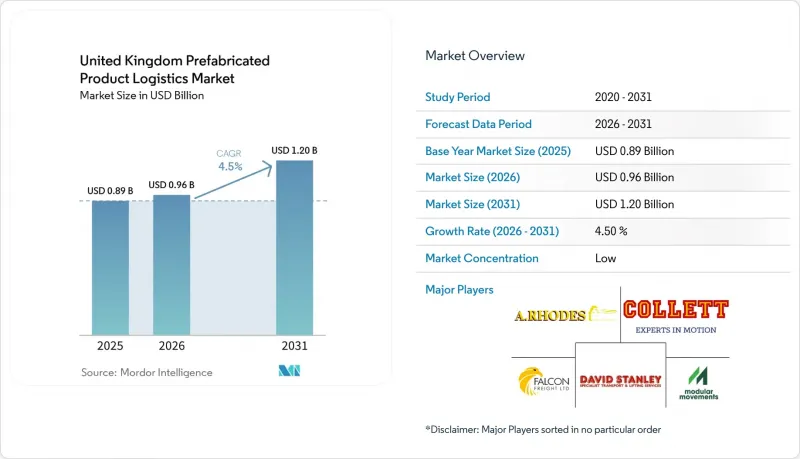
Housing delivery, public procurement, and factory-based construction continued to support the United Kingdom prefabricated product logistics market in 2026. This report is Segmented by Service (Transportation, Warehousing and Storage, Value-Added Services), by Product Type (Modular Buildings, Panelized and Componentized Systems, Other Prefab Types), and by Application (Residential Buildings, Commercial Buildings, Others). The Market Forecasts are Provided in Terms of Value (USD).
United Kingdom Prefabricated Product Logistics Market Trends and Insights
Housing Delivery Pressure and Public Framework Demand
The target of 1.5 million new homes by the end of the current Parliament remained a major demand signal for the United Kingdom prefabricated product logistics market. The Social and Affordable Homes Programme for 2026 to 2036 replaced the prior Affordable Homes Programme and accepted bids that used modern methods of construction. This approach supported a continuing flow of factory-made building components and related transport activity. It also made delivery coordination more important because factory output had to arrive when sites, cranes, labor, and local access arrangements were ready. A missed delivery window could disrupt the sequence of installation work, so logistics firms had a stronger role in protecting project schedules. The United Kingdom prefabricated product logistics market benefited when manufacturers and contractors treated transport planning as part of project delivery rather than a separate purchase. Homes England stated that agency-supported gross housing completions could rise from 40,000 a year in 2025 and 2026 to more than 80,000 a year by 2029 and 2030. Bidders could use off-site methods without a fixed requirement, which placed greater weight on program certainty and delivery performance. Providers that combined route surveys with time-window planning were better placed to support projects that needed dependable factory-to-site delivery.
Skilled Labor Scarcity and On-Site Productivity Constraints
England's construction workforce declined by 1.3% in 2025 to 2.23 million workers, and CITB projected a further 0.9% decline in 2026 before growth returned from 2027. Government modeling cited by the National Audit Office shows that housing delivery requires 317,000 additional workers, while the Warm Homes Plan requires 130,000, and infrastructure commitments require as many as 445,000 by 2030. The shortage is uneven across the country and affects the availability of site labor. It limits the capacity available for conventional construction tasks, particularly where projects need several trades to work in a tight sequence. Manufacturers could complete more repeatable work in factories, but this shifted pressure to the movement, storage, and controlled arrival of finished units. Specialist providers had to coordinate collections with production schedules and installations with site access restrictions. The National Audit Office also reported that 60% of United Kingdom colleges limited or closed construction apprenticeship courses in 2025, while 56% had waiting lists. Factory production reduced dependence on some site activities and raised the number of completed units that needed specialist movement. The United Kingdom prefabricated product logistics market, therefore, gained work as construction tasks moved from sites to controlled production settings.
High Factory CAPEX and Utilization Risk
Prefabricated product logistics volumes depended on the financial condition and factory use rates of off-site manufacturers. Automated production lines, quality systems, and dedicated factory sites required substantial capital investment. A production suspension or insolvency could remove shipment volumes for a logistics provider with little warning. The effect could extend beyond transport because providers also lost demand for storage, lifting, route planning, and site support. Equipment investments can be difficult to redeploy when trailers or cranes are selected for a narrow range of module dimensions. A broader client base and contracted minimum volumes offered some protection, although smaller firms could find these measures difficult to establish. Construction insolvencies totaled 4,411 in the year to March 2026 and remained 22% above pre-pandemic levels despite a 5% year-over-year decline. Firms reliant on a small group of manufacturers faced revenue gaps when factory utilization fell below viable levels. This risk was greater for operators who bought custom trailers or HIAB equipment designed around one module format.
Other drivers and restraints analyzed in the detailed report include:
- Net Zero Compliance and Low-Waste Offsite Delivery
- Industrial and Logistics Facility Expansion
- Certification, Valuation, and Mortgage Acceptance Friction
For complete list of drivers and restraints, kindly check the Table Of Contents.
Segment Analysis
Transportation held 67.20% of the United Kingdom prefabricated product logistics market share by value in 2025. The service linked off-site factories in Yorkshire, Humberside, the Midlands, and the South West with construction sites across the United Kingdom. Road transport dominated because many modular and panelized loads needed flatbed extenders, low-loaders, or HIAB-equipped rigid vehicles. These movements operated under the Road Vehicles Authorisation of Special Types General Order 2003 framework. The National Police Chiefs' Council guidance required 2 working days of notification for loads up to 80,000 kg and 5 days for loads up to 150,000 kg. Loads wider than 6.1 m or heavier than 150,000 kg require a Special Order through National Highways.
Value-added services recorded a 6.20% CAGR through 2031, the highest rate among service categories. These services included pre-delivery route surveys, traffic temporary road order management, lifting, crane work, staging, storage, and digital tracking. Clients increasingly sought one provider for these linked activities instead of transport alone. A combined service reduced the number of handovers between parties and gave the contractor a clearer view of where each assembly was in the delivery process. It also helped providers manage changes in site readiness, traffic controls, and lifting availability without separating responsibilities across several firms. These features supported the faster growth of value-added work within the United Kingdom prefabricated product logistics market. GS1 UK and NBS established a 2025 partnership to apply Global Trade Item Numbers to construction products, supporting standardized identification across supply chains. This approach supported clearer records from factory release through site receipt. Warehousing and storage continued to provide a buffer when factory completion dates and site readiness did not align.
Complete Report Scope:
- By Service
- Transportation
- Road
- Rail
- Air
- Sea and Inland Waterways
- Warehousing and Storage
- Value-Added Services
- Transportation
- By Product Type
- Modular Buildings
- Panelized and Componentized Systems
- Other Prefab Types
- By Application
- Residential Buildings
- Commercial Buildings
- Others
List of Companies Covered in this Report:
- Modular Movements Ltd
- David Stanley Transport Ltd
- WS Transportation Ltd
- Falcon Freight Ltd
- A. Rhodes Haulage Ltd
- Le Dale Transport Ltd
- AC Lifting Ltd
- Lymer's Assist Ltd
- Collett and Sons Ltd
- Dainton Storage Solutions Ltd
- Neill and Brown Ltd
- Musgrave Transport Ltd
- MRC Crane Hire
- Brookdale Transport
- Nortons Hiab Services
- Network Hiab
- Container Lifting UK
- Warrior Link
- Midlands Portable Buildings
- SJP Transport
Additional Benefits:
- The market estimate (ME) sheet in Excel format
- 3 months of analyst support
TABLE OF CONTENTS
1 Introduction
- 1.1 Study Assumptions and Market Definition
- 1.2 Scope of the Study
2 Research Methodology
3 Executive Summary
4 Market Landscape
- 4.1 Market Overview
- 4.2 Market Drivers
- 4.2.1 Housing Delivery Pressure and Public Framework Demand
- 4.2.2 Skilled Labor Scarcity and On-Site Productivity Constraints
- 4.2.3 Net Zero Compliance and Low-Waste Offsite Delivery
- 4.2.4 Traceability Demand for Complex Prefab Supply Chains
- 4.2.5 Planning and Route Constraints on Oversized Loads
- 4.2.6 Industrial and Logistics Facility Expansion
- 4.3 Market Restraints
- 4.3.1 High Factory CAPEX and Utilization Risk
- 4.3.2 Certification, Valuation, and Mortgage Acceptance Friction
- 4.3.3 Insolvency-Driven Trust Deficit Across the Supply Chain
- 4.3.4 Module Size Limits and Transport Complexity
- 4.4 Value / Supply-Chain Analysis
- 4.5 Regulatory Landscape
- 4.6 Technological Outlook
- 4.7 Porter's Five Forces Analysis
- 4.7.1 Bargaining Power of Suppliers
- 4.7.2 Bargaining Power of Buyers
- 4.7.3 Threat of New Entrants
- 4.7.4 Threat of Substitutes
- 4.7.5 Industry Rivalry
- 4.8 Impact of Geopolitical Events on the Market
5 Market Size and Growth Forecasts (Value in USD)
- 5.1 By Service
- 5.1.1 Transportation
- 5.1.1.1 Road
- 5.1.1.2 Rail
- 5.1.1.3 Air
- 5.1.1.4 Sea and Inland Waterways
- 5.1.2 Warehousing and Storage
- 5.1.3 Value-Added Services
- 5.1.1 Transportation
- 5.2 By Product Type
- 5.2.1 Modular Buildings
- 5.2.2 Panelized and Componentized Systems
- 5.2.3 Other Prefab Types
- 5.3 By Application
- 5.3.1 Residential Buildings
- 5.3.2 Commercial Buildings
- 5.3.3 Others
6 Competitive Landscape
- 6.1 Market Concentration
- 6.2 Strategic Moves
- 6.3 Market Share Analysis
- 6.4 Company Profiles (includes Global Level Overview, Market Level Overview, Core Segments, Financials as available, Strategic Information, Geographic Coverage, Products and Services, Recent Developments)
- 6.4.1 Modular Movements Ltd
- 6.4.2 David Stanley Transport Ltd
- 6.4.3 WS Transportation Ltd
- 6.4.4 Falcon Freight Ltd
- 6.4.5 A. Rhodes Haulage Ltd
- 6.4.6 Le Dale Transport Ltd
- 6.4.7 AC Lifting Ltd
- 6.4.8 Lymer's Assist Ltd
- 6.4.9 Collett and Sons Ltd
- 6.4.10 Dainton Storage Solutions Ltd
- 6.4.11 Neill and Brown Ltd
- 6.4.12 Musgrave Transport Ltd
- 6.4.13 MRC Crane Hire
- 6.4.14 Brookdale Transport
- 6.4.15 Nortons Hiab Services
- 6.4.16 Network Hiab
- 6.4.17 Container Lifting UK
- 6.4.18 Warrior Link
- 6.4.19 Midlands Portable Buildings
- 6.4.20 SJP Transport
7 Market Opportunities and Future Outlook
- 7.1 White-Space and Unmet-Need Assessment

