PUBLISHER: Mordor Intelligence | PRODUCT CODE: 2157105

PUBLISHER: Mordor Intelligence | PRODUCT CODE: 2157105
Indonesia Prefabricated Product Logistics - Market Share Analysis, Industry Trends & Statistics, Growth Forecasts (2026 - 2031)
According to Mordor Intelligence, the Indonesia prefabricated product logistics market size was valued at USD 366.86 million in 2025 and estimated to grow from USD 395.07 million in 2026 to reach USD 570.17 million by 2031, at a CAGR of 7.61% during the forecast period (2026-2031).
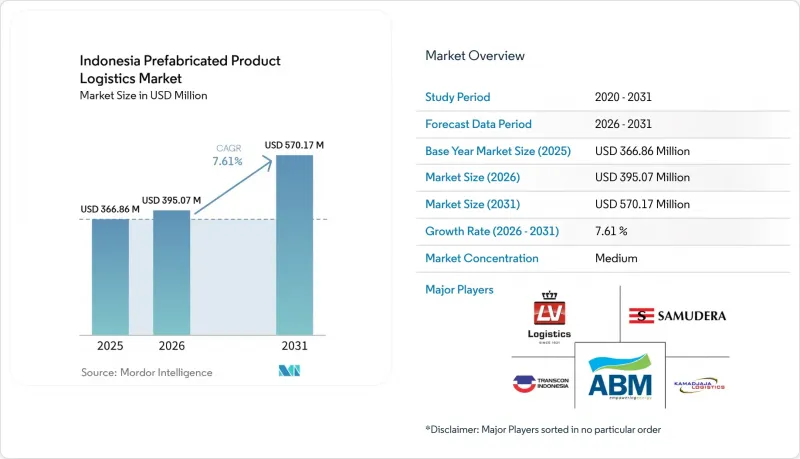
Government infrastructure delivery supports freight demand for factory-built components across roads, dams, irrigation systems, and housing projects. This report is Segmented by Service (Transportation, Warehousing and Storage, Value-Added Services), by Product Type (Modular Buildings, Panelized and Componentized Systems, Other Prefab Types), and by Application (Residential Buildings, Commercial Buildings, Others). The Market Forecasts are Provided in Terms of Value (USD).
Indonesia Prefabricated Product Logistics Market Trends and Insights
Government Infrastructure Delivery and Industrial Relocation Pipeline
Infrastructure activity converted into demand for prefabricated freight rather than only raising construction output. Nine toll roads were scheduled to enter service in 2026, while railway reactivation work expanded demand for route-specific logistics planning. IKN Nusantara required an estimated 300,000 construction workers, while East Kalimantan could supply fewer than 1/3 of that workforce. This gap increased reliance on modules shipped from factories in Java through roll-on-roll-off services. Industrial relocation from crowded Java corridors to special economic zones in Batam, Sulawesi, and East Kalimantan created additional demand for modular production facilities. The Indonesia prefabricated product logistics market, therefore, gained cargo volumes at both the factory origin and the destination project site.
Inter-Island Prefab Movement Efficiency Gains Versus Conventional Site Build
The cost advantage of prefabrication depends on well-designed transport and high cargo density. Flat-pack designs carried 16 units in a 40-foot high-cube container, which was 2 times the density of pre-assembled rigid cabins. The same designs generated ocean freight savings of 15% or more on Kalimantan routes. Indonesia allocated IDR 524.98 billion (USD 31.32 million) to the sea-toll program within the IDR 4.74 trillion (USD 282.81 million) marine public service obligation for 2026. These routes served frontier, outermost, and remote areas where shipments had previously been less economical. Zero Over-Dimension Over-Load enforcement also favored flat-pack configurations over oversized pre-assembled units.
High Inter-Island Freight, Handling, and Escort Costs for Large Modules
Freight economics remained the main structural constraint for large, rigid modules. PELNI adjusted tariffs from July 1, 2026, raising rates for dry high-cube containers, general cargo, and oversized cargo. The change passed higher costs directly to shippers of prefabricated units. Charter barges for remote locations remained costly and sensitive to weather conditions. Zero Over-Dimension Over-Load compliance addressed earlier distortion from overloading, but fleet upgrades raised near-term costs for smaller operators. The Indonesia prefabricated product logistics market faced the greatest pressure, where low shipment volumes could not absorb these costs.
Other drivers and restraints analyzed in the detailed report include:
- Expansion of Remote Mining, Energy, and Worker Camp Deployments
- Distributed Micro-Factories Near Demand Clusters for Delivery-Time Reduction
- Fragmented Permitting and Oversized Cargo Clearance Across Provinces
For complete list of drivers and restraints, kindly check the Table Of Contents.
Segment Analysis
Transportation held 65.20% of the Indonesia prefabricated product logistics market share in 2025 and remained the revenue base for the sector. Sea and inland waterway services carried modules between islands through roll-on-roll-off and flat-rack vessels. These routes had limited alternatives across Indonesia's archipelago. Road transport connected Java factories with ports and linked ports with inland project sites. Zero over-dimension overload rules encouraged dedicated flat-bed fleets designed for prefabricated loads.
Value-added services were the fastest-growing service segment at a 9.60% CAGR from 2026 to 2031. Warehousing and storage expanded through bonded logistics centers that staged modules before phased site delivery. Clients sought sequence-sorted delivery, site assembly coordination, and inventory visibility alongside transport. One notable example was CKB Logistics, which reported a 93.8% on-time delivery rate in 2024. PT Transcon Indonesia provided photographic documentation and real-time inventory visibility across 8 branches in 5 cities.
Complete Report Scope:
- By Service
- Transportation
- Road
- Rail
- Air
- Sea and Inland Waterways
- Warehousing and Storage
- Value-Added Services
- Transportation
- By Product Type
- Modular Buildings
- Panelized and Componentized Systems
- Other Prefab Types
- By Application
- Residential Buildings
- Commercial Buildings
- Others
List of Companies Covered in this Report:
- PT ABM Investama Tbk
- Kamadjaja Group
- PT Transcon Indonesia
- LV Logistics Group
- NYK Line
- HSN Group
- PT Multimodatrans Indonesia
- PT Arpeni Pratama Ocean Line Tbk
- Dewata Group
- Samudera Indonesia Group
- PT Puninar Saranaraya
- Pancaran Group
- PT Iron Bird Transport
- PT Cardig Logistics Indonesia
- PT Tangguh Logistindo
- Global Trans Logistics
- PT Bandar Indah Permata
- Cakra Global Logistik
- PT Serasi Logistics Indonesia (SELOG)
Additional Benefits:
- The market estimate (ME) sheet in Excel format
- 3 months of analyst support
TABLE OF CONTENTS
1 Introduction
- 1.1 Study Assumptions and Market Definition
- 1.2 Scope of the Study
2 Research Methodology
3 Executive Summary
4 Market Landscape
- 4.1 Market Overview
- 4.2 Market Drivers
- 4.2.1 Government Infrastructure Delivery and Industrial Relocation Pipeline
- 4.2.2 Inter-Island Prefab Movement Efficiency Gains Versus Conventional Site Build
- 4.2.3 Expansion of Remote Mining, Energy, and Worker Camp Deployments
- 4.2.4 Carbon and Material-Waste Reduction Requirements in Controlled Factory Production
- 4.2.5 Modularized Logistics Control Towers and Route Engineering for Oversized Loads
- 4.2.6 Distributed Micro-Factories Near Demand Clusters for Delivery-Time Reduction
- 4.3 Market Restraints
- 4.3.1 High Inter-Island Freight, Handling, and Escort Costs for Large Modules
- 4.3.2 Fragmented Permitting and Oversized Cargo Clearance Across Provinces
- 4.3.3 Limited Heavy-Lift Port, Road, and Bridge Readiness in Secondary Corridors
- 4.3.4 Demand Volatility and Capex Intensity of Specialized Prefab Logistics Networks
- 4.4 Value / Supply-Chain Analysis
- 4.5 Regulatory Landscape
- 4.6 Technological Outlook
- 4.7 Porter's Five Forces Analysis
- 4.7.1 Bargaining Power of Suppliers
- 4.7.2 Bargaining Power of Buyers
- 4.7.3 Threat of New Entrants
- 4.7.4 Threat of Substitutes
- 4.7.5 Industry Rivalry
- 4.8 Impact of Geopolitical Events on the Market
5 Market Size and Growth Forecasts (Value in USD)
- 5.1 By Service
- 5.1.1 Transportation
- 5.1.1.1 Road
- 5.1.1.2 Rail
- 5.1.1.3 Air
- 5.1.1.4 Sea and Inland Waterways
- 5.1.2 Warehousing and Storage
- 5.1.3 Value-Added Services
- 5.1.1 Transportation
- 5.2 By Product Type
- 5.2.1 Modular Buildings
- 5.2.2 Panelized and Componentized Systems
- 5.2.3 Other Prefab Types
- 5.3 By Application
- 5.3.1 Residential Buildings
- 5.3.2 Commercial Buildings
- 5.3.3 Others
6 Competitive Landscape
- 6.1 Market Concentration
- 6.2 Strategic Moves
- 6.3 Market Share Analysis
- 6.4 Company Profiles (includes Global Level Overview, Market Level Overview, Core Segments, Financials as available, Strategic Information, Geographic/Network Coverage, Products and Services, Recent Developments)
- 6.4.1 PT ABM Investama Tbk
- 6.4.2 Kamadjaja Group
- 6.4.3 PT Transcon Indonesia
- 6.4.4 LV Logistics Group
- 6.4.5 NYK Line
- 6.4.6 HSN Group
- 6.4.7 PT Multimodatrans Indonesia
- 6.4.8 PT Arpeni Pratama Ocean Line Tbk
- 6.4.9 Dewata Group
- 6.4.10 Samudera Indonesia Group
- 6.4.11 PT Puninar Saranaraya
- 6.4.12 Pancaran Group
- 6.4.13 PT Iron Bird Transport
- 6.4.14 PT Cardig Logistics Indonesia
- 6.4.15 PT Tangguh Logistindo
- 6.4.16 Global Trans Logistics
- 6.4.17 PT Bandar Indah Permata
- 6.4.18 Cakra Global Logistik
- 6.4.19 PT Serasi Logistics Indonesia (SELOG)
7 Market Opportunities and Future Outlook
- 7.1 White-Space and Unmet-Need Assessment

