PUBLISHER: Mordor Intelligence | PRODUCT CODE: 2157149

PUBLISHER: Mordor Intelligence | PRODUCT CODE: 2157149
Agritech - Market Share Analysis, Industry Trends & Statistics, Growth Forecasts (2026 - 2031)
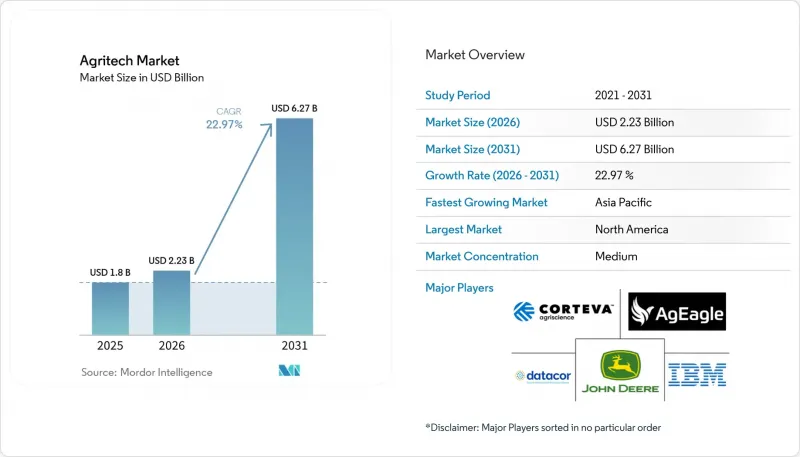
According to Mordor Intelligence, the agritech market size is anticipated to grow from USD 1.8 billion in 2025 to USD 2.23 billion in 2026 and is forecast to reach USD 6.27 billion by 2031 at a 22.97% CAGR over 2026-2031.
Global Agritech Market Trends and Insights
Rapid Cost Declines of Vision-Guided Field Robots
Autonomous robots equipped with computer vision fell below USD 50,000 in 2025, opening the Agritech market to mid-sized farms that previously relied on manual labor. In 2025, Aigen, inc. has introduced the solar-powered Element Gen2 robot designed for weeding crops. Each Element robot operates autonomously and can cover up to 20 acres. John Deere has enhanced its fully autonomous tractor technology, unveiling second-generation AI-powered autonomous machines at CES 2025 to tackle significant skilled labor shortages in agriculture. It plans to introduce its next-generation "Autonomy 2.0" perception system, with a full release scheduled for 2026. This system offers 360-degree operation with "set-and-forget" functionality, enabling unattended overnight field preparation and improved operational speed. Advanced cameras and AI enable driverless operation, addressing labor shortages and reducing costs during high-demand seasons. Similar cost trajectories are visible in Japan, where Kubota's rice transplanters cut transplanting time by 40%. The spread of robot-as-a-service contracts further transforms spending from capex (capital expenditure) to predictable monthly fees.
Edge-AI Chips Enabling On-Device Analytics
Low-power neural processing units now deliver more than 250 TOPS (tera operations per second) while consuming less than 15 watts, so drones and ground robots can classify weeds or detect disease without a network hop. In 2025-2026, a notable shift allows advanced AI tasks, such as Local Large Language Models (LLMs) and intricate computer vision, to operate directly on devices, eliminating the need for cloud connectivity. NVIDIA Corporation's Jetson Orin module, deployed across multiple Agritech market segments during 2024, exemplifies this leap. Trimble embedded similar edge inference in its guidance consoles in 2025, creating prescription maps in seconds and bypassing cloud costs. In India, Cropin Technology fitted smartphone cameras with edge analytics to serve areas where 4G coverage remains under 60%. With this technology, users can conduct real-time field analyses such as pest detection and crop health assessments directly on their devices, reducing the need for constant cloud connectivity. The same architecture addresses data sovereignty rules by keeping sensor streams on-premises.
Limited Rural Connectivity Bandwidth
In 2024, approximately 83% of urban residents worldwide are anticipated to use the Internet, compared to 48% of the rural population. Among the estimated 2.6 billion people offline in 2024, 1.8 billion reside in rural areas. High latency above 500 milliseconds renders real-time variable-rate spraying impractical, limiting use cases to post-harvest analytics. The United States allocated USD 40 million for fiber build-out in 2025, yet completions stretch to 2028. The United States telecom industry experienced its most significant single-year growth in 2025, with the addition of approximately 11.8 million new fiber-to-the-home (FTTH) passings. This expansion increased total United States fiber coverage to over 60% of households. As of early 2026, India's BharatNet project is undergoing significant expansion under the revised, higher-budget framework known as the Amended BharatNet Program. This initiative aims to connect all 650,000 villages. While substantial progress has been achieved, challenges in implementation persist. The original target was limited to 250,000 Gram Panchayats (GPs), but the current scope has been considerably expanded. The divide forces vendors to design hybrid cloud-edge stacks, fragmenting software ecosystems inside the Agritech market.
Other drivers and restraints analyzed in the detailed report include:
- Adoption of Farming-as-a-Service Subscription Models
- Acute Farm-Labor Shortages
- Data-Ownership and Sovereignty Concerns
For complete list of drivers and restraints, kindly check the Table Of Contents.
Segment Analysis
Big Data and Analytics accounted for 35% of the Agritech market size in 2025 as satellite imagery and sensor fusion optimized seeding rates, fertilizer doses, and irrigation scheduling. Robotics and Automation are projected to have the fastest 29% CAGR from 2026 to 2031 because camera-guided weeders and autonomous harvesters directly offset labor shortages. Sensors and connected devices accounted for a significant share of the agritech market, driven by declining chip prices. Biotechnology tools represented a smaller portion, supported by AI-driven gene-editing and phenotyping pipelines. The remaining share was attributed to blockchain traceability and supply chain software.
Robotics is narrowing the gap with analytics as capital outlays drop and financing models expand. In 2025, John Deere customers reduced non-residual herbicide usage by approximately 50% with the use of the See and Spray system across 5 million acres of farmland, saving nearly 31 million gallons of herbicide mix. Kubota reached an increased penetration of autonomous rice planters in Japan during 2025. Sensor commoditization is steering suppliers toward service bundles that lock customers in with decision support rather than hardware margins. Biotechnology Tools should accelerate as seed companies adopt AI to shorten breeding cycles for climate-resilient varieties.
Complete Report Scope:
- By Type
- Biotechnology and Biotech
- Big Data and Analytics
- Robotics and Automation
- Sensors and Connected Devices
- Others
- By Application
- Broad Acre Applications
- Field Mapping
- Seeding and Planting
- Fertilizing and Irrigation
- Intercultural Operations
- Picking and Harvesting
- Livestock Farm Management
- Milking
- Shepherding and Herding
- Others
- Indoor Farming
- Agrochemicals
- Aerial Data Collection
- Weather Tracking and Forecasting
- Supply Chain Management
- Inventory Management
- Others
- Broad Acre Applications
- By Offering
- Hardware
- Software
- Other Products
- Services
- By Geography
- North America
- United States
- Canada
- Mexico
- Rest of North America
- Europe
- Germany
- United Kingdom
- France
- Spain
- Italy
- Rest of Europe
- Asia-Pacific
- China
- Japan
- India
- Australia
- Rest of Asia-Pacific
- South America
- Brazil
- Argentina
- Rest of South America
- Africa
- South Africa
- Rest of Africa
- Middle East
- United Arab Emirates
- Saudi Arabia
- Rest of Middle East
- North America
Geography Analysis
North America controlled 41% of the Agritech market revenue in 2025. Broadband grants totaling USD 40 million in the United States aim to address the analytics latency gap. In Canada, CAD 50 million (USD 37 million) was co-invested in AgriTech startups specializing in livestock and carbon programs. In Alberta(Canada), Olds College Smart Farm manages a 2,800-acre site dedicated to testing agricultural technologies, including drones, sensors, and artificial intelligence. Government initiatives, such as the Agricultural Clean Technology Program, facilitate the adoption of these technologies on farms. Mexico has implemented multispectral drones in avocado and berry orchards to enable early detection of water stress.
In Europe, the Common Agricultural Policy allocated heavily for precision tools. Germany is at the forefront of autonomous tractor adoption, with companies such as Fendt and Claas incorporating AI-based guidance systems. In the United Kingdom, subsidy payments are linked to verified environmental outcomes, driving the adoption of software that tracks soil health. Additionally, carbon monetization frameworks are increasing the demand for comprehensive data logs across the region.
Asia-Pacific is on pace for a 27.5% CAGR during 2026-2031, the fastest global rate. China allocated CNY 10 billion (USD 1.4 billion) in subsidies for smart equipment in 2024. India aims to digitize 100 million smallholder farmers by 2027 through an INR 2,817 crore (USD 337 million) farmer database initiative. Japan has committed to funding robotic rice transplanters to address its aging workforce. Australia is utilizing soil sensors and satellite imagery to manage drought risks across its grain belts. In South America, Brazil integrates AI across sugarcane and soybean chains to meet export standards. Africa grows through smart-farm pilots in Egypt and South Africa, including IBM-led irrigation scheduling over several hectares. The Middle East is driven by the United Arab Emirates and Saudi Arabia's indoor farming investments.
- Deere & Company
- Harvest Automation, Inc.
- AGCO Corporation
- Naio Technologies SAS
- CNH Industrial N.V.
- AgEagle Aerial Systems Inc.
- International Business Machines Corporation
- Corteva Agriscience
- Datacor, Inc (Format Solution)
- Trimble Inc.
- CropX Technologies Ltd.
- Alltech Inc.
- Kubota Corporation
- Valmont Industries, Inc. (Prospera)
- Syngenta Group
Additional Benefits:
- The market estimate (ME) sheet in Excel format
- 3 months of analyst support
TABLE OF CONTENTS
1 Introduction
- 1.1 Study Assumptions and Market Definition
- 1.2 Scope of the Study
2 Research Methodology
3 Executive Summary
4 Market Landscape
- 4.1 Market Overview
- 4.2 Market Drivers
- 4.2.1 Rapid cost declines of vision-guided field robots
- 4.2.2 Edge-AI chips enabling on-device analytics
- 4.2.3 Adoption of farming-as-a-service subscription models
- 4.2.4 Government smart-farm grant programs
- 4.2.5 Acute farm-labor shortages
- 4.2.6 Carbon-credit monetization of AI-optimized practices
- 4.3 Market Restraints
- 4.3.1 Limited rural connectivity bandwidth
- 4.3.2 Data-ownership and sovereignty concerns
- 4.3.3 High annual maintenance fees for autonomous fleets
- 4.3.4 Short lifecycle of sensor hardware
- 4.4 Regulatory Landscape
- 4.5 Technological Outlook
- 4.6 Industry Attractiveness - Porter's Five Forces Analysis
- 4.6.1 Bargaining Power of Suppliers
- 4.6.2 Bargaining Power of Buyers
- 4.6.3 Threat of New Entrants
- 4.6.4 Threat of Substitute Products
- 4.6.5 Intensity of Competitive Rivalry
5 Market Size and Growth Forecasts (Value)
- 5.1 By Type
- 5.1.1 Biotechnology and Biotech
- 5.1.2 Big Data and Analytics
- 5.1.3 Robotics and Automation
- 5.1.4 Sensors and Connected Devices
- 5.1.5 Others
- 5.2 By Application
- 5.2.1 Broad Acre Applications
- 5.2.1.1 Field Mapping
- 5.2.1.2 Seeding and Planting
- 5.2.1.3 Fertilizing and Irrigation
- 5.2.1.4 Intercultural Operations
- 5.2.1.5 Picking and Harvesting
- 5.2.2 Livestock Farm Management
- 5.2.2.1 Milking
- 5.2.2.2 Shepherding and Herding
- 5.2.2.3 Others
- 5.2.3 Indoor Farming
- 5.2.4 Agrochemicals
- 5.2.5 Aerial Data Collection
- 5.2.6 Weather Tracking and Forecasting
- 5.2.7 Supply Chain Management
- 5.2.8 Inventory Management
- 5.2.9 Others
- 5.2.1 Broad Acre Applications
- 5.3 By Offering
- 5.3.1 Hardware
- 5.3.2 Software
- 5.3.3 Other Products
- 5.3.4 Services
- 5.4 By Geography
- 5.4.1 North America
- 5.4.1.1 United States
- 5.4.1.2 Canada
- 5.4.1.3 Mexico
- 5.4.1.4 Rest of North America
- 5.4.2 Europe
- 5.4.2.1 Germany
- 5.4.2.2 United Kingdom
- 5.4.2.3 France
- 5.4.2.4 Spain
- 5.4.2.5 Italy
- 5.4.2.6 Rest of Europe
- 5.4.3 Asia-Pacific
- 5.4.3.1 China
- 5.4.3.2 Japan
- 5.4.3.3 India
- 5.4.3.4 Australia
- 5.4.3.5 Rest of Asia-Pacific
- 5.4.4 South America
- 5.4.4.1 Brazil
- 5.4.4.2 Argentina
- 5.4.4.3 Rest of South America
- 5.4.5 Africa
- 5.4.5.1 South Africa
- 5.4.5.2 Rest of Africa
- 5.4.6 Middle East
- 5.4.6.1 United Arab Emirates
- 5.4.6.2 Saudi Arabia
- 5.4.6.3 Rest of Middle East
- 5.4.1 North America
6 Competitive Landscape
- 6.1 Market Concentration
- 6.2 Strategic Moves
- 6.3 Market Share Analysis
- 6.4 Company Profiles (Includes Global Level Overview, Market Level overview, Core Segments, Financials as Available, Strategic Information, Market Rank/Share for Key Companies, Products and Services, and Recent Developments)
- 6.4.1 Deere & Company
- 6.4.2 Harvest Automation, Inc.
- 6.4.3 AGCO Corporation
- 6.4.4 Naio Technologies SAS
- 6.4.5 CNH Industrial N.V.
- 6.4.6 AgEagle Aerial Systems Inc.
- 6.4.7 International Business Machines Corporation
- 6.4.8 Corteva Agriscience
- 6.4.9 Datacor, Inc (Format Solution)
- 6.4.10 Trimble Inc.
- 6.4.11 CropX Technologies Ltd.
- 6.4.12 Alltech Inc.
- 6.4.13 Kubota Corporation
- 6.4.14 Valmont Industries, Inc. (Prospera)
- 6.4.15 Syngenta Group
7 Market Opportunities and Future Outlook

