PUBLISHER: Mordor Intelligence | PRODUCT CODE: 2163346

PUBLISHER: Mordor Intelligence | PRODUCT CODE: 2163346
Molecular Sieve Desiccants - Market Share Analysis, Industry Trends & Statistics, Growth Forecasts (2026 - 2031)
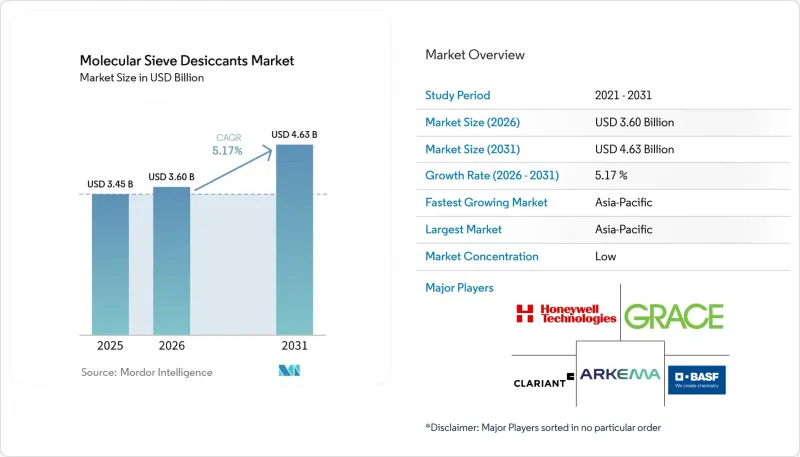
According to Mordor Intelligence, the molecular sieve desiccants market size was valued at USD 3.45 billion in 2025 and is estimated to grow from USD 3.60 billion in 2026 to USD 4.63 billion by 2031, at a CAGR of 5.17% during the forecast period (2026-2031).
Global Molecular Sieve Desiccants Market Trends and Insights
Expansion of Natural Gas Processing and LNG Dehydration
Global LNG liquefaction projects through 2030 are increasing demand for 3A and 4A molecular sieves in the molecular sieve desiccants market. Projects on the U.S. Gulf Coast, Qatar's North Field expansion, and emerging African export projects require dehydration equipment before liquefaction. LNG production requires water removal to below 0.1 ppmv, a level that molecular sieve beds can achieve. In September 2026, BASF announced that Cheniere Energy commissioned Durasorb LNG MAX across multiple trains at Corpus Christi, with the remaining trains targeted for completion by the end of 2027. The technology removes heavy hydrocarbons, benzene, toluene, ethylbenzene, xylene (BTEX), and water in a single adsorption unit. Variable cycling adjusts the adsorption cycle length based on bed age, supporting service life, and fuel efficiency. Each new LNG train also generates replacement demand, as adsorbent contracts recur every 3 to 7 years.
Rising Moisture-Control Requirements in Pharmaceuticals and Electronics
Pharmaceutical packaging requires validated desiccant performance within the container-closure system under U.S. Food and Drug Administration (FDA) and United States Pharmacopeia (USP) requirements. International Council for Harmonization (ICH) stability testing and EU good manufacturing practice requirements also require manufacturers to assess material interactions, extractables, and leachables. These compliance requirements support the recurring purchase of precision-grade molecular sieves following product-system validation. Under its Production Linked Incentive scheme, India commissioned 38 greenfield bulk drug projects, establishing 56,800 tons of annual domestic active pharmaceutical ingredient (API) capacity. This capacity creates demand for 3A and 4A zeolite desiccants for pharmaceutical moisture management. Electronics applications require low relative humidity during the cleanroom transport and storage of advanced semiconductors, organic light-emitting diode (OLED) components, and AI accelerator packages. The expansion of pharmaceutical and electronics activities in the Asia-Pacific supports demand for molecular sieve desiccants.
Energy-Intensive Activation and Regeneration
Thermal swing adsorption regeneration requires operators to heat zeolite beds to 200-350 °C using steam- or gas-fired heaters. A study of single-layer 3A zeolite beds reported energy consumption of 15-20 MJ per kg of water removed. This energy requirement can limit adoption in cost-sensitive applications and affect the lifecycle cost comparison with competing technologies. A 2025 Scientific Reports study found that microwave-assisted regeneration of 13X reduced energy consumption from 0.62 kWh to 0.06 kWh at equivalent regeneration temperatures. In the referenced study, layered beds combining silica gel and 3A zeolite reduced energy consumption from 19.57 MJ/kg to 4.51 MJ/kg. However, the same configuration increased the adsorption cycle time from 760 minutes to 1,530 minutes. Heat integration and variable cycling can reduce this constraint; however, energy costs remain a commercial consideration in the molecular sieve desiccants market.
Other drivers and restraints analyzed in the detailed report include:
- Growth of High-Purity Industrial Gas and Air-Separation Systems
- Industrialization and Manufacturing Expansion in the Asia-Pacific
- Competition From Membranes, Silica Gel, and Activated Alumina
For complete list of drivers and restraints, kindly check the Table Of Contents.
Segment Analysis
Beads accounted for 46.73% of the molecular sieve desiccants market in 2025. Their spherical geometry reduces bed pressure drop compared with extruded pellets in adsorption systems. Lower pressure drop can reduce the energy requirements of the blower and compressor during the adsorption cycle. Beads also help control dust in gas-phase dryer columns, making them suitable for continuous twin-tower and multi-bed dryer configurations. Established industrial drying systems continue to use bead-based molecular sieve desiccants.
Pellets are forecast to grow at a 5.56% CAGR through 2031 in the molecular sieve desiccants market. Their crush strength and controlled geometry support their use in fixed-bed reactors, pharmaceutical blister lines, and compact automotive air-brake dryers. Powder remains important in applications that require uniform dispersion in coatings, adhesives, sealants, elastomers, and polyurethane formulations. In these liquid applications, physical dispersion is more important than bed hydraulics. A 2024 study found that regenerated molecular sieves retained 80-90% of their original adsorption capacity after thermal treatment, thereby reducing replacement frequency in mature installations. Therefore, adoption in new applications will support demand growth across the molecular sieve desiccants market.
Type 4A accounted for 28.12% of the molecular sieve desiccants market in 2025. It is used in static packaging, industrial gas drying, refrigerant moisture removal, and solvent dehydration. This range of applications supports its position as a general-purpose desiccant. Type 3A remains important for natural gas and liquefied natural gas (LNG) dehydration, as well as polar liquid drying. Its pore structure excludes hydrocarbon molecules in certain applications, thereby preserving adsorption capacity. Type 5A is used for normal- and isoparaffin separation and for nitrogen and oxygen adsorption.
Type 13X is forecast to grow at a CAGR of 5.71% through 2031. Demand will stem from air separation units, carbon dioxide removal in biogas upgrading, and drying circuits for hydrofluoroolefin (HFO) refrigerants. The material can remove both moisture and carbon dioxide in suitable air-purification applications. A 2026 pressure swing adsorption study reported that 13X achieved oxygen purity of up to 95.9%. Other molecular sieve types include LiX and high-silica formulations, which are used in carbon capture and specialty gas purification. These specialized products face fewer commodity competitors in applications that require proprietary crystal engineering. This mix of performance requirements supports a broader product base for the molecular sieve desiccants market.
Complete Report Scope:
- By Form
- Beads
- Pellets
- Powder
- By Type
- 3A
- 4A
- 5A
- 13X
- Other Molecular Sieve Types
- By Application
- Refinery
- Industrial Drying
- Air Brakes
- Packaging
- Coatings, Adhesives, Sealants and Elastomers
- Refrigerant
- Insulation Glass
- Other Applications
- By End-User Industry
- Oil and Gas
- Pharmaceutical
- Electronics and Semiconductors
- Food and Beverage
- Chemicals and Petrochemicals
- Automotive and Transportation
- Other End Users
- By Geography
- Asia-Pacific
- China
- India
- Japan
- South Korea
- ASEAN Countries
- Rest of Asia-Pacific
- North America
- United States
- Canada
- Mexico
- Europe
- Germany
- United Kingdom
- France
- Italy
- NORDIC Countries
- Rest of Europe
- South America
- Brazil
- Argentina
- Rest of South America
- Middle East and Africa
- Saudi Arabia
- South Africa
- Rest of Middle East and Africa
- Asia-Pacific
Geography Analysis
Asia-Pacific held 39.41% of the molecular sieve desiccants market share in 2025 and is forecast to grow at a CAGR of 6.11% through 2031. China has manufacturing bases in Pingxiang, Ningbo, and Dalian and serves as a demand center for refining, liquefied natural gas (LNG) terminals, and semiconductor fabrication. India's Production Linked Incentive program supported 38 greenfield bulk-drug projects, with a combined annual active pharmaceutical ingredient (API) capacity of 56,800 tons. This capacity supports demand for 3A and 4A desiccants in processing and packaging applications. Japan and South Korea generate demand from electronics and precision chemical manufacturing.
North America accounted for a share of revenue in 2025, supported by LNG export terminals and ethylene cracker complexes along the U.S. Gulf Coast. Plaquemines LNG, Golden Pass LNG, and related projects support procurement of dehydration equipment through 2028. Canada contributes to demand through oil sands gas processing, while Mexico supports demand through petrochemical manufacturing. Europe generates unit-value demand from insulation glass and pharmaceutical applications. The Energy Performance of Buildings Directive supports energy-efficiency requirements across the European building stock. BASF's Ludwigshafen site supports the regional production of specialty zeolite products.
South America's molecular sieve desiccants market is supported by Brazil's pre-salt gas processing activities and Argentina's LNG ambitions in Vaca Muerta. As gas infrastructure becomes operational, these investments can create recurring demand for adsorbents. The Middle East and Africa consume less molecular sieve material per unit of gas reserves. Saudi Arabia's downstream diversification program and South Africa's industrial gas sector support existing demand. East African LNG projects anticipated through 2030 may increase demand for dehydration systems. The Middle East combines wellhead gas production, LNG export targets, and petrochemical integration, supporting long-term supply contracts for premium grades and technical services in the molecular sieve desiccants market.
- Arkema
- Axens
- BASF
- Bear River Zeolite Co.
- CLARIANT
- CWK Chemiewerk Bad Kostritz GmbH
- HengYe Inc.
- Honeywell International Inc
- JALON
- KNT Group
- Sorbchem India
- Tosoh Corporation
- W. R. Grace & Co.
- Zeochem
- Zeolyst
Additional Benefits:
- The market estimate (ME) sheet in Excel format
- 3 months of analyst support
TABLE OF CONTENTS
1 Introduction
- 1.1 Study Assumptions and Market Definition
- 1.2 Scope of the Study
2 Research Methodology
3 Executive Summary
4 Market Landscape
- 4.1 Market Overview
- 4.2 Market Drivers
- 4.2.1 Expansion of Natural Gas Processing and LNG Dehydration
- 4.2.2 Rising Moisture-Control Requirements in Pharmaceuticals and Electronics
- 4.2.3 Growth of High-Purity Industrial Gas and Air-Separation Systems
- 4.2.4 Industrialization and Manufacturing Expansion in Asia-Pacific
- 4.2.5 Application-Specific Pore Engineering for Low-Emission Processing
- 4.3 Market Restraints
- 4.3.1 Energy-Intensive Activation and Regeneration
- 4.3.2 Competition From Membranes, Silica Gel and Activated Alumina
- 4.3.3 Feedstock and Specialty Raw-Material Price Volatility
- 4.4 Value Chain Analysis
- 4.5 Porter's Five Forces Analysis
- 4.5.1 Bargaining Power of Suppliers
- 4.5.2 Bargaining Power of Buyers
- 4.5.3 Threat of New Entrants
- 4.5.4 Threat of Substitutes
- 4.5.5 Competitive Rivalry
5 Market Size and Growth Forecasts (Value)
- 5.1 By Form
- 5.1.1 Beads
- 5.1.2 Pellets
- 5.1.3 Powder
- 5.2 By Type
- 5.2.1 3A
- 5.2.2 4A
- 5.2.3 5A
- 5.2.4 13X
- 5.2.5 Other Molecular Sieve Types
- 5.3 By Application
- 5.3.1 Refinery
- 5.3.2 Industrial Drying
- 5.3.3 Air Brakes
- 5.3.4 Packaging
- 5.3.5 Coatings, Adhesives, Sealants and Elastomers
- 5.3.6 Refrigerant
- 5.3.7 Insulation Glass
- 5.3.8 Other Applications
- 5.4 By End-User Industry
- 5.4.1 Oil and Gas
- 5.4.2 Pharmaceutical
- 5.4.3 Electronics and Semiconductors
- 5.4.4 Food and Beverage
- 5.4.5 Chemicals and Petrochemicals
- 5.4.6 Automotive and Transportation
- 5.4.7 Other End Users
- 5.5 By Geography
- 5.5.1 Asia-Pacific
- 5.5.1.1 China
- 5.5.1.2 India
- 5.5.1.3 Japan
- 5.5.1.4 South Korea
- 5.5.1.5 ASEAN Countries
- 5.5.1.6 Rest of Asia-Pacific
- 5.5.2 North America
- 5.5.2.1 United States
- 5.5.2.2 Canada
- 5.5.2.3 Mexico
- 5.5.3 Europe
- 5.5.3.1 Germany
- 5.5.3.2 United Kingdom
- 5.5.3.3 France
- 5.5.3.4 Italy
- 5.5.3.5 NORDIC Countries
- 5.5.3.6 Rest of Europe
- 5.5.4 South America
- 5.5.4.1 Brazil
- 5.5.4.2 Argentina
- 5.5.4.3 Rest of South America
- 5.5.5 Middle East and Africa
- 5.5.5.1 Saudi Arabia
- 5.5.5.2 South Africa
- 5.5.5.3 Rest of Middle East and Africa
- 5.5.1 Asia-Pacific
6 Competitive Landscape
- 6.1 Market Concentration
- 6.2 Strategic Moves
- 6.3 Market Share (%)/Ranking Analysis
- 6.4 Company Profiles (includes Global Overview, Market Overview, Core Segments, Financials as available, Strategic Information, Products and Services, and Recent Developments)
- 6.4.1 Arkema
- 6.4.2 Axens
- 6.4.3 BASF
- 6.4.4 Bear River Zeolite Co.
- 6.4.5 CLARIANT
- 6.4.6 CWK Chemiewerk Bad Kostritz GmbH
- 6.4.7 HengYe Inc.
- 6.4.8 Honeywell International Inc
- 6.4.9 JALON
- 6.4.10 KNT Group
- 6.4.11 Sorbchem India
- 6.4.12 Tosoh Corporation
- 6.4.13 W. R. Grace & Co.
- 6.4.14 Zeochem
- 6.4.15 Zeolyst
7 Market Opportunities and Future Outlook
- 7.1 White-Space and Unmet-Need Assessment

