PUBLISHER: Mordor Intelligence | PRODUCT CODE: 2163355

PUBLISHER: Mordor Intelligence | PRODUCT CODE: 2163355
Indonesia Project Cargo Logistics - Market Share Analysis, Industry Trends & Statistics, Growth Forecasts (2026 - 2031)
According to Mordor Intelligence, the Indonesia project cargo logistics market size was valued at USD 7.87 billion in 2025 and is estimated to grow from USD 8.50 billion in 2026 to reach USD 12.34 billion by 2031, at a CAGR of 7.74% during the forecast period 2026 to 2031.
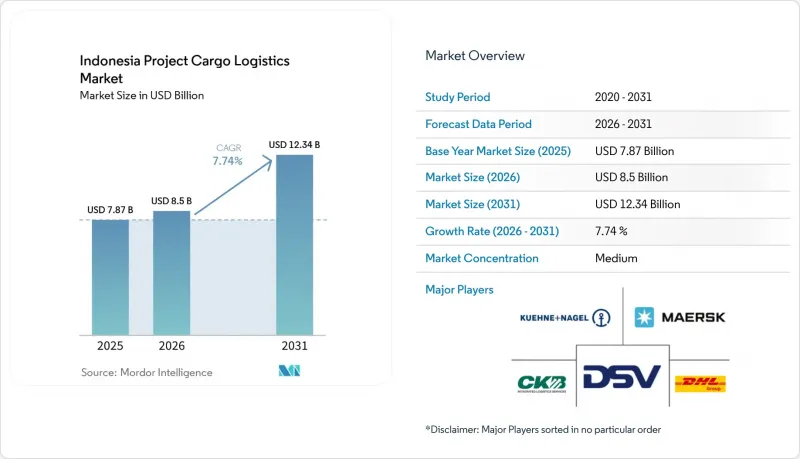
Government infrastructure programs and industrial processing investments are creating simultaneous demand for specialized transport across several islands. This report is Segmented by Service (Transportation, Warehousing, Distribution & Inventory Management, and More), by Cargo Type (Oversized/OOG, Heavy-Lift Cargo, and More), by End-User Industry (Oil & Gas, Mining and Quarrying, Energy Generation and Transmission, and More), and by Region (Java, Sumatra, Kalimantan, Sulawesi, and More). The Market Forecasts are Provided in Terms of Value (USD).
Indonesia Project Cargo Logistics Market Trends and Insights
Infrastructure Projects Increasing Specialized Project Logistics Demand
Indonesia's infrastructure investment cycle covers toll roads, ports, airports, power generation, and new capital construction at the same time. The IKN Authority awarded IDR 3 trillion (USD 179.5 million) in November 2025 for legislative and judicial zone infrastructure scheduled through December 2027. These contracts create sustained equipment flows from Java into Kalimantan. PT PP's USD 143 million New Priok Eastern Access Section II project began in 2025 and connected the Nusantara Bonded Zone with New Priok Container Terminal 1. The project improves the last-mile route for large equipment entering through Tanjung Priok. Each infrastructure project also requires crane mobilization, staging-yard management, permit coordination, and marine assurance, which expands the Indonesia project cargo logistics market beyond conventional freight assignments.
Renewable Energy Expansion Driving Heavy-Lift Transport Requirements
PLN's RUPTL 2025 to 2034 includes 42.6 GW of new renewable capacity, representing 61% of planned capacity additions. In August 2026, President Prabowo launched construction of the 134 MWp Gajah Mungkur floating solar plant in Central Java, supported by IDR 1.6 trillion (USD 90.2 million) in investment. Renewable equipment has large dimensions, even when individual items weigh less than conventional oil and gas modules. This profile requires flat-bed and RoRo transport, route-clearance permits, and marine-transit planning. Pelindo Regional 2 Banten handled 347,850 MT of windmill tower general cargo through Ciwandan in 2025, and handled 269,006 MT from January through August 2026. The Indonesia project cargo logistics market, therefore, needs operating capabilities that match renewable components rather than only traditional heavy modules.
Archipelagic Transshipment Increasing Project Logistics Cost Complexity
Indonesia's geography requires most outer-island project cargo to pass through at least 1 transshipment point. This adds handling steps, delivery time, and cargo risk to movements outside the main western corridors. The Sea Toll program allocated IDR 623.4 billion (USD 35.28 million) across 756 voyages serving 104 ports in 2025. Eastbound and westbound cargo flows remain uneven, which raises empty repositioning costs. The Indonesia project cargo logistics market faces a structural cost floor in eastern locations, where providers need denser networks to improve margins.
Other drivers and restraints analyzed in the detailed report include:
- Mining Downstreaming Expanding Industrial Project Cargo Volumes
- Manufacturing Localization Increasing Industrial Logistics Project Activity
- Permitting and Axle Rules Delaying Cargo Movements
For complete list of drivers and restraints, kindly check the Table Of Contents.
Segment Analysis
Transportation accounted for 58.85% of Indonesia project cargo logistics market share in 2025, while value-added services and others are projected to record an 8.69% CAGR through 2031, reflecting the continued importance of physical project movements alongside increasing demand for integrated logistics support. Transportation covers road delivery, sea and barge transit, air charters, and emerging rail links in Java, with mode selection depending on cargo dimensions, project location, delivery timelines, and site accessibility. Warehousing, distribution, and inventory management support staging and sequencing before installation, allowing contractors to pre-position equipment closer to remote project sites and reduce delays during project execution.
Value-added services are increasingly being combined with transport contracts and include engineering reviews, route surveys, marine assurance, and on-site supervision. Kuehne+Nagel's renewed 4-year LNG resupply contract at Lamongan Shorebase, combined with marine assets, staging-yard management, and specialist personnel, illustrated the broader shift toward integrated project logistics solutions. The PLB framework can also support project logistics by deferring import duties and enabling customs processing away from congested port locations, improving inventory and cash-flow management for EPC contractors. The Indonesia project cargo logistics market, therefore, increasingly requires providers to combine transportation with staging, technical support, customs coordination, and on-site execution capabilities.
Complete Report Scope:
- By Service
- Transportation
- Road
- Rail
- Air
- Sea / Barge
- Warehousing, Distribution & Inventory Management
- Value-Added Services & Others
- Transportation
- By Cargo Type
- Oversized / Out-of-Gauge Cargo
- Heavy-Lift Cargo
- Breakbulk Project Cargo
- Other Specialized Project Cargo
- By End-User Industry
- Oil and Gas, Mining and Quarrying
- Energy Generation and Transmission (Includes Renewable Energy)
- Construction and Infrastructure
- Manufacturing and Industrial Plants
- Aerospace and Defense
- Others (Maritime and Shipbuilding, Telecommunications, etc.)
- By Region
- Java (Jakarta and BOD)
- Sumatra
- Kalimantan
- Sulawesi
- Bali and Nusa Tenggara
- Papua Region and Maluku Islands
List of Companies Covered in this Report:
- DHL Group
- DSV A/S
- Kuehne+Nagel International AG
- A.P. Moller - Maersk
- CEVA Logistics
- GEODIS
- deugro
- Nippon Express (NX Group) Indonesia
- F.H. Bertling Logistics
- Noatum Logistics
- PT Cipta Krida Bahari (CKB Logistics)
- PT Samudera Indonesia Tbk
- Meratus Group
- PT Puninar Logistics
- PT Kamadjaja Logistics
- PT Dunia Express Transindo
- PT Serasi Logistics Indonesia (SELOG)
- PT TEMAS Tbk
- Pancaran Group
- Cakra Global Logistik
- PT Synthesis Project Logistics
- Sinotrans Indonesia
Additional Benefits:
- The market estimate (ME) sheet in Excel format
- 3 months of analyst support
TABLE OF CONTENTS
1 INTRODUCTION
- 1.1 Study Assumptions and Market Definition
- 1.2 Scope of the Study
2 RESEARCH METHODOLOGY
3 EXECUTIVE SUMMARY
- 3.1 Market Size, Growth, and Forecast Outlook
- 3.2 Key Demand Drivers and Project Logistics Trends
- 3.3 Major Project Corridors and Cargo Concentration
- 3.4 Competitive Landscape and Leading Project Logistics Providers
4 MARKET LANDSCAPE
- 4.1 Market Overview and Importance of Project Cargo Logistics
- 4.2 Market Drivers
- 4.2.1 Infrastructure Projects Increasing Specialized Project Logistics Demand
- 4.2.2 Renewable Energy Expansion Driving Heavy-Lift Transport Requirements
- 4.2.3 Mining Downstreaming Expanding Industrial Project Cargo Volumes
- 4.2.4 Manufacturing Localization Increasing Industrial Logistics Project Activity
- 4.2.5 Heavy-Lift Outsourcing Supporting Specialized Multimodal Logistics Demand
- 4.2.6 Digital Control Towers Improving Project Cargo Coordination
- 4.3 Market Restraints
- 4.3.1 Archipelagic Transshipment Increasing Project Logistics Cost Complexity
- 4.3.2 Permitting and Axle Rules Delaying Cargo Movements
- 4.3.3 Infrastructure Bottlenecks Restricting Heavy Cargo Site Access
- 4.3.4 Engineering Talent Shortages Limiting Complex Project Execution
- 4.4 Value Chain Structure and Project Cargo Flow Analysis
- 4.5 Regulatory Framework and Project Cargo Compliance Analysis
- 4.6 Technology Adoption and Project Logistics Digitalization Analysis
- 4.7 Port Infrastructure and Project Cargo Handling Analysis
- 4.8 Multimodal Project Cargo Corridor Development Analysis
- 4.9 Project Cargo Freight Rate and Cost Analysis
- 4.10 Porter's Five Forces Analysis
- 4.10.1 Threat of New Entrants
- 4.10.2 Bargaining Power of Buyers
- 4.10.3 Bargaining Power of Suppliers
- 4.10.4 Threat of Substitute Services
- 4.10.5 Intensity of Competitive Rivalry
- 4.11 Impact of Geo-Political Events on Supply Chain Shifts
5 MARKET SIZE AND GROWTH FORECASTS
- 5.1 By Service
- 5.1.1 Transportation
- 5.1.1.1 Road
- 5.1.1.2 Rail
- 5.1.1.3 Air
- 5.1.1.4 Sea / Barge
- 5.1.2 Warehousing, Distribution & Inventory Management
- 5.1.3 Value-Added Services & Others
- 5.1.1 Transportation
- 5.2 By Cargo Type
- 5.2.1 Oversized / Out-of-Gauge Cargo
- 5.2.2 Heavy-Lift Cargo
- 5.2.3 Breakbulk Project Cargo
- 5.2.4 Other Specialized Project Cargo
- 5.3 By End-User Industry
- 5.3.1 Oil and Gas, Mining and Quarrying
- 5.3.2 Energy Generation and Transmission (Includes Renewable Energy)
- 5.3.3 Construction and Infrastructure
- 5.3.4 Manufacturing and Industrial Plants
- 5.3.5 Aerospace and Defense
- 5.3.6 Others (Maritime and Shipbuilding, Telecommunications, etc.)
- 5.4 By Region
- 5.4.1 Java (Jakarta and BOD)
- 5.4.2 Sumatra
- 5.4.3 Kalimantan
- 5.4.4 Sulawesi
- 5.4.5 Bali and Nusa Tenggara
- 5.4.6 Papua Region and Maluku Islands
6 COMPETITIVE LANDSCAPE
- 6.1 Market Concentration
- 6.2 Strategic Moves
- 6.3 Market Share Analysis
- 6.4 Company Profiles (includes Global Level Overview, Market Level Overview, Core Segments, Financials as available, Strategic Information, Geographic Coverage, Products and Services, Recent Developments)
- 6.4.1 DHL Group
- 6.4.2 DSV A/S
- 6.4.3 Kuehne+Nagel International AG
- 6.4.4 A.P. Moller - Maersk
- 6.4.5 CEVA Logistics
- 6.4.6 GEODIS
- 6.4.7 deugro
- 6.4.8 Nippon Express (NX Group) Indonesia
- 6.4.9 F.H. Bertling Logistics
- 6.4.10 Noatum Logistics
- 6.4.11 PT Cipta Krida Bahari (CKB Logistics)
- 6.4.12 PT Samudera Indonesia Tbk
- 6.4.13 Meratus Group
- 6.4.14 PT Puninar Logistics
- 6.4.15 PT Kamadjaja Logistics
- 6.4.16 PT Dunia Express Transindo
- 6.4.17 PT Serasi Logistics Indonesia (SELOG)
- 6.4.18 PT TEMAS Tbk
- 6.4.19 Pancaran Group
- 6.4.20 Cakra Global Logistik
- 6.4.21 PT Synthesis Project Logistics
- 6.4.22 Sinotrans Indonesia
7 MARKET OPPORTUNITIES AND FUTURE OUTLOOK
- 7.1 White-Space Opportunities and Unmet Project Logistics Needs
- 7.2 High-Potential End-User Segments and Project Opportunities
- 7.3 Strategic Growth Priorities Across Project Logistics Ecosystem
- 7.4 Future Market Outlook and Emerging Project Demand Pockets
8 APPENDIX

