PUBLISHER: Mordor Intelligence | PRODUCT CODE: 2163390

PUBLISHER: Mordor Intelligence | PRODUCT CODE: 2163390
3D Printing Gases - Market Share Analysis, Industry Trends & Statistics, Growth Forecasts (2026 - 2031)
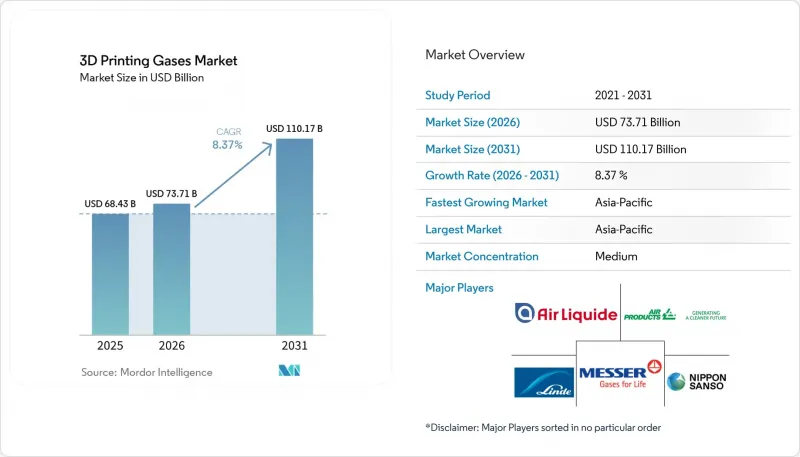
According to Mordor Intelligence, the 3D printing gases market size was valued at USD 68.43 billion in 2025 and is estimated to grow from USD 73.71 billion in 2026 to reach USD 110.17 billion by 2031, at a CAGR of 8.37% during the forecast period (2026-2031).
Global 3D Printing Gases Market Trends and Insights
Industrialization of Metal Additive Manufacturing
The 3D printing gases market benefits as metal additive manufacturing transitions from low-volume prototyping to certified serial production. Production facilities require a continuous supply of argon and nitrogen, often under long-term contracts rather than project-based cylinder purchases. Gas demand extends beyond the build chamber to powder handling, chamber cycling, thermal processing, and recovery systems. These requirements can multiply gas use by 3X to 5X relative to build chamber capacity alone. Multi-laser powder bed fusion platforms contribute to this demand, as larger machines require stable, uniform gas flow across wider build areas. The expansion from single- and dual-laser systems to 12-laser systems, with larger configurations under development, also increases the value of real-time atmospheric monitoring and gas-recovery equipment.
Aerospace Qualification and Lightweighting Requirements
Aerospace qualification requirements create a sustained need for high-specification gases in the 3D printing gases market. NADCAP expanded its additive manufacturing framework in 2025 through revised criteria for metallic powder bed fusion (AC7131/1) and directed energy deposition (AC7131/2). These requirements cover gas management, powder purchasing, and personnel qualification, making atmospheric control an auditable part of aerospace production. Suppliers producing reactive alloy parts must demonstrate disciplined gas handling before programs move into serial production. This can make it difficult to change argon specifications, even when alternative gases offer lower unit costs. More than 100 powder bed fusion audits were completed under the framework by mid-2026, with accredited suppliers across North America, Europe, Taiwan, Saudi Arabia, and India.
High Cost of High-Purity Gas Infrastructure
The cost of high-purity gas infrastructure limits smaller additive manufacturers' participation in the 3D printing gases market. Serial metal production requires cryogenic argon logistics, nitrogen pressure swing adsorption or membrane systems, leak-tight piping, and chambers capable of operating at oxygen levels below 100 parts per million (ppm). Manufacturers with fewer than 10 metal printers often depend on delivered argon cylinders, which cost more per unit than bulk supply or on-site generation. This cost structure limits their ability to enter long-term supply arrangements and reduces operating margins at higher production output. The constraint is most pronounced in South America and MEA, where bulk liquid argon logistics and high-pressure distribution networks are less developed. Limited process-gas expertise can compound the problem, as smaller firms may lack the personnel needed to specify, operate, and validate complex atmospheric systems.
Other drivers and restraints analyzed in the detailed report include:
- Expansion of Powder Atomization and Feedstock Production
- Rising Demand for Patient-Specific Medical Components
- Supply and Price Volatility of Helium and Specialty Gases
For complete list of drivers and restraints, kindly check the Table Of Contents.
Segment Analysis
Argon held 45.35% of the 3D printing gases market in 2025. Its position reflects its use with titanium, nickel superalloys, and cobalt-chrome in powder bed fusion, where trace nitrogen can form inclusions that reduce fatigue performance. Aerospace programs commonly specify argon for reactive alloy builds under controlled quality systems. These requirements create a degree of specification continuity for argon, even where nitrogen costs 30% to 40% less per unit. Gas mixtures remain the smallest category, but they are gaining interest in wire-arc directed energy deposition. A 2025 study of Inconel 718 wire-arc additive manufacturing found that an R7 composition of 2% hydrogen with argon performed better than single-gas options for bead geometry and defect control.
Nitrogen is the fastest-growing gas type, with a projected CAGR of 9.14% through 2031. It is used where its lower inertness does not compromise material performance, including stainless steel, tool steel, and aluminum composite applications. The 3D printing gases market also uses nitrogen in powder atomization, where its properties can improve the economics of industrial feedstock production. Research on K340 tool steel found that nitrogen-atomized powder had 20% better flowability than argon-atomized powder and exhibited finer dendrite arm spacing. On-site nitrogen generation through pressure swing adsorption or membrane systems can lower the cost per Nm3 by 60% to 70% compared with delivered cylinder supply. Messer commissioned a facility in East China in August 2026 with 50,000 Nm3/h of high-purity nitrogen supply capacity for advanced manufacturing customers, illustrating the scale of supply being developed for compatible uses.
Insulation held 42.83% of the market value in 2025, making it the leading function in the 3D printing gases market. The category includes build chamber purging, powder-bed blanketing, and atmosphere maintenance during printing. These steps are central to metal additive manufacturing because oxygen exposure can damage powder and part quality. Controlled nitrogen atmospheres also support surface oxidation control during binder jetting at ambient temperature. Illumination is the smallest function, covering nitrogen blanketing in UV-curing photopolymer applications such as stereolithography and PolyJet. The other category includes carrier-gas roles in directed energy deposition, wire feeds, and powder conveying.
Cooling is the fastest-growing function, with a projected CAGR of 9.45% through 2031. Multi-laser laser powder bed fusion systems and high-power directed energy deposition platforms create greater thermal loads during each build. Controlled nitrogen and argon flows help reduce residual stress, limit thermal distortion, and shorten inter-layer cycle times. Air Products identifies controlled cooling flows as important for dimensional accuracy in metallic builds because thermal gradients affect mechanical properties. Helium's high thermal conductivity does not necessarily translate into direct cooling of printed parts in laser powder bed fusion. A Department of Energy study instead points to reduced energy absorption and lower keyhole porosity, which supports a more targeted approach to gas-mixture selection.
Complete Report Scope:
- By Gas
- Argon
- Nitrogen
- Gas Mixtures
- By Function
- Insulation
- Cooling
- Illumination
- Others
- By Technology
- Stereolithography
- Laser Sintering
- Binder Jetting
- PolyJet
- Others
- By End-User Industry
- Aerospace and Defense
- Automotive
- Healthcare
- Industrial Manufacturing
- Consumer Products
- Others
- By Geography
- Asia-Pacific
- China
- India
- Japan
- South Korea
- ASEAN Countries
- Rest of Asia-Pacific
- North America
- United States
- Canada
- Mexico
- Europe
- Germany
- United Kingdom
- France
- Italy
- NORDIC Countries
- Rest of Europe
- South America
- Brazil
- Argentina
- Rest of South America
- Middle East and Africa
- Saudi Arabia
- South Africa
- Rest of Middle East and Africa
- Asia-Pacific
Geography Analysis
Asia-Pacific accounted for 55.62% of the 3D printing gases market in 2025 and is expected to record the highest regional CAGR of 9.51% through 2031. The region's position is driven by additive manufacturing activity in China, Japan, India, and other manufacturing centers. In August 2025, Japan's Taiyo Nippon Sanso was selected for a five-year New Energy and Industrial Technology Development Organization (NEDO) project combining sinter-based additive manufacturing and digital process design. The project runs from FY2024 through FY2028 and includes 3DPro gas solutions with Yamaha Motor, Mitsubishi Materials, and Kyushu University. In August 2026, Messer commissioned a 50,000 Nm3/h high-purity nitrogen facility in East China to serve customers in the electronics and advanced manufacturing sectors. These developments reflect a shift toward larger, longer-term gas supply arrangements across Northeast Asia and ASEAN manufacturing corridors.
North America is the second-largest regional market for 3D printing gases. A dense US aerospace and defense supply chain and a growing domestic powder production base support its position. In June 2026, Amaero commissioned its third Electrode Induction-melting Gas Atomization (EIGA) atomizer in Tennessee, expanding titanium alloy powder capacity to 480 tons per year. The company plans to commission an argon recycling plant in Q1 2027, designed to reduce the cost per kilogram of argon by 80%. Canada and Mexico are growing secondary locations as automotive and aerospace suppliers build additive manufacturing capacity near North American original equipment manufacturers. This is increasing regional demand for reliable supplies of argon and nitrogen, as well as specialized powder-processing support.
Europe remains a significant regional market, with Germany maintaining a large automotive and aerospace additive manufacturing base. Air Liquide supplies nitrogen, argon, and helium across the additive manufacturing workflow, including atomization, storage, build-chamber inerting, and post-processing. In June 2026, SSAB announced that its Oxelosund facility will reach 350 tons per year of additive manufacturing-grade steel powder in Q1 2028, adding a new demand point for upstream use of argon and nitrogen in Northern Europe. South America, the Middle East, and Africa (MEA) are smaller but developing markets for 3D printing gases. Brazil's industrial manufacturing base, GCC aerospace programs, and South Africa's medical device activity are generating demand, while underdeveloped bulk gas infrastructure continues to limit near-term adoption.
- Air Liquide
- Air Products and Chemicals, Inc.
- Airgas
- Atlas Copco Group
- Ellenbarrie Industrial Gases Limited
- Gulfcryo
- Iwatani Corporation
- Kaimeite Gases Co., Ltd.
- Linde PLC
- Messer SE & Co. KGaA
- Nippon Sanso Holdings Corporation
- Norco Industries, Inc.
- Rotarex
- SOL Spa
- Universal Industrial Gases, LLC
- Yingde Gases Group Company Limited
Additional Benefits:
- The market estimate (ME) sheet in Excel format
- 3 months of analyst support
TABLE OF CONTENTS
1 Introduction
- 1.1 Study Assumptions and Market Definition
- 1.2 Scope of the Study
2 Research Methodology
3 Executive Summary
4 Market Landscape
- 4.1 Market Overview
- 4.2 Market Drivers
- 4.2.1 Industrialization of Metal Additive Manufacturing
- 4.2.2 Aerospace Qualification and Lightweighting Requirements
- 4.2.3 Expansion of Powder Atomization and Feedstock Production
- 4.2.4 Rising Demand for Patient-Specific Medical Components
- 4.2.5 Real-Time Atmosphere Monitoring and Gas-Recovery Systems
- 4.3 Market Restraints
- 4.3.1 High Cost of High-Purity Gas Infrastructure
- 4.3.2 Supply and Price Volatility of Helium and Specialty Gases
- 4.3.3 Limited Process-Gas Expertise Among Smaller Manufacturers
- 4.4 Value Chain Analysis
- 4.5 Porter's Five Forces Analysis
- 4.5.1 Bargaining Power of Suppliers
- 4.5.2 Bargaining Power of Buyers
- 4.5.3 Threat of New Entrants
- 4.5.4 Threat of Substitutes
- 4.5.5 Competitive Rivalry
5 Market Size and Growth Forecasts (Value)
- 5.1 By Gas
- 5.1.1 Argon
- 5.1.2 Nitrogen
- 5.1.3 Gas Mixtures
- 5.2 By Function
- 5.2.1 Insulation
- 5.2.2 Cooling
- 5.2.3 Illumination
- 5.2.4 Others
- 5.3 By Technology
- 5.3.1 Stereolithography
- 5.3.2 Laser Sintering
- 5.3.3 Binder Jetting
- 5.3.4 PolyJet
- 5.3.5 Others
- 5.4 By End-User Industry
- 5.4.1 Aerospace and Defense
- 5.4.2 Automotive
- 5.4.3 Healthcare
- 5.4.4 Industrial Manufacturing
- 5.4.5 Consumer Products
- 5.4.6 Others
- 5.5 By Geography
- 5.5.1 Asia-Pacific
- 5.5.1.1 China
- 5.5.1.2 India
- 5.5.1.3 Japan
- 5.5.1.4 South Korea
- 5.5.1.5 ASEAN Countries
- 5.5.1.6 Rest of Asia-Pacific
- 5.5.2 North America
- 5.5.2.1 United States
- 5.5.2.2 Canada
- 5.5.2.3 Mexico
- 5.5.3 Europe
- 5.5.3.1 Germany
- 5.5.3.2 United Kingdom
- 5.5.3.3 France
- 5.5.3.4 Italy
- 5.5.3.5 NORDIC Countries
- 5.5.3.6 Rest of Europe
- 5.5.4 South America
- 5.5.4.1 Brazil
- 5.5.4.2 Argentina
- 5.5.4.3 Rest of South America
- 5.5.5 Middle East and Africa
- 5.5.5.1 Saudi Arabia
- 5.5.5.2 South Africa
- 5.5.5.3 Rest of Middle East and Africa
- 5.5.1 Asia-Pacific
6 Competitive Landscape
- 6.1 Market Concentration
- 6.2 Strategic Moves
- 6.3 Market Share (%)/Ranking Analysis
- 6.4 Company Profiles (includes Global Overview, Market Overview, Core Segments, Financials as available, Strategic Information, Products and Services, and Recent Developments)
- 6.4.1 Air Liquide
- 6.4.2 Air Products and Chemicals, Inc.
- 6.4.3 Airgas
- 6.4.4 Atlas Copco Group
- 6.4.5 Ellenbarrie Industrial Gases Limited
- 6.4.6 Gulfcryo
- 6.4.7 Iwatani Corporation
- 6.4.8 Kaimeite Gases Co., Ltd.
- 6.4.9 Linde PLC
- 6.4.10 Messer SE & Co. KGaA
- 6.4.11 Nippon Sanso Holdings Corporation
- 6.4.12 Norco Industries, Inc.
- 6.4.13 Rotarex
- 6.4.14 SOL Spa
- 6.4.15 Universal Industrial Gases, LLC
- 6.4.16 Yingde Gases Group Company Limited
7 Market Opportunities and Future Outlook
- 7.1 White-Space and Unmet-Need Assessment

