PUBLISHER: Mordor Intelligence | PRODUCT CODE: 2163409

PUBLISHER: Mordor Intelligence | PRODUCT CODE: 2163409
Non-Contact Thickness Measurement Systems - Market Share Analysis, Industry Trends & Statistics, Growth Forecasts (2026 - 2031)
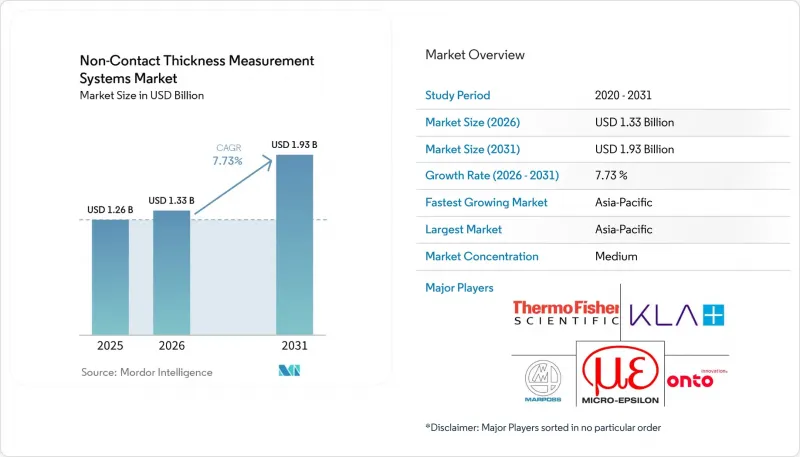
According to Mordor Intelligence, the Non-Contact thickness measurement systems market size was valued at USD 1.26 billion in 2025 and estimated to expand from USD 1.33 billion in 2026 to reach USD 1.93 billion by 2031, at a CAGR of 7.73% during the forecast period 2026-2031.
Global Non-Contact Thickness Measurement Systems Market Trends and Insights
Expansion of Inline Quality Control and Industry 4.0 Adoption
The Non-Contact Thickness Measurement Systems Market is gaining from the shift away from end-of-line sampling toward continuous inspection. When thickness data feeds process controls, manufacturers can correct deviations before the material reaches later production stages. This makes a gauge part of operating control rather than a separate inspection device. Quality teams are also using artificial intelligence to interpret sensor data and identify patterns that ordinary threshold checks can miss. Automotive and battery supply chains therefore place greater value on full-line coverage and traceable process records. These requirements favor systems that maintain high data rates while operating continuously in demanding factory conditions.
Rising Precision Requirements in Semiconductor and Electronics Manufacturing
Advanced semiconductor structures require measurement tools capable of resolving thinner, more complex films at production speed. Onto Innovation introduced its Atlas G6 system in 2025 for process control of advanced devices, including gate-all-around logic structures that can shrink by up to 30% per generation. The Non-Contact Thickness Measurement Systems Market, therefore, needs optical methods that combine physical models with software-assisted analysis. A 2025 study found that a revised full-spectrum fitting approach improved computational efficiency by 50% and reduced measurement error by 20%. Nova presented wafer-edge imaging methods in 2026 that convert detailed edge images into thickness maps for chemical mechanical polishing and hybrid-bonding control. These needs raise the value of certified measurement platforms and regular calibration for advanced films.
High Initial System and Integration Costs
A complete inline installation can include sensor heads, frames, motion equipment, software, and integration work. This cost is especially difficult for mid-sized film, packaging, and nonwoven processors operating on narrow margins. Wider multi-track C-Frame and O-Frame systems provide greater process visibility but require a higher initial investment. Procurement teams can also struggle to separate savings from a gauge installation from gains caused by other process changes. Suppliers are responding with modular systems and software upgrades that keep installed hardware useful for longer. This approach supports customer retention, but it can defer new equipment orders at existing sites.
Other drivers and restraints analyzed in the detailed report include:
- Increasing Lithium-Ion Battery Electrode and Separator Production
- Tighter Thickness Tolerances in Metal, Plastic Film, and Packaging Production
- Measurement Complexity for Reflective, Transparent, and Multilayer Materials
For complete list of drivers and restraints, kindly check the Table Of Contents.
Segment Analysis
Laser triangulation held 24.83% of global revenue in 2025. It remains widely used in metal strip and plastic film production because it combines practical cost, high operating speed, and established service support. Laser systems can reach measurement speeds of up to 392 kHz in suitable applications. Their installed base also benefits from familiar calibration practices and trained maintenance teams. However, applications requiring multilayer penetration or very fine-scale semiconductor measurements use other technologies.
Millimeter-wave technology is projected to expand at a 10.83% CAGR from 2026 to 2031 in the Non-Contact Thickness Measurement Systems Market. It can measure opaque and multilayered materials without ionizing radiation or contact with the media. SIKORA's PLANOWAVE 6000 operates at 80-300 GHz and specifies 50 µm accuracy with 10 µm repeatability without operator calibration. Spectroscopic reflectometry and ellipsometry support semiconductor films, while chromatic confocal systems suit moving battery webs. Hybrid platforms are becoming more relevant because combining optical, millimeter-wave, eddy-current, or other readings can address limits that a single sensor principle cannot solve.
Inline and online systems accounted for 54.67% of the Non-Contact Thickness Measurement Systems Market size in 2025. High-volume manufacturers use these systems for continuous feedback and full inspection coverage. Battery plants and semiconductor facilities are increasingly designing gauges into new lines rather than adding them after commissioning. Offline and laboratory tools continue to support materials development, prototype qualification, and audit work. Portable equipment also serves aerospace inspection, pipeline wall checks, and incoming-material verification.
At-line measurement is expected to expand at a 9.17% CAGR from 2026 to 2031. It provides a middle path for film, coating, and specialty-nonwoven producers that need faster feedback than periodic sampling but cannot justify a full inline installation. At-line data can also be compared with inline readings to identify sensor drift and verify performance. Renishaw introduced the RUP60 on-machine ultrasonic probe in September 2026 for single-sided measurement, specifying accuracy better than 10 µm and repeatability of 2 µm. This type of portable validation tool can help users move toward more automated inspection in stages.
Complete Report Scope:
- By Measurement Technology
- Laser Triangulation
- Spectroscopic Reflectometry and Ellipsometry
- Chromatic Confocal
- Optical Interferometry
- Eddy Current and Capacitive
- Ultrasonic and Picosecond Ultrasonic
- X-Ray and Other Radiation-Based Technologies
- Millimeter-Wave Technology
- Hybrid Multisensor Technology
- By Measurement Mode
- Inline and Online Measurement
- At-Line Measurement
- Offline and Laboratory Measurement
- Portable and Handheld Measurement
- By Application
- Metal Sheet, Plate, and Strip
- Plastic Films and Sheets
- Coatings and Paints
- Semiconductor Films and Wafers
- Lithium-Ion Battery Electrodes and Separators
- Glass and Transparent Materials
- Nonwoven Materials and Textiles
- Rubber, Foam, and Insulation Materials
- Ceramic Tapes and Advanced Materials
- Other Applications
- By End-User Industry
- Metals and Metal Processing
- Plastics and Flexible Packaging
- Semiconductors and Electronics
- Batteries and Energy Storage
- Automotive and Transportation
- Aerospace and Defense
- Glass and Optical Products
- Research Institutions and Contract Laboratories
- Other End-User Industries
- By Geography
- North America
- United States
- Canada
- Mexico
- South America
- Brazil
- Argentina
- Rest of South America
- Europe
- Germany
- United Kingdom
- France
- Italy
- Spain
- Rest of Europe
- Asia-Pacific
- China
- Japan
- India
- South Korea
- Rest of Asia-Pacific
- Middle East and Africa
- Middle East
- Saudi Arabia
- United Arab Emirates
- Turkey
- Rest of the Middle East
- Africa
- South Africa
- Nigeria
- Rest of Africa
- Middle East
- North America
Geography Analysis
Asia-Pacific accounted for 39.86% of global revenue in 2025 and is projected to grow at a 10.26% CAGR through 2031. China supports volume demand through battery capacity additions and automotive steel production. Japan supports premium demand in precision electronics, semiconductor packaging, and advanced-material measurement. South Korea combines DRAM and NAND fabrication with major battery-cell production. India is developing semiconductor packaging and automated inspection capacity, which can add demand for precision measurement equipment.
Europe and North America had a substantial installed base in 2025 across automotive steel, aluminum rolling, specialty chemicals, and pharmaceutical packaging. Germany remains an important supply center for industrial measurement equipment and has a dense customer base in precision engineering and specialty films. North America benefits from semiconductor fabrication construction and from suppliers serving advanced process control. Replacement of nuclear gauges is a near-term opportunity in North American paper, plastics, and flexible packaging plants because licensing and handling create continuing compliance obligations. The United Kingdom's battery pilot facilities also provide reference sites for inline electrode measurement systems.
South America, the Middle East, and Africa, and other Asia-Pacific markets are at earlier stages of adoption. Brazil's automotive and mining sectors support demand for metal strips and equipment inspection. Saudi Arabia and the United Arab Emirates are adding downstream petrochemical capacity, where pipeline and vessel monitoring are established applications. South Africa's mining and steel sectors add baseline demand, while regional service partnerships allow suppliers to reach customers without local manufacturing.
- Marposs S.p.A.
- Thermo Fisher Scientific Inc.
- Micro-Epsilon Messtechnik Gmbh & Co. Kg
- KLA Corporation
- Onto Innovation Inc.
- Nova Ltd.
- SICK AG
- SolveTech, Inc.
- Lumetrics, Inc.
- Advanced Gauging Technologies, Inc.
- Hammer-IMS nv
- nokra GmbH
- MTI Instruments, Inc.
- Novacam Technologies Inc.
- SCREEN Holdings Co., Ltd.
- HORIBA, Ltd.
- Keyence Corporation
- Waygate Technologies GmbH
- RIFTEK LLC
- Friedrich Vollmer Feinmessgeratebau GmbH
Additional Benefits:
- The market estimate (ME) sheet in Excel format
- 3 months of analyst support
TABLE OF CONTENTS
1 INTRODUCTION
- 1.1 Study Assumptions and Market Definition
- 1.2 Scope of the Study
2 RESEARCH METHODOLOGY
3 EXECUTIVE SUMMARY
4 MARKET LANDSCAPE
- 4.1 Market Overview
- 4.2 Market Drivers
- 4.2.1 Expansion of Inline Quality Control and Industry 4.0 Adoption
- 4.2.2 Rising Precision Requirements in Semiconductor and Electronics Manufacturing
- 4.2.3 Increasing Lithium-Ion Battery Electrode and Separator Production
- 4.2.4 Tighter Thickness Tolerances in Metal, Plastic Film, and Packaging Production
- 4.2.5 Replacement of Nuclear Gauges With Non-Nuclear Measurement Technologies
- 4.2.6 Sensor Fusion and AI-Based Thickness Uniformity Control
- 4.3 Market Restraints
- 4.3.1 High Initial System and Integration Costs
- 4.3.2 Measurement Complexity for Reflective, Transparent, and Multilayer Materials
- 4.3.3 Limited Availability of Market-Specific Calibration Standards for Emerging Materials
- 4.3.4 Integration Disruption During Retrofit of Legacy Production Lines
- 4.4 Impact of Macroeconomic Factors on the Market
- 4.5 Industry Supply-Chain Analysis
- 4.6 Technology Outlook
- 4.7 Regulatory Landscape
- 4.8 Porter's Five Forces Analysis
- 4.8.1 Threat of New Entrants
- 4.8.2 Bargaining Power of Suppliers
- 4.8.3 Bargaining Power of Buyers
- 4.8.4 Threat of Substitutes
- 4.8.5 Intensity of Competitive Rivalry
5 MARKET SIZE AND GROWTH FORECASTS (VALUE)
- 5.1 By Measurement Technology
- 5.1.1 Laser Triangulation
- 5.1.2 Spectroscopic Reflectometry and Ellipsometry
- 5.1.3 Chromatic Confocal
- 5.1.4 Optical Interferometry
- 5.1.5 Eddy Current and Capacitive
- 5.1.6 Ultrasonic and Picosecond Ultrasonic
- 5.1.7 X-Ray and Other Radiation-Based Technologies
- 5.1.8 Millimeter-Wave Technology
- 5.1.9 Hybrid Multisensor Technology
- 5.2 By Measurement Mode
- 5.2.1 Inline and Online Measurement
- 5.2.2 At-Line Measurement
- 5.2.3 Offline and Laboratory Measurement
- 5.2.4 Portable and Handheld Measurement
- 5.3 By Application
- 5.3.1 Metal Sheet, Plate, and Strip
- 5.3.2 Plastic Films and Sheets
- 5.3.3 Coatings and Paints
- 5.3.4 Semiconductor Films and Wafers
- 5.3.5 Lithium-Ion Battery Electrodes and Separators
- 5.3.6 Glass and Transparent Materials
- 5.3.7 Nonwoven Materials and Textiles
- 5.3.8 Rubber, Foam, and Insulation Materials
- 5.3.9 Ceramic Tapes and Advanced Materials
- 5.3.10 Other Applications
- 5.4 By End-User Industry
- 5.4.1 Metals and Metal Processing
- 5.4.2 Plastics and Flexible Packaging
- 5.4.3 Semiconductors and Electronics
- 5.4.4 Batteries and Energy Storage
- 5.4.5 Automotive and Transportation
- 5.4.6 Aerospace and Defense
- 5.4.7 Glass and Optical Products
- 5.4.8 Research Institutions and Contract Laboratories
- 5.4.9 Other End-User Industries
- 5.5 By Geography
- 5.5.1 North America
- 5.5.1.1 United States
- 5.5.1.2 Canada
- 5.5.1.3 Mexico
- 5.5.2 South America
- 5.5.2.1 Brazil
- 5.5.2.2 Argentina
- 5.5.2.3 Rest of South America
- 5.5.3 Europe
- 5.5.3.1 Germany
- 5.5.3.2 United Kingdom
- 5.5.3.3 France
- 5.5.3.4 Italy
- 5.5.3.5 Spain
- 5.5.3.6 Rest of Europe
- 5.5.4 Asia-Pacific
- 5.5.4.1 China
- 5.5.4.2 Japan
- 5.5.4.3 India
- 5.5.4.4 South Korea
- 5.5.4.5 Rest of Asia-Pacific
- 5.5.5 Middle East and Africa
- 5.5.5.1 Middle East
- 5.5.5.1.1 Saudi Arabia
- 5.5.5.1.2 United Arab Emirates
- 5.5.5.1.3 Turkey
- 5.5.5.1.4 Rest of the Middle East
- 5.5.5.2 Africa
- 5.5.5.2.1 South Africa
- 5.5.5.2.2 Nigeria
- 5.5.5.2.3 Rest of Africa
- 5.5.5.1 Middle East
- 5.5.1 North America
6 COMPETITIVE LANDSCAPE
- 6.1 Market Concentration
- 6.2 Strategic Moves
- 6.3 Market Share Analysis
- 6.4 Company Profiles (includes Global Level Overview, Market Level Overview, Core Segments, Financials as available, Strategic Information, Market RankandShare, Products and Services, Recent Developments)
- 6.4.1 Marposs S.p.A.
- 6.4.2 Thermo Fisher Scientific Inc.
- 6.4.3 Micro-Epsilon Messtechnik Gmbh & Co. Kg
- 6.4.4 KLA Corporation
- 6.4.5 Onto Innovation Inc.
- 6.4.6 Nova Ltd.
- 6.4.7 SICK AG
- 6.4.8 SolveTech, Inc.
- 6.4.9 Lumetrics, Inc.
- 6.4.10 Advanced Gauging Technologies, Inc.
- 6.4.11 Hammer-IMS nv
- 6.4.12 nokra GmbH
- 6.4.13 MTI Instruments, Inc.
- 6.4.14 Novacam Technologies Inc.
- 6.4.15 SCREEN Holdings Co., Ltd.
- 6.4.16 HORIBA, Ltd.
- 6.4.17 Keyence Corporation
- 6.4.18 Waygate Technologies GmbH
- 6.4.19 RIFTEK LLC
- 6.4.20 Friedrich Vollmer Feinmessgeratebau GmbH
7 MARKET OPPORTUNITIES AND FUTURE OUTLOOK
- 7.1 White-Space and Unmet-Need Assessment

