PUBLISHER: Mordor Intelligence | PRODUCT CODE: 2163451

PUBLISHER: Mordor Intelligence | PRODUCT CODE: 2163451
Styrene Butadiene Latex - Market Share Analysis, Industry Trends & Statistics, Growth Forecasts (2026 - 2031)
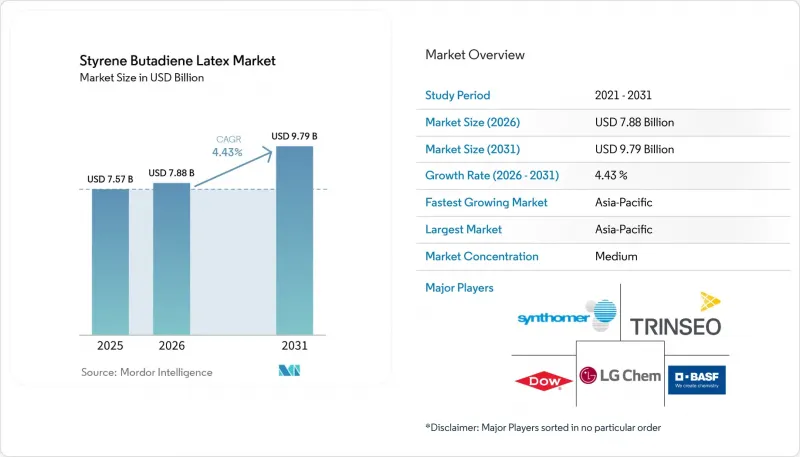
According to Mordor Intelligence, the styrene butadiene latex market size was valued at USD 7.57 billion in 2025 and is estimated to grow from USD 7.88 billion in 2026 to reach USD 9.79 billion by 2031, at a CAGR of 4.43% during the forecast period (2026-2031).
Global Styrene Butadiene Latex Market Trends and Insights
Paper and Paperboard Packaging Conversion Drives Structural Demand
The shift from single-use plastics to fiber-based packaging supports demand for paper-coating binders in the styrene-butadiene latex market. Coated paperboard used in food, beverage, and e-commerce applications requires gloss, pigment holdout, and water resistance in a single formulation. Carboxylated styrene-butadiene latex (SBL) provides these properties while supporting repulpable packaging requirements. Paper and board recycling rates in Europe remain above 70%, reinforcing the use of water-based binder systems that align with circular packaging objectives. The same requirements driving coated-paperboard production also favor water-based systems over less compatible alternatives. BASF modernized its Hamina dispersion site in 2024 and expanded the facility in 2025 to support Nordic paper and board customers with Styronal and Basonal XSB binders.
Water-Based, Low-VOC Binder Substitution and High-Solids Formulations Support Qualification
The styrene-butadiene latex market benefits as coating and adhesive formulators pursue binder systems with lower volatile organic compound (VOC) content. Commission Decision (EU) 2025/2607 established updated EU Ecolabel criteria for decorative paints, varnishes, and related products in December 2025. These criteria differentiate VOC emission limits and restrict certain substances in formulations. Water-based SBL aligns with the shift toward low-VOC products, while some alternative systems may require reformulation. Registration, Evaluation, Authorization and Restriction of Chemicals (REACH)-related supplier qualification can lengthen approval timelines for specialty latex grades, potentially favoring established suppliers with compliant products. High-solids formulations can also reduce dryer energy intensity, linking product development with operational efficiency across European and North American coating lines.
Styrene and Butadiene Price Volatility Compresses Margins and Complicates Qualification
Feedstock volatility limits producers' ability to plan margins in the styrene-butadiene latex market. Butadiene prices fell to cyclical lows by the end of 2025 and rose in Q2 2026, as Middle East tensions and concerns regarding the Strait of Hormuz affected the availability of naphtha-cracking feedstock. Producers operating under fixed-price contracts with paper mills and carpet manufacturers may face cost pressures during these price movements. Contracts spanning 12 to 24 months can hinder timely price pass-through. Dispersion stability requirements and high-speed coating-line qualification present additional constraints, as customers must validate latex performance under demanding operating conditions. These constraints are particularly relevant in Europe and North America, where established coating lines operate within narrow performance tolerances and supplier approval processes are lengthy.
Other drivers and restraints analyzed in the detailed report include:
- Infrastructure, Waterproofing, and Repair-Mortar Demand Opens a High-Growth Application Niche
- Growth of Carpet, Textile, and Nonwoven Backcoating Sustains Demand in Asia
- Substitution by Acrylic, Vinyl, Polyurethane, and Bio-Based Binders Erodes Select Uses
For complete list of drivers and restraints, kindly check the Table Of Contents.
Segment Analysis
Carboxylated styrene-butadiene latex accounted for 60.34% of the styrene-butadiene latex market in 2025. Its position reflects established specifications in the two largest applications. Carboxyl groups support pigment binding, mechanical stability at high coating solids, and adhesion to polar substrates. These properties support consistent operating performance on high-speed paper-coating lines. BASF expanded its Hamina site in 2025, adding ISCC PLUS-certified capacity for Styronal and Basonal XSB grades used in sustainable fiber-based packaging. The expansion indicates how certification can differentiate carboxylated grades in specification-driven procurement.
Non-carboxylated SBL is expected to be the fastest-growing product type, with a CAGR of 4.78% through 2031. Its adoption is increasing in applications where simple, low-cost processing outweighs the additional functionality provided by carboxylation. General-purpose paper treatment, lower-performance adhesives, and select textile-finishing applications align with this profile. Specialty-modified SBL also serves smaller applications, including glass-fiber sizing, battery binders, and specialty textile finishes. BASF markets Licity XSBL for lithium-ion battery applications, and the Hamina site produces these materials alongside paper-coating grades. These specialty applications have technical specification requirements that differ from those of established paper-coating and adhesive applications.
Complete Report Scope:
- By Product Type
- Carboxylated Styrene Butadiene Latex
- Non-Carboxylated Styrene Butadiene Latex
- Specialty Modified Styrene Butadiene Latex
- By Application
- Paper and Paperboard Coating
- Carpet Backing and Textile Backcoating
- Adhesives and Sealants
- Paints and Coatings
- Glass Fiber Processing
- Mortar Additives
- Other Applications
- By Geography
- Asia-Pacific
- China
- India
- Japan
- South Korea
- ASEAN Countries
- Rest of Asia-Pacific
- North America
- United States
- Canada
- Mexico
- Europe
- Germany
- United Kingdom
- France
- Italy
- NORDIC Countries
- Rest of Europe
- South America
- Brazil
- Argentina
- Rest of South America
- Middle East and Africa
- Saudi Arabia
- South Africa
- Rest of Middle East and Africa
- Asia-Pacific
Geography Analysis
Asia-Pacific accounted for 44.18% of the styrene butadiene latex market in 2025 and is projected to register the highest CAGR of 4.81% through 2031. China's base of coated-paperboard production and consumption supports regional demand. Packaging converters in Guangdong, Jiangsu, and Shandong are expanding coated-board production to support e-commerce fulfillment. India is a source of regional growth across paper, mortar, and nonwoven textile applications. The National Infrastructure Pipeline supports construction demand through its USD 1.4 trillion commitment. Japan and South Korea drive demand for specialty battery-binder and glass-fiber-sizing grades, where technical performance is a key purchasing criterion.
North America and Europe are established regions with stringent specification requirements. Europe's REACH regulations and updated EU Ecolabel criteria support demand for certified, low-VOC styrene butadiene latex (SBL) grades. These requirements can create qualification barriers for suppliers. In May 2025, Trinseo announced an increase of USD 0.04 per dry lb for styrene-butadiene latex products sold to the North American carpet market, effective July 1, 2025. The company cited rising raw material and transportation costs as the basis for the increase. Established logistics relationships and supplier qualification histories continue to influence purchasing decisions in the region.
South America is a developing region, with Brazil's paper and packaging industry and construction activity forming its demand base. The Middle East and Africa are emerging consumption regions for construction mortar applications. Saudi Arabia and the UAE are expanding infrastructure projects, which can increase demand for polymer-modified cementitious formulations. The region's exposure to Hormuz-related feedstock disruptions can affect local SBL pricing. This exposure may create short-term incentives to consider locally produced acrylic alternatives.
- Apcotex
- Arkema
- Asahi Kasei Corporation
- BASF
- DIC Corporation
- Dow
- JSR Corporation
- Kumho Petrochemical Co., Ltd.
- LANXESS
- LG Chem
- Mallard Creek Polymers
- NANTEX Industry Co., Ltd.
- Synthomer plc
- Trinseo
- ZEON CORPORATION
Additional Benefits:
- The market estimate (ME) sheet in Excel format
- 3 months of analyst support
TABLE OF CONTENTS
1 Introduction
- 1.1 Study Assumptions and Market Definition
- 1.2 Scope of the Study
2 Research Methodology
3 Executive Summary
4 Market Landscape
- 4.1 Market Overview
- 4.2 Market Drivers
- 4.2.1 Paper and Paperboard Packaging Conversion
- 4.2.2 Water-Based, Low-VOC Binder Substitution
- 4.2.3 Infrastructure, Waterproofing, and Repair-Mortar Demand
- 4.2.4 Growth of Carpet, Textile, and Nonwoven Backcoating
- 4.2.5 High-Solids Formulations Reducing Dryer Energy Intensity
- 4.3 Market Restraints
- 4.3.1 Styrene and Butadiene Price Volatility
- 4.3.2 Substitution by Acrylic, Vinyl, Polyurethane, and Bio-Based Binders
- 4.3.3 Dispersion Stability and High-Speed Coating-Line Qualification
- 4.4 Value Chain Analysis
- 4.5 Porter's Five Forces Analysis
- 4.5.1 Bargaining Power of Suppliers
- 4.5.2 Bargaining Power of Buyers
- 4.5.3 Threat of New Entrants
- 4.5.4 Threat of Substitutes
- 4.5.5 Competitive Rivalry
5 Market Size and Growth Forecasts (Value)
- 5.1 By Product Type
- 5.1.1 Carboxylated Styrene Butadiene Latex
- 5.1.2 Non-Carboxylated Styrene Butadiene Latex
- 5.1.3 Specialty Modified Styrene Butadiene Latex
- 5.2 By Application
- 5.2.1 Paper and Paperboard Coating
- 5.2.2 Carpet Backing and Textile Backcoating
- 5.2.3 Adhesives and Sealants
- 5.2.4 Paints and Coatings
- 5.2.5 Glass Fiber Processing
- 5.2.6 Mortar Additives
- 5.2.7 Other Applications
- 5.3 By Geography
- 5.3.1 Asia-Pacific
- 5.3.1.1 China
- 5.3.1.2 India
- 5.3.1.3 Japan
- 5.3.1.4 South Korea
- 5.3.1.5 ASEAN Countries
- 5.3.1.6 Rest of Asia-Pacific
- 5.3.2 North America
- 5.3.2.1 United States
- 5.3.2.2 Canada
- 5.3.2.3 Mexico
- 5.3.3 Europe
- 5.3.3.1 Germany
- 5.3.3.2 United Kingdom
- 5.3.3.3 France
- 5.3.3.4 Italy
- 5.3.3.5 NORDIC Countries
- 5.3.3.6 Rest of Europe
- 5.3.4 South America
- 5.3.4.1 Brazil
- 5.3.4.2 Argentina
- 5.3.4.3 Rest of South America
- 5.3.5 Middle East and Africa
- 5.3.5.1 Saudi Arabia
- 5.3.5.2 South Africa
- 5.3.5.3 Rest of Middle East and Africa
- 5.3.1 Asia-Pacific
6 Competitive Landscape
- 6.1 Market Concentration
- 6.2 Strategic Moves
- 6.3 Market Share (%)/Ranking Analysis
- 6.4 Company Profiles (includes Global Overview, Market Overview, Core Segments, Financials as available, Strategic Information, Products and Services, and Recent Developments)
- 6.4.1 Apcotex
- 6.4.2 Arkema
- 6.4.3 Asahi Kasei Corporation
- 6.4.4 BASF
- 6.4.5 DIC Corporation
- 6.4.6 Dow
- 6.4.7 JSR Corporation
- 6.4.8 Kumho Petrochemical Co., Ltd.
- 6.4.9 LANXESS
- 6.4.10 LG Chem
- 6.4.11 Mallard Creek Polymers
- 6.4.12 NANTEX Industry Co., Ltd.
- 6.4.13 Synthomer plc
- 6.4.14 Trinseo
- 6.4.15 ZEON CORPORATION
7 Market Opportunities and Future Outlook
- 7.1 White-Space and Unmet-Need Assessment

