PUBLISHER: Mordor Intelligence | PRODUCT CODE: 2163471

PUBLISHER: Mordor Intelligence | PRODUCT CODE: 2163471
Luxury Bedding - Market Share Analysis, Industry Trends & Statistics, Growth Forecasts (2026 - 2031)
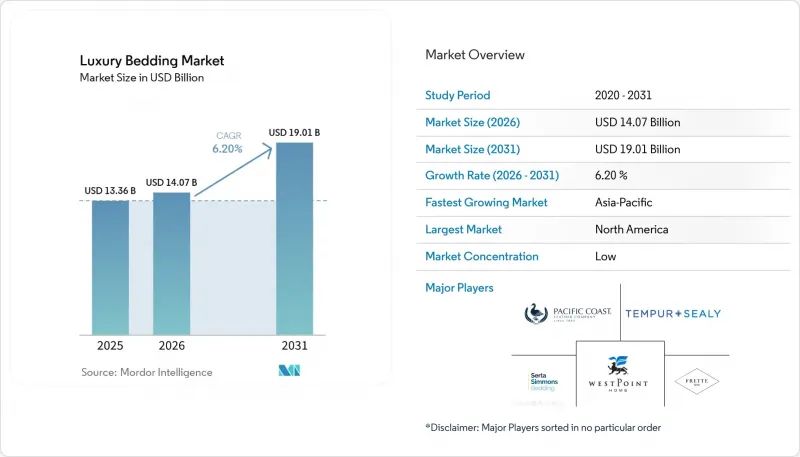
According to Mordor Intelligence, the luxury bedding market was valued at USD 13.36 billion in 2025 and is expected to reach USD 14.07 billion in 2026, and is forecast to rise to USD 19 billion by 2031, at a CAGR of 6.2% during the forecast period from 2026 to 2031.
Global Luxury Bedding Market Trends and Insights
Sleep Health and Wellness Premiumization
Sleep health is becoming a mainstream concern among affluent consumers and is supporting demand in the luxury bedding market. The U.S. Centers for Disease Control and Prevention states that 1 in 3 adults does not get enough sleep, which gives brands a recognized health context for products focused on comfort and rest. Buyers are increasingly looking for GOTS-certified organic cotton, temperature-regulating lyocell, and hypoallergenic down alternatives. These material choices make product credentials more central to purchase decisions than thread count alone. The Global Wellness Institute reported a global wellness economy worth more than USD 5.6 trillion in 2025, creating a broader spending environment for home products linked to personal well-being. Japan's Healthy Longevity Extension policy also places sleep environments within a wider public-health discussion, which supports wellness-oriented positioning in the region.
Premium Home Decor and Renovation Spending
Home renovation activity continues to support premium purchases for bedrooms and other private living spaces, because the luxury bedding market benefits when buyers seek a consistent finish across renovated rooms rather than treating bedding as a separate purchase. The 2026 Houzz & Home Study found that 54% of homeowners undertook renovation projects in 2025, while the median renovation spend was USD 20,000. The same study reported that spending by the top decile reached USD 150,000 or more, 7% above USD 140,000 in 2024. Harvard Joint Center for Housing Studies projects homeowner remodeling expenditures to reach USD 524 billion in early 2026, supporting demand for higher-specification furnishings. A newly renovated bedroom or adjacent primary bathroom can encourage consumers to replace older bedding so the room has a consistent standard of finish. Eurostat data also shows that furnishings and home maintenance form a meaningful part of household spending in major European economies.
Volatility in Cotton, Silk, Down, and Specialty Fiber Costs
Raw-material volatility is a persistent operating risk for the luxury bedding market because premium products rely on fibers with limited substitution options, and buyers often expect the same touch, warmth, and durability from each replacement purchase. Higher input costs can narrow margins when brands choose not to pass the full increase to consumers. They can also lead manufacturers to change fill volumes or material mixes, which can weaken the product proposition. The greatest pressure falls on brands that have natural-fiber commitments but lack the purchasing scale or pricing power of the largest suppliers. Procurement teams therefore need closer control of supplier contracts, quality testing, and inventory planning. Stable sourcing is particularly important where a brand's value rests on fiber provenance, durability, and a consistent sleep experience.
Other drivers and restraints analyzed in the detailed report include:
- Luxury Hospitality Room Upgrades and New Hotel Supply
- E-Commerce and Direct-to-Consumer Accessibility
- Inflation-Driven Trading Down and Premium Demand Elasticity
For complete list of drivers and restraints, kindly check the Table Of Contents.
Segment Analysis
Mattresses accounted for 43.12% of the luxury bedding market share in 2025 and remained the category's largest value contributor. Consumers typically research a mattress extensively because it is a long-term purchase with a direct link to comfort. Mattress makers use hand-tufted construction, natural materials, and personal comfort features to support premium pricing. Serta Simmons Bedding launched the 11-model Simmons Luxury Collection in July 2026, with retail prices ranging from the mid-USD 4,000s to USD 10,000. Mattress purchases can initiate later spending on sheets, pillows, and duvet products, allowing the luxury bedding market to capture a series of related purchases from consumers who want materials, colors, and comfort levels to work together across the full bed.
The luxury bedding market size for bedlinen and bedsheets is forecast to grow at a 7.11% CAGR from 2026 to 2031, the fastest rate among product categories. Bed linen is often the next upgrade after a consumer purchases a premium sleep surface. Consumers increasingly consider sheets and duvet sets part of a room's appearance, temperature management, and perceived cleanliness. Egyptian cotton, European linen, and hotel-style duvet products address these needs. This product range allows brands to build repeat sales without requiring another major mattress purchase.
Complete Report Scope:
- By Product Type
- Bedlinen/Bedsheets
- Pillows and Pillowcases
- Blankets and Quilts
- Mattresses
- Mattress Toppers and Pads
- Duvets and Duvet Cases
- Other Products (Comforters, Bedspreads, Coverlets, Shams, Throws, etc.)
- By End-User
- Residential
- Commercial
- Hospitality, Hotels and Resorts
- Healthcare and Elderly-Care Facilities
- Institutional, Dormitories and Military
- Other Commercial End Users
- By Distribution Channel
- B2C/Retail Channels
- Multi-Brand Stores
- Specialty Bedding Stores, Including Exclusive Brand Outlets
- Online
- Other Retail Distribution Channels
- B2B/Direct Purchases from Manufacturers by Large Commercial Users
- B2C/Retail Channels
- By Geography
- North America
- Canada
- United States
- Mexico
- South America
- Brazil
- Peru
- Chile
- Argentina
- Rest of South America
- Europe
- United Kingdom
- Germany
- France
- Spain
- Italy
- BENELUX (Belgium, Netherlands, and Luxembourg)
- NORDICS (Denmark, Finland, Iceland, Norway, and Sweden)
- Rest of Europe
- Asia-Pacific
- India
- China
- Japan
- Australia
- South Korea
- South East Asia (Singapore, Malaysia, Thailand, Indonesia, Vietnam, and the Philippines)
- Rest of Asia-Pacific
- Middle East and Africa
- United Arab Emirates
- Saudi Arabia
- South Africa
- Nigeria
- Rest of the Middle East and Africa
- North America
Geography Analysis
North America accounted for 34.54% of the luxury bedding market share in 2025 and remained the largest regional market. The United States is the central source of demand because high-income households have a strong renovation culture and access to direct-to-consumer brands. Harvard Joint Center for Housing Studies expects total homeowner remodeling expenditure to reach USD 524 billion in early 2026. Canada is receiving direct attention from luxury brands, illustrated by Frette's first standalone Canadian boutique in Toronto in May 2026. Mexico has a smaller demand base but benefits from luxury hospitality and concentrated urban affluence.
Europe remains important to the luxury bedding market because of its heritage brands, certification systems, and high-value hospitality sector, which together reinforce demand for provenance, documented material quality, and durable construction. Eurostat reports that furnishings and home maintenance are a meaningful component of household consumption in major EU economies. Germany, the United Kingdom, and France support a major part of the regional value. Italy contributes production heritage and discerning domestic demand, while Spain supports commercial demand through hotels.
Asia-Pacific is projected to grow at a 6.85% CAGR from 2026 to 2031 and is the fastest-growing regional part of the luxury bedding market size. China is a leading contributor to regional value, while India and Southeast Asia provide room for further adoption. Japan's Healthy Longevity Extension policy frames quality sleep environments within wider health and aging priorities. International luxury hotel openings in Vietnam, Indonesia, and Thailand can introduce high-end bedding standards to commercial buyers and consumers. The Middle East is principally hospitality-led, while African demand remains concentrated in higher-income urban areas and hotel destinations.
- WestPoint Home LLC
- Pacific Coast Feather Company
- Rivolta Carmignani
- Tempur Sealy International, Inc.
- Frette S.r.l.
- SFERRA
- Serta Simmons Bedding, LLC
- Yves Delorme
- Peacock Alley, Inc.
- Matouk
- Pratesi
- Hastens Sangar AB
- Christian Fischbacher Co. AG
- Ralph Lauren Corporation
- The White Company (Int.) Limited
- Boll & Branch
- Coyuchi, Inc.
- D. Porthault
- Standard Textile Co., Inc.
- Garnier-Thiebaut
Additional Benefits:
- The market estimate (ME) sheet in Excel format
- 3 months of analyst support
TABLE OF CONTENTS
1 Introduction
- 1.1 Study Assumptions and Market Definition
- 1.2 Scope of the Study
2 Research Methodology
3 Executive Summary
4 Market Landscape
- 4.1 Market Overview
- 4.2 Market Drivers
- 4.2.1 Sleep Health and Wellness Premiumization
- 4.2.2 Premium Home Decor and Renovation Spending
- 4.2.3 Luxury Hospitality Room Upgrades and New Hotel Supply
- 4.2.4 E-Commerce and Direct-to-Consumer Accessibility
- 4.2.5 Certification-Led Demand for Traceable Natural Fibers
- 4.2.6 Bespoke Fit, Modular Layering and Personalization
- 4.3 Market Restraints
- 4.3.1 Volatility in Cotton, Silk, Down and Specialty Fiber Costs
- 4.3.2 Inflation-Driven Trading Down and Premium Demand Elasticity
- 4.3.3 Certification, Traceability and Circularity Compliance Burden
- 4.3.4 Counterfeit, Parallel Trade and Brand Dilution Risk
- 4.4 Industry Value Chain Analysis
- 4.5 Porter's Five Forces Analysis
- 4.5.1 Bargaining Power of Suppliers
- 4.5.2 Bargaining Power of Buyers
- 4.5.3 Threat of New Entrants
- 4.5.4 Threat of Substitutes
- 4.5.5 Industry Rivalry
- 4.6 Insights into the Latest Trends and Innovations in the Industry
- 4.7 Insights into the Recent Developments (New Product Launches, Strategic Initiatives, Investments, Partnerships, JVs, Expansion, M&As, etc.) in the Industry
5 Market Size & Growth Forecasts (value in USD Billion)
- 5.1 By Product Type
- 5.1.1 Bedlinen/Bedsheets
- 5.1.2 Pillows and Pillowcases
- 5.1.3 Blankets and Quilts
- 5.1.4 Mattresses
- 5.1.5 Mattress Toppers and Pads
- 5.1.6 Duvets and Duvet Cases
- 5.1.7 Other Products (Comforters, Bedspreads, Coverlets, Shams, Throws, etc.)
- 5.2 By End-User
- 5.2.1 Residential
- 5.2.2 Commercial
- 5.2.2.1 Hospitality, Hotels and Resorts
- 5.2.2.2 Healthcare and Elderly-Care Facilities
- 5.2.2.3 Institutional, Dormitories and Military
- 5.2.2.4 Other Commercial End Users
- 5.3 By Distribution Channel
- 5.3.1 B2C/Retail Channels
- 5.3.1.1 Multi-Brand Stores
- 5.3.1.2 Specialty Bedding Stores, Including Exclusive Brand Outlets
- 5.3.1.3 Online
- 5.3.1.4 Other Retail Distribution Channels
- 5.3.2 B2B/Direct Purchases from Manufacturers by Large Commercial Users
- 5.3.1 B2C/Retail Channels
- 5.4 By Geography
- 5.4.1 North America
- 5.4.1.1 Canada
- 5.4.1.2 United States
- 5.4.1.3 Mexico
- 5.4.2 South America
- 5.4.2.1 Brazil
- 5.4.2.2 Peru
- 5.4.2.3 Chile
- 5.4.2.4 Argentina
- 5.4.2.5 Rest of South America
- 5.4.3 Europe
- 5.4.3.1 United Kingdom
- 5.4.3.2 Germany
- 5.4.3.3 France
- 5.4.3.4 Spain
- 5.4.3.5 Italy
- 5.4.3.6 BENELUX (Belgium, Netherlands, and Luxembourg)
- 5.4.3.7 NORDICS (Denmark, Finland, Iceland, Norway, and Sweden)
- 5.4.3.8 Rest of Europe
- 5.4.4 Asia-Pacific
- 5.4.4.1 India
- 5.4.4.2 China
- 5.4.4.3 Japan
- 5.4.4.4 Australia
- 5.4.4.5 South Korea
- 5.4.4.6 South East Asia (Singapore, Malaysia, Thailand, Indonesia, Vietnam, and the Philippines)
- 5.4.4.7 Rest of Asia-Pacific
- 5.4.5 Middle East and Africa
- 5.4.5.1 United Arab Emirates
- 5.4.5.2 Saudi Arabia
- 5.4.5.3 South Africa
- 5.4.5.4 Nigeria
- 5.4.5.5 Rest of the Middle East and Africa
- 5.4.1 North America
6 Competitive Landscape
- 6.1 Market Concentration
- 6.2 Strategic Moves
- 6.3 Market Share Analysis
- 6.4 Company Profiles {(includes Global level Overview, Market level overview, Core Segments, Financials as available, Strategic Information, Market Rank/Share for key companies, Products & Services, and Recent Developments)}
- 6.4.1 WestPoint Home LLC
- 6.4.2 Pacific Coast Feather Company
- 6.4.3 Rivolta Carmignani
- 6.4.4 Tempur Sealy International, Inc.
- 6.4.5 Frette S.r.l.
- 6.4.6 SFERRA
- 6.4.7 Serta Simmons Bedding, LLC
- 6.4.8 Yves Delorme
- 6.4.9 Peacock Alley, Inc.
- 6.4.10 Matouk
- 6.4.11 Pratesi
- 6.4.12 Hastens Sangar AB
- 6.4.13 Christian Fischbacher Co. AG
- 6.4.14 Ralph Lauren Corporation
- 6.4.15 The White Company (Int.) Limited
- 6.4.16 Boll & Branch
- 6.4.17 Coyuchi, Inc.
- 6.4.18 D. Porthault
- 6.4.19 Standard Textile Co., Inc.
- 6.4.20 Garnier-Thiebaut
7 Market Opportunities & Future Outlook
- 7.1 Affordable Entry Products That Preserve Luxury Material Credibility
- 7.2 Traceable Regenerative and Low-Water Fiber Collections

