PUBLISHER: Mordor Intelligence | PRODUCT CODE: 2163581

PUBLISHER: Mordor Intelligence | PRODUCT CODE: 2163581
United States Coin-Operated Laundry Machines - Market Share Analysis, Industry Trends & Statistics, Growth Forecasts (2026 - 2031)
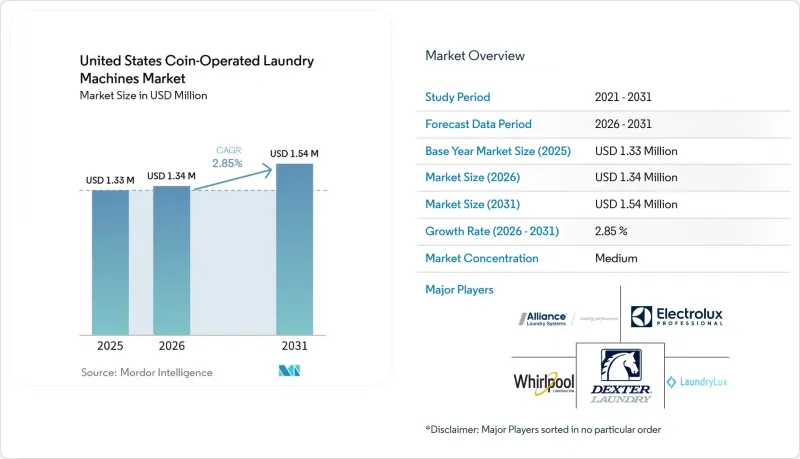
According to Mordor Intelligence, the United States coin-operated laundry machines market size was USD 1.33 billion in 2025 and is expected to reach USD 1.34 billion, and is forecast to reach USD 1.54 billion by 2031, growing at a CAGR of 2.85% from 2026 to 2031.
United States Coin-Operated Laundry Machines Market Trends and Insights
High Renter Concentration and Limited In-Unit Laundry Access
The United States coin-operated laundry machines market relies on a clear difference between renter and owner access to in-unit appliances. The 2024 Residential Energy Consumption Survey found that 16.01 million renter households lacked an in-unit washer. Those households need either common-area machines or local self-service laundromats for routine laundry. This demand is less dependent on discretionary spending than many other commercial appliance purchases. Older multifamily buildings remain important because adding hookups can require extensive plumbing and electrical work. The resulting access gap gives operators a recurring customer base in rental-heavy areas.
Replacement of Aging Commercial Laundry Equipment
The United States coin-operated laundry machines market is also supported by replacement demand from equipment installed between 2008 and 2013. Commercial washer-extractors and tumble dryers generally operate for 10 to 14 years before replacement becomes more compelling. Coin-O-Matic notes that operators must weigh repairs, replacement, and upgrades across a machine's operating life. Older machines can require more service while using more electricity and drying time. Newer high-spin equipment can reduce residual moisture before the drying stage. This can make replacement decisions more attractive where utility charges are high.
High Utility Costs and Volatile Water, Gas, and Electricity Prices
Utility costs can limit returns for operators in the United States coin-operated laundry machines market. Electricity, water, sewer, and gas expenses directly affect the cost of each wash and dry cycle. State electricity prices differed widely in 2024, according to the U.S. Energy Information Administration. Operators cannot always adjust vend prices as quickly as utility bills increase. Coin-operated equipment may require physical changes when a price is adjusted. Water and sewer charges create further pressure in western areas with constrained supplies. These conditions favor equipment that reduces water use, drying time, and energy consumption.
Other drivers and restraints analyzed in the detailed report include:
- Growth of Mobile, Card, and Contactless Payments
- Utility-Efficiency and High-G-Force Equipment Upgrades
- High Equipment, Fit-Out, and Plumbing Infrastructure Costs
For complete list of drivers and restraints, kindly check the Table Of Contents.
Segment Analysis
Washers held 52.31% of the United States coin-operated laundry machines market share within the product segment in 2025. Each customer visit begins with a wash cycle, which makes washer capacity and cycle availability central to store economics. Washer-extractors, therefore, remain the core asset in most self-service locations. Dryers are normally installed in relation to washer throughput. Their demand follows the volume created by the washer base. Larger stack dryers can still change equipment layouts in sites with limited space. The product mix is shaped by machine reliability, capacity, and the time required for each cycle. Operators also evaluate how an installation will support future payment and monitoring upgrades. These factors keep washers at the center of purchasing decisions.
Washer-dryer combinations are forecast to expand at a 4.11% CAGR through 2031. The category is relevant where separate units would use too much of the available floor area. Boutique multifamily rooms, extended-stay properties, and converted retail units can face these constraints. Combination units offer one way to place laundry capability within a smaller footprint. They do not displace the central role of separate commercial washers and dryers in high-volume laundromats. Ancillary equipment also remains tied to the core machine fleet. Payment kiosks, folding stations, and management hardware can improve the usability of a store. The United States coin-operated laundry machines market develops with both core machine replacement and supporting equipment upgrades. The product pattern reflects the different needs of large stores and constrained installations.
The Above 15 kg to 30 kg category held 44.51% of capacity-segment revenue in 2025. This range is the established workhorse category across many laundromats. It serves common household loads while fitting standard store layouts. The installed base in this category creates a sizable replacement opportunity. Operators often consider throughput, utilities, and floor space when replacing these machines. Smaller units can suit boutique locations and rural facilities with tighter installation limits. Machines above 50 kg are more relevant to specialized settings such as military housing, campgrounds, and large hospitality facilities. Capacity choices, therefore, vary with customer volume and site conditions. The United States coin-operated laundry machines market retains demand across several capacity tiers.
The Above 30 kg to 50 kg tier is forecast to grow at a 4.06% CAGR through 2031. Larger drums can increase the volume handled in one cycle. This matters to route operators serving multifamily and dormitory locations. It can also reduce waits during high-use periods. Alliance Laundry Systems introduced its Stack 55 tumbler in August 2025 with two 55-pound pockets in the footprint of the prior Stack 45. The company stated that the model offered 10% more capacity than the nearest competitor. Such releases show why equipment makers are pursuing capacity gains without requiring larger stores. Larger machines can support revenue generation per available square foot. The United States coin-operated laundry machines industry is therefore moving toward equipment that serves denser operating environments.
Complete Report Scope:
- By Product Type
- Washers
- Dryers
- Washer-Dryer Combinations
- Ancillary Laundry Equipment and Services
- By Capacity Range
- Up to 15 kg
- Above 15 kg to 30 kg
- Above 30 kg to 50 kg
- Above 50 kg
- By Payment Method
- Traditional Coin-Operated
- Prepaid Cards
- Mobile Wallet and App-Based
- Contactless Credit and Debit Cards
- Hybrid Systems
- By End-User
- Standalone Laundromats
- Multifamily Housing
- Student Housing and Dormitories
- Military Housing and Base Facilities
- Campgrounds, Marinas and Recreational Facilities
- Hotels, Motels and Extended-Stay Properties
- Gyms, Spas and Fitness Centers
- Workplace and Staff Housing
- By Distribution Channel
- Direct Sales
- Distributors and Dealers
- By Geography
- Northeast
- Southeast
- Midwest
- Southwest
- West
List of Companies Covered in this Report:
- Alliance Laundry Systems LLC
- Dexter Laundry, Inc.
- Electrolux Professional AB
- Laundrylux, Inc.
- Whirlpool Corporation
- Maytag Commercial
- Continental Girbau, Inc.
- Girbau, S.A.
- Pellerin Milnor Corporation
- B&C Technologies
- Fagor Professional
- Miele Professional
- LG Electronics USA, Inc.
- Samsung Electronics America, Inc.
- American Dryer Corporation
- UniMac
- Speed Queen Commercial
- Wascomat
- Encore Pro
- CSC ServiceWorks
Additional Benefits:
- The market estimate (ME) sheet in Excel format
- 3 months of analyst support
TABLE OF CONTENTS
1 Introduction
- 1.1 Study Assumptions and Market Definition
- 1.2 Scope of the Study
2 Research Methodology
3 Executive Summary
4 Market Landscape
- 4.1 Market Overview
- 4.2 Market Drivers
- 4.2.1 High Renter Concentration and Limited In-Unit Laundry Access
- 4.2.2 Replacement of Aging Commercial Laundry Equipment
- 4.2.3 Utility-Efficiency and High-G-Force Equipment Upgrades
- 4.2.4 Growth of Mobile, Card and Contactless Payments
- 4.2.5 Multi-Store Operator Professionalization and Remote Management
- 4.2.6 Conversion of Underused Retail and Multifamily Spaces into Laundry Facilities
- 4.3 Market Restraints
- 4.3.1 High Utility Costs and Volatile Water, Gas and Electricity Prices
- 4.3.2 High Equipment, Fit-Out and Plumbing Infrastructure Costs
- 4.3.3 Competition from In-Unit Washers and Dryers
- 4.3.4 Site Constraints, Lease Commitments and Local Permitting Complexity
- 4.4 Industry Value Chain Analysis
- 4.5 Porter's Five Forces Analysis
- 4.5.1 Bargaining Power of Suppliers
- 4.5.2 Bargaining Power of Buyers
- 4.5.3 Threat of New Entrants
- 4.5.4 Threat of Substitutes
- 4.5.5 Industry Rivalry
- 4.6 Insights into the Latest Trends and Innovations in the Industry
- 4.7 Insights into the Recent Developments (New Product Launches, Strategic Initiatives, Investments, Partnerships, JVs, Expansion, M&As, etc.) in the Industry
5 Market Size & Growth Forecasts (value in USD Million)
- 5.1 By Product Type
- 5.1.1 Washers
- 5.1.2 Dryers
- 5.1.3 Washer-Dryer Combinations
- 5.1.4 Ancillary Laundry Equipment and Services
- 5.2 By Capacity Range
- 5.2.1 Up to 15 kg
- 5.2.2 Above 15 kg to 30 kg
- 5.2.3 Above 30 kg to 50 kg
- 5.2.4 Above 50 kg
- 5.3 By Payment Method
- 5.3.1 Traditional Coin-Operated
- 5.3.2 Prepaid Cards
- 5.3.3 Mobile Wallet and App-Based
- 5.3.4 Contactless Credit and Debit Cards
- 5.3.5 Hybrid Systems
- 5.4 By End-User
- 5.4.1 Standalone Laundromats
- 5.4.2 Multifamily Housing
- 5.4.3 Student Housing and Dormitories
- 5.4.4 Military Housing and Base Facilities
- 5.4.5 Campgrounds, Marinas and Recreational Facilities
- 5.4.6 Hotels, Motels and Extended-Stay Properties
- 5.4.7 Gyms, Spas and Fitness Centers
- 5.4.8 Workplace and Staff Housing
- 5.5 By Distribution Channel
- 5.5.1 Direct Sales
- 5.5.2 Distributors and Dealers
- 5.6 By Geography
- 5.6.1 Northeast
- 5.6.2 Southeast
- 5.6.3 Midwest
- 5.6.4 Southwest
- 5.6.5 West
6 Competitive Landscape
- 6.1 Market Concentration
- 6.2 Strategic Moves
- 6.3 Market Share Analysis
- 6.4 Company Profiles {(includes Global level Overview, Market level overview, Core Segments, Financials as available, Strategic Information, Market Rank/Share for key companies, Products & Services, and Recent Developments)}
- 6.4.1 Alliance Laundry Systems LLC
- 6.4.2 Dexter Laundry, Inc.
- 6.4.3 Electrolux Professional AB
- 6.4.4 Laundrylux, Inc.
- 6.4.5 Whirlpool Corporation
- 6.4.6 Maytag Commercial
- 6.4.7 Continental Girbau, Inc.
- 6.4.8 Girbau, S.A.
- 6.4.9 Pellerin Milnor Corporation
- 6.4.10 B&C Technologies
- 6.4.11 Fagor Professional
- 6.4.12 Miele Professional
- 6.4.13 LG Electronics USA, Inc.
- 6.4.14 Samsung Electronics America, Inc.
- 6.4.15 American Dryer Corporation
- 6.4.16 UniMac
- 6.4.17 Speed Queen Commercial
- 6.4.18 Wascomat
- 6.4.19 Encore Pro
- 6.4.20 CSC ServiceWorks
7 Market Opportunities & Future Outlook
- 7.1 Water-Efficient Equipment for Water-Stressed States
- 7.2 Small-Footprint Equipment for High-Rent Urban Locations

