PUBLISHER: Mordor Intelligence | PRODUCT CODE: 2163586

PUBLISHER: Mordor Intelligence | PRODUCT CODE: 2163586
GCC Diving Tourism - Market Share Analysis, Industry Trends & Statistics, Growth Forecasts (2026 - 2031)
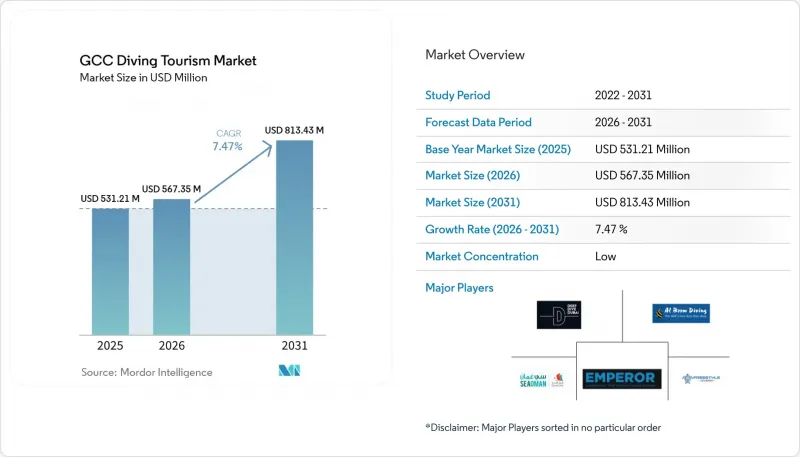
According to Mordor Intelligence, the GCC diving tourism market was valued at USD 531.21 million in 2025 and estimated to grow from USD 567.35 million in 2026 to reach USD 813.43 million by 2031, at a CAGR of 7.47% during the forecast period (2026-2031).
GCC Diving Tourism Market Trends and Insights
Red Sea and Gulf of Oman Marine Asset Advantage
The Red Sea serves as a key natural foundation for the GCC tourism market, supported by Saudi Arabia's extensive dive sites, coral reefs, diverse marine species, and sea turtle populations. The Gulf of Aqaba gained attention during the 2024 marine heat wave for its thermally resilient coral populations, which demonstrated better recovery potential after bleaching stress compared to other reef systems. Oman contributes to the market through Musandam, where operators promote encounters with marine species such as whale sharks, manta rays, and barracuda across multiple dive sites. Lower diver traffic at many reef sites in Saudi Arabia and Oman has helped maintain reef structures and visual quality, offering an alternative to more crowded locations. Saudi Arabia's Vision 2030 framework identifies Red Sea dive tourism, liveaboards, and freediving experiences at Farasan Island as focus areas for adventure tourism growth.
Tourism Liberalization and Visa Simplification Across GCC
The GCC diving tourism market benefits from improved cross-border access, driven by Saudi Arabia's simplified digital travel entry for more nationalities. The KSA Visa platform consolidates e-visa applications, processing, and approvals into a single digital system, expanding access to citizens of numerous countries. The planned Unified GCC Tourist Visa enhances multi-country itineraries, appealing to dive travelers who combine flights, coastal stays, and dive days across destinations. Saudi Arabia's tourism policy changes have translated into increased visitor flows and spending, reflecting the effectiveness of these measures. Certified divers, who plan trips well in advance and spend more per trip than casual visitors, gain significantly from streamlined visa processes. This supports guided excursions, liveaboards, and bundled dive holidays, offering more value to the diving tourism market compared to low-value day tourism.
High Cost of Certified Diving, Equipment, and Coastal Logistics
Entry-level diving remains costly in the GCC diving tourism market, limiting participation from first-time divers. Certification courses in the Red Sea region are priced higher compared to other regions, and liveaboard berths also add significant expenses. Equipment rental and accessing remote sites such as the Farasan Islands or Al Hallaniyat further increase costs due to additional charges for transfers or charters. Operators in the GCC face challenges with training scale and cost structures, unlike regions such as Egypt or Thailand, where similar courses are more affordable. High trip costs are driven by factors including imported diving gear, limited regional distribution, and logistical challenges in remote coastal areas. This has shifted the focus of the market toward experienced divers rather than attracting entry-level participants.
Other drivers and restraints analyzed in the detailed report include:
- Rising Demand for Experiential and Eco-Adventures
- Growth of Women-Led and Inclusive Dive Programs
- Seasonality and Weather-Driven Visibility Fluctuations
For complete list of drivers and restraints, kindly check the Table Of Contents.
Segment Analysis
Scuba Diving accounted for 71.73% of the GCC diving tourism market in 2025, driven by a strong training base, extensive equipment availability, and a network of PADI and SSI-certified dive centers. Established compressed air and Nitrox supply chains across all six GCC countries make scuba diving more scalable than niche categories. Red Sea Global's Galaxea brand operates a PADI 5-Star Dive Center at Nujuma in the Al Wajh Lagoon, reflecting investments in in-house scuba infrastructure by destination operators. The segment attracts a broad customer base, including resort guests, club divers, certification seekers, and luxury liveaboard travelers. Although Technical Diving has a smaller volume, it holds commercial importance as rebreather, trimix, and deep-penetration divers spend 2 to 4 times more per day than recreational scuba customers.
Freediving is projected to grow at a 7.85% CAGR through 2031, making it the fastest-growing segment in the GCC diving tourism market. Its growth is linked to lower equipment requirements, lifestyle appeal, and increased participation from women and younger demographics. AIDA certifications among Arab women rose by 61% between 2023 and 2025, providing a measurable boost to the segment. Competitive events like the AIDA United Arab Emirates National Open Freediving Championship and Dubai's Apnea Pirates have helped establish freediving as a structured activity. AIDA certification pathways support monetization by offering progression from beginner sessions to advanced training, extending beyond basic snorkeling or introductory ocean experiences.
Dive Excursions & Guided Trips accounted for 40.45% of the GCC diving tourism market size in 2025, highlighting the dominance of single-day and short-format experiences. This trend is evident in the United Arab Emirates, where expatriate residents, hotel guests, and weekend travelers drive demand for half-day and full-day trips. Dive Training & Certifications and Equipment Rental remain key secondary revenue streams, fostering repeat engagement and converting casual interest into recurring spending. PADI reported 220 new dive operations and over 100 store conversions across 47 countries in 2025, reflecting the sustained growth of organized training networks relevant to the GCC. Guided excursions are popular due to their ease of scheduling, straightforward sales, and accessibility for travelers seeking flexible options.
Dive Travel Packages are projected to grow at a 7.93% CAGR through 2031, attracting higher-value travelers. International divers often prefer comprehensive packages that include flights, accommodation, guided diving, and equipment, as regional logistics can be challenging for first-time visitors. A Saudi Red Sea liveaboard package generates 6 to 8 times the revenue of a single guided dive, making even small shifts toward packages impactful for revenue growth. AMAALA's Phase One opening in 2025 introduced 6 resorts, a yacht club, a marine life institute, and a marina, designed to cater to this travel format. The SAR 51.04 billion investment in Phase One demonstrates the region's focus on bundled marine travel rather than relying solely on local excursions.
Complete Report Scope:
- By Diving Type
- Scuba Diving
- Freediving
- Technical Diving
- By Tourist Type
- International Tourists
- Domestic Tourists
- By Booking Channel
- Direct Booking
- Online Travel Agencies (OTAs)
- Dive Tour Operators & Travel Agencies
- By Revenue Source
- Dive Excursions & Guided Trips
- Dive Training & Certifications
- Equipment Rental
- Dive Travel Packages
- By Country
- Saudi Arabia
- United Arab Emirates
- Oman
- Qatar
- Bahrain
- Kuwait
List of Companies Covered in this Report:
- Deep Dive Dubai
- Al Boom Diving
- Emperor Divers
- SeaOman
- Desert Sea Divers
- Extra Divers Musandam
- Coral Diving
- Freestyle Divers
- Nemo Diving Center
- Dive Campus
- Al-Haddad Scuba
- West Coast Diver
- Divers Down UAE
- Scuba Shade
- Muscat Diving & Adventure Centre
- Dubai Diving Centre
- Aqua Divers Club
- Bandar Al Khiran Diving Center
- Reef Oasis Diving Center
- Scuba World Divers
Additional Benefits:
- The market estimate (ME) sheet in Excel format
- 3 months of analyst support
TABLE OF CONTENTS
1 Introduction
- 1.1 Study Assumptions and Market Definition
- 1.2 Scope of the Study
2 Research Methodology
3 Executive Summary
4 Market Landscape
- 4.1 Market Overview
- 4.2 Market Drivers
- 4.2.1 Red Sea and Gulf of Oman Marine Asset Advantage
- 4.2.2 Tourism Liberalization and Visa Simplification Across GCC
- 4.2.3 Rising Demand for Experiential and Eco-Adventures
- 4.2.4 Growth of Women-Led and Inclusive Dive Programs
- 4.2.5 Expansion of Regenerative Tourism and Marine Conservation Brands
- 4.2.6 Digital Discovery, Booking, and Creator-Led Destination Marketing
- 4.3 Market Restraints
- 4.3.1 High Cost of Certified Diving, Equipment, and Coastal Logistics
- 4.3.2 Seasonality and Weather-Driven Visibility Fluctuations
- 4.3.3 Reef Sensitivity, Conservation Limits, and Access Restrictions
- 4.3.4 Shortage of Deeply Localized Dive Infrastructure in Smaller GCC Markets
- 4.4 Value / Supply-Chain Analysis
- 4.5 Regulatory Landscape
- 4.6 Technological Outlook
- 4.7 Porter's Five Forces Analysis
- 4.7.1 Bargaining Power of Buyers
- 4.7.2 Bargaining Power of Suppliers
- 4.7.3 Threat of New Entrants
- 4.7.4 Threat of Substitutes
- 4.7.5 Competitive Rivalry
5 Market Size & Growth Forecasts (Value)
- 5.1 By Diving Type
- 5.1.1 Scuba Diving
- 5.1.2 Freediving
- 5.1.3 Technical Diving
- 5.2 By Tourist Type
- 5.2.1 International Tourists
- 5.2.2 Domestic Tourists
- 5.3 By Booking Channel
- 5.3.1 Direct Booking
- 5.3.2 Online Travel Agencies (OTAs)
- 5.3.3 Dive Tour Operators & Travel Agencies
- 5.4 By Revenue Source
- 5.4.1 Dive Excursions & Guided Trips
- 5.4.2 Dive Training & Certifications
- 5.4.3 Equipment Rental
- 5.4.4 Dive Travel Packages
- 5.5 By Country
- 5.5.1 Saudi Arabia
- 5.5.2 United Arab Emirates
- 5.5.3 Oman
- 5.5.4 Qatar
- 5.5.5 Bahrain
- 5.5.6 Kuwait
6 Competitive Landscape
- 6.1 Market Concentration
- 6.2 Strategic Moves
- 6.3 Market Share Analysis
- 6.4 Company Profiles (includes Overview, Market Level Overview, Core Segments, Financials as available, Strategic Information, Market Rank/Share, Products and Services, Recent Developments)
- 6.4.1 Deep Dive Dubai
- 6.4.2 Al Boom Diving
- 6.4.3 Emperor Divers
- 6.4.4 SeaOman
- 6.4.5 Desert Sea Divers
- 6.4.6 Extra Divers Musandam
- 6.4.7 Coral Diving
- 6.4.8 Freestyle Divers
- 6.4.9 Nemo Diving Center
- 6.4.10 Dive Campus
- 6.4.11 Al-Haddad Scuba
- 6.4.12 West Coast Diver
- 6.4.13 Divers Down UAE
- 6.4.14 Scuba Shade
- 6.4.15 Muscat Diving & Adventure Centre
- 6.4.16 Dubai Diving Centre
- 6.4.17 Aqua Divers Club
- 6.4.18 Bandar Al Khiran Diving Center
- 6.4.19 Reef Oasis Diving Center
- 6.4.20 Scuba World Divers
7 Market Opportunities & Future Outlook
- 7.1 White-space and Unmet-Need Assessment
- 7.2 Opportunity Areas
- 7.2.1 Women-Centric Dive Products and Beginner-To-Advanced Training Funnels
- 7.2.2 Conservation-Led Premium Diving and Regenerative Tourism Packages

