PUBLISHER: Mordor Intelligence | PRODUCT CODE: 2163597

PUBLISHER: Mordor Intelligence | PRODUCT CODE: 2163597
Indonesia Full Container Load (FCL) - Market Share Analysis, Industry Trends & Statistics, Growth Forecasts (2026 - 2031)
According to Mordor Intelligence, the Indonesia full container load (FCL) market size was valued at USD 5.32 billion in 2025 and is estimated to grow from USD 5.72 billion in 2026 to reach USD 7.82 billion by 2031, at a CAGR of 6.45% during the forecast period from 2026 to 2031.
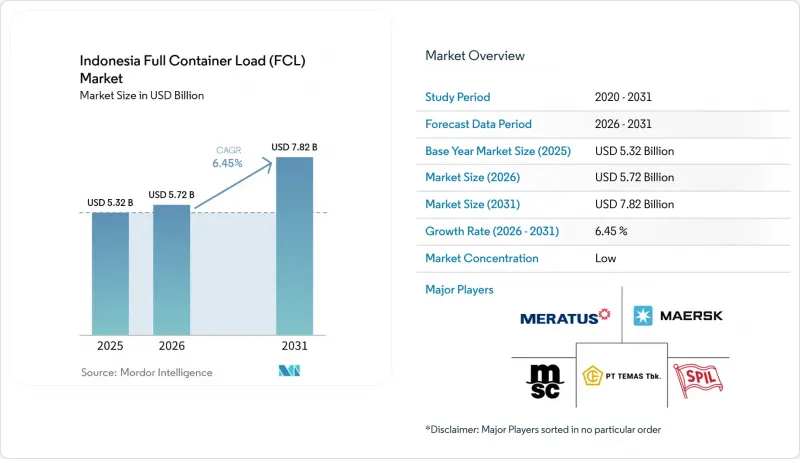
The Indonesia full container load (FCL) market is supported by rising container use, industrial processing investment, and trade among Indonesia's islands, where freight patterns vary sharply by corridor, export base, and local handling capacity. This report is Segmented by Trade Flow (Domestic/Inter-Island FCL, International FCL), by Container Type (Dry, Refrigerated, Tank, Special Equipment), by Container Size (20-Foot, 40-Foot), by End-User Industry (Manufacturing and Industrial, Retail and Consumer Goods, Food and Beverage, and More), and by Region (Java, Sumatra, Kalimantan, and More). The Market Forecasts are Provided in Terms of Value (USD).
Indonesia Full Container Load (FCL) Market Trends and Insights
Containerization Growth Increasing Domestic and Export FCL Volumes
Domestic cargo is shifting from break-bulk handling toward containerized movements, creating bookings that do not depend only on overall trade growth. TPK Semarang reported a 13.7% year-over-year increase in export containers to 189,162 TEUs from January to May 2026. More manufacturers are selecting dedicated full-container shipments as service frequency, and reliability improves at secondary ports. This shift gives Indonesia full container load (FCL) market a steadier demand base than cargo flows linked mainly to commodity prices. It also supports capacity planning because operators can align vessel deployment with repeat industrial shipments.
Port Expansion Improving Container Handling Capacity and Efficiency
New terminal capacity is changing the supply structure of the Indonesia full container load (FCL) market. Pelindo began operating Terminal 2 Petikemas at Tanjung Priok in August 2026, adding a 517.5 m berth and 98,700 m2 of yard space. Pelindo's Indonesia Network Pendulum plan also targets 20 inter-island shipping corridors, including 7 planned by the end of 2026. Patimban has an initial installed capacity of 200,000 TEUs and is planned to expand to 600,000 TEUs in its next phase. Additional gateways can reduce dependence on a single hub, but their benefit depends on road, rail, and depot connections. Investment at secondary ports is, therefore, important because it determines whether new capacity removes bottlenecks or moves them inland.
Empty Container Imbalances Increasing Repositioning and Backhaul Costs
East-to-west trade imbalances remain a persistent cost issue for the Indonesia full container load (FCL) market. This indicates that east-to-west load factors remain near 30%, leaving many containers to return empty from eastern ports. PELNI data for 2025 showed 9,103 TEUs of outbound cargo and 4,039 TEUs of return cargo on Tol Laut routes. This imbalance increased repositioning expenses and raised freight charges for exporters. Academic research also identifies market structure and empty backhauls as important factors in trucking cost efficiency. The constraint is particularly relevant for remote production areas, where a return load is less certain than on Java-based corridors.
Other drivers and restraints analyzed in the detailed report include:
- Industrial Investment Increasing Export-Oriented Containerized Cargo Demand
- Digitalization Improving Port-Hinterland Coordination and Shipment Visibility
- Port-Hinterland Delays Increasing Overall Container Logistics Costs
For complete list of drivers and restraints, kindly check the Table Of Contents.
Segment Analysis
Domestic and inter-island services held 65.89% of the Indonesia full container load (FCL) market share in 2025. The Tol Laut program served 104 ports in 2025 and received IDR 623.4 billion (USD 37.40 million) in subsidy support. Its 2026 allocation changed to IDR 525.0 billion (USD 31.50 million) under a cargo consignment mechanism. The program can open commercially viable routes to private operators as demand becomes established. Return cargo represented only 31% of Tol Laut volumes in 2025, showing the challenge of assembling cargo in the reverse direction.
International services are the faster-growing trade flow, with an 8.94% CAGR projected from 2026 to 2031. International services carry raw materials and capital goods on the import leg as well as processed products on the export leg. This mix requires carriers to manage both regular industrial demand and trade-lane imbalances. The Indonesia full container load (FCL) market can benefit where operators can combine outbound volumes and secure dependable backhaul cargo. That requirement may remain central to private investment decisions on eastern routes.
Dry containers held 82.37% of the Indonesia full container load (FCL) market size in 2025. Java and Sumatra offer stronger reefer yields because they have more developed cold storage and compliant logistics facilities. Pharmaceutical handling is becoming more demanding as service providers meet Good Distribution Practice requirements. These requirements can favor operators with validated handling procedures and equipment.
Refrigerated containers are expected to register at a 9.45% CAGR through 2031, the highest rate among container types. Pharmaceutical distribution, seafood, processed food, and nutrition-program logistics support demand for temperature-controlled capacity. 30% of pharmaceutical shipments still encounter temperature-storage issues during transit. This gap creates demand for more consistent reefer services in eastern corridors. The Indonesia full container load (FCL) market, therefore, has room for specialized capacity even as dry containers remain the principal volume base.
Complete Report Scope:
- By Trade Flow
- Domestic / Inter-Island FCL
- International FCL
- Import Flow
- Export Flow
- By Container Type
- Dry Containers
- Refrigerated Containers
- Tank Containers
- Special Equipment Containers
- By Container Size
- 20-Foot Containers
- 40-Foot Containers
- By End-User Industry
- Manufacturing and Industrial
- Retail and Consumer Goods
- Food and Beverage
- Automotive and Components
- Chemicals and Petrochemicals
- Electronics and Electrical
- Agriculture and Forestry
- Healthcare and Pharmaceuticals
- Other End Users
- By Region
- Java (Jakarta and BOD)
- Sumatra
- Kalimantan
- Sulawesi
- Bali and Nusa Tenggara
- Papua Region and Maluku Islands
List of Companies Covered in this Report:
- Mediterranean Shipping Company (MSC)
- A.P. Moller - Maersk
- CMA CGM
- COSCO SHIPPING Lines
- Ocean Network Express (ONE)
- Hapag-Lloyd
- Evergreen Marine Corporation
- Yang Ming Marine Transport Corporation
- HMM Co., Ltd.
- Pacific International Lines (PIL)
- ZIM Integrated Shipping Services
- Wan Hai Lines
- SITC International Holdings
- X-Press Feeders
- PT Salam Pacific Indonesia Lines (SPIL)
- Meratus Group
- PT TEMAS Tbk
- PT Samudera Indonesia Tbk
- PT Tanto Intim Line
- DHL Global Forwarding
- Kuehne+Nagel International AG
- DSV A/S
Additional Benefits:
- The market estimate (ME) sheet in Excel format
- 3 months of analyst support
TABLE OF CONTENTS
1 INTRODUCTION
- 1.1 Study Assumptions and Market Definition
- 1.2 Scope of the Study
2 RESEARCH METHODOLOGY
3 EXECUTIVE SUMMARY
- 3.1 Market Size, Growth, and Forecast Outlook
- 3.2 Key Demand Drivers and FCL Shipping Trends
- 3.3 Major FCL Gateways and Cargo Concentration
- 3.4 Competitive Landscape and Leading FCL Providers
4 MARKET LANDSCAPE
- 4.1 Market Overview and Importance of Full Container Load Market
- 4.2 Market Drivers
- 4.2.1 Containerization Growth Increasing Domestic and Export FCL Volumes
- 4.2.2 Port Expansion Improving Container Handling Capacity and Efficiency
- 4.2.3 Industrial Investment Increasing Export-Oriented Containerized Cargo Demand
- 4.2.4 Digitalization Improving Port-Hinterland Coordination and Shipment Visibility
- 4.2.5 Sea-Toll Development Strengthening Eastern Indonesia Container Connectivity
- 4.2.6 Reefer Demand Expanding Specialized Container Shipping Requirements
- 4.3 Market Restraints
- 4.3.1 Empty Container Imbalances Increasing Repositioning and Backhaul Costs
- 4.3.2 Port-Hinterland Delays Increasing Overall Container Logistics Costs
- 4.3.3 Regional Infrastructure Gaps Restricting Efficient Container Accessibility
- 4.3.4 Customs and Documentation Complexity Increasing FCL Processing Friction
- 4.4 Value Chain Structure and FCL Cargo Flow Analysis
- 4.5 Regulatory Framework and FCL Shipping Compliance Analysis
- 4.6 Technology Adoption and FCL Digitalization Trend Analysis
- 4.7 Major Port and FCL Gateway Concentration Analysis
- 4.8 FCL Freight Rate and Surcharge Trend Analysis
- 4.9 Shipping Line Network and Service Coverage Analysis
- 4.10 Porter's Five Forces Analysis
- 4.10.1 Threat of New Entrants
- 4.10.2 Bargaining Power of Buyers
- 4.10.3 Bargaining Power of Suppliers
- 4.10.4 Threat of Substitute Services
- 4.10.5 Intensity of Competitive Rivalry
- 4.11 Impact of Geo-Political Events on Supply Chain Shifts
5 MARKET SIZE AND GROWTH FORECASTS
- 5.1 By Trade Flow
- 5.1.1 Domestic / Inter-Island FCL
- 5.1.2 International FCL
- 5.1.2.1 Import Flow
- 5.1.2.2 Export Flow
- 5.2 By Container Type
- 5.2.1 Dry Containers
- 5.2.2 Refrigerated Containers
- 5.2.3 Tank Containers
- 5.2.4 Special Equipment Containers
- 5.3 By Container Size
- 5.3.1 20-Foot Containers
- 5.3.2 40-Foot Containers
- 5.4 By End-User Industry
- 5.4.1 Manufacturing and Industrial
- 5.4.2 Retail and Consumer Goods
- 5.4.3 Food and Beverage
- 5.4.4 Automotive and Components
- 5.4.5 Chemicals and Petrochemicals
- 5.4.6 Electronics and Electrical
- 5.4.7 Agriculture and Forestry
- 5.4.8 Healthcare and Pharmaceuticals
- 5.4.9 Other End Users
- 5.5 By Region
- 5.5.1 Java (Jakarta and BOD)
- 5.5.2 Sumatra
- 5.5.3 Kalimantan
- 5.5.4 Sulawesi
- 5.5.5 Bali and Nusa Tenggara
- 5.5.6 Papua Region and Maluku Islands
6 COMPETITIVE LANDSCAPE
- 6.1 Market Concentration
- 6.2 Strategic Moves
- 6.3 Market Share Analysis
- 6.4 Company Profiles (includes Global Level Overview, Market Level Overview, Core Segments, Financials as available, Strategic Information, Geographic Coverage, Products and Services, Recent Developments)
- 6.4.1 Mediterranean Shipping Company (MSC)
- 6.4.2 A.P. Moller - Maersk
- 6.4.3 CMA CGM
- 6.4.4 COSCO SHIPPING Lines
- 6.4.5 Ocean Network Express (ONE)
- 6.4.6 Hapag-Lloyd
- 6.4.7 Evergreen Marine Corporation
- 6.4.8 Yang Ming Marine Transport Corporation
- 6.4.9 HMM Co., Ltd.
- 6.4.10 Pacific International Lines (PIL)
- 6.4.11 ZIM Integrated Shipping Services
- 6.4.12 Wan Hai Lines
- 6.4.13 SITC International Holdings
- 6.4.14 X-Press Feeders
- 6.4.15 PT Salam Pacific Indonesia Lines (SPIL)
- 6.4.16 Meratus Group
- 6.4.17 PT TEMAS Tbk
- 6.4.18 PT Samudera Indonesia Tbk
- 6.4.19 PT Tanto Intim Line
- 6.4.20 DHL Global Forwarding
- 6.4.21 Kuehne+Nagel International AG
- 6.4.22 DSV A/S
7 MARKET OPPORTUNITIES AND FUTURE OUTLOOK
- 7.1 White-Space Opportunities and Unmet FCL Service Needs
- 7.2 High-Potential End-User Segments and Trade Opportunities
- 7.3 Strategic Growth Priorities Across FCL Shipping Ecosystem
- 7.4 Future Market Outlook and Emerging FCL Demand Pockets
8 APPENDIX

