PUBLISHER: Mordor Intelligence | PRODUCT CODE: 2163603

PUBLISHER: Mordor Intelligence | PRODUCT CODE: 2163603
Personal Care Services - Market Share Analysis, Industry Trends & Statistics, Growth Forecasts (2026 - 2031)
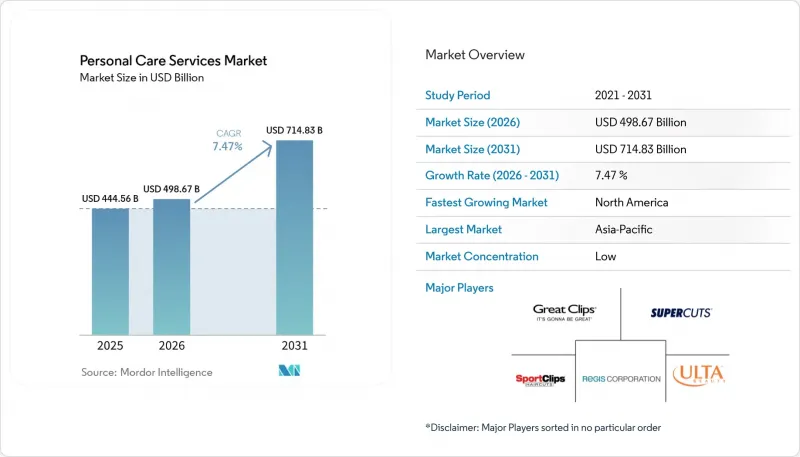
According to Mordor Intelligence, the global personal care services market was valued at USD 444.56 billion in 2025 and estimated to grow from USD 498.67 billion in 2026 to reach USD 714.83 billion by 2031, at a CAGR of 7.47% during the forecast period (2026-2031).
Global Personal Care Services Market Trends and Insights
Rising Demand for Premium Grooming and Self-Care Experiences
Repositioning treatments as results-driven routines rather than one-time indulgences is increasing average ticket values across the global personal care services market. The Global Wellness Institute reported that personal care and beauty were one of six wellness sectors, indicating sustained consumer spending on services aligned with wellness and self-care habits. This shift is broadening demand for scalp treatments, clinical facials, and other specialist formats that deliver visible outcomes and stronger repeat rates. Wellness-linked spending is significant because it increases willingness to pay for services that combine expertise, personalization, and measurable progress. Operators that reposition their service offerings around efficacy and wellness relevance are better placed to capture higher-value demand and protect margins.
Growth of Subscription and Membership-Based Salon Models
Subscription and membership programs are improving revenue quality in the global personal care services market by converting irregular visits into recurring spending patterns. Zenoti reported 24% membership sales growth in 2024 across salons, waxing centers, and medspas, identifying memberships as a primary driver of growth across most tracked categories. This model reduces seasonal fluctuations, lowers dependence on walk-in traffic, and provides operators with a more stable base for staffing and retail planning. Digital tools are reinforcing this trend; in 2025, Great Clips stated that its mobile app had surpassed 25 million downloads following updates that expanded ReadyNext text alert functionality. The global personal care services market is moving toward a model in which booking, payments, loyalty, and memberships are integrated, improving retention and generating more predictable monthly revenue.
Labor Shortages and High Staff Turnover
Labor availability remains one of the clearest restraints on the global personal care services market, as service revenue depends directly on trained staff, utilization rates, and client continuity. Vagaro reported in 2025 that 90% of service professionals across personal care industries experienced moderate to high stress, while 40% cited work-life balance challenges and 78% pointed to rising supply costs as significant financial burdens. According to Vagaro's April 2025 report, the United States Bureau of Labor Statistics projected that employment for barbers, hairstylists, and cosmetologists is expected to grow 7% through 2033, reflecting sustained demand for trained professionals rather than a short-term hiring gap. High turnover weakens the market not only through recruitment costs but also through client migration, as customers follow individual stylists rather than the salon brand. This pressure is more pronounced in franchised systems, where rapid network expansion can expose uneven service standards if training quality, operational discipline, and staff retention do not keep pace.
Other drivers and restraints analyzed in the detailed report include:
- Increasing Male Grooming and Specialty Service Consumption
- Digitization of Booking, Payments, and Loyalty Programs
- Sensitivity to Discretionary Spending Cycles
For complete list of drivers and restraints, kindly check the Table Of Contents.
Segment Analysis
Hair care accounted for 40.16% of the global personal care services market revenue in 2025, making it the largest service category. This position reflects the essential, high-frequency nature of haircuts, color, and treatment services across broad age groups and income levels. Nail care is projected to grow at a 10.10% CAGR through 2031, making it the fastest-growing service type in the market, supported by rising consumer interest in nail artistry, gel extensions, and related formats that customers prefer receiving from trained technicians.
Skin care generates less revenue than hair care but is increasingly strategic as more salons introduce clinical facials, dermaplaning, and LED-based treatments. Spa and wellness services contribute meaningfully by connecting beauty services with broader self-care routines and supporting higher average transaction values. The Global Wellness Institute's 2025 update noted that the wider wellness economy continues to expand, providing personal care and beauty with a stronger long-term spending base. For market operators, hair care provides a stable utilization floor, while nail and skin services offer stronger growth potential and clearer service differentiation, shaping investment decisions across service offerings.
Women accounted for 65.45% of the Global Personal Care Services Market share in 2025, making them the largest end-user segment. This position reflects both the wider range of services consumed and the higher average visit frequency across hair, skin, nail, and related categories. Men are projected to grow at a 9.30% CAGR through 2031, making them the fastest-growing end-user group in the market. This shift indicates that male spending is moving beyond routine haircuts into specialist services with higher value per visit. Children and unisex formats remain relevant as supporting categories, contributing recurring family traffic and serving markets where inclusive beauty norms are gaining ground.
Male demand is expanding as grooming routines become broader and more specialized. Sport Clips' 2026 rollout of its Fans First service commitment demonstrates how organized operators are adapting store experience, personalization, and brand positioning to retain repeat male customers. Men are entering through haircut-led channels but increasingly moving into scalp care, beard services, facials, and maintenance-oriented treatment plans. Once acquired, these customers can strengthen rebooking and attachment rates, particularly in franchise systems built around clear service routines and familiar environments.
Complete Report Scope:
- By Service Type
- Hair Care Services
- Skin Care Services
- Nail Care Services
- Spa and Wellness Services
- Other Personal Care Services
- By End User
- Women
- Men
- Children
- Unisex
- By Service Model
- In-Salon Services
- At-Home Services
- Mobile Services
- Subscription / Membership Services
- By Price Tier
- Premium
- Mid-Range
- Economy
- By Geography
- North America
- United States
- Canada
- Mexico
- South America
- Brazil
- Peru
- Chile
- Argentina
- Rest of South America
- Europe
- United Kingdom
- Germany
- France
- Spain
- Italy
- BENELUX (Belgium, Netherlands, and Luxembourg)
- NORDICS (Denmark, Finland, Iceland, Norway, and Sweden)
- Rest of Europe
- Asia-Pacific
- India
- China
- Japan
- Australia
- South Korea
- South East Asia (Singapore, Malaysia, Thailand, Indonesia, Vietnam, and Philippines)
- Rest of Asia-Pacific
- Middle East and Africa
- United Arab Emirates
- Saudi Arabia
- South Africa
- Nigeria
- Rest of Middle East and Africa
- North America
Geography Analysis
Asia-Pacific held 35.12% of the global personal care services market in 2025, making it the largest regional contributor by revenue. The region's scale is supported by urbanization, rising disposable incomes, and the influence of K-beauty and J-beauty routines, which have increased demand for multi-step, expert-administered services. NielsenIQ reported in October 2025 that Asia-Pacific led global beauty growth at 14.3%, with China's hair and skin care categories remaining strong and Douyin posting 49% growth as a beauty commerce channel. Digital beauty discovery is shortening the path from product awareness to salon appointment demand. India also remains an important part of the regional mix, as beauty demand is spreading beyond metropolitan areas and supporting organized salon expansion into smaller cities.
North America is the fastest-growing region, with a forecast CAGR of 10.17% through 2031. The Global Wellness Institute reported in 2025 that North American per-capita wellness spending stood at USD 6,029 annually. Growth is driven not only by increased traffic but also by better monetization through technology, memberships, and layered service offerings.
Europe holds a significant share, supported by a mature salon culture across Western Europe. South America, led by Brazil and Chile, is developing a stronger beauty culture, while the Middle East and Africa are attracting more investment in hospitality and lifestyle spending. Across these markets, success depends on aligning with local spending patterns, service preferences, and labor availability.
- Great Clips
- Regis Corporation
- Sport Clips
- Ulta Beauty
- Drybar
- Fantastic Sams
- Toni & Guy
- Dessange International
- BLO Blow Dry Bar
- FaceGym
- Saks Hair
- TGF Hairdressing
- House of Enspa
- Provalliance
- European Wax Center
- Massage Envy
- The Lash Lounge
- The Woodhouse Day Spa
- Milk + Honey
- Seva Beauty
Additional Benefits:
- The market estimate (ME) sheet in Excel format
- 3 months of analyst support
TABLE OF CONTENTS
1 Introduction
- 1.1 Study Assumptions and Market Definition
- 1.2 Scope of the Study
2 Research Methodology
3 Executive Summary
4 Market Landscape
- 4.1 Market Overview
- 4.2 Market Drivers
- 4.2.1 Rising Demand for Premium Grooming and Self-Care Experiences
- 4.2.2 Growth of Subscription and Membership-Based Salon Models
- 4.2.3 Increasing Male Grooming and Specialty Service Consumption
- 4.2.4 Digitization of Booking, Payments, and Loyalty Programs
- 4.2.5 Expansion of Franchise-Led Multi-Unit Service Formats
- 4.2.6 Rising Wellness-Linked Personal Care Spending
- 4.3 Market Restraints
- 4.3.1 Labor Shortages and High Staff Turnover
- 4.3.2 Sensitivity to Discretionary Spending Cycles
- 4.3.3 Rental and Occupancy Cost Pressure in Prime Locations
- 4.3.4 Service Standardization Challenges Across Franchised Networks
- 4.4 Value Chain / Supply Chain Analysis
- 4.5 Regulatory Landscape
- 4.6 Technological Outlook
- 4.7 Porter's Five Forces Analysis
- 4.7.1 Bargaining Power of Suppliers
- 4.7.2 Bargaining Power of Buyers
- 4.7.3 Threat of New Entrants
- 4.7.4 Threat of Substitutes
- 4.7.5 Intensity of Competitive Rivalry
5 Market Size & Growth Forecasts (Value)
- 5.1 By Service Type
- 5.1.1 Hair Care Services
- 5.1.2 Skin Care Services
- 5.1.3 Nail Care Services
- 5.1.4 Spa and Wellness Services
- 5.1.5 Other Personal Care Services
- 5.2 By End User
- 5.2.1 Women
- 5.2.2 Men
- 5.2.3 Children
- 5.2.4 Unisex
- 5.3 By Service Model
- 5.3.1 In-Salon Services
- 5.3.2 At-Home Services
- 5.3.3 Mobile Services
- 5.3.4 Subscription / Membership Services
- 5.4 By Price Tier
- 5.4.1 Premium
- 5.4.2 Mid-Range
- 5.4.3 Economy
- 5.5 By Geography
- 5.5.1 North America
- 5.5.1.1 United States
- 5.5.1.2 Canada
- 5.5.1.3 Mexico
- 5.5.2 South America
- 5.5.2.1 Brazil
- 5.5.2.2 Peru
- 5.5.2.3 Chile
- 5.5.2.4 Argentina
- 5.5.2.5 Rest of South America
- 5.5.3 Europe
- 5.5.3.1 United Kingdom
- 5.5.3.2 Germany
- 5.5.3.3 France
- 5.5.3.4 Spain
- 5.5.3.5 Italy
- 5.5.3.6 BENELUX (Belgium, Netherlands, and Luxembourg)
- 5.5.3.7 NORDICS (Denmark, Finland, Iceland, Norway, and Sweden)
- 5.5.3.8 Rest of Europe
- 5.5.4 Asia-Pacific
- 5.5.4.1 India
- 5.5.4.2 China
- 5.5.4.3 Japan
- 5.5.4.4 Australia
- 5.5.4.5 South Korea
- 5.5.4.6 South East Asia (Singapore, Malaysia, Thailand, Indonesia, Vietnam, and Philippines)
- 5.5.4.7 Rest of Asia-Pacific
- 5.5.5 Middle East and Africa
- 5.5.5.1 United Arab Emirates
- 5.5.5.2 Saudi Arabia
- 5.5.5.3 South Africa
- 5.5.5.4 Nigeria
- 5.5.5.5 Rest of Middle East and Africa
- 5.5.1 North America
6 Competitive Landscape
- 6.1 Market Concentration
- 6.2 Strategic Moves
- 6.3 Market Share Analysis
- 6.4 Company Profiles (includes Global Level Overview, Market Level Overview, Core Segments, Financials as available, Strategic Information, Market Rank/Share, Products and Services, Recent Developments)
- 6.4.1 Great Clips
- 6.4.2 Regis Corporation
- 6.4.3 Sport Clips
- 6.4.4 Ulta Beauty
- 6.4.5 Drybar
- 6.4.6 Fantastic Sams
- 6.4.7 Toni & Guy
- 6.4.8 Dessange International
- 6.4.9 BLO Blow Dry Bar
- 6.4.10 FaceGym
- 6.4.11 Saks Hair
- 6.4.12 TGF Hairdressing
- 6.4.13 House of Enspa
- 6.4.14 Provalliance
- 6.4.15 European Wax Center
- 6.4.16 Massage Envy
- 6.4.17 The Lash Lounge
- 6.4.18 The Woodhouse Day Spa
- 6.4.19 Milk + Honey
- 6.4.20 Seva Beauty
7 Market Opportunities & Future Outlook
- 7.1 Market Opportunities
- 7.1.1 Premium Subscription Bundles for High-Frequency Urban Consumers
- 7.1.2 Mobile, At-Home, and On-Demand Service Expansion
- 7.2 White-space and Unmet-Need Assessment

