PUBLISHER: Mordor Intelligence | PRODUCT CODE: 2163616

PUBLISHER: Mordor Intelligence | PRODUCT CODE: 2163616
Serviced Apartment - Market Share Analysis, Industry Trends & Statistics, Growth Forecasts (2026 - 2031)
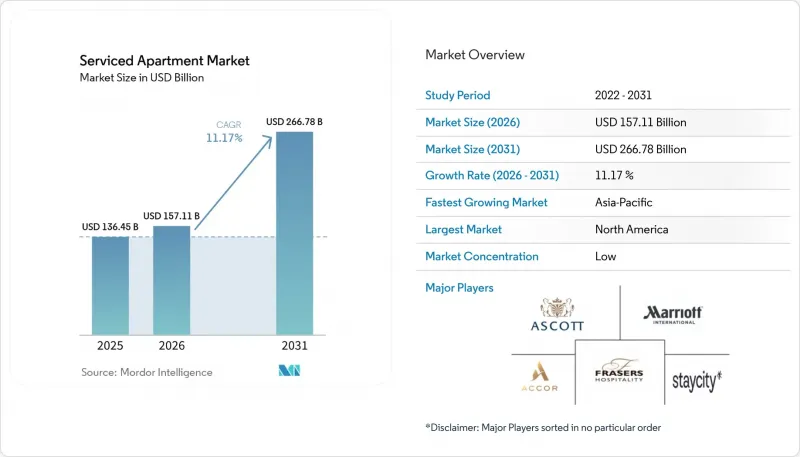
According to Mordor Intelligence, the serviced apartment market size is expected to grow from USD 136.45 billion in 2025 to USD 157.11 billion in 2026 and is forecast to reach USD 266.78 billion by 2031 at 11.17% CAGR over 2026-2031.
Global Serviced Apartment Market Trends and Insights
Longer Stay Demand from Corporate Mobility and Relocation
Corporate mobility is moving further away from conventional hotel stays and toward longer-stay furnished formats with better cost visibility and easier compliance handling. In the global serviced apartment market, this supports steadier demand because assignments linked to relocation, internal transfers, and rotational staffing often run well beyond a few nights. Business travel spending is expected to reach USD 1.57 trillion in 2026, which keeps the corporate demand base active across major markets. Companies are also treating these properties as part of their risk-control framework because professional management, inclusive pricing, and standardized service reduce the uncertainty that comes with informal rentals. This shift is also relevant for India, where multinational employers expanding GCC operations need accommodation that can support both short onboarding cycles and multi-month project stays.
Regulatory Re-Allocation Away from Informal Short-Term Rentals
Regulatory tightening across several major markets is acting as a channel for demand transfer in the global serviced apartment market. Stricter rules in cities like Amsterdam and Edinburgh, as well as broader national regulations in France and Spain, are making compliance harder for unregulated short-term rental inventory and easier for professionally managed operators to win displaced demand. This matters because compliant serviced apartment operators can absorb guests who still need city-based, furnished, flexible accommodation, especially for work-led travel. The effect is not only about occupancy, because it also improves the relative position of licensed operators when investors and corporate buyers compare risk. For the global serviced apartment market, the result is a stronger competitive moat in cities where enforcement is tightening, and professional formats have clearer legal standing.
Fragmented Supply and Inconsistent Operating Standards
Fragmented supply remains one of the clearest operational limits on the global serviced apartment market. Large corporate buyers want consistent quality, transparent reporting, consolidated billing, and compliance-ready documentation across multiple cities, but smaller, independent operators often struggle to deliver this at scale. The revenue management in this segment is more complex than in standard hotel inventory because stay length and utilization patterns differ sharply. This creates a technological barrier separating well-funded platform operators from undercapitalized independents. In the global serviced apartment market, that gap affects both profitability and buyer confidence, especially in enterprise-led contracts.
Other drivers and restraints analyzed in the detailed report include:
- Hybrid Living, Working, and Co-Living Preferences
- Institutional Capital Seeking Operationally Efficient Living Assets
- Zoning, Licensing, and Planning Constraints in Core Cities
For complete list of drivers and restraints, kindly check the Table Of Contents.
Segment Analysis
Long-Term (>30 Nights) accommodation held 62.10% of the global serviced apartment market share in 2025 and is projected to grow at a 13.90% CAGR through 2031. This segment continues to lead because corporate assignments, expatriate relocations, and project-based deployments still require furnished units that can function as temporary homes. The value proposition is straightforward: clients get inclusive utilities, living space, and service support in one package, while operators benefit from steadier occupancy and stronger unit economics over longer-stay periods. In the global serviced apartment market, longer stays also reduce turnover intensity, helping operators manage labor and service costs more efficiently. The segment remains closely tied to business mobility patterns, which is why it remains the core revenue anchor.
Short-Term (<30 Nights) accommodation remains smaller in revenue share, but it is expanding its role as demand patterns become more flexible. Guests staying for 7 to 12 nights increasingly prefer managed apartments when they want more space, privacy, and in-room utility than a standard hotel room provides. This does not displace long-term demand, but it does widen the addressable customer base for the same operating format. The global serviced apartment market, therefore, benefits from a broader stay-length spectrum, in which a single property can appeal to both corporate and lifestyle travelers across different trip durations. Operators that can balance rate, occupancy, and stay length across both formats are likely to create more stable portfolio performance through the cycle.
Online Travel Platforms accounted for 54.55% of bookings in 2025 and are forecast to grow at a 14.23% CAGR through 2031. Their lead comes from visibility, comparison tools, and the convenience of established digital booking behavior across leisure and mixed-purpose travelers. In the global serviced apartment market, these platforms remain the highest-volume channel, especially for shorter stays and first-time bookings in new cities. Their influence is also reinforced by loyalty ecosystems and rate transparency, which help users compare furnished accommodation with hotel options within the same trip-planning flow. This means platform dependency is still a defining feature of distribution for many operators.
Direct Booking remains strategically important because the economics are better when operators can avoid third-party commissions and manage the guest relationship themselves. Moving 15% to 20% of bookings toward direct channels can recover meaningful commission outflow for a 50-unit property. Direct channels also suit corporate buyers because negotiated rate codes, B2B portals, and consolidated billing better align with procurement and compliance processes than retail booking journeys. Others, including marketplace booking, relocation platforms, and specialist corporate housing channels, continue to matter for longer stays, where transparency into the total assignment cost is more important than broad consumer discovery. The global serviced apartment market is therefore likely to remain split between high-volume platform distribution and higher-margin managed channels, with technology investment shaping who benefits most.
Complete Report Scope:
- By Type
- Short-Term Less Than 30 Nights
- Long-Term More Than 30 Nights
- By Booking Mode
- Direct Booking
- Online Travel Platforms
- Others (Marketplace Booking and others)
- By Traveler Type
- Domestic
- International
- By End Use
- Corporate and Business Traveler
- Leisure Traveler
- Expats and Relocators
- Other End Users
- By Geography
- North America
- United States
- Canada
- Mexico
- South America
- Brazil
- Peru
- Chile
- Argentina
- Rest of South America
- Europe
- United Kingdom
- Germany
- France
- Spain
- Italy
- BENELUX (Belgium, Netherlands, Luxembourg)
- NORDICS (Denmark, Finland, Iceland, Norway, Sweden)
- Rest of Europe
- Asia-Pacific
- India
- China
- Japan
- Australia
- South Korea
- South-East Asia (Singapore, Malaysia, Thailand, Indonesia, Vietnam, and The Philippines)
- Rest of Asia-Pacific
- Middle East & Africa
- United Arab Emirates
- Saudi Arabia
- South Africa
- Nigeria
- Rest of Middle East & Africa
- North America
Geography Analysis
North America held 35.44% of the global serviced apartment market share in 2025, making it the largest regional market. The region benefits from a mature extended-stay ecosystem, deeper corporate housing infrastructure, and steady demand from business mobility across the United States, Canada, and Mexico. The United States extended-stay hotel demand rose 5.4% year on year in Q1 2026, while occupancy remained 13.5 percentage points above comparable hotel classes, which supports the structural strength of the format. Project-linked demand tied to data centers, manufacturing, and infrastructure investment is adding further support in corridors such as Texas, Northern Virginia, and the Midwest. At the same time, fit-out and labor costs, along with zoning timelines, are keeping new supply disciplined, which protects pricing for existing inventory.
Europe remains one of the most established regions in the global serviced apartment market, supported by gateway cities such as London, Berlin, Madrid, Paris, and Amsterdam. Demand is being supported by tighter regulation of informal short-term rentals, which is improving the position of licensed, professionally managed operators in several urban markets. Serviced apartment occupancy in Europe reached 79% in 2025, compared with 75% for the wider hotel market, suggesting stronger operating resilience for this format. The Middle East and Africa remain less penetrated. Still, the region is scaling as real estate, infrastructure, energy, and headquarters activity bring more long-stay business travelers and expatriate staff into key cities. This is relevant from an Indian research perspective because many Indian firms, service providers, and professionals are directly linked to mobility corridors across the Gulf.
Asia-Pacific is the fastest-growing region in the global serviced apartment market, with a projected 14.66% CAGR through 2031. Growth is being supported by manufacturing-linked workforce movement in Vietnam, semiconductor and AI investment in Japan, and the spread of GCC activity in India beyond the major metros. The Tokyo serviced apartment ADR rose 6% quarter on quarter in Q2 2026, which reflects stronger demand from foreign professionals and advanced industry investment. India is a standout within this region because demand is moving into Pune, Jaipur, Kochi, and Coimbatore, where professionally managed long-stay supply remains constrained. South America is still smaller in value terms, but Tier-1 cities such as Sao Paulo and Bogota are gradually building a longer-stay furnished accommodation base as multinational activity in the region expands.
- The Ascott Limited
- Frasers Hospitality
- Marriott International, Inc.
- Accor S.A.
- IHG Hotels and Resorts
- Staycity Group
- Adagio
- Habicus Group
- Blueground
- Sonder Holdings Inc.
- Oakwood Worldwide
- Citadines Apart'hotel
- Quest Apartment Hotels
- SilverDoor Apartments
- National Corporate Housing
- Synergy Global Housing
- The Serviced Apartment Company
- Staybridge Suites
- Adina Apartment Hotels
- NUMA Group
Additional Benefits:
- The market estimate (ME) sheet in Excel format
- 3 months of analyst support
TABLE OF CONTENTS
1 Introduction
- 1.1 Study Assumptions and Market Definition
- 1.2 Scope of the Study
2 Research Methodology
3 Executive Summary
4 Market Landscape
- 4.1 Market Overview
- 4.2 Market Drivers
- 4.2.1 Longer Stay Demand From Corporate Mobility and Relocation
- 4.2.2 Regulatory Re-Allocation Away From Informal Short-Term Rentals
- 4.2.3 Hybrid Living, Working, and Co-Living Preferences
- 4.2.4 Institutional Capital Seeking Operationally Efficient Living Assets
- 4.2.5 Technology-Led Direct Booking and Revenue Management
- 4.2.6 Rising Demand From Project-Based Workforce Deployment
- 4.3 Market Restraints
- 4.3.1 Fragmented Supply and Inconsistent Operating Standards
- 4.3.2 Zoning, Licensing, and Planning Constraints in Core Cities
- 4.3.3 High Fit-Out, Compliance, and Asset Conversion Costs
- 4.3.4 Limited High-Quality Investable Stock in Prime Markets
- 4.4 Value Chain Analysis
- 4.5 Regulatory Landscape
- 4.6 Technological Outlook
- 4.7 Porter's Five Forces Analysis
- 4.7.1 Threat of New Entrants
- 4.7.2 Bargaining Power of Buyers
- 4.7.3 Bargaining Power of Suppliers
- 4.7.4 Threat of Substitutes
- 4.7.5 Competitive Rivalry
5 Market Size and Growth Forecasts
- 5.1 By Type
- 5.1.1 Short-Term Less Than 30 Nights
- 5.1.2 Long-Term More Than 30 Nights
- 5.2 By Booking Mode
- 5.2.1 Direct Booking
- 5.2.2 Online Travel Platforms
- 5.2.3 Others (Marketplace Booking and others)
- 5.3 By Traveler Type
- 5.3.1 Domestic
- 5.3.2 International
- 5.4 By End Use
- 5.4.1 Corporate and Business Traveler
- 5.4.2 Leisure Traveler
- 5.4.3 Expats and Relocators
- 5.4.4 Other End Users
- 5.5 By Geography
- 5.5.1 North America
- 5.5.1.1 United States
- 5.5.1.2 Canada
- 5.5.1.3 Mexico
- 5.5.2 South America
- 5.5.2.1 Brazil
- 5.5.2.2 Peru
- 5.5.2.3 Chile
- 5.5.2.4 Argentina
- 5.5.2.5 Rest of South America
- 5.5.3 Europe
- 5.5.3.1 United Kingdom
- 5.5.3.2 Germany
- 5.5.3.3 France
- 5.5.3.4 Spain
- 5.5.3.5 Italy
- 5.5.3.6 BENELUX (Belgium, Netherlands, Luxembourg)
- 5.5.3.7 NORDICS (Denmark, Finland, Iceland, Norway, Sweden)
- 5.5.3.8 Rest of Europe
- 5.5.4 Asia-Pacific
- 5.5.4.1 India
- 5.5.4.2 China
- 5.5.4.3 Japan
- 5.5.4.4 Australia
- 5.5.4.5 South Korea
- 5.5.4.6 South-East Asia (Singapore, Malaysia, Thailand, Indonesia, Vietnam, and The Philippines)
- 5.5.4.7 Rest of Asia-Pacific
- 5.5.5 Middle East & Africa
- 5.5.5.1 United Arab Emirates
- 5.5.5.2 Saudi Arabia
- 5.5.5.3 South Africa
- 5.5.5.4 Nigeria
- 5.5.5.5 Rest of Middle East & Africa
- 5.5.1 North America
6 Competitive Landscape
- 6.1 Strategic Moves
- 6.2 Market Share Analysis
- 6.3 Company Profiles (includes Global Level Overview, Market Level Overview, Core Segments, Financials as available, Strategic Information, Market Rank/Share, Products and Services, Recent Developments)
- 6.3.1 The Ascott Limited
- 6.3.2 Frasers Hospitality
- 6.3.3 Marriott International, Inc.
- 6.3.4 Accor S.A.
- 6.3.5 IHG Hotels and Resorts
- 6.3.6 Staycity Group
- 6.3.7 Adagio
- 6.3.8 Habicus Group
- 6.3.9 Blueground
- 6.3.10 Sonder Holdings Inc.
- 6.3.11 Oakwood Worldwide
- 6.3.12 Citadines Apart'hotel
- 6.3.13 Quest Apartment Hotels
- 6.3.14 SilverDoor Apartments
- 6.3.15 National Corporate Housing
- 6.3.16 Synergy Global Housing
- 6.3.17 The Serviced Apartment Company
- 6.3.18 Staybridge Suites
- 6.3.19 Adina Apartment Hotels
- 6.3.20 NUMA Group
7 Market Opportunities and Future Outlook
- 7.1 Market Opportunities
- 7.1.1 Hybrid Corporate-Lifestyle Product Formats
- 7.1.2 Secondary City and Suburban Expansion
- 7.2 White-space and Unmet-Need Assessment

