PUBLISHER: Mordor Intelligence | PRODUCT CODE: 2163621

PUBLISHER: Mordor Intelligence | PRODUCT CODE: 2163621
Financial Auditing Professional Services - Market Share Analysis, Industry Trends & Statistics, Growth Forecasts (2026 - 2031)
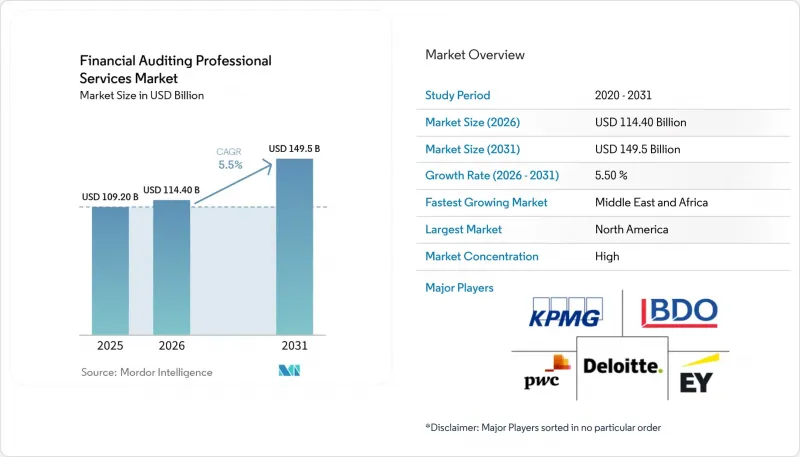
According to Mordor Intelligence, the financial auditing professional services market size was valued at USD 109.2 billion in 2025 and is estimated to grow from USD 114.4 billion in 2026 to reach USD 149.5 billion by 2031, at a CAGR of 5.5% during the forecast period (2026-2031).
Global Financial Auditing Professional Services Market Trends and Insights
Increasing Regulatory And Financial Reporting Complexity
Mandatory reporting rules are becoming more detailed across jurisdictions, making regulatory complexity a major support for the financial auditing professional services market. The Public Company Accounting Oversight Board adopted amendments to QC 1000 in September 2026, establishing a principles-based quality-management framework for registered public accounting firms that becomes effective on December 15, 2026. The amendments require firms to evaluate their quality-control systems each year, which increases the need for documented processes and implementation support. The International Auditing and Assurance Standards Board also proposed revisions to ISA 330, ISA 500, and ISA 520 in August 2026 to address technology use in audit evidence. These revisions encourage clients to engage audit teams earlier when changing reporting rules that affect controls, evidence, and disclosure requirements.
Expansion Of Cross-Border Operations And Capital Markets
Cross-border business activity raises demand for coordinated audit work where entities report across several jurisdictions. IFRS reporting across more than 100 countries requires multinational groups to align accounting records, audit evidence, and reporting procedures. The IAS 21 currency-exchangeability amendments, effective from 2025, increase recurring reconciliation and disclosure work in 2026 for subsidiaries operating in restricted-currency jurisdictions. Group audit requirements also remain important for companies headquartered in the United Kingdom with component auditors in other countries. In Saudi Arabia, Vision 2030-linked ventures and the Financial Oversight Law increase the importance of audit-quality IFRS reporting for tenders and private investment activity.
Shortage Of Qualified Audit And Technology-Risk Professionals
The shortage of audit and technology-risk professionals limits how quickly firms can expand engagement capacity. The Controllers Council recorded a Talent Shortage Index of 77% in its 2026 study, compared with a Talent Surplus Index of 108% in 2025. The average number of open accounting and finance positions per company rose to 17 in 2026 from 5 in 2025 and 2 in 2024. The profession has lost more than 300,000 accountants and auditors since 2020, while retirements and fewer CPA candidates continue to reduce available capacity. The Institute of Chartered Accountants in England and Wales reported in July 2026 that retirements exceed new trainees in many jurisdictions, extending this staffing pressure beyond North America.
Other drivers and restraints analyzed in the detailed report include:
- Rising Demand For Fraud Risk Assessment And Financial Transparency
- Adoption Of AI, Data Analytics, And Continuous Audit Techniques
- Auditor Independence, Liability, And Reputation Exposure
For complete list of drivers and restraints, kindly check the Table Of Contents.
Segment Analysis
General-purpose financial-statement audits represented 67.2% of the financial auditing professional services market size in 2025. Annual opinion audits remain the core assurance service for public companies, regulated financial institutions, and large private enterprises. Their role reflects filing obligations, investor expectations, and the need for independent assurance over annual financial statements. Reviews of historical financial information are projected to grow at a 7.2% CAGR through 2031, which exceeds the overall rate. Private-equity due diligence, lender covenant verification, and IPO readiness work support demand for reviews that provide substantial assurance without a full audit opinion.
The January 2026 amendments to ISRE 2400 address the use of external experts in review engagements, placing greater attention on the design and documentation of these assignments. Special-purpose audits and local-GAAP statutory audits serve multinational groups that must meet jurisdiction-specific filing obligations. These engagements can operate alongside a group audit because component entities may have separate legal reporting requirements. Agreed-upon procedures and compilation assignments address more limited assurance and compliance needs, including tender and grant-related submissions. PwC reported USD 19.8 billion in assurance revenue for FY2025, with growth in new assurance areas that include sustainability and artificial intelligence-related work.
Statutorily and regulatorily required mandates held 71.6% of the financial auditing professional services market size in 2025. Governments and sector regulators have embedded audit obligations into corporate governance, financial-sector supervision, and not-for-profit reporting. This structure makes mandatory audits the largest source of recurring demand across regions. Updated Public Company Accounting Oversight Board standards will become effective in December 2026 and extend public-company audit requirements in the United States. The scale of statutory demand is therefore expected to remain stable as reporting and quality-management rules evolve.
Contractually required mandates are projected to grow at a 6.7% CAGR through 2031, the highest rate within this segmentation. Loan covenants, bond agreements, private-equity arrangements, and government contracts often require audited or audit-quality information outside formal statutory rules. These arrangements connect financing availability and governance commitments with a need for independent assurance. Voluntary and governing-body-initiated audits remain smaller, but they are relevant for donor-funded organizations, family-owned companies, and businesses preparing for investment or succession. In the United Arab Emirates, Ministerial Decision No. 84 of 2025 shifted certain corporate-tax audit requirements from voluntary practice toward mandatory compliance for taxable persons with annual revenue above AED 50 million (USD 13.6 million).
Complete Report Scope:
- By Engagement Type
- General-Purpose Financial-Statement Audit
- Special-Purpose, Component and Statutory Local-GAAP Audit
- Review of Historical Financial Information
- Compilation With an Attest / Compilation Report
- Agreed-Upon Procedures on Financial Information
- Standalone Financial-Reporting-Control Attest
- Other In-Scope Financial Assurance
- By Mandate Type
- Statutorily / Regulatorily Required
- Contractually Required
- Voluntary / Governing-Body Initiated
- By Auditee Size
- Large Enterprises
- Mid-Sized Enterprises
- Small and Micro Enterprises
- By End-Use Industry
- Banking, Financial Services and Insurance
- Technology, Media and Telecommunications
- Manufacturing
- Healthcare and Life Sciences
- Retail, Consumer and Hospitality
- Energy, Utilities and Natural Resources
- Real Estate and Construction
- Transportation and Logistics
- Professional and Business Services
- Education and Not-For-Profit
- Public Bodies Audited by Licensed Independent Firms
- Other Industries
- By Geography
- North America
- United States
- Canada
- Mexico
- South America
- Brazil
- Argentina
- Rest of South America
- Europe
- United Kingdom
- Germany
- France
- Italy
- Spain
- Rest of Europe
- Asia-Pacific
- China
- Japan
- India
- South Korea
- Australia
- Indonesia
- Thailand
- Malaysia
- Singapore
- Vietnam
- Rest of Asia-Pacific
- Middle East and Africa
- Saudi Arabia
- United Arab Emirates
- Turkey
- South Africa
- Egypt
- Rest of Middle East and Africa
- North America
Geography Analysis
North America held 44.1% of the financial auditing professional services market share in 2025. The region is supported by the United States Securities and Exchange Commission oversight of public company issuers and Sarbanes-Oxley integrated audit requirements for accelerated filers. The United States also has a large concentration of listed businesses and globally important financial institutions. Deloitte reported USD 38.8 billion in Americas revenue in FY2025, while PwC generated USD 25.6 billion in the Americas region. Canada's audit requirements and Mexico's digital invoicing enforcement add to the regional demand base beyond the United States.
Europe remains the 2nd-largest regional block in the financial auditing professional services market. European Union sustainability reporting rules and United Kingdom audit standards expand the assurance work attached to annual reporting cycles. Germany's audit and tax advisory field grew 6.1% in FY2025 to EUR 22.6 billion (USD 24.2 billion), showing continued demand despite a difficult economic environment. Asia-Pacific is the 3rd-largest regional block, supported by India's mandatory audit requirements, regulatory consolidation among Chinese firms, and growing listings in Southeast Asia. The Asia-Pacific region also faced pressure on Big Four revenue in FY2025 because of currency headwinds.
The Middle East and Africa region is projected to grow at a 7.6% CAGR through 2031, the fastest geographic rate in the financial auditing professional services market. Saudi Arabia's Financial Oversight Law took effect on April 11, 2026, and established a risk-based public-fund oversight framework coordinated by the Ministry of Finance, SOCPA, and ZATCA. The framework expands audit-quality obligations for firms working in the Kingdom. The Dubai Financial Services Authority published its 9th Audit Monitoring Report in July 2026, requiring transparency reports from auditors of DIFC-listed companies and identifying artificial intelligence in audit as a 2026 priority. South America is supported by Brazil's statutory audit framework and IFRS use among listed companies, while amended IAS 21 requirements add complexity for businesses in Argentina.
- Deloitte
- PwC
- EY
- KPMG
- BDO
- Grant Thornton
- RSM
- Forvis Mazars
- Baker Tilly
- Crowe
- Nexia
- Moore Global
- PKF
- HLB
- UHY
- CliftonLarsonAllen (CLA)
- EisnerAmper
- CBIZ
- Armanino
- Wipfli
Additional Benefits:
- The market estimate (ME) sheet in Excel format
- 3 months of analyst support
TABLE OF CONTENTS
1 INTRODUCTION
- 1.1 Study Assumptions and Market Definition
- 1.2 Scope of the Study
2 RESEARCH METHODOLOGY
3 EXECUTIVE SUMMARY
4 MARKET LANDSCAPE
- 4.1 Market Overview
- 4.2 Market Drivers
- 4.2.1 Increasing Regulatory and Financial Reporting Complexity
- 4.2.2 Expansion of Cross-Border Operations and Capital Markets
- 4.2.3 Rising Demand for Fraud Risk Assessment and Financial Transparency
- 4.2.4 Adoption of AI, Data Analytics, and Continuous Audit Techniques
- 4.2.5 Growing Audit Complexity from Cloud-Based and Digitized Financial Systems
- 4.2.6 Increasing Demand For Continuous Auditing, Assurance And Real-Time Financial Monitoring
- 4.3 Market Restraints
- 4.3.1 Shortage of Qualified Audit and Technology-Risk Professionals
- 4.3.2 Auditor Independence, Liability, and Reputation Exposure
- 4.3.3 Confidentiality and Data-Security Risks in Digital Audit Environments
- 4.3.4 Limitations in Explainability and Reliability of AI-Assisted Audit Procedures
- 4.4 Value Chain Analysis
- 4.4.1 Client Data and Source-System Access
- 4.4.2 Audit Planning, Materiality, and Risk Assessment
- 4.4.3 Controls Testing and Substantive Audit Procedures
- 4.4.4 Audit Reporting, Opinion, and Remediation Support
- 4.5 Regulatory Landscape
- 4.5.1 International Auditing and Assurance Standards
- 4.5.2 Public-Company Audit Oversight and Inspection Requirements
- 4.5.3 Financial Reporting and Internal-Control Requirements
- 4.5.4 Data Protection and Cybersecurity Requirements for Audit Data
- 4.6 Technological Outlook
- 4.6.1 Artificial Intelligence and Generative AI in Audit
- 4.6.2 Robotic Process Automation and Intelligent Audit Workflows
- 4.6.3 Cloud-Based Audit Platforms and Data Integration
- 4.6.4 Continuous Auditing, Advanced Analytics, and Real-Time Assurance
- 4.7 Porter's Five Forces Analysis
- 4.7.1 Threat of New Entrants
- 4.7.2 Bargaining Power of Suppliers
- 4.7.3 Bargaining Power of Buyers
- 4.7.4 Threat of Substitutes
- 4.7.5 Competitive Rivalry
5 MARKET SIZE AND GROWTH FORECASTS
- 5.1 By Engagement Type
- 5.1.1 General-Purpose Financial-Statement Audit
- 5.1.2 Special-Purpose, Component and Statutory Local-GAAP Audit
- 5.1.3 Review of Historical Financial Information
- 5.1.4 Compilation With an Attest / Compilation Report
- 5.1.5 Agreed-Upon Procedures on Financial Information
- 5.1.6 Standalone Financial-Reporting-Control Attest
- 5.1.7 Other In-Scope Financial Assurance
- 5.2 By Mandate Type
- 5.2.1 Statutorily / Regulatorily Required
- 5.2.2 Contractually Required
- 5.2.3 Voluntary / Governing-Body Initiated
- 5.3 By Auditee Size
- 5.3.1 Large Enterprises
- 5.3.2 Mid-Sized Enterprises
- 5.3.3 Small and Micro Enterprises
- 5.4 By End-Use Industry
- 5.4.1 Banking, Financial Services and Insurance
- 5.4.2 Technology, Media and Telecommunications
- 5.4.3 Manufacturing
- 5.4.4 Healthcare and Life Sciences
- 5.4.5 Retail, Consumer and Hospitality
- 5.4.6 Energy, Utilities and Natural Resources
- 5.4.7 Real Estate and Construction
- 5.4.8 Transportation and Logistics
- 5.4.9 Professional and Business Services
- 5.4.10 Education and Not-For-Profit
- 5.4.11 Public Bodies Audited by Licensed Independent Firms
- 5.4.12 Other Industries
- 5.5 By Geography
- 5.5.1 North America
- 5.5.1.1 United States
- 5.5.1.2 Canada
- 5.5.1.3 Mexico
- 5.5.2 South America
- 5.5.2.1 Brazil
- 5.5.2.2 Argentina
- 5.5.2.3 Rest of South America
- 5.5.3 Europe
- 5.5.3.1 United Kingdom
- 5.5.3.2 Germany
- 5.5.3.3 France
- 5.5.3.4 Italy
- 5.5.3.5 Spain
- 5.5.3.6 Rest of Europe
- 5.5.4 Asia-Pacific
- 5.5.4.1 China
- 5.5.4.2 Japan
- 5.5.4.3 India
- 5.5.4.4 South Korea
- 5.5.4.5 Australia
- 5.5.4.6 Indonesia
- 5.5.4.7 Thailand
- 5.5.4.8 Malaysia
- 5.5.4.9 Singapore
- 5.5.4.10 Vietnam
- 5.5.4.11 Rest of Asia-Pacific
- 5.5.5 Middle East and Africa
- 5.5.5.1 Saudi Arabia
- 5.5.5.2 United Arab Emirates
- 5.5.5.3 Turkey
- 5.5.5.4 South Africa
- 5.5.5.5 Egypt
- 5.5.5.6 Rest of Middle East and Africa
- 5.5.1 North America
6 COMPETITIVE LANDSCAPE
- 6.1 Market Concentration
- 6.2 Strategic Moves
- 6.3 Market Share Analysis (Top 5-6 players)
- 6.4 Company Profiles (includes Global Level Overview, Market Level Overview, Core Segments, Financials as available, Strategic Information, Market Rank/Share, Products and Services, Recent Developments)
- 6.4.1 Deloitte
- 6.4.2 PwC
- 6.4.3 EY
- 6.4.4 KPMG
- 6.4.5 BDO
- 6.4.6 Grant Thornton
- 6.4.7 RSM
- 6.4.8 Forvis Mazars
- 6.4.9 Baker Tilly
- 6.4.10 Crowe
- 6.4.11 Nexia
- 6.4.12 Moore Global
- 6.4.13 PKF
- 6.4.14 HLB
- 6.4.15 UHY
- 6.4.16 CliftonLarsonAllen (CLA)
- 6.4.17 EisnerAmper
- 6.4.18 CBIZ
- 6.4.19 Armanino
- 6.4.20 Wipfli
7 MARKET OPPORTUNITIES AND FUTURE OUTLOOK
- 7.1 White-Space and Unmet-Need Assessment
- 7.1.1 Affordable, Technology-Enabled Audit Services for SMEs
- 7.1.2 Cross-Border Data, Evidence, and Audit-Trail Interoperability
- 7.1.3 AI-Enabled Continuous Auditing for Complex and Digital-Native Businesses

