PUBLISHER: Mordor Intelligence | PRODUCT CODE: 2163631

PUBLISHER: Mordor Intelligence | PRODUCT CODE: 2163631
North America Professional Indemnity Insurance - Market Share Analysis, Industry Trends & Statistics, Growth Forecasts (2026 - 2031)
According to Mordor Intelligence, the North America professional indemnity insurance market size was valued at USD 14.8 billion in 2025 and is estimated to grow from USD 15.4 billion in 2026 to reach USD 19 billion by 2031, at a CAGR of 4.3% during the forecast period, 2026 to 2031.
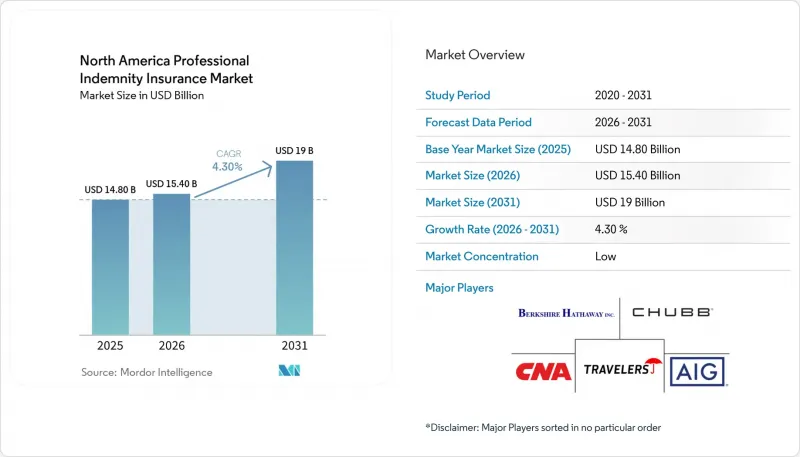
Demand is supported by the wider use of professional services in legal, technology, financial advisory, engineering, and consulting work. This report is Segmented by Product Type (Miscellaneous/General Professional Indemnity and More), Profession of the Insured (Legal Services and More), Insured Firm Size (Sole Practitioners and More), Distribution Channel (Insurance Brokers and More), Policy Structure (Annual Practice Claims-Made Policies and More), and Geography. The Market Forecasts are Provided in Terms of Value (USD).
North America Professional Indemnity Insurance Market Trends and Insights
Rising Professional Liability Exposures from Complex Client Engagements and Litigation
More complex client assignments are increasing both the frequency and cost of professional liability claims across North America. In a 2026 survey, 60% of insurers reported higher claim severity during 2025, compared with 53% in 2024 and 41% in 2023. None of the surveyed insurers reported lower severity. The same survey found that 82% of respondents paid multimillion-dollar claims in 2025, including 13% that paid claims between USD 10 million and USD 19.9 million. Litigation funding adds pressure because it can support claims that would otherwise be difficult for plaintiffs to pursue. Higher potential losses encourage professional firms to reassess limits and coverage terms, which supports the North America professional indemnity insurance market.
Expansion of Professional Services and SME Insurance Adoption
Insurance take-up among small businesses increased as professional services firms faced more client coverage requirements. Professional liability insurance adoption among small businesses rose from 20% in 2023 to 31% in 2025. The United States Small Business Administration reported that the United States had 33.3 million small businesses, leaving a large group of firms without professional indemnity protection. Enterprise buyers and government agencies increasingly request proof of coverage from suppliers and advisers before awarding contracts. NEXT Insurance launched NEXT Pro+ in October 2025 with broader coverage, higher limits, and simplified quoting for professional services businesses. Easier underwriting and digital distribution can make smaller accounts more practical for insurers and managing general agents to serve.
Abundant Capacity and Competitive Pricing Pressure
Available capacity is limiting rate momentum even as insurers face higher underlying loss costs. Ryan Specialty described the miscellaneous professional liability and errors and omissions business as extremely competitive in May 2026. New managing general agents have increased pressure on established carriers to match pricing and coverage terms for accounts with no major loss concerns. Financial and professional lines rates fell 5% globally in the first quarter of 2026. Conditions differ by risk type because complex or loss-affected accounts can still obtain firmer pricing. This split means the North America professional indemnity insurance market may show steady premium growth even as standard-account margins face pressure.
Other drivers and restraints analyzed in the detailed report include:
- Increasing AI, Technology Consulting and Digital Transformation Liability
- Mandatory and Contractually Required Professional Liability Coverage
- Escalating Defense Costs, Claim Severity and Social Inflation
For complete list of drivers and restraints, kindly check the Table Of Contents.
Segment Analysis
Miscellaneous and general policies accounted for 38.8% of the North America professional indemnity insurance market size in 2025. Their broad design serves management consultants, human resources advisers, media professionals, and other occupations without a dedicated specialist line. Construction and design coverage remains tied to lender and contract requirements on infrastructure and commercial projects. Financial professionals' E&O continues to support advisers and fund managers with substantial compliance obligations. Technology professional indemnity is the fastest-growing product type and is forecast to expand at a 6.6% CAGR through 2031. The segment reflects rising demand from software as a service developers, managed service providers, and businesses using artificial intelligence in client delivery.
Technology E&O insurers are adjusting terms as clients seek a clearer response to artificial intelligence-related losses. CFC's 2026 update named model hallucinations, artificial intelligence-generated content, and model drift among covered exposures in selected product lines. This approach gives buyers more visibility than policies that are silent on artificial intelligence. Ryan Specialty noted that technology E&O was more difficult than miscellaneous E&O and cyber for certain accounts in 2026. Copyright litigation involving major artificial intelligence platforms has increased underwriter caution around higher-hazard large language model accounts. The product mix, therefore, combines accessible pricing in broad miscellaneous lines with more selective conditions in technology risk.
Legal services professionals held 22.3% of the North America professional indemnity insurance market share in 2025. Their position reflects mandatory coverage arrangements and the potential severity of legal malpractice claims. LAWPRO insured more than 32,000 Ontario lawyers and paralegals in private practice in 2026, with a base premium of CAD 3,250 (USD 2,385). Architecture, engineering, surveying, accountancy, financial advisory, and management consulting form other important profession groups. Real estate, property management, media, advertising, education, training, travel, and recruitment services remain smaller but relevant groups. Regulatory and contractual requirements remain an important route to coverage adoption among smaller professional firms.
Information technology, software, software as a service, and managed services are projected to grow at a 6.8% CAGR through 2031. This is faster than legal services because technology coverage is still developing relative to the liability created by technology-dependent client work. Insurers have moved from unclear artificial intelligence positions toward affirmative terms or exclusions since 2025. Firms without documented artificial intelligence governance can face tighter renewal discussions when coverage is sought. The North America professional indemnity insurance industry is responding with product language that addresses technology service, content, and model-performance issues. This process can increase both review activity and new policy placements among technology firms.
Complete Report Scope:
- By Product Type
- Miscellaneous/General Professional Indemnity
- Construction and Design Professional Indemnity
- Financial Professionals and Intermediaries E&O
- Technology Professional Indemnity
- By Profession of the Insured
- Legal Services
- Architecture, Engineering, and Surveying
- Accountancy and Corporate Secretarial Services
- Financial Advisory, Fund Management, and Insurance Broking
- Management, Strategy, and Human Resources Consulting
- Information Technology, Software, SaaS, and Managed Services
- Real Estate and Property Management
- Media, Advertising, Public Relations, and Events
- Education, Training, and Teaching Organizations
- Travel, Recruitment, and Employment Services
- Other Professional Services
- By Insured Firm Size
- Sole Practitioners
- Small and Medium-Sized Enterprises
- Large Firms
- By Distribution Channel
- Insurance Brokers
- Insurance Agents
- Direct Insurer Distribution
- Other Channels
- By Policy Structure
- Annual Practice Claims-Made Policies
- Project-Specific Professional Indemnity
- Run-Off and Extended Reporting Period
- By Country
- United States
- Canada
- Mexico
List of Companies Covered in this Report:
- Chubb Limited
- AIG / Lexington
- AXA XL
- Berkshire Hathaway Specialty Insurance (BHSI)
- CNA Financial
- The Travelers Companies
- Zurich Insurance Group
- Beazley
- W. R. Berkley / Berkley Professional
- The Hartford
- Liberty Mutual
- Arch Insurance
- AXIS Capital
- Hiscox
- Markel
- Everest Insurance
- Tokio Marine HCC
- Sompo International
- QBE Insurance Group
- CFC Underwriting
Additional Benefits:
- The market estimate (ME) sheet in Excel format
- 3 months of analyst support
TABLE OF CONTENTS
1 INTRODUCTION
- 1.1 Study Assumptions and Market Definition
- 1.2 Scope of the Study
2 RESEARCH METHODOLOGY
3 EXECUTIVE SUMMARY
4 MARKET LANDSCAPE
- 4.1 Market Overview
- 4.2 Market Drivers
- 4.2.1 Rising Professional Liability Exposures from Complex Client Engagements and Litigation
- 4.2.2 Expansion of Professional Services and SME Insurance Adoption
- 4.2.3 Increasing AI, Technology Consulting and Digital Transformation Liability
- 4.2.4 Mandatory and Contractually Required Professional Liability Coverage
- 4.2.5 Growing Demand for Integrated Cyber, Privacy and Professional Liability Protection
- 4.2.6 Expansion of MGA, Digital Brokerage and Specialized Distribution Channels for Niche Professional Risks
- 4.3 Market Restraints
- 4.3.1 Abundant Capacity and Competitive Pricing Pressure
- 4.3.2 Escalating Defense Costs, Claim Severity and Social Inflation
- 4.3.3 Limited Loss Data and Coverage Uncertainty for Generative AI Risks
- 4.3.4 Increasing Complexity of Overlapping Cyber, Technology and Professional Liability Exposures
- 4.4 Value Chain Analysis
- 4.4.1 Professional Firms / Policyholders
- 4.4.2 Retail and Wholesale Brokers / MGAs
- 4.4.3 Primary, Excess and Specialty Professional Liability Insurers
- 4.4.4 Reinsurers and Claims-Service Providers
- 4.5 Regulatory Landscape
- 4.5.1 State-Level Insurance Regulation and Professional Liability Requirements in the United States
- 4.5.2 Canadian Provincial Insurance and Professional Licensing Requirements
- 4.5.3 Data Privacy, Cybersecurity and AI Governance Requirements Affecting Professional Services
- 4.5.4 Profession-Specific Liability, Contracting and Client-Mandated Insurance Requirements
- 4.6 Technological Outlook
- 4.6.1 AI-Enabled Underwriting, Submission Triage and Professional Risk Assessment
- 4.6.2 AI-Assisted Claims Triage, Fraud Detection and Claims Analytics
- 4.6.3 Contract Analytics and Automated Professional Risk Assessment
- 4.6.4 Digital, Embedded and API-Enabled Professional Indemnity Distribution and Policy Administration
- 4.7 Porter's Five Forces Analysis
- 4.7.1 Bargaining Power of Insurers and Reinsurers
- 4.7.2 Bargaining Power of Buyers
- 4.7.3 Threat of New Entrants
- 4.7.4 Threat of Substitutes
- 4.7.5 Competitive Rivalry
5 MARKET SIZE AND GROWTH FORECASTS
- 5.1 By Product Type
- 5.1.1 Miscellaneous/General Professional Indemnity
- 5.1.2 Construction and Design Professional Indemnity
- 5.1.3 Financial Professionals and Intermediaries E&O
- 5.1.4 Technology Professional Indemnity
- 5.2 By Profession of the Insured
- 5.2.1 Legal Services
- 5.2.2 Architecture, Engineering, and Surveying
- 5.2.3 Accountancy and Corporate Secretarial Services
- 5.2.4 Financial Advisory, Fund Management, and Insurance Broking
- 5.2.5 Management, Strategy, and Human Resources Consulting
- 5.2.6 Information Technology, Software, SaaS, and Managed Services
- 5.2.7 Real Estate and Property Management
- 5.2.8 Media, Advertising, Public Relations, and Events
- 5.2.9 Education, Training, and Teaching Organizations
- 5.2.10 Travel, Recruitment, and Employment Services
- 5.2.11 Other Professional Services
- 5.3 By Insured Firm Size
- 5.3.1 Sole Practitioners
- 5.3.2 Small and Medium-Sized Enterprises
- 5.3.3 Large Firms
- 5.4 By Distribution Channel
- 5.4.1 Insurance Brokers
- 5.4.2 Insurance Agents
- 5.4.3 Direct Insurer Distribution
- 5.4.4 Other Channels
- 5.5 By Policy Structure
- 5.5.1 Annual Practice Claims-Made Policies
- 5.5.2 Project-Specific Professional Indemnity
- 5.5.3 Run-Off and Extended Reporting Period
- 5.6 By Country
- 5.6.1 United States
- 5.6.2 Canada
- 5.6.3 Mexico
6 COMPETITIVE LANDSCAPE
- 6.1 Market Concentration
- 6.2 Strategic Moves
- 6.3 Market Share Analysis (Top 5-6 players)
- 6.4 Company Profiles (includes Global Level Overview, Market Level Overview, Core Segments, Financials as available, Strategic Information, Market Rank/Share, Products and Services, Recent Developments)
- 6.4.1 Chubb Limited
- 6.4.2 AIG / Lexington
- 6.4.3 AXA XL
- 6.4.4 Berkshire Hathaway Specialty Insurance (BHSI)
- 6.4.5 CNA Financial
- 6.4.6 The Travelers Companies
- 6.4.7 Zurich Insurance Group
- 6.4.8 Beazley
- 6.4.9 W. R. Berkley / Berkley Professional
- 6.4.10 The Hartford
- 6.4.11 Liberty Mutual
- 6.4.12 Arch Insurance
- 6.4.13 AXIS Capital
- 6.4.14 Hiscox
- 6.4.15 Markel
- 6.4.16 Everest Insurance
- 6.4.17 Tokio Marine HCC
- 6.4.18 Sompo International
- 6.4.19 QBE Insurance Group
- 6.4.20 CFC Underwriting
7 MARKET OPPORTUNITIES AND FUTURE OUTLOOK
- 7.1 White-Space and Unmet-Need Assessment
- 7.1.1 Affordable and Accessible E&O Coverage for Micro and Small Professional Firms
- 7.1.2 Affirmative AI and Emerging Technology Professional Liability Coverage
- 7.1.3 Project-Specific Professional Liability for Complex Technology and Construction Projects
- 7.1.4 Integrated Cyber, Privacy and Professional Indemnity Solutions

