PUBLISHER: Mordor Intelligence | PRODUCT CODE: 2163637

PUBLISHER: Mordor Intelligence | PRODUCT CODE: 2163637
United Kingdom Educational Tourism - Market Share Analysis, Industry Trends & Statistics, Growth Forecasts (2026 - 2031)
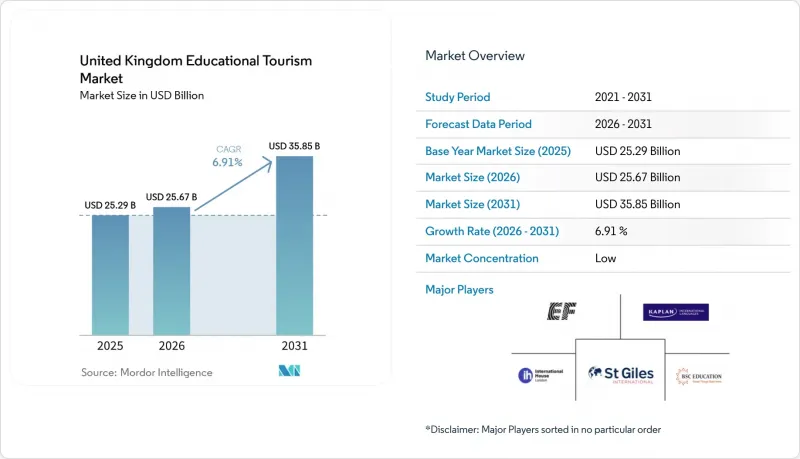
According to Mordor Intelligence, the United Kingdom educational tourism market was valued at USD 25.29 billion in 2025 and is estimated to grow from USD 25.67 billion in 2026 to reach USD 35.85 billion by 2031, at a CAGR of 6.91% during the forecast period (2026 - 2031).
United Kingdom Educational Tourism Market Trends and Insights
Global demand for English education sustains strong United Kingdom academic-tourism growth
English remains the primary language for business, higher education, and global mobility, ensuring the United Kingdom educational tourism market relies on steady global demand rather than short-term travel trends. The British Council reports significant annual student inflows to the United Kingdom for English studies, enabling providers to offer diverse programs, including junior camps, adult courses, exam preparation, and blended language options. By 2024, ELT student numbers had not fully recovered to pre-pandemic levels, but spending per student increased, reflecting a shift toward shorter, higher-value stays. The market benefits from diversified source countries, with growth from China, Turkey, and Colombia helping offset declines from Spain and Italy. Provider credibility is supported by the British Council accreditation scheme, operated with English United Kingdom, which fosters trust across source markets and establishes accredited delivery as a key requirement for sustained success in the United Kingdom educational tourism market.
The United Kingdom's International Education Strategy supports long-term education-export expansion
The United Kingdom's International Education Strategy seeks to enhance education exports significantly by 2030. It emphasizes student recruitment, transnational education, English language teaching, skills programs, and edtech, broadening the scope of offerings to attract visitors. Heads of Mission will act as Local Education Champions in West Africa and the Gulf starting in 2026, utilizing diplomatic infrastructure to promote education in key regions. The Turing Scheme is set to fund thousands of outbound placements in 2025/26, with a majority allocated to disadvantaged students. Plans to rejoin Erasmus+ in 2027 aim to strengthen exchange routes with Europe. The global delivery of United Kingdom higher education continues to play a vital role, with hundreds of thousands of students across numerous countries enrolled in United Kingdom programs, creating pathways for future visits and campus-based learning opportunities in the United Kingdom.
Post-Brexit travel restrictions sharply reduced European Union school-group arrivals
Brexit has complicated the United Kingdom educational tourism market, making school travel, higher education entry, and short study planning more difficult for European Union learners. European Union student enrollments in United Kingdom higher education have significantly declined since the shift from home-fee to international-fee status. The IZA Institute of Labor Economics attributes much of this drop to the fee policy change, which heavily impacted cross-border mobility. School groups face similar challenges due to new passport and ETA requirements for adult chaperones, particularly in markets like Germany, where ID-card arrangements previously sufficed. These barriers have strengthened the appeal of rival destinations such as Ireland, Malta, and Canada, which promote easier access. As a result, the United Kingdom has lost ground in European Union short-course and group travel segments.
Other drivers and restraints analyzed in the detailed report include:
- Rising middle-class and HNWI populations are increasing immersive study-travel demand
- Youth Mobility Scheme expansion enhances inbound travel for students and school groups
- High tuition and living costs reduce affordability versus competing destinations
For complete list of drivers and restraints, kindly check the Table Of Contents.
Segment Analysis
The 13-25 years age group accounted for 39.42% of the United Kingdom educational tourism market revenue in 2025 and is projected to grow at a 7.64% CAGR through 2031. This segment benefits from demand for junior language immersion and degree or pathway travel. In 2024, junior learners represented 38% of English United Kingdom's full-time ELT students, while adult volumes declined by 8%, highlighting stronger resilience among younger travelers. This group supports local spending through travel formats combining classroom instruction, excursions, homestays, and campus life. Providers can retain learners across multiple products, spanning school age to early degree studies, ensuring long-term engagement in the market.
The under-12 segment faces challenges, with Child Student visas declining by 15.9% in 2025 and mainland China recording a one-third drop after VAT was introduced on private school tuition in January 2025. This change has increased costs, limiting access to families with higher purchasing power or domestic school trips. The 26-40 age group is growing as mid-career learners seek residential upskilling, executive education, and micro-credentials that align with work schedules. The over-40 group, though smaller, contributes through longer stays, private accommodations, and interest in cultural and small-group learning experiences. The 13-25 years segment remains central to the United Kingdom educational tourism market, while older age groups diversify the value mix and create opportunities for specialized offerings.
Graduation-level programs accounted for 34.34% of market value in 2025, highlighting the prominence of undergraduate and pathway-linked studies in the United Kingdom educational tourism market. Post-graduation programs are projected to grow at 7.14% through 2031, reflecting increased demand for research, specialization, and career-focused credentials. This shift aligns with a maturing market, as undergraduate volumes have stabilized while postgraduate research enrollment rose by 6.3% in 2024/25, driving longer stays and higher accommodation spending. Graduation programs remain central to global student mobility, connecting feeder schools, international colleges, pathway companies, and universities, supported by a well-established distribution network.
Postgraduate taught studies declined by 12.7% in 2024/25, driven by reduced demand from India and Nigeria following dependent visa policy changes, exposing the segment's sensitivity to migration regulations. Secondary education contributes significantly through A-Level, GCSE, school immersion, and study tours, particularly where administrative ease benefits European school groups. Primary programs face challenges due to high boarding costs and weaker Child Student visa demand, shifting some interest to domestic curriculum travel. Providers spanning pathway, graduation, and post-graduation stages can leverage repeat spending across a learner's educational journey, enhancing cross-selling opportunities. This multi-tier approach is increasingly valuable as source-market conditions vary more sharply by age, income, and visa profiles, making broad market exposure more advantageous than focusing on a single degree category.
Complete Report Scope:
- By Age Group
- Less than 12 Years
- 13 - 25 Years
- 26 - 40 Years
- Over 40 Years
- By Education Type
- Primary
- Secondary
- Graduation
- Post-Graduation
- By Course & Program Duration
- Short-Term (Less than or equal to 4 weeks)
- Medium-Term (1 - 3 months)
- Long-Term (More than 3 months / full academic year)
- By Booking Channel
- Direct Enrolment
- Education Agents & Counselors
- Online & Digital Platforms
- Others
- By Tourism Type
- Domestic
- International
List of Companies Covered in this Report:
- EF Education First
- Kaplan International Languages
- St Giles International
- International House London
- Language Studies International (LSI)
- British Study Centers (BSC)
- Bell Education Group
- UKLC - United Kingdom Language Courses
- Experience Education
- Halsbury Travel
- NST Travel Group
- The School Travel Company
- Educating Adventures (EA School Tours)
- ECE Travel (European Cultural Experiences Ltd)
- Project International
- UK Educational Holidays Ltd
- INTO University Partnerships
- Oxford International Education Group
- GVI (Global Vision International)
- Camps International
Additional Benefits:
- The market estimate (ME) sheet in Excel format
- 3 months of analyst support
TABLE OF CONTENTS
1 Introduction
- 1.1 Study Assumptions & Market Definition
- 1.2 Scope of the Study
2 Research Methodology
3 Executive Summary
4 Market Landscape
- 4.1 Market Overview
- 4.2 Market Drivers
- 4.2.1 Global demand for English education sustains strong United Kingdom academic-tourism growth
- 4.2.2 The United Kingdom's International Education Strategy supports long-term education-export expansion
- 4.2.3 Rising middle-class and HNWI populations are increasing immersive study-travel demand
- 4.2.4 Youth Mobility Scheme expansion enhances inbound travel for students and school groups
- 4.2.5 Demand for United Kingdom-accredited certifications drives professional education-tourism growth
- 4.2.6 In-person study in the United Kingdom enhances cultural immersion and increases visitor spending
- 4.3 Market Restraints
- 4.3.1 Post-Brexit travel restrictions sharply reduced European Union school-group arrivals
- 4.3.2 High tuition and living costs reduce affordability versus competing destinations
- 4.3.3 Student-dependent visa restrictions lower demand from key source markets
- 4.3.4 Homestay accommodation shortages limit peak-season enrolment capacity
- 4.4 Value / Supply-Chain Analysis
- 4.5 Regulatory Landscape
- 4.6 Technological Outlook
- 4.7 Porter's Five Forces
- 4.7.1 Bargaining Power of Buyers
- 4.7.2 Bargaining Power of Suppliers
- 4.7.3 Threat of New Entrants
- 4.7.4 Threat of Substitute Products/Services
- 4.7.5 Competitive Rivalry
5 Market Size & Growth Forecasts (Value, USD Million)
- 5.1 By Age Group
- 5.1.1 Less than 12 Years
- 5.1.2 13 - 25 Years
- 5.1.3 26 - 40 Years
- 5.1.4 Over 40 Years
- 5.2 By Education Type
- 5.2.1 Primary
- 5.2.2 Secondary
- 5.2.3 Graduation
- 5.2.4 Post-Graduation
- 5.3 By Course & Program Duration
- 5.3.1 Short-Term (Less than or equal to 4 weeks)
- 5.3.2 Medium-Term (1 - 3 months)
- 5.3.3 Long-Term (More than 3 months / full academic year)
- 5.4 By Booking Channel
- 5.4.1 Direct Enrolment
- 5.4.2 Education Agents & Counselors
- 5.4.3 Online & Digital Platforms
- 5.4.4 Others
- 5.5 By Tourism Type
- 5.5.1 Domestic
- 5.5.2 International
6 Competitive Landscape
- 6.1 Market Concentration & Competitive Intensity
- 6.2 Strategic Moves & Developments
- 6.3 Market Share Analysis
- 6.4 Company Profiles (includes Global level Overview, Market level overview, Core Segments, Financials as available, Strategic Information, Market Rank/Share for key companies, Products & Services, and Recent Developments)
- 6.4.1 EF Education First
- 6.4.2 Kaplan International Languages
- 6.4.3 St Giles International
- 6.4.4 International House London
- 6.4.5 Language Studies International (LSI)
- 6.4.6 British Study Centers (BSC)
- 6.4.7 Bell Education Group
- 6.4.8 UKLC - United Kingdom Language Courses
- 6.4.9 Experience Education
- 6.4.10 Halsbury Travel
- 6.4.11 NST Travel Group
- 6.4.12 The School Travel Company
- 6.4.13 Educating Adventures (EA School Tours)
- 6.4.14 ECE Travel (European Cultural Experiences Ltd)
- 6.4.15 Project International
- 6.4.16 UK Educational Holidays Ltd
- 6.4.17 INTO University Partnerships
- 6.4.18 Oxford International Education Group
- 6.4.19 GVI (Global Vision International)
- 6.4.20 Camps International
7 Market Opportunities & Future Outlook
- 7.1 White-space & Unmet-Need Assessment
- 7.2 EdTech-integrated hybrid study-abroad packages
- 7.3 Micro-credential-oriented short courses for mid-career professionals

