PUBLISHER: Mordor Intelligence | PRODUCT CODE: 2163639

PUBLISHER: Mordor Intelligence | PRODUCT CODE: 2163639
Corporate Leadership Training - Market Share Analysis, Industry Trends & Statistics, Growth Forecasts (2026 - 2031)
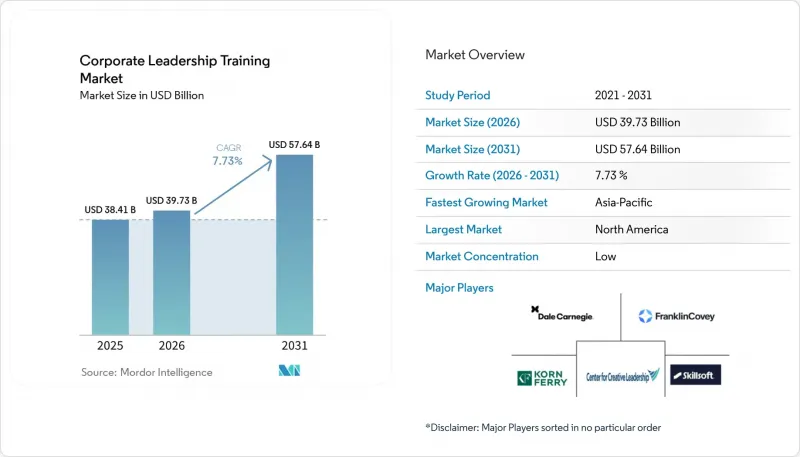
According to Mordor Intelligence, the global corporate leadership training market is expected to grow from USD 38.41 billion in 2025 to USD 39.73 billion in 2026 and is forecast to reach USD 57.64 billion by 2031 at 7.73% CAGR over 2026-2031.
Global Corporate Leadership Training Market Trends and Insights
Hybrid and distributed team leadership gaps
Hybrid work has exposed a significant training gap for frontline and mid-level managers in the corporate leadership training market. Only 25% of managers have received training in leading teams, reflecting slow adaptation to new work patterns. A 2025 study highlighted the need for managers to combine technological knowledge, soft skills, and management expertise, emphasizing the demand for updated leadership curricula over narrow virtual team modules. Gen Z employees advocate technology-enabled leadership and are more likely to leave employers whose leadership culture does not align with hybrid work expectations. Gallup identified a broader training shortfall, with only 10% of managers receiving mandatory hybrid leadership training. This reveals a substantial opportunity for targeted programs in the corporate leadership training market.
Succession-pipeline rebuilding across manager layers
Succession risk is a key driver in the corporate leadership training market as organizations face high turnover and cannot rely on informal promotion pipelines. 56% of companies lacked a structured succession strategy, exposing a significant readiness gap for critical roles. Only 20% of CHROs had leaders prepared to fill essential business positions, highlighting weak bench strength across organizations. Succession planning has emerged as a top concern for most HR leaders, reflecting its growing strategic importance. As a result, training budgets are increasingly tied to measurable readiness outcomes rather than general leadership development. Providers that can accelerate leadership readiness for director and vice president successors are well positioned to secure longer-term contracts and expanded mandates in the corporate leadership training market.
ROI attribution remains difficult for soft-skill programs
Linking leadership behavior changes to financial outcomes remains a key challenge in the corporate leadership training market. AI-driven cost pressures and tighter budgets have increased scrutiny on HR teams to justify learning investments. While 62% of organizations use employee surveys to measure leadership effectiveness, these fail to meet finance teams' need for operational or commercial evidence. Many companies do not track financial KPIs for learning initiatives, exposing gaps in measurement infrastructure compared to content innovation. Although advancements in analytics are expected to gradually address this issue, budget growth for enterprise buyers continues to face restrictions in this market.
Other drivers and restraints analyzed in the detailed report include:
- AI transformation requires people-leader upskilling
- Shift toward personalized and measurable learning journeys
- High program cost and time-away-from-work burden
For complete list of drivers and restraints, kindly check the Table Of Contents.
Segment Analysis
Instructor-Led Training (ILT) held a 42.63% share of the corporate leadership training market in 2025. This reflects the ongoing demand for trust-based, cohort-focused experiences at senior and executive levels, where feedback and accountability outweigh convenience. Only 26% of leaders rated their development programs as high quality, explaining why organizations continue to invest in facilitated experiences instead of fully adopting lower-cost digital modules. The corporate leadership training market continues to value live facilitation for programs targeting senior decision-makers or high-potential successors, as ILT remains effective in enabling deeper behavioral change and stronger peer interaction.
Online Training is projected to grow at a 7.94% CAGR through 2031, driven by the increasing importance of scalability and flexibility. Skillsoft reported a 341% year-over-year increase in engagement with its CAISY simulator in fiscal 2026, with the tool available in over 40 languages, demonstrating the effectiveness and localization capabilities of AI-enabled online formats. Organizations are increasingly adopting blended delivery models that combine classroom learning, virtual instructor-led sessions, job aids, and coaching, reinforcing the continued role of hybrid learning over full digital substitution. Buyers in regulated sectors are focusing on auditable designs and service quality, enabling structured online programs to expand without replacing live formats. ILT retains its position, while online and blended formats continue to grow among first-line managers and emerging leaders.
Mid-Level Leadership held 44.81% of the corporate leadership training market share in 2025, making it the largest segment. This group bridges strategy and execution, translating plans into daily operations while managing changes from senior leaders and frontline teams. 73% of organizations recognize the need to redefine the manager's role, but only a small share have made significant progress, highlighting strong unmet demand. Programs for mid-level managers focused on coaching, delegation, and execution continue to generate substantial revenue, while executive leadership programs, though smaller in participant numbers, contribute significantly due to higher per-participant pricing.
Emerging Leadership is the fastest-growing segment, with an 8.06% CAGR projected through 2031, reflecting a broader expansion of leadership development across all employee levels. This shift is driven by increasing emphasis on early-career leadership pipelines and structured development pathways before employees' step into management roles. It also aligns with retention strategies, as younger employees prioritize clarity in growth opportunities. However, only 35% of frontline leaders report finding their roles purposeful, indicating that skill development alone may not be sufficient to retain talent. Providers that integrate skills development with purpose-building and career clarity are better positioned to gain share in this segment of the corporate leadership training market.
Complete Report Scope:
- By Delivery Mode
- Online Training
- Instructor-Led Training
- Blended Training
- By Leadership Level
- Emerging Leadership
- Mid-Level Leadership
- Executive Leadership
- By Organization Size
- Large Enterprises
- Small and Medium Enterprises
- By Industry Vertical
- Information Technology and Telecom
- BFSI
- Healthcare and Life Sciences
- Manufacturing
- Retail and E-commerce
- Professional Services
- Energy and Utilities
- Public Sector and Government-Linked Enterprises
- By Geography
- North America
- United States
- Canada
- Mexico
- South America
- Brazil
- Peru
- Chile
- Argentina
- Rest of South America
- Europe
- United Kingdom
- Germany
- France
- Spain
- Italy
- BENELUX (Belgium, Netherlands, and Luxembourg)
- NORDICS (Denmark, Finland, Iceland, Norway, and Sweden)
- Rest of Europe
- Asia-Pacific
- India
- China
- Japan
- Australia
- South Korea
- South East Asia (Singapore, Malaysia, Thailand, Indonesia, Vietnam, and Philippines)
- Rest of Asia-Pacific
- Middle East and Africa
- United Arab Emirates
- Saudi Arabia
- South Africa
- Nigeria
- Rest of Middle East and Africa
- North America
Geography Analysis
North America accounted for 36.87% of the corporate leadership training market share in 2025, maintaining its leading revenue position. The United States drove this dominance with its extensive corporate training base, mature external provider ecosystem, and established enterprise learning functions. The United States organizations spent USD 102.8 billion on training in 2025, with spending on external products and services rising 29% to USD 16 billion, reflecting increased reliance on third-party providers. Nearly 25% of organizations expanded their talent development staff in 2025, alongside broader adoption of diverse delivery methods. Canada and Mexico contributed through multinational program spillovers and local succession planning investments, though ROI scrutiny remains a key challenge.
Asia-Pacific is the fastest-growing region in the corporate leadership training market, with a projected CAGR of 9.83% through 2031. Growth is driven by large emerging leader populations, enterprise digitization, and increased investment in management training across India, China, Japan, and Southeast Asia. Over 5,000 participants from 90+ client companies across 30+ countries engaged with HR development services in FY2025, alongside the launch of new English-language leadership programs in 2026. Additionally, an MOU signed with the Confederation of Indian Industry in May 2026 aims to advance AI governance and digital leadership training in India, strengthening program delivery infrastructure. These developments position Asia-Pacific for faster growth compared to Western markets.
Europe's corporate leadership training market is shaped by regulatory pressures and compliance-driven learning demand. The European Union AI Act has increased the need for AI literacy and responsible use training, adding a compliance layer to budgets. Germany and the United Kingodm are the largest markets, though Germany's co-determination framework slows AI-based diagnostics adoption while favoring providers with strong compliance documentation. NIIT Learning Systems acquired Germany-based MST Group in July 2025 for EUR 22.37 million (USD 24.1 million), signaling confidence in the DACH region. The Middle East and Africa, though smaller in revenue, are gaining importance due to national talent development agendas and sovereign-backed initiatives.
- Dale Carnegie & Associates
- FranklinCovey
- Korn Ferry
- Center for Creative Leadership
- Skillsoft
- Blanchard
- BTS Group
- Wilson Learning Worldwide
- Cegos Group
- Development Dimensions International (DDI)
- Harvard Business Impact
- American Management Association
- BetterUp
- CoachHub
- GP Strategies
- NIIT Learning Solutions
- IMD
- Crucial Learning
- MindGym
- LinkedIn Learning
Additional Benefits:
- The market estimate (ME) sheet in Excel format
- 3 months of analyst support
TABLE OF CONTENTS
1 Introduction
- 1.1 Study Assumptions & Market Definition
- 1.2 Scope of the Study
2 Research Methodology
3 Executive Summary
4 Market Landscape
- 4.1 Market Overview
- 4.2 Market Drivers
- 4.2.1 Hybrid and distributed team leadership gaps
- 4.2.2 Succession-pipeline rebuilding across manager layers
- 4.2.3 AI transformation requires people-leader upskilling
- 4.2.4 Shift toward personalized and measurable learning journeys
- 4.2.5 Leaner organizations widen manager span of control
- 4.2.6 Return-to-office policy friction raises manager judgment needs
- 4.3 Market Restraints
- 4.3.1 ROI attribution remains difficult for soft-skill programs
- 4.3.2 High program cost and time-away-from-work burden
- 4.3.3 Privacy and works-council friction around AI-led diagnostics
- 4.3.4 Self-paced content fatigue weakens behavior transfer
- 4.4 Value / Supply-Chain Analysis
- 4.5 Regulatory Landscape
- 4.6 Technological Outlook
- 4.7 Porter's Five Forces
- 4.7.1 Threat of New Entrants
- 4.7.2 Bargaining Power of Buyers
- 4.7.3 Bargaining Power of Suppliers
- 4.7.4 Threat of Substitutes
- 4.7.5 Intensity of Competitive Rivalry
5 Market Size & Growth Forecasts (Value)
- 5.1 By Delivery Mode
- 5.1.1 Online Training
- 5.1.2 Instructor-Led Training
- 5.1.3 Blended Training
- 5.2 By Leadership Level
- 5.2.1 Emerging Leadership
- 5.2.2 Mid-Level Leadership
- 5.2.3 Executive Leadership
- 5.3 By Organization Size
- 5.3.1 Large Enterprises
- 5.3.2 Small and Medium Enterprises
- 5.4 By Industry Vertical
- 5.4.1 Information Technology and Telecom
- 5.4.2 BFSI
- 5.4.3 Healthcare and Life Sciences
- 5.4.4 Manufacturing
- 5.4.5 Retail and E-commerce
- 5.4.6 Professional Services
- 5.4.7 Energy and Utilities
- 5.4.8 Public Sector and Government-Linked Enterprises
- 5.5 By Geography
- 5.5.1 North America
- 5.5.1.1 United States
- 5.5.1.2 Canada
- 5.5.1.3 Mexico
- 5.5.2 South America
- 5.5.2.1 Brazil
- 5.5.2.2 Peru
- 5.5.2.3 Chile
- 5.5.2.4 Argentina
- 5.5.2.5 Rest of South America
- 5.5.3 Europe
- 5.5.3.1 United Kingdom
- 5.5.3.2 Germany
- 5.5.3.3 France
- 5.5.3.4 Spain
- 5.5.3.5 Italy
- 5.5.3.6 BENELUX (Belgium, Netherlands, and Luxembourg)
- 5.5.3.7 NORDICS (Denmark, Finland, Iceland, Norway, and Sweden)
- 5.5.3.8 Rest of Europe
- 5.5.4 Asia-Pacific
- 5.5.4.1 India
- 5.5.4.2 China
- 5.5.4.3 Japan
- 5.5.4.4 Australia
- 5.5.4.5 South Korea
- 5.5.4.6 South East Asia (Singapore, Malaysia, Thailand, Indonesia, Vietnam, and Philippines)
- 5.5.4.7 Rest of Asia-Pacific
- 5.5.5 Middle East and Africa
- 5.5.5.1 United Arab Emirates
- 5.5.5.2 Saudi Arabia
- 5.5.5.3 South Africa
- 5.5.5.4 Nigeria
- 5.5.5.5 Rest of Middle East and Africa
- 5.5.1 North America
6 Competitive Landscape
- 6.1 Market Concentration
- 6.2 Strategic Moves
- 6.3 Market Share Analysis
- 6.4 Company Profiles (includes Global level Overview, Market level overview, Core Segments, Financials as available, Strategic Information, Market Rank/Share for key companies, Products & Services, and Recent Developments)
- 6.4.1 Dale Carnegie & Associates
- 6.4.2 FranklinCovey
- 6.4.3 Korn Ferry
- 6.4.4 Center for Creative Leadership
- 6.4.5 Skillsoft
- 6.4.6 Blanchard
- 6.4.7 BTS Group
- 6.4.8 Wilson Learning Worldwide
- 6.4.9 Cegos Group
- 6.4.10 Development Dimensions International (DDI)
- 6.4.11 Harvard Business Impact
- 6.4.12 American Management Association
- 6.4.13 BetterUp
- 6.4.14 CoachHub
- 6.4.15 GP Strategies
- 6.4.16 NIIT Learning Solutions
- 6.4.17 IMD
- 6.4.18 Crucial Learning
- 6.4.19 MindGym
- 6.4.20 LinkedIn Learning
7 Market Opportunities & Future Outlook
- 7.1 White-space & unmet-need assessment
- 7.2 Market Opportunities
- 7.2.1 AI-native coaching copilots for first-line managers
- 7.2.2 Sector-specific leadership academies for regulated and high-turnover workforces

