PUBLISHER: Mordor Intelligence | PRODUCT CODE: 2184611

PUBLISHER: Mordor Intelligence | PRODUCT CODE: 2184611
Europe Wireless Electric Vehicle Charging - Market Share Analysis, Industry Trends & Statistics, Growth Forecasts (2026 - 2031)
According to Mordor Intelligence, the Europe wireless electric vehicle charging market size was valued at USD 33.41 million in 2025, is estimated at USD 45.90 million in 2026, and is projected to reach USD 224.60 million by 2031, registering a CAGR of 37.38% between 2026 and 2031.
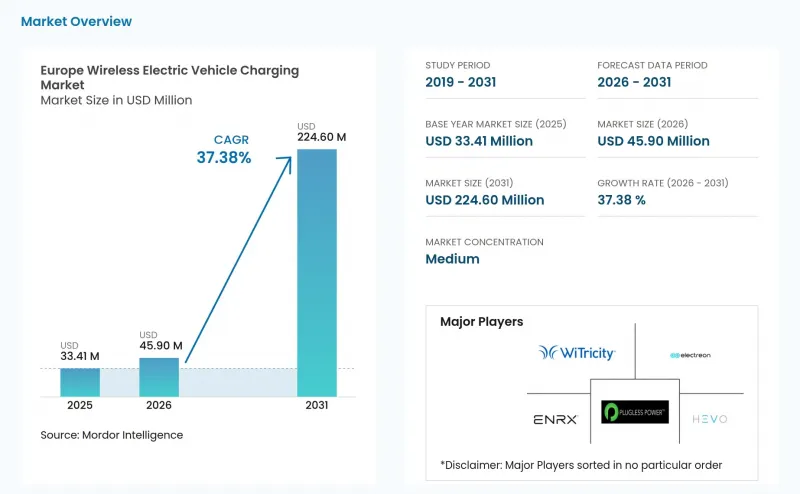
Europe Wireless Electric Vehicle Charging Market Trends and Insights
European Emissions Regulations and Electrification Mandates
EU Delegated Regulation 2025/656 was adopted on April 2, 2025, and entered into force on January 8, 2026. It requires EN IEC 61980-1, EN IEC 61980-2, and EN IEC 61980-3 for inductive static wireless recharging points for light-duty electric vehicles. The common requirements give municipal buyers a clearer basis for including wireless equipment in tender specifications, which is important when public purchasers need documented compliance criteria before they can compare alternative infrastructure approaches. They also reduce the need for vendors to navigate separate national interpretations when serving several EU countries. The Europe wireless electric vehicle charging market can therefore benefit from a more consistent certification route for static systems. This matters for suppliers that want to offer the same core equipment across several countries, for public buyers that need comparable tender requirements, and for vehicle makers that do not want a charging option to require a different technical path in every European location. It can also make project discussions more focused on site design, grid connection, vehicle compatibility, and operational use rather than on unresolved differences in national interpretation. AFIR also requires a minimum pool power of 600 kW at TEN-T Core charging stations from 2027, which encourages operators to plan for a high-capacity wired foundation that can later support automation features [.
Public Transit and Municipal Fleet Electrification
Public transit authorities are considering wireless charging as fleets are renewed, especially on bus routes with frequent, predictable operating cycles. Automated depot charging can eliminate an additional driver task and support vehicle availability during overnight operations. Oslo, Helsinki, and Amsterdam have dense bus networks with energy use that can be planned on a per-route basis. This setting improves the commercial case because pad use can be measured against the cost of each installation, and operators can relate the charging pattern to known routes, planned dwell time, and the number of vehicles using the site. Fleet procurement cycles typically run for 5-8 years, so systems specified in 2026 can influence the installed base into the early 2030s. The Europe wireless electric vehicle charging market has an opportunity to build references through transit deployments before broader fleet adoption.
High Capital Expenditure Compared With Wired DC Charging
Dynamic wireless systems require excavation, coil embedding, and road-surface restoration, which raise the capital cost of a route compared with wired charging infrastructure. Road closures can add indirect costs to active logistics corridors. Static pads require less extensive civil work, but they can still cost more than alternatives that do not need sub-floor installation. The Europe wireless electric vehicle charging market must show operational savings and battery-related benefits to support a higher upfront investment. The commercial case is strongest where charging automation offers clear value for fleet uptime or labor utilization, since an operator must be able to link the higher project cost to measurable benefits from a more dependable charging process. Cost reduction will depend on installing coils alongside planned road maintenance and increasing hardware production volumes.
Other drivers and restraints analyzed in the detailed report include:
- Depot Automation and Fleet Uptime Economics
- OEM Integration and Premium EV Adoption
- Limited Factory-Fit Receiver Availability in Mass-Market Vehicles
For complete list of drivers and restraints, kindly check the Table Of Contents.
Segment Analysis
Base Charging Pads accounted for 37.67% of 2025 component revenue, making ground-side equipment the largest current hardware element. Each installation requires a transmitter pad, whether it serves a private parking space, a depot, or a road system, so the ground-side asset remains central to the delivered system value and the installation plan. Battery Management Systems are forecast to grow at a CAGR of 40.39% from 2026 to 2031. Wireless BMS designs can eliminate low-voltage wiring harnesses between battery cells, thereby changing the battery-pack architecture and giving vehicle developers another reason to coordinate charging and battery-system decisions. This can lower pack weight and simplify battery assembly. It can also support over-the-air diagnostics and predictive maintenance functions.
The Europe wireless electric vehicle charging market size for components will continue to reflect the need for both ground-side and vehicle-side equipment. Power Control Units manage power transfer across varying air gaps and vehicle positions. Vehicle Charging Pads receive the transmitted energy and must work with the vehicle battery system. EN IEC 61980-2:2023 defines communications between a pad and vehicle receiver under the EU requirements that apply from January 2026. This standard provides suppliers with a shared interface for integration, so that the charging pad, the receiver, and the vehicle systems can be designed around common communication expectations rather than different approaches for each national or vehicle-specific deployment. For suppliers, that consistency is particularly important when component development must align with multiple OEM programs and infrastructure projects simultaneously. It may lower the cost of adapting a wireless BMS architecture for multiple OEM programs.
Static Wireless Charging held 78.43% of 2025 revenue, reflecting its earlier commercial readiness in depots and parking locations. Vehicle positions are predictable in these settings, and civil work can be planned within a defined site. Operators can also estimate returns based on known fleet or parking use. Dynamic Wireless Charging will grow at a CAGR of 53.29% from 2026 to 2031, building on a smaller installed base. Its progress depends on corridor pilots moving into formal road-authority procurement, where sponsors must demonstrate that the technology can be installed, maintained, and operated within normal road-management practices. The assessment also extends beyond the charging equipment because authorities must consider traffic disruption, construction sequencing, road-surface quality, and the expected use by compatible commercial vehicles. The A10 project near Paris provides an operational test case for this transition.
The A10 deployment covers 1.5 km of live motorway and uses 900 copper induction coils. A consortium led by VINCI Autoroutes reported peak power exceeding 300 kW and average power exceeding 200 kW during trials. Independent laboratories from Gustave Eiffel University assessed the results. Static and dynamic applications serve different customer groups and use different contract structures, with site owners making focused equipment decisions and road authorities assessing longer-lived public infrastructure commitments. Static systems are usually sold for a specific site, while dynamic systems require long-term agreements with road authorities or concession holders. The Europe wireless electric vehicle charging market will require vendors to choose carefully between these operating models. A vendor serving a depot can work with a defined fleet owner, a known site, and a contained construction schedule. A vendor serving a public road faces a wider group of stakeholders that can include a road agency, a concession holder, construction contractors, electricity providers, local authorities, and commercial vehicle operators. The skills, timing, and financial structure for those opportunities are therefore materially different even when both use inductive energy transfer.
Complete Report Scope:
- By Component Type
- Base Charging Pad
- Power Control Unit
- Vehicle Charging Pad
- Battery Management Systems
- By Charging Type
- Static Wireless Charging
- Dynamic Wireless Charging
- By Vehicle Type
- Passenger Cars
- Commercial Vehicles
- Buses and Coaches
- Light Commercial Vehicles
- Heavy Commercial Vehicles
- By Power Output
- Below 10 kW
- 11-50 kW
- 50-150 kW
- Above 150 kW
- By Installation Site
- Commercial and Depot
- Public Parking
- Highway and Lane
- By Technology Platform
- Inductive Resonant Coupling
- Multi-Coil Alignment Platforms
- Other Technology Platforms
- By Country
- Germany
- France
- United Kingdom
- Spain
- Italy
- Norway
- Finland
- Netherlands
- Russia
- Rest of Europe
List of Companies Covered in this Report:
- WiTricity Corporation
- Electreon Wireless Ltd.
- HEVO Power
- Plugless Power Inc. (Evatran Group)
- Continental AG
- Robert Bosch GmbH
- Toshiba Corporation
- Qualcomm Technologies, Inc.
- Siemens AG
- ABB Ltd.
- Wireless Advanced Vehicle Electrification, LLC.
- ENRX Group AS
- Momentum Dynamics Corporation
- ZF Friedrichshafen AG
- Valeo SE
- Denso Corporation
- Hitachi Astemo, Ltd.
Additional Benefits:
- The market estimate (ME) sheet in Excel format
- 3 months of analyst support
TABLE OF CONTENTS
1 Introduction
- 1.1 Study Assumptions and Market Definition
- 1.2 Scope of the Study
2 Research Methodology
3 Executive Summary
4 Market Landscape
- 4.1 Market Overview
- 4.2 Market Drivers
- 4.2.1 European Emissions Regulations and Electrification Mandates
- 4.2.2 Public Transit and Municipal Fleet Electrification
- 4.2.3 Depot Automation and Fleet Uptime Economics
- 4.2.4 OEM Integration and Premium EV Adoption
- 4.2.5 Dynamic Wireless Charging Corridors for Commercial Transport
- 4.2.6 Reduced Battery Sizing Through Opportunity Charging
- 4.3 Market Restraints
- 4.3.1 High Capital Expenditure Compared With Wired DC Charging
- 4.3.2 Limited Factory-Fit Receiver Availability in Mass-Market Vehicles
- 4.3.3 Permitting and Civil-Works Complexity for In-Road Systems
- 4.3.4 Alignment, Efficiency, and Electromagnetic Compatibility Validation
- 4.4 Value and Supply-Chain Analysis
- 4.5 Regulatory Landscape
- 4.6 Technological Outlook
- 4.7 Porter's Five Forces Analysis
- 4.7.1 Threat of New Entrants
- 4.7.2 Bargaining Power of Buyers and Consumers
- 4.7.3 Bargaining Power of Suppliers
- 4.7.4 Threat of Substitute Products
- 4.7.5 Intensity of Competitive Rivalry
5 Market Size and Growth Forecasts (Value, USD)
- 5.1 By Component Type
- 5.1.1 Base Charging Pad
- 5.1.2 Power Control Unit
- 5.1.3 Vehicle Charging Pad
- 5.1.4 Battery Management Systems
- 5.2 By Charging Type
- 5.2.1 Static Wireless Charging
- 5.2.2 Dynamic Wireless Charging
- 5.3 By Vehicle Type
- 5.3.1 Passenger Cars
- 5.3.2 Commercial Vehicles
- 5.3.2.1 Buses and Coaches
- 5.3.2.2 Light Commercial Vehicles
- 5.3.2.3 Heavy Commercial Vehicles
- 5.4 By Power Output
- 5.4.1 Below 10 kW
- 5.4.2 11-50 kW
- 5.4.3 50-150 kW
- 5.4.4 Above 150 kW
- 5.5 By Installation Site
- 5.5.1 Commercial and Depot
- 5.5.2 Public Parking
- 5.5.3 Highway and Lane
- 5.6 By Technology Platform
- 5.6.1 Inductive Resonant Coupling
- 5.6.2 Multi-Coil Alignment Platforms
- 5.6.3 Other Technology Platforms
- 5.7 By Country
- 5.7.1 Germany
- 5.7.2 France
- 5.7.3 United Kingdom
- 5.7.4 Spain
- 5.7.5 Italy
- 5.7.6 Norway
- 5.7.7 Finland
- 5.7.8 Netherlands
- 5.7.9 Russia
- 5.7.10 Rest of Europe
6 Competitive Landscape
- 6.1 Market Concentration
- 6.2 Strategic Moves
- 6.3 Market Share Analysis
- 6.4 Company Profiles (Includes Global Level Overview, Market Level Overview, Core Segments, Financials as available, Strategic Information, Market Rank/Share, Products and Services, Recent Developments)
- 6.4.1 WiTricity Corporation
- 6.4.2 Electreon Wireless Ltd.
- 6.4.3 HEVO Power
- 6.4.4 Plugless Power Inc. (Evatran Group)
- 6.4.5 Continental AG
- 6.4.6 Robert Bosch GmbH
- 6.4.7 Toshiba Corporation
- 6.4.8 Qualcomm Technologies, Inc.
- 6.4.9 Siemens AG
- 6.4.10 ABB Ltd.
- 6.4.11 Wireless Advanced Vehicle Electrification, LLC.
- 6.4.12 ENRX Group AS
- 6.4.13 Momentum Dynamics Corporation
- 6.4.14 ZF Friedrichshafen AG
- 6.4.15 Valeo SE
- 6.4.16 Denso Corporation
- 6.4.17 Hitachi Astemo, Ltd.
7 Market Opportunities and Future Outlook

