PUBLISHER: Mordor Intelligence | PRODUCT CODE: 2184636

PUBLISHER: Mordor Intelligence | PRODUCT CODE: 2184636
South America Dairy Alternatives - Market Share Analysis, Industry Trends & Statistics, Growth Forecasts (2026 - 2031)
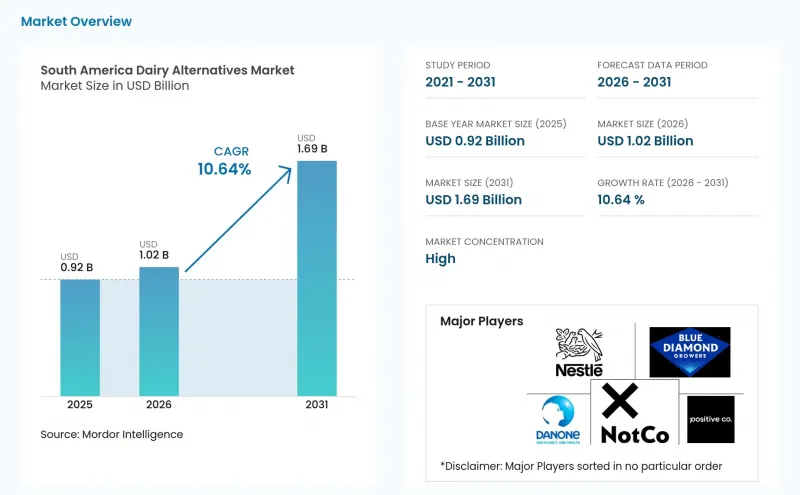
According to Mordor Intelligence, the South America dairy alternatives market size was valued at USD 0.92 billion in 2025 and estimated to grow from USD 1.02 billion in 2026 to reach USD 1.69 billion by 2031, at a CAGR of 10.64% during the forecast period (2026-2031).
South America Dairy Alternatives Market Trends and Insights
Rising Lactose Intolerance and Dairy Allergy Awareness
Lactose malabsorption affects a large share of the regional population, and the supplied research estimates that it affects 50% of people in South America. The commercial effect is stronger when consumers receive a diagnosis and begin looking for dependable replacements rather than simply reducing dairy intake. That change also makes product availability more important because a consumer who changes a routine purchase needs a suitable option in ordinary neighborhood stores, not only in specialized outlets. This creates repeat demand for milk, yogurt, and other alternatives that meet familiar daily use occasions. Clear product identity and labeling rules can make these choices easier for clinicians, dietitians, retailers, and consumers to understand. Brazil's proposed framework under MAPA Ordinance SDA/Mapa No. 831/2023 addresses minimum identity and quality requirements for plant-based analogues, helping formalize expectations for products sold in the country. The South American dairy alternatives market therefore benefits when health needs, product communication, and retail availability work together.
Expansion of Vegan and Flexitarian Consumption
The main source of volume growth is not limited to consumers following vegan diets because flexitarian households represent a broader group of potential buyers. A 2025 Good Food Institute Brazil study found that 21% of respondents identified as flexitarians and 34% reported some restriction of animal products in their diets. The same study reported that 27% had reduced red meat consumption in the prior 12 months, with health cited more often than price as the reason. This behavior supports products that fit ordinary breakfasts, coffee occasions, and home cooking rather than items designed only for a specialized audience. It also means that familiar taste, convenient packaging, and a price that can support repeat purchases matter as much as a vegan or environmental label when a household is deciding what to buy. Younger consumers are especially relevant because they are more open to trying plant-based products and comparing nutrition claims. In the South America dairy alternatives market, that wider pool of occasional and regular buyers supports growth across milk, yogurt, and fortified products.
Premium Pricing and Consumer Nutrition Concerns
Plant-based dairy alternatives remain more expensive than conventional dairy on comparable retail shelves in many South American countries. The supplied research places the difference at two to three times per liter in Brazil and Argentina, which limits reach among households with tighter food budgets. The issue is particularly material outside larger urban centers, where awareness may be rising but price remains decisive. Price sensitivity can also slow the move from a trial purchase to a regular household purchase, even when consumers are interested in lactose-free or plant-based choices. Brands can partly address this constraint through ambient, shelf-stable products and economy-positioned packages that reduce distribution costs. They also need to address questions about sugar, protein, and additives with simple labeling and credible nutrition information. The South America dairy alternatives market will have difficulty reaching a wider consumer base if its value proposition remains limited to premium health positioning.
Other drivers and restraints analyzed in the detailed report include:
- Premium Oat and Almond Products Gain Support From Cafes and Fortification
- Local Ingredients and Fermented Formats Extend Product Choice
- Cold-Chain Limits and Soy Supply Scrutiny
For complete list of drivers and restraints, kindly check the Table Of Contents.
Segment Analysis
Non-dairy milk commands 66.23% of the South American dairy alternatives market in 2025, a share built on the back of decades of soy milk consumption and, more recently, the surge in oat, almond, coconut, cashew, hazelnut, and hemp-based varieties. Within the non-dairy milk sub-segment, oat milk is the fastest-expanding format, propelled by barista-grade adoption in specialty cafes and its reputation for neutral flavor and sustainability.
Non-dairy yogurt records the steepest overall category growth at a 11.67% CAGR between 2026 and 2031, as fermented plant-based formats benefit from rising consumer familiarity with gut-health messaging and the successful format-extension strategies of established dairy brands. Danone's fortified protein dairy infrastructure in Brazil is expanding capacity by 50% at its Pocos de Caldas, Minas Gerais facility, creating cross-category capabilities that will benefit future plant-based yogurt line extensions. Non-dairy cheese and non-dairy desserts remain smaller segments but are gaining traction in urban specialty food retail and in the out-of-home food service channel, where menu diversification is encouraging trial beyond beverage formats.
Complete Report Scope:
- By Product Type
- Non-Dairy Milk
- Oat Milk
- Hemp Milk
- Hazelnut Milk
- Soy Milk
- Almond Milk
- Coconut Milk
- Cashew Milk
- Non-Dairy Cheese
- Non-Dairy Desserts
- Non-Dairy Yogurt
- Others
- Non-Dairy Milk
- Packaging Type
- PET Bottles
- Cans
- Cartons
- Others
- Distribution Channel
- On-trade
- Off-trade
- Convenience Stores
- Supermarkets and Hypermarkets
- Online Retail
- Other Distribution Channel
- Country
- Brazil
- Argentina
- Colombia
- Chile
- Peru
- Rest of South America
List of Companies Covered in this Report:
- The Coca-Cola Company
- Positive Brands Industria e Comercio de Alimentos Saudaveis SA
- Danone SA
- Nestle SA
- NotCo
- McCormick & Company, Inc.
- General Mills, Inc.
- SunOpta Inc.
- Blue Diamond Growers
- The Hain Celestial Group, Inc.
- Oatly Group AB
- Califia Farms, LLC
- Daiya Foods Inc.
- Vitasoy International Holdings Limited
- Archer-Daniels-Midland Company
- CP Kelco U.S., Inc.
- A Tal da Castanha
- Vida Veg
- Jasmine Alimentos Ltda.
- Vrimilk
Additional Benefits:
- The market estimate (ME) sheet in Excel format
- 3 months of analyst support
TABLE OF CONTENTS
1 INTRODUCTION
- 1.1 Study Assumptions and Market Definition
- 1.2 Scope of the Study
2 RESEARCH METHODOLOGY
3 EXECUTIVE SUMMARY
4 MARKET DYNAMICS
- 4.1 Market Overview
- 4.2 Market Drivers
- 4.2.1 Rising Lactose Intolerance and Dairy Allergy Awareness
- 4.2.2 Expansion of Vegan and Flexitarian Consumption
- 4.2.3 Premiumization of Oat and Almond Formats
- 4.2.4 Functional Fortification With Protein, Calcium, and Fiber
- 4.2.5 Barista and Foodservice Adoption of Plant-Based Milk
- 4.2.6 Local Fermentation and Crop-Adapted Formulation Innovation
- 4.3 Market Restraints
- 4.3.1 Premium Price Versus Conventional Dairy
- 4.3.2 Uneven Cold-Chain and Modern-Trade Availability Outside Major Cities
- 4.3.3 Consumer Perception of Sugar, Protein, and Additive Trade-Offs
- 4.3.4 Soy Supply Concentration and Sustainability Scrutiny
- 4.4 Supply Chain Analysis
- 4.5 Regulatory Landscape
- 4.6 Technological Outlook
- 4.7 Porter's Five Forces
- 4.7.1 Threat of New Entrants
- 4.7.2 Bargaining Power of Buyers/Consumers
- 4.7.3 Bargaining Power of Suppliers
- 4.7.4 Threat of Substitute Products
- 4.7.5 Intensity of Competitive Rivalry
5 MARKET SIZE AND GROWTH FORECASTS (VALUE AND VOLUME)
- 5.1 By Product Type
- 5.1.1 Non-Dairy Milk
- 5.1.1.1 Oat Milk
- 5.1.1.2 Hemp Milk
- 5.1.1.3 Hazelnut Milk
- 5.1.1.4 Soy Milk
- 5.1.1.5 Almond Milk
- 5.1.1.6 Coconut Milk
- 5.1.1.7 Cashew Milk
- 5.1.2 Non-Dairy Cheese
- 5.1.3 Non-Dairy Desserts
- 5.1.4 Non-Dairy Yogurt
- 5.1.5 Others
- 5.1.1 Non-Dairy Milk
- 5.2 Packaging Type
- 5.2.1 PET Bottles
- 5.2.2 Cans
- 5.2.3 Cartons
- 5.2.4 Others
- 5.3 Distribution Channel
- 5.3.1 On-trade
- 5.3.2 Off-trade
- 5.3.2.1 Convenience Stores
- 5.3.2.2 Supermarkets and Hypermarkets
- 5.3.2.3 Online Retail
- 5.3.2.4 Other Distribution Channel
- 5.4 Country
- 5.4.1 Brazil
- 5.4.2 Argentina
- 5.4.3 Colombia
- 5.4.4 Chile
- 5.4.5 Peru
- 5.4.6 Rest of South America
6 COMPETITIVE LANDSCAPE
- 6.1 Market Concentration
- 6.2 Strategic Moves
- 6.3 Market Ranking Analysis
- 6.4 Company Profiles (includes Global level Overview, Market level overview, Core Segments, Financials, Strategic Information, Market Rank/Share, Products and Services, Recent Developments)
- 6.4.1 The Coca-Cola Company
- 6.4.2 Positive Brands Industria e Comercio de Alimentos Saudaveis SA
- 6.4.3 Danone SA
- 6.4.4 Nestle SA
- 6.4.5 NotCo
- 6.4.6 McCormick & Company, Inc.
- 6.4.7 General Mills, Inc.
- 6.4.8 SunOpta Inc.
- 6.4.9 Blue Diamond Growers
- 6.4.10 The Hain Celestial Group, Inc.
- 6.4.11 Oatly Group AB
- 6.4.12 Califia Farms, LLC
- 6.4.13 Daiya Foods Inc.
- 6.4.14 Vitasoy International Holdings Limited
- 6.4.15 Archer-Daniels-Midland Company
- 6.4.16 CP Kelco U.S., Inc.
- 6.4.17 A Tal da Castanha
- 6.4.18 Vida Veg
- 6.4.19 Jasmine Alimentos Ltda.
- 6.4.20 Vrimilk
7 MARKET OPPORTUNITIES AND FUTURE TRENDS

