PUBLISHER: Mordor Intelligence | PRODUCT CODE: 2184693

PUBLISHER: Mordor Intelligence | PRODUCT CODE: 2184693
Magnetic Beads - Market Share Analysis, Industry Trends & Statistics, Growth Forecasts (2026 - 2031)
According to Mordor Intelligence, the magnetic beads market size is projected to expand from USD 2.60 billion in 2025 and USD 2.85 billion in 2026 to USD 4.30 billion by 2031, registering a CAGR of 8.58% between 2026 and 2031.
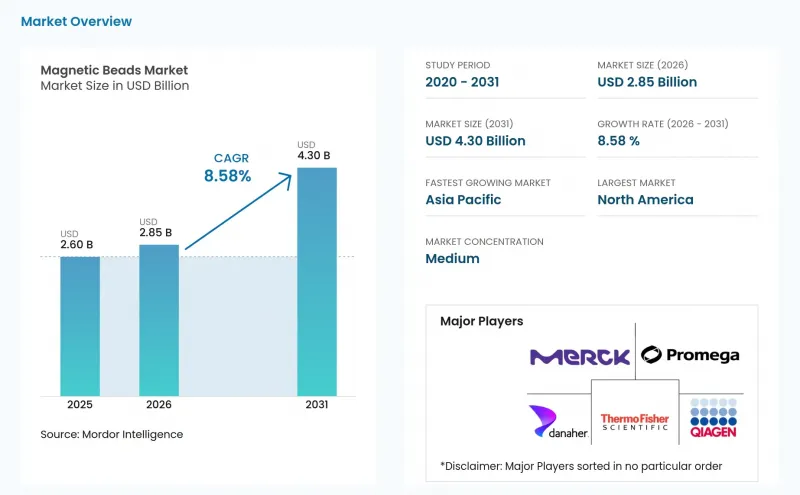
Global Magnetic Beads Market Trends and Insights
Automation-Ready Nucleic Acid Extraction in Molecular Diagnostics
Automated magnetic bead extraction is increasingly important in the magnetic beads market in molecular diagnostic laboratories that need repeatable processing and electronic documentation. QIAGEN states that its QIAsprint Connect system supports audit trails and secure electronic records designed for 21 CFR Part 11 readiness. Such functions are difficult to reproduce with manual spin-column steps, especially in regulated laboratory settings. QIAGEN launched QIAmini in September 2026 for laboratories that still process smaller batches manually. The launch shows that automated workflows are reaching lower-throughput research environments as well as high-volume testing centers. In the magnetic beads market, vendors that pair consumables with instruments can benefit from recurring reagent demand and more durable customer relationships.
Rapid Adoption of MACS in Cell and Gene Therapy Manufacturing
Magnetic activated cell sorting remains a well-established practice in the magnetic beads market and a method for clinical-grade T-cell isolation and processing. Thermo Fisher stated in December 2024 that Dynabeads were used in more than 200 active clinical trials and several approved cell therapy products. Miltenyi's CliniMACS Prodigy integrates enrichment, activation, transduction, and expansion within a closed manufacturing workflow. This integration makes cell isolation part of a broader manufacturing platform rather than an isolated reagent choice. As production moves to larger commercial volumes, throughput can become a limiting issue for conventional magnetic processing. Detachable bead formats address this concern by allowing cells to be released after isolation, reducing residual-particle concerns in the final process.
Other drivers and restraints analyzed in the detailed report include:
- Point-of-Care IVD Kits Using Bead-Based Enrichment
- High-Throughput Proteomics and Interactomics Research
- Batch-to-Batch Variability of Bead Surface Chemistry
- Price Premium Over Chromatographic Resins in Large-Volume Bioprocessing
For complete list of drivers and restraints, kindly check the Table Of Contents.
Segment Analysis
In vitro diagnostics held 43.35% of the magnetic beads market share in 2025, supported by high-volume nucleic acid extraction in clinical and reference laboratories. Magnetic capture supports automated DNA and RNA preparation across many molecular testing workflows. Life-science research was the second-largest application because researchers use beads in protein pull-downs, immunoprecipitation, and next-generation sequencing preparation. Environmental and food testing provided additional volume where pathogen screening is required. Drug delivery and therapeutics remained at an early commercial stage, even though magnetic nanocarrier systems have shown proof-of-concept results. A 2025 study described folic acid-conjugated magnetic nanoparticles for controlled doxorubicin release, while commercial scale-up still presents challenges.
Cell separation and therapy is projected to grow at a 9.89% CAGR through 2031, making it the fastest-growing application in the magnetic beads market. CAR-T and CAR-NK manufacturing requires controlled cell selection, activation, and expansion procedures. Miltenyi Bioindustry's work with BioOra and Immatics indicates that MACS-based processing is moving into commercial-phase cell therapy operations. The U.S. Food and Drug Administration issued guidance on CAR T cell product development in January 2024. The guidance supports investment in documented process controls and qualified bead-handling tools. The segment's demand will be tied to therapy approvals, manufacturing capacity, and the ability of CDMOs to deliver consistent batches.
Iron oxide accounted for 93.28% of segment revenue in 2025 because it combines superparamagnetic behavior, biocompatibility, and established use in diagnostic and bioprocessing settings. Decades of manufacturing refinement also support its broad acceptance across commercial bead formats. Cobalt ferrite offers higher coercivity but has toxicity constraints that limit its use in clinical applications. The supplied research places approximately 52% of high-purity iron oxide production capacity in Asia-Pacific. China and Japan remain important refining centers under this supply structure. This regional concentration can support nearby manufacturers while creating supply exposure for purchasers in other regions.
Nickel ferrite is projected to grow at a 9.38% CAGR through 2031, although its revenue base remains much smaller than iron oxide. Its magnetic saturation characteristics can support low-gradient separator designs for larger bioprocessing volumes. Conventional permanent-magnet systems can lose field uniformity when process volumes rise above 1 liter. Nickel ferrite is therefore relevant to separator and bead co-design rather than broad replacement of iron oxide. The magnetic beads market size for this material will depend on progress in large-volume magnetic separation. Its growth reflects focused materials development for specialized purification systems instead of a change in the core material hierarchy.
Complete Report Scope:
- By Application
- In-vitro Diagnostics
- Life-Science Research
- Cell Separation & Therapy
- Drug Delivery & Therapeutics
- Environmental & Food Testing
- Other Applications
- By Magnetic Core Material
- Iron Oxide (Fe3O4 / Magnetite)
- Cobalt Ferrite
- Nickel Ferrite
- Others
- By Surface Chemistry / Coating
- Silica-coated
- Polystyrene-coated
- Agarose-coated
- Carboxyl-functionalized
- Streptavidin / Biotinylated
- Tosyl-activated
- Other Surface Chemistry / Coatings
- By Particle Size Range
- <100 nm (Nanobeads)
- 100 nm - 1 µm
- >1 µm
- By End User
- Pharmaceutical & Biotechnology Companies
- Diagnostic Laboratories
- Academic & Research Institutes
- CROs/CDMOs
- Other End Users
- By Geography
- North America
- United States
- Canada
- Mexico
- Europe
- Germany
- United Kingdom
- France
- Italy
- Spain
- Rest of Europe
- Asia Pacific
- China
- India
- Japan
- Australia
- South Korea
- Rest of Asia Pacific
- Middle East and Africa
- GCC
- South Africa
- Rest of Middle East and Africa
- South America
- Brazil
- Argentina
- Rest of South America
- North America
Geography Analysis
North America held 41.79% of the magnetic beads market share in 2025. The region benefits from a large base of cell and gene therapy clinical trials, established molecular diagnostics, and substantial pharmaceutical and biotechnology research activity. The United States generates demand from academic proteomics through commercial CAR-T manufacturing. These linked activities support consumption across research, clinical testing, and regulated production. South America remained a smaller contributor, although public health laboratory modernization in Brazil is creating additional diagnostic demand.
Europe was the second-largest regional market in 2025. Germany is both a production and consumption center, with Miltenyi Biotec, micromod Partikeltechnologie, and Merck KGaA's life science business contributing to the regional supplier base. The United Kingdom also has a growing cell and gene therapy manufacturing ecosystem. ISO/DIS 25802 reflects a higher focus on immunomagnetic bead quality control and could raise technical compliance requirements in Europe. These requirements can favor manufacturers with GMP capabilities while raising entry barriers for smaller suppliers. GenScript's European mRNA hub, established in March 2026, extends access to mRNA synthesis and purification infrastructure.
Asia-Pacific is expected to advance at a 10.03% CAGR through 2031, the fastest rate among regions. China's CAR-T pipeline and government-backed genomic medicine investment are increasing demand for cell-processing materials. The supplied research expects magnetic bead consumption in CAR-T manufacturing to double by 2031 from its 2026 base. Precision System Science's Magtration technology supports automated nucleic acid extraction and reduces reliance on imported workflows in Japan. India's healthcare modernization and growing CRO activity support future demand. South Korea, Australia, GCC countries, and other Middle East and African markets add demand through biotech investment, diagnostic upgrades, and hospital modernization.
- Abbkine Scientific Co. Ltd
- Bangs Laboratories Inc.
- Bioneer
- Bio-Rad Laboratories
- CD Bioparticles
- Creative Diagnostics
- Cytiva
- EpigenTek Group Inc.
- Genscript
- Magnostics
- Merck
- micromod Partikeltechnologie GmbH
- Miltenyi Biotec
- New England Biolabs
- Ocean NanoTech LLC
- Promega
- QIAGEN
- RayBiotech Inc.
- Stem Cell Technologies
- Takara Bio
- Thermo Fisher Scientific
Additional Benefits:
- The market estimate (ME) sheet in Excel format
- 3 months of analyst support
TABLE OF CONTENTS
1 Introduction
- 1.1 Study Assumptions & Market Definition
- 1.2 Scope of the Study
2 Research Methodology
3 Executive Summary
4 Market Landscape
- 4.1 Market Overview
- 4.2 Market Drivers
- 4.2.1 Automation-Ready Nucleic-Acid Extraction in Molecular Diagnostics
- 4.2.2 Rapid Adoption of Magnetic-Activated Cell Sorting (MACS) in Cell & Gene Therapy Manufacturing
- 4.2.3 Surging Demand for High-Throughput Proteomics & Interactomics Research
- 4.2.4 Mainstreaming of Point-of-Care IVD Kits Employing Bead-Based Enrichment
- 4.2.5 Emergence of Bead-Assisted mRNA Vaccine Purification Workflows
- 4.2.6 Development of Reusable Low-Gradient Separators for Bioprocess Scale-Up
- 4.3 Market Restraints
- 4.3.1 Batch-to-Batch Variability of Bead Surface Chemistry
- 4.3.2 Price Premium Over Chromatographic Resins in Large-Volume Bioprocessing
- 4.3.3 Regulatory Uncertainty for Bead Carry-Over in Cell Therapies
- 4.3.4 Supply-Risk of High-Purity Iron-Oxide Feedstock
- 4.4 Value / Supply-Chain Analysis
- 4.5 Regulatory Landscape
- 4.6 Technological Outlook
- 4.7 Porter's Five Forces Analysis
- 4.7.1 Threat of New Entrants
- 4.7.2 Bargaining Power of Buyers
- 4.7.3 Bargaining Power of Suppliers
- 4.7.4 Threat of Substitutes
- 4.7.5 Competitive Rivalry
5 Market Size & Growth Forecasts (Value, USD)
- 5.1 By Application
- 5.1.1 In-vitro Diagnostics
- 5.1.2 Life-Science Research
- 5.1.3 Cell Separation & Therapy
- 5.1.4 Drug Delivery & Therapeutics
- 5.1.5 Environmental & Food Testing
- 5.1.6 Other Applications
- 5.2 By Magnetic Core Material
- 5.2.1 Iron Oxide (Fe3O4 / Magnetite)
- 5.2.2 Cobalt Ferrite
- 5.2.3 Nickel Ferrite
- 5.2.4 Others
- 5.3 By Surface Chemistry / Coating
- 5.3.1 Silica-coated
- 5.3.2 Polystyrene-coated
- 5.3.3 Agarose-coated
- 5.3.4 Carboxyl-functionalized
- 5.3.5 Streptavidin / Biotinylated
- 5.3.6 Tosyl-activated
- 5.3.7 Other Surface Chemistry / Coatings
- 5.4 By Particle Size Range
- 5.4.1 <100 nm (Nanobeads)
- 5.4.2 100 nm - 1 µm
- 5.4.3 >1 µm
- 5.5 By End User
- 5.5.1 Pharmaceutical & Biotechnology Companies
- 5.5.2 Diagnostic Laboratories
- 5.5.3 Academic & Research Institutes
- 5.5.4 CROs/CDMOs
- 5.5.5 Other End Users
- 5.6 By Geography
- 5.6.1 North America
- 5.6.1.1 United States
- 5.6.1.2 Canada
- 5.6.1.3 Mexico
- 5.6.2 Europe
- 5.6.2.1 Germany
- 5.6.2.2 United Kingdom
- 5.6.2.3 France
- 5.6.2.4 Italy
- 5.6.2.5 Spain
- 5.6.2.6 Rest of Europe
- 5.6.3 Asia Pacific
- 5.6.3.1 China
- 5.6.3.2 India
- 5.6.3.3 Japan
- 5.6.3.4 Australia
- 5.6.3.5 South Korea
- 5.6.3.6 Rest of Asia Pacific
- 5.6.4 Middle East and Africa
- 5.6.4.1 GCC
- 5.6.4.2 South Africa
- 5.6.4.3 Rest of Middle East and Africa
- 5.6.5 South America
- 5.6.5.1 Brazil
- 5.6.5.2 Argentina
- 5.6.5.3 Rest of South America
- 5.6.1 North America
6 Competitive Landscape
- 6.1 Market Concentration
- 6.2 Market Share Analysis
- 6.3 Company Profiles (includes Global Level Overview, Market Level Overview, Core Segments, Financials as Available, Strategic Information, Market Rank/Share for Key Companies, Products & Services, and Recent Developments)
- 6.3.1 Abbkine Scientific Co. Ltd
- 6.3.2 Bangs Laboratories Inc.
- 6.3.3 Bioneer Corporation
- 6.3.4 Bio-Rad Laboratories Inc.
- 6.3.5 CD Bioparticles
- 6.3.6 Creative Diagnostics
- 6.3.7 Cytiva (Danaher Corporation)
- 6.3.8 EpigenTek Group Inc.
- 6.3.9 GenScript Biotech Corporation
- 6.3.10 Magnostics
- 6.3.11 Merck KGaA
- 6.3.12 micromod Partikeltechnologie GmbH
- 6.3.13 Miltenyi Biotec
- 6.3.14 New England Biolabs
- 6.3.15 Ocean NanoTech LLC
- 6.3.16 Promega Corporation
- 6.3.17 QIAGEN NV
- 6.3.18 RayBiotech Inc.
- 6.3.19 STEMCELL Technologies Inc.
- 6.3.20 Takara Bio Inc.
- 6.3.21 Thermo Fisher Scientific Inc.
7 Market Opportunities & Future Outlook
- 7.1 White-space & Unmet-need Assessment

