PUBLISHER: Mordor Intelligence | PRODUCT CODE: 2184706

PUBLISHER: Mordor Intelligence | PRODUCT CODE: 2184706
Fava Bean Protein - Market Share Analysis, Industry Trends & Statistics, Growth Forecasts (2026 - 2031)
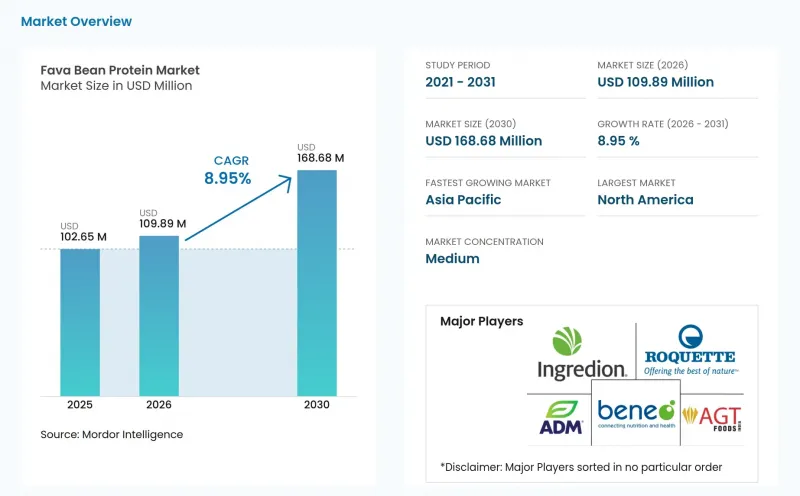
According to Mordor Intelligence, the fava bean protein market size was valued at USD 102.65 million in 2025 and estimated to grow from USD 109.89 million in 2026 to reach USD 168.68 million by 2031, at a CAGR of 8.95% during the forecast period (2026-2031).
Global Fava Bean Protein Market Trends and Insights
Increasing Demand for Allergen-Friendly Protein Ingredients
The Fava bean protein market is supported by demand for soy-free and dairy-free ingredient options. Fava beans are not listed among the major allergens in the European Union food information regulation, which can make them useful in products designed around free-from positioning. This status matters because formulators have fewer protein choices when a product must avoid both soy and dairy. Breeding work that reduces vicine and convicine may extend the range of fava ingredients available to people who limit fava consumption because of G6PD deficiency. Burcon NutraScience launched FavaPro in August 2025 as a non-GMO fava protein isolate with more than 90% purity, showing how allergen-related positioning is being translated into a commercial ingredient.
Rapid Expansion of the Plant-Based Food Industry
The Fava bean protein market is linked to continued reformulation activity in plant-based foods. Food brands are assessing ingredients for functional performance as well as protein content. North American developers use fava protein in meat analogue applications, while European developers also use it to diversify protein supply. The European Commission's Farm to Fork policy supports a food system with a reduced dependence on imported protein feedstocks, which aligns with interest in locally sourced pulse proteins. This combination of application demand and supply diversification can support longer qualification cycles and ingredient purchasing relationships across more than one region. It also gives suppliers a rationale to invest in local processing and customer trials even when demand in one application is still developing.
Presence of Off-Flavors and Beany Taste
Off-flavors remain a practical limit for the Fava bean protein market, especially in beverages and other taste-sensitive products. Vicine, convicine, and lipoxygenase activity can contribute to hexanal and related volatile compounds that cause beany or bitter notes. Formulators may need deodorization, flavor masking, or lower inclusion levels, which can raise formulation cost or reduce the protein contribution. A 2025 study found that plasma-activated water changed the solubility and structural properties of fava bean protein isolate, indicating a possible route for modifying flavor-related processing conditions. Industrial-scale use remains early, so pea protein can retain an advantage in applications that require a neutral flavor profile. Until processing solutions become more widely available, beverage developers may limit fava inclusion levels or reserve the ingredient for formats where other flavors and ingredients can better manage the sensory profile.
Other drivers and restraints analyzed in the detailed report include:
- Advances in Protein Extraction and Fractionation Technologies
- Rising Demand for Clean-Label Plant Protein Ingredients
- Competition From Well-Established Plant Proteins
For complete list of drivers and restraints, kindly check the Table Of Contents.
Segment Analysis
Isolates held 46.74% of the Fava bean protein market in 2025, reflecting their fit with high-purity applications. Beverages, dairy alternatives, sports nutrition, and baked goods use isolates when high protein content and consistent functionality are essential. Burcon's FavaPro has more than 90% purity and is positioned for nutritional beverages, dairy alternatives, snacks, and bakery products. This product profile shows why isolates continue to anchor the higher-value end of ingredient demand, while their high purity makes it easier for developers to add protein without changing the rest of a recipe as much as a lower-purity ingredient could.
Textured protein is projected to grow at a 9.87% CAGR through 2031, the highest rate within product type. Demand for textured fava formats is supported by the need for structure, bite, and moisture retention in meat analogue products. These applications require the ingredient to perform after extrusion and during cooking, not only to deliver protein on a specification sheet. Suppliers that meet those requirements can address products where sensory experience determines whether consumers return to a plant-based option. GoodMills Innovation's wheat-fava texturate was designed to deliver fiber and layer structures while maintaining integrity through thermal and mechanical processing.
Complete Report Scope:
- By Product Type
- Isolate
- Concentrate
- Textured Protein
- By Nature
- Organic
- Conventional
- By Application
- Food and Beverage
- Meat and Fish Analogues
- Dairy Alternatives
- Bakery and Snacks
- Sports and Clinical Nutrition
- Beverages
- Animal Nutrition
- Other Applications
- Food and Beverage
- By Geography
- North America
- United States
- Canada
- Mexico
- Rest of North America
- Europe
- Germany
- United Kingdom
- Italy
- France
- Spain
- Rest of Europe
- Asia-Pacific
- China
- India
- Japan
- Australia
- Rest of Asia-Pacific
- South America
- Brazil
- Argentina
- Rest of South America
- Middle East and Africa
- South Africa
- Saudi Arabia
- Rest of Middle East and Africa
- North America
Geography Analysis
North America held 38.41% of the Fava bean protein market in 2025. The region benefits from established plant-based food development, food technology pipelines, and demand for allergen-sensitive products. The United States has a clear setting for commercial development of new protein ingredients under its food safety framework. Burcon produces FavaPro at its Galesburg, Illinois facility, making the region both a demand center and a processing base for premium fava isolates. Canada contributes pulse crops and formulation capabilities, while Mexico and other markets in the region add end-use demand, including animal nutrition.
Europe is the second-largest regional position in the supplied analysis. Policy efforts to support domestic protein supply shape investment decisions across France, Germany, and the United Kingdom. The Farm to Fork strategy provides a policy setting that favors diversification away from imported soy-based protein supply. GoodMills Innovation's 2025 launch of an EU-certified wheat-fava texturate reflects the combination of regional sourcing, clean-label demand, and application development in Europe. European novel food requirements can lengthen development timelines, but they can also create a barrier for suppliers that lack regulatory and technical resources. Larger suppliers and well-prepared specialists may therefore benefit when they can complete product development, documentation, and customer qualification in a coordinated way.
Asia-Pacific is projected to grow at a 9.74% CAGR through 2031, the fastest regional rate in the supplied data. The Fava bean protein market size in Asia-Pacific is shaped by rising protein demand, urbanization, and government nutrition programs in China and India. China offers familiarity with fava beans, while its food manufacturing sector is investing in higher-value protein processing. Australia strengthens the regional supply base through pulse crop exports and ingredient production for domestic and Southeast Asian customers. South America and the Middle East and Africa remain longer-term areas of interest, led by Brazil and Argentina in South America and by food security procurement priorities in South Africa and Saudi Arabia. These regions are not the present growth leaders in the supplied data, but they add to the range of markets where suppliers may pursue longer-horizon distribution and procurement relationships.
- Roquette Freres S.A.
- Ingredion Incorporated
- Sudzucker AG (Beneo)
- Archer Daniels Midland Company
- AGT Food and Ingredients Inc.
- Burcon NutraScience Corporation
- Cosun Protein
- Vitalo Life Science
- DSM-Firmenich
- Top Health Ingredients
- Australian Plant Proteins
- Deltagen (UK) Ltd
- Meelunie B.V.
- The Scoular Company
- Integra Foods Australia Pty Ltd
- A&B Ingredients, Inc.
- Vestkorn Milling AS
- Global Resources Direct
- Guzen Development, Inc.
- Bioway (Xi'an) Organic Ingredients Co., Ltd.
Additional Benefits:
- The market estimate (ME) sheet in Excel format
- 3 months of analyst support
TABLE OF CONTENTS
1 INTRODUCTION
- 1.1 Study Assumptions and Market Definition
- 1.2 Scope of the Study
2 RESEARCH METHODOLOGY
3 EXECUTIVE SUMMARY
4 MARKET LANDSCAPE
- 4.1 Market Overview
- 4.2 Market Drivers
- 4.2.1 Increasing demand for allergen-friendly protein ingredients
- 4.2.2 Rapid expansion of the plant-based food industry
- 4.2.3 Advances in protein extraction and fractionation technologies
- 4.2.4 Rising demand for clean-label plant protein ingredients
- 4.2.5 Growing adoption in high-protein and functional foods
- 4.2.6 Favorable functional properties in food formulations
- 4.3 Market Restraints
- 4.3.1 Presence of off-flavors and beany taste
- 4.3.2 Competition from well-established plant proteins
- 4.3.3 Cost-intensive protein extraction and ingredient processing requirements
- 4.3.4 Raw material supply volatility driven by regional cultivation and seasonal harvest patterns
- 4.4 Value Chain Analysis
- 4.5 Regulatory Landscape
- 4.6 Porter's Five Forces Analysis
- 4.6.1 Threat of New Entrants
- 4.6.2 Bargaining Power of Suppliers
- 4.6.3 Bargaining Power of Buyers
- 4.6.4 Threat of Substitutes
- 4.6.5 Industry Rivalry
5 MARKET SIZE AND GROWTH FORECASTS (VALUE)
- 5.1 By Product Type
- 5.1.1 Isolate
- 5.1.2 Concentrate
- 5.1.3 Textured Protein
- 5.2 By Nature
- 5.2.1 Organic
- 5.2.2 Conventional
- 5.3 By Application
- 5.3.1 Food and Beverage
- 5.3.1.1 Meat and Fish Analogues
- 5.3.1.2 Dairy Alternatives
- 5.3.1.3 Bakery and Snacks
- 5.3.1.4 Sports and Clinical Nutrition
- 5.3.1.5 Beverages
- 5.3.2 Animal Nutrition
- 5.3.3 Other Applications
- 5.3.1 Food and Beverage
- 5.4 By Geography
- 5.4.1 North America
- 5.4.1.1 United States
- 5.4.1.2 Canada
- 5.4.1.3 Mexico
- 5.4.1.4 Rest of North America
- 5.4.2 Europe
- 5.4.2.1 Germany
- 5.4.2.2 United Kingdom
- 5.4.2.3 Italy
- 5.4.2.4 France
- 5.4.2.5 Spain
- 5.4.2.6 Rest of Europe
- 5.4.3 Asia-Pacific
- 5.4.3.1 China
- 5.4.3.2 India
- 5.4.3.3 Japan
- 5.4.3.4 Australia
- 5.4.3.5 Rest of Asia-Pacific
- 5.4.4 South America
- 5.4.4.1 Brazil
- 5.4.4.2 Argentina
- 5.4.4.3 Rest of South America
- 5.4.5 Middle East and Africa
- 5.4.5.1 South Africa
- 5.4.5.2 Saudi Arabia
- 5.4.5.3 Rest of Middle East and Africa
- 5.4.1 North America
6 COMPETITIVE LANDSCAPE
- 6.1 Market Concentration
- 6.2 Strategic Moves
- 6.3 Market Share Analysis
- 6.4 Company Profiles (includes Company Highlights, Core Segments, Financials (if available), Strategic Information, Market Share Analysis for key companies, Products, and Recent Developments)
- 6.4.1 Roquette Freres S.A.
- 6.4.2 Ingredion Incorporated
- 6.4.3 Sudzucker AG (Beneo)
- 6.4.4 Archer Daniels Midland Company
- 6.4.5 AGT Food and Ingredients Inc.
- 6.4.6 Burcon NutraScience Corporation
- 6.4.7 Cosun Protein
- 6.4.8 Vitalo Life Science
- 6.4.9 DSM-Firmenich
- 6.4.10 Top Health Ingredients
- 6.4.11 Australian Plant Proteins
- 6.4.12 Deltagen (UK) Ltd
- 6.4.13 Meelunie B.V.
- 6.4.14 The Scoular Company
- 6.4.15 Integra Foods Australia Pty Ltd
- 6.4.16 A&B Ingredients, Inc.
- 6.4.17 Vestkorn Milling AS
- 6.4.18 Global Resources Direct
- 6.4.19 Guzen Development, Inc.
- 6.4.20 Bioway (Xi'an) Organic Ingredients Co., Ltd.
7 MARKET OPPORTUNITIES AND FUTURE OUTLOOK

