PUBLISHER: Mordor Intelligence | PRODUCT CODE: 2184751

PUBLISHER: Mordor Intelligence | PRODUCT CODE: 2184751
Online Data Science Training Programs - Market Share Analysis, Industry Trends & Statistics, Growth Forecasts (2026 - 2031)
According to Mordor Intelligence, the online data science training programs market size stood at USD 11.87 billion in 2026, up from USD 11.13 billion in 2025, and is projected to reach USD 22.39 billion by 2031, with a 13.53% CAGR.
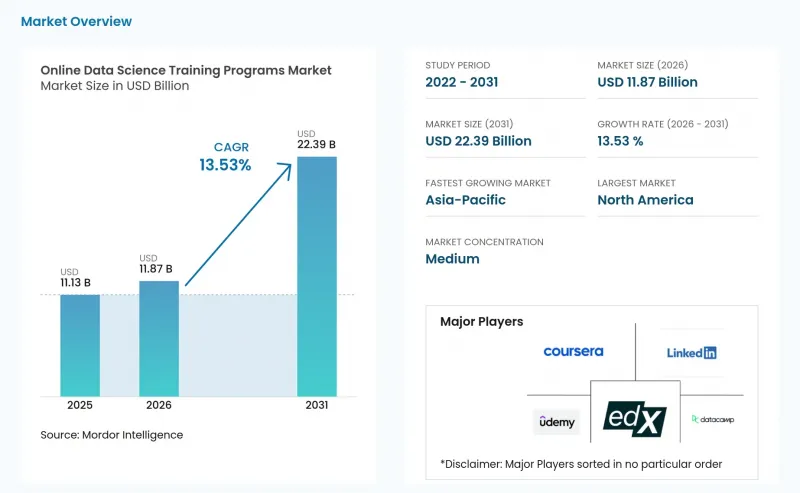
Global Online Data Science Training Programs Market Trends and Insights
Rising Demand for Job-Ready Data Science Skills
The online data science training programs market is being driven by employer demand for candidates who can use data tools in real-world settings from the start. The UK Department for Science, Innovation and Technology found that Python appeared in 68% of AI-related job postings, data science methods in 64%, and machine learning in 63%, indicating how closely these skills now co-occur in hiring decisions. The same labor market evidence shows that data and AI hiring is spreading across a broader range of occupations, rather than remaining concentrated in specialist technical roles. That change matters for the online data science training programs market because more workers now need structured learning to move into analytics-adjacent jobs or remain competitive in current roles. It also supports demand for certification-led offerings because employers increasingly want evidence of applied skill readiness rather than informal self-study alone.
Accelerating Enterprise Upskilling for AI and Analytics Adoption
The online data science training programs market is seeing stronger enterprise demand as companies move AI adoption from pilot work into day-to-day workflows. Corporate learners are the fastest-growing end-user group, with a projected 14.26% CAGR through 2031, which shows that budget control is shifting toward employers rather than individual learners. Platform launches also point in the same direction, with Coursera embedding learning directly into Microsoft 365 Copilot and LinkedIn Learning introducing role-based Skills Tracks for data and AI functions. These actions show that buyers are placing more value on occupation-linked learning paths, skills verification, and tighter alignment with enterprise productivity systems. As a result, the online data science training programs market is moving toward multi-seat contracts, cohort models, and stronger reporting on learner outcomes.
Free and Low-Cost Open Course Substitutes
The online data science training programs market faces steady pricing pressure from free and low-cost beginner-level learning options. Open educational content, video-led instruction, and free platform tiers give learners access to Python, SQL, and entry-level analytics material without paying for a full course path. This does not remove demand for paid programs. Still, it does make it harder for providers to hold pricing on foundation content unless they attach clear credential value, employer recognition, or career support. The risk is greater in price-sensitive regions, where the first learning decision is often based on access cost rather than structured assessment. That dynamic keeps the online data science training programs market focused on value-added differentiation at the intermediate and advanced levels.
Other drivers and restraints analyzed in the detailed report include:
- Expansion of Credential-Based Online Learning Pathways
- Growth of Mobile-First and Self-Paced Learning Consumption
- Rapid Curriculum Obsolescence in Fast-Changing Tool Stacks
For complete list of drivers and restraints, kindly check the Table Of Contents.
Segment Analysis
Certification courses held 51.54% of the online data science training programs market share in 2025, which made them the largest program type by revenue. Their scale reflects employers' preference for role-specific proof of capability, especially when hiring managers want a clearer signal than a general course-completion line or an old academic transcript. Digital credential adoption supports this position, since 91% of employers actively screened for digital credentials during candidate review in 2025. That screening behavior gives certification-led offerings stronger commercial logic than broad, non-assessed content libraries. It also helps explain why the online data science training programs market continues to favor structured, accessible learning over informal course consumption alone.
The others segment, which includes bootcamps and corporate cohort programs, is projected to grow at 13.79% CAGR through 2031, making it the fastest-growing program type in the draft. That growth comes from a shift in how bootcamps are sold, with a larger share moving toward enterprise delivery rather than serving only individual career switchers. The online data science training programs industry is also seeing stronger demand for cohort formats, as procurement teams respond better to completion and accountability than to fully self-directed learning. Professional degree courses remain relevant at the premium end, especially where formal accreditation shapes buyer confidence and pricing. This preserves a place for degree-led offerings even though they are not expected to match the growth pace of certification and cohort-based formats.
The online data science training programs market size for self-paced learning remained the largest in 2025, with a 56.22% share of revenue. This mode fits working professionals who want flexible pacing, broad course choice, and the ability to learn outside standard business hours. It also supports provider scale because content can be distributed across a wide learner base without the same delivery cost profile as live instruction. Even so, the draft shows that standalone self-paced formats achieved only a 23% completion rate, limiting satisfaction and upsell potential when no support layer is added. That tension explains why the online data science training programs market still values self-paced delivery for reach, but not as a complete solution for all learner types.
The online data science training programs market for blended learning is forecast to grow at a 14.86% CAGR through 2031, making it the fastest-growing mode. Enterprises are favoring blended formats because they combine schedule flexibility with live touchpoints, peer accountability, and stronger completion performance. This is also changing how procurement teams compare vendors, since the buying decision now includes delivery structure and measurable completion rather than course catalog depth alone. Instructor-led live learning remains important for premium, customized training, especially when buyers want direct support and structured evaluation. As a result, the online data science training programs market is likely to maintain a layered delivery mix, with self-paced, at-scale, and blended formats driving faster growth and higher-value contracts.
Complete Report Scope:
- By Program Type
- Professional Degree Courses
- Certification Courses
- Others (Bootcamps,Corporate Cohort Programs)
- By End User
- Individual Learners
- Corporate Learners
- By Learning Mode
- Self-Paced Online Learning
- Instructor-Led Live Learning
- Blended Learning
- By Content Focus
- Python
- R Programming
- SQL and Data Engineering
- Machine Learning and AI
- Statistics and Probability
- By Geography
- North America
- United States
- Canada
- Mexico
- South America
- Brazil
- Peru
- Chile
- Argentina
- Rest of South America
- Europe
- United Kingdom
- Germany
- France
- Spain
- Italy
- BENELUX (Belgium, Netherlands, and Luxembourg)
- NORDICS (Denmark, Finland, Iceland, Norway, and Sweden)
- Rest of Europe
- Asia-Pacific
- India
- China
- Japan
- Australia
- South Korea
- South East Asia (Singapore, Malaysia, Thailand, Indonesia, Vietnam, and Philippines)
- Rest of Asia-Pacific
- Middle East and Africa
- United Arab Emirates
- Saudi Arabia
- South Africa
- Nigeria
- Rest of Middle East and Africa
- North America
Geography Analysis
North America held 38.95% of the online data science training programs market share in 2025, which made it the largest regional market by revenue. The region remains the most mature part of the online data science training programs market because enterprise technology spending is high, digital credential acceptance is established, and several leading learning platforms are based there. Growth is projected at 7.00% CAGR through 2031, which is slower than the global average but still reflects healthy expansion from a larger installed base. Employer recognition of structured credentials is an important demand support in the region, especially as hiring managers place more weight on verified skills signals. The United States leads regional demand, while Canada supports the market through institutional partnerships, and Mexico presents an opportunity as demand for Spanish-language technical content rises.
Europe is projected to expand at 6.20% CAGR through 2031, with the UK, Germany, and France acting as the core markets. The online data science training programs market in Europe is supported by formal skills policy, public concern over digital capability gaps, and a stronger quality orientation in workforce training. The UK government's 2026 Annual Skills Report identified digital and AI capabilities as major shortfalls across priority sectors, which supports institutional demand for structured online learning. France also benefits from a culture of certification that supports the willingness to pay for recognized training pathways.
Asia-Pacific is the fastest-growing region in the online data science training programs market, with a projected growth of 14.95% CAGR through 2031. A large learner base is lifting demand, stronger enterprise AI adoption, and policy action that is pushing digital workforce development higher on national agendas. China's State Council published an "AI+" action plan in August 2025 that called for greater integration of AI skills across industries, thereby supporting institutional demand for structured training. South America is projected to grow at 8.50% CAGR, led by Brazil, while the Middle East and Africa present two linked but different growth stories, with Africa at 9.00% CAGR and Western Asia at 7.40% CAGR. These regions remain less well served by localized course design, creating space in the online data science training programs market for providers that can adapt their language, industry examples, and delivery methods to local conditions.
- Coursera, Inc.
- Udemy, Inc.
- edX LLC
- DataCamp, Inc.
- LinkedIn Learning (Microsoft Corporation)
- Pluralsight, LLC
- 2U, Inc.
- Udacity, Inc.
- Great Learning
- Simplilearn Solutions Pvt. Ltd.
- Intellipaat Software Solutions Pvt. Ltd.
- BrainStation
- General Assembly
- Springboard, Inc.
- Thinkful (Chegg, Inc.)
- Dataquest Labs, Inc.
- 365 Data Science
- IBM Skills Network
- Databricks Academy
- Great Lakes E-Learning Services Pvt. Ltd.
Additional Benefits:
- The market estimate (ME) sheet in Excel format
- 3 months of analyst support
TABLE OF CONTENTS
1 Introduction
- 1.1 Study Assumptions and Market Definition
- 1.2 Scope of the Study
2 Research Methodology
3 Executive Summary
4 Market Landscape
- 4.1 Market Overview
- 4.2 Market Drivers
- 4.2.1 Rising Demand for Job-Ready Data Science Skills
- 4.2.2 Accelerating Enterprise Upskilling for AI and Analytics Adoption
- 4.2.3 Expansion of Credential-Based Online Learning Pathways
- 4.2.4 Growth of Mobile-First and Self-Paced Learning Consumption
- 4.2.5 Increasing Adoption of Simulation-Based Virtual Labs
- 4.2.6 Rising Demand for Role-Specific Corporate Data Training
- 4.3 Market Restraints
- 4.3.1 Free and Low-Cost Open Course Substitutes
- 4.3.2 Rapid Curriculum Obsolescence in Fast-Changing Tool Stacks
- 4.3.3 Weak Outcome Standardization Across Providers
- 4.3.4 Credential Overlap and Buyer Confusion Across Similar Programs
- 4.4 Value Chain and Supply Chain Analysis
- 4.5 Regulatory Landscape
- 4.6 Technological Outlook
- 4.7 Porter's Five Forces Analysis
- 4.7.1 Bargaining Power of Buyers
- 4.7.2 Bargaining Power of Suppliers
- 4.7.3 Threat of New Entrants
- 4.7.4 Threat of Substitutes
- 4.7.5 Competitive Rivalry
5 Market Size & Growth Forecasts
- 5.1 By Program Type
- 5.1.1 Professional Degree Courses
- 5.1.2 Certification Courses
- 5.1.3 Others (Bootcamps,Corporate Cohort Programs)
- 5.2 By End User
- 5.2.1 Individual Learners
- 5.2.2 Corporate Learners
- 5.3 By Learning Mode
- 5.3.1 Self-Paced Online Learning
- 5.3.2 Instructor-Led Live Learning
- 5.3.3 Blended Learning
- 5.4 By Content Focus
- 5.4.1 Python
- 5.4.2 R Programming
- 5.4.3 SQL and Data Engineering
- 5.4.4 Machine Learning and AI
- 5.4.5 Statistics and Probability
- 5.5 By Geography
- 5.5.1 North America
- 5.5.1.1 United States
- 5.5.1.2 Canada
- 5.5.1.3 Mexico
- 5.5.2 South America
- 5.5.2.1 Brazil
- 5.5.2.2 Peru
- 5.5.2.3 Chile
- 5.5.2.4 Argentina
- 5.5.2.5 Rest of South America
- 5.5.3 Europe
- 5.5.3.1 United Kingdom
- 5.5.3.2 Germany
- 5.5.3.3 France
- 5.5.3.4 Spain
- 5.5.3.5 Italy
- 5.5.3.6 BENELUX (Belgium, Netherlands, and Luxembourg)
- 5.5.3.7 NORDICS (Denmark, Finland, Iceland, Norway, and Sweden)
- 5.5.3.8 Rest of Europe
- 5.5.4 Asia-Pacific
- 5.5.4.1 India
- 5.5.4.2 China
- 5.5.4.3 Japan
- 5.5.4.4 Australia
- 5.5.4.5 South Korea
- 5.5.4.6 South East Asia (Singapore, Malaysia, Thailand, Indonesia, Vietnam, and Philippines)
- 5.5.4.7 Rest of Asia-Pacific
- 5.5.5 Middle East and Africa
- 5.5.5.1 United Arab Emirates
- 5.5.5.2 Saudi Arabia
- 5.5.5.3 South Africa
- 5.5.5.4 Nigeria
- 5.5.5.5 Rest of Middle East and Africa
- 5.5.1 North America
6 Competitive Landscape
- 6.1 Market Concentration
- 6.2 Strategic Moves
- 6.3 Market Share Analysis
- 6.4 Company Profiles (includes Global Level Overview, Market Level Overview, Core Segments, Financials as available, Strategic Information, Market Rank/Share, Products and Services, Recent Developments)
- 6.4.1 Coursera, Inc.
- 6.4.2 Udemy, Inc.
- 6.4.3 edX LLC
- 6.4.4 DataCamp, Inc.
- 6.4.5 LinkedIn Learning (Microsoft Corporation)
- 6.4.6 Pluralsight, LLC
- 6.4.7 2U, Inc.
- 6.4.8 Udacity, Inc.
- 6.4.9 Great Learning
- 6.4.10 Simplilearn Solutions Pvt. Ltd.
- 6.4.11 Intellipaat Software Solutions Pvt. Ltd.
- 6.4.12 BrainStation
- 6.4.13 General Assembly
- 6.4.14 Springboard, Inc.
- 6.4.15 Thinkful (Chegg, Inc.)
- 6.4.16 Dataquest Labs, Inc.
- 6.4.17 365 Data Science
- 6.4.18 IBM Skills Network
- 6.4.19 Databricks Academy
- 6.4.20 Great Lakes E-Learning Services Pvt. Ltd.
7 Market Opportunities & Future Outlook
- 7.1 Enterprise-Grade Role Based Data Science Academies
- 7.2 Outcome Verified Micro-Credential Bundles

