PUBLISHER: Mordor Intelligence | PRODUCT CODE: 2184752

PUBLISHER: Mordor Intelligence | PRODUCT CODE: 2184752
Machine Learning Courses - Market Share Analysis, Industry Trends & Statistics, Growth Forecasts (2026 - 2031)
According to Mordor Intelligence, the global machine learning courses market size stood at USD 4.35 billion in 2026, up from USD 3.97 billion in 2025, and is projected to reach USD 8.18 billion by 2031, with a 13.46% CAGR.
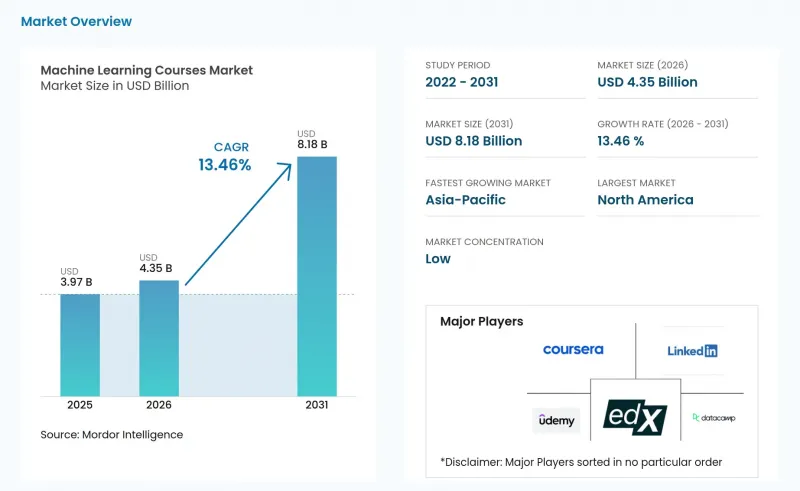
Global Machine Learning Courses Market Trends and Insights
Rising Demand for Job-Ready ML and GenAI Skills
A stronger employer focus is pushing the machine learning courses market on applied AI capability that can be used on the job without a long transition period. The World Bank reported that GenAI-specific job vacancies increased ninefold globally between 2021 and 2024, and the demand spread beyond traditional ICT roles into functions such as content, design, marketing, and health care. The same report showed that GenAI literacy carried a 25% to 36% wage premium in non-technical white-collar roles, which helps explain why more professionals outside core engineering teams are enrolling in ML and GenAI learning tracks. This shift is changing the machine learning courses market from a niche technical training space into a broader professional education category with relevance across sectors. It also favors providers that can package foundational concepts into shorter application-focused courses with visible outcomes and clearer links to employment needs.
Corporate Upskilling in AI, Data, and Automation Roles
The machine learning courses market is also gaining support from enterprise spending on internal AI capability building. Germany provides a clear example: the TUV-Verband found that 27% of enterprises had trained employees in AI in 2026, up from 12% in 2024, while 50% reported a high or very high need for AI training. The same study showed that 72% of companies identified application-oriented AI knowledge as the primary qualification target, indicating demand for courses that move beyond theory into deployment and workflow use. This pattern matters for the machine learning courses market because corporate buyers usually prefer structured programs with tracking, assessments, and clearer completion evidence than open catalogs provide. As a result, providers with enterprise-ready delivery models are better placed to capture premium demand, especially where organizations want job-role mapping, internal reporting, and auditable learning records.
High Learner Drop-Off in Self-Paced Technical Courses
The machine learning courses market still faces a major demand-side challenge due to weak completion rates in self-paced technical learning. Research published in MDPI Applied Sciences in 2025 found that empirical studies consistently reported completion rates below 10% among registered MOOC learners, with the first graded assessment serving as a key drop-off point. NSF-supported research on MOOC stopout patterns also found that heavier question loads and higher early time commitment were associated with higher stopout rates. This weakens the machine learning courses market in two ways: it reduces the potential for repeat purchases. It lowers the signaling value of certificates when employers suspect that many learners did not finish or retain the material. It is one reason why platforms are investing more in guided pathways, practice-heavy design, and learning support tools that can improve persistence without making the curriculum too easy.
Other drivers and restraints analyzed in the detailed report include:
- Employer Preference for Credentialed Micro-Certifications
- Regulatory and Enterprise AI Governance Training Requirements
- Rapid Content Obsolescence in ML Toolchains and Frameworks
For complete list of drivers and restraints, kindly check the Table Of Contents.
Segment Analysis
Beginner-level courses held 49.5% of the machine learning courses market share in 2025, while advanced-level courses are projected to expand at a 14.9% CAGR through 2031. Beginner content remains the broadest entry point in the machine learning courses market because many learners are still approaching ML from non-specialist roles and need accessible starting material before moving into model building or deployment. The World Bank reported that GenAI course enrollments on major platforms increased 12-fold between 2023 and 2025, and Coursera alone passed 8 million cumulative GenAI enrollments by April 2025, with 12 people per minute signing up during 2025. That scale strongly supports the continued weight of beginner learning in the machine learning courses market, because first-time learners still make up the largest intake pool. Intermediate courses remain strategically important because they sit between broad awareness and specialized practice, and are increasingly defined by use-case focus rather than by difficulty alone.
The revenue mix is still expected to move upward over time because advanced learning is where specialization, enterprise alignment, and higher willingness to pay come together in the machine learning courses industry. A 2025 peer-reviewed study comparing project-based learning with lecture-based instruction in ML found stronger outcomes for the project-based group in model accuracy, code quality, and problem-solving, including a statistically significant difference in model optimization. This is contributing to a redesign of intermediate and advanced course structures toward labs, capstones, and assessed application work instead of passive lecture sequences. Advanced tracks are also gaining relevance as enterprises want training in areas such as MLOps, fine-tuning, documentation, and responsible deployment. Within the machine learning courses industry, that trend should gradually raise the share of higher-value specialized courses, even though beginner learning remains the largest source of learner volume.
Complete Report Scope:
- By Courses
- Beginner-Level Courses
- Intermediate-Level Courses
- Advanced-Level Courses
- By Delivery Mode
- Self-Paced Online Learning
- Instructor-Led Live Learning
- Blended Learning
- By End User
- Individual Learners
- Corporate Learners
- By Geography
- North America
- United States
- Canada
- Mexico
- South America
- Brazil
- Peru
- Chile
- Argentina
- Rest of South America
- Europe
- United Kingdom
- Germany
- France
- Spain
- Italy
- BENELUX (Belgium, Netherlands, and Luxembourg)
- NORDICS (Denmark, Finland, Iceland, Norway, and Sweden)
- Rest of Europe
- Asia-Pacific
- India
- China
- Japan
- Australia
- South Korea
- South East Asia (Singapore, Malaysia, Thailand, Indonesia, Vietnam, and Philippines)
- Rest of Asia-Pacific
- Middle East And Africa
- United Arab Emirates
- Saudi Arabia
- South Africa
- Nigeria
- Rest of Middle East And Africa
- North America
Geography Analysis
North America held 37.4% of the machine learning courses market share in 2025, and the region is projected to grow at a 15% CAGR through 2031. The United States remains the main anchor for the machine learning courses market because it combines deep technology hiring demand with a mature corporate learning ecosystem and large-scale adoption of online platforms. The World Bank reported that the United States accounted for nearly 30% of global GenAI job vacancies in 2024, with around 84,000 postings compared with roughly 3,000 in 2021. Canada also strengthened the regional demand base, with AI vacancies nearly doubling between 2021 and 2024, according to the same source. South America is projected to grow at a 16.2% CAGR through 2031, and Brazil stands out because GenAI job vacancies increased 82-fold between 2021 and 2024, underscoring the region's need for scalable training options.
Europe is projected to grow at a 14.8% CAGR through 2031, with demand supported by both labor-market changes and formal regulatory pressure. Germany is the clearest enterprise upskilling case in the region, because the TUV-Verband found that the share of companies training employees in AI rose from 12% in 2024 to 27% in 2026, while 50% reported a high or very high need for AI training. The EU AI Act adds another layer of urgency because AI literacy obligations have already entered into force, and broader requirements begin applying from August 2026, making it harder for firms using AI systems to postpone documented training. Regional demand is not limited to Germany, as the World Bank recorded around 12,000 GenAI vacancies in the United Kingdom and 53,000 in France in 2024.
Asia-Pacific is the fastest-growing region in the machine learning courses market, with a 15.7% CAGR projected through 2031. India remains a core demand engine, and the World Bank reported that the country sustained roughly 230,000 annual AI-skills job vacancies across 2021 to 2024, which supports continued training demand at scale. Public policy support is also important in the region, and Singapore's SkillsFuture program remains a useful reference point because it directly funds adult upskilling through an official national framework. Japan also adds depth to the regional opportunity, with AI vacancies nearly doubling between 2021 and 2024, while the University of Tokyo launched an industry-facing deep learning course in 2026 that covers topics such as transformers, large language models, and deep reinforcement learning. The Middle East and Africa add another high-growth layer to the machine learning courses market, with Africa projected at 18.3% CAGR and Western Asia at 17.1% CAGR through 2031, while the World Bank also noted that Kenya recorded a fourfold increase in AI vacancies and that Egypt and Pakistan doubled their AI job postings between 2021 and 2024.
- Coursera Inc.
- Udemy, Inc.
- LinkedIn Corporation
- DataCamp, Inc.
- edX LLC
- Udacity, Inc.
- Simplilearn Solutions Pvt. Ltd.
- DeepLearning.AI
- IBM Corporation
- Google LLC
- Great Learning Education Services Pvt. Ltd.
- Pluralsight LLC
- Skillsoft Corporation
- Codecademy, Inc.
- Kaggle, Inc.
- Harvard University
- Massachusetts Institute of Technology
- Stanford University
- University of London
- University of Toronto
Additional Benefits:
- The market estimate (ME) sheet in Excel format
- 3 months of analyst support
TABLE OF CONTENTS
1 Introduction
- 1.1 Study Assumptions & Market Definition
- 1.2 Scope of the Study
2 Research Methodology
3 Executive Summary
4 Market Landscape
- 4.1 Market Overview
- 4.2 Market Drivers
- 4.2.1 Rising Demand for Job-Ready ML and GenAI Skills
- 4.2.2 Corporate Upskilling in AI, Data, and Automation Roles
- 4.2.3 Employer Preference for Credentialed Micro-Certifications
- 4.2.4 AI-Personalized Learning Improves Completion and Conversion
- 4.2.5 Shift Toward Project-Based and Hands-On Learning Formats
- 4.2.6 Regulatory and Enterprise AI Governance Training Requirements
- 4.3 Market Restraints
- 4.3.1 Rapid Content Obsolescence in ML Toolchains and Frameworks
- 4.3.2 High Learner Drop-Off in Self-Paced Technical Courses
- 4.3.3 Premium Pricing Pressure for Instructor-Led and Mentored Tracks
- 4.3.4 Credibility Gaps Across Unaccredited Providers and Short Courses
- 4.4 Value and Supply-Chain Analysis
- 4.5 Regulatory Landscape
- 4.6 Technological Outlook
- 4.7 Porter's Five Forces Analysis
- 4.7.1 Bargaining Power of Buyers
- 4.7.2 Bargaining Power of Suppliers
- 4.7.3 Threat of New Entrants
- 4.7.4 Threat of Substitutes
- 4.7.5 Industry Rivalry
5 Market Size & Growth Forecasts (Value)
- 5.1 By Courses
- 5.1.1 Beginner-Level Courses
- 5.1.2 Intermediate-Level Courses
- 5.1.3 Advanced-Level Courses
- 5.2 By Delivery Mode
- 5.2.1 Self-Paced Online Learning
- 5.2.2 Instructor-Led Live Learning
- 5.2.3 Blended Learning
- 5.3 By End User
- 5.3.1 Individual Learners
- 5.3.2 Corporate Learners
- 5.4 By Geography
- 5.4.1 North America
- 5.4.1.1 United States
- 5.4.1.2 Canada
- 5.4.1.3 Mexico
- 5.4.2 South America
- 5.4.2.1 Brazil
- 5.4.2.2 Peru
- 5.4.2.3 Chile
- 5.4.2.4 Argentina
- 5.4.2.5 Rest of South America
- 5.4.3 Europe
- 5.4.3.1 United Kingdom
- 5.4.3.2 Germany
- 5.4.3.3 France
- 5.4.3.4 Spain
- 5.4.3.5 Italy
- 5.4.3.6 BENELUX (Belgium, Netherlands, and Luxembourg)
- 5.4.3.7 NORDICS (Denmark, Finland, Iceland, Norway, and Sweden)
- 5.4.3.8 Rest of Europe
- 5.4.4 Asia-Pacific
- 5.4.4.1 India
- 5.4.4.2 China
- 5.4.4.3 Japan
- 5.4.4.4 Australia
- 5.4.4.5 South Korea
- 5.4.4.6 South East Asia (Singapore, Malaysia, Thailand, Indonesia, Vietnam, and Philippines)
- 5.4.4.7 Rest of Asia-Pacific
- 5.4.5 Middle East And Africa
- 5.4.5.1 United Arab Emirates
- 5.4.5.2 Saudi Arabia
- 5.4.5.3 South Africa
- 5.4.5.4 Nigeria
- 5.4.5.5 Rest of Middle East And Africa
- 5.4.1 North America
6 Competitive Landscape
- 6.1 Market Concentration
- 6.2 Strategic Moves
- 6.3 Market Share Analysis
- 6.4 Company Profiles (includes Global Level Overview, Market Level Overview, Core Segments, Financials as available, Strategic Information, Market Rank/Share, Products and Services, Recent Developments)
- 6.4.1 Coursera Inc.
- 6.4.2 Udemy, Inc.
- 6.4.3 LinkedIn Corporation
- 6.4.4 DataCamp, Inc.
- 6.4.5 edX LLC
- 6.4.6 Udacity, Inc.
- 6.4.7 Simplilearn Solutions Pvt. Ltd.
- 6.4.8 DeepLearning.AI
- 6.4.9 IBM Corporation
- 6.4.10 Google LLC
- 6.4.11 Great Learning Education Services Pvt. Ltd.
- 6.4.12 Pluralsight LLC
- 6.4.13 Skillsoft Corporation
- 6.4.14 Codecademy, Inc.
- 6.4.15 Kaggle, Inc.
- 6.4.16 Harvard University
- 6.4.17 Massachusetts Institute of Technology
- 6.4.18 Stanford University
- 6.4.19 University of London
- 6.4.20 University of Toronto
7 Market Opportunities & Future Outlook
- 7.1 Adaptive GenAI Lab-Based Credential Programs
- 7.2 Enterprise-Embedded ML Learning for Regulated Industries

