PUBLISHER: Mordor Intelligence | PRODUCT CODE: 2184753

PUBLISHER: Mordor Intelligence | PRODUCT CODE: 2184753
GCC Staycation - Market Share Analysis, Industry Trends & Statistics, Growth Forecasts (2026 - 2031)
According to Mordor Intelligence, the GCC staycation market was valued at USD 23.15 billion in 2025 and estimated to grow from USD 23.38 billion in 2026 to reach USD 29.89 billion by 2031, at a CAGR of 5.04% during the forecast period (2026-2031).
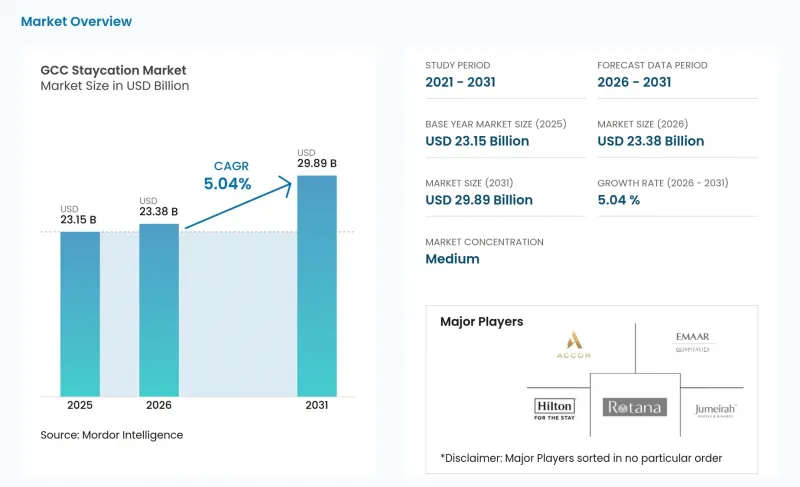
GCC Staycation Market Trends and Insights
Rising Intra-GCC Domestic Travel
Intra-GCC travel accounted for a significant portion of the bloc's total international tourist flows in 2024, with strong growth observed over the preceding years. This trend reflects the increasing reliance on internal travel within the GCC, reducing dependence on long-haul arrivals that are more susceptible to external factors such as currency fluctuations, political instability, and travel restrictions. The shift has enabled hotel operators in both major cities and smaller destinations to retain regional leisure spending that previously went to other regions. Domestic tourism spending in Saudi Arabia saw notable growth in 2025, supported by initiatives aimed at enhancing local travel options. The Saudi Tourism Authority's campaign introduced additional domestic flight seats and new tourism experiences, further strengthening the GCC staycation market and providing travelers with expanded choices within the region.
Visa Liberalization and Cross-Border Mobility
Visa policies are directly supporting the GCC staycation market by enabling easier movement, which increases the number of residents interested in short regional trips. Kuwait's Ministry of Interior introduced a directive allowing GCC-resident expatriates to obtain a 90-day tourist visa on arrival at all entry points, significantly expanding the traveler base. The GCC Grand Tours Visa is expected to simplify multi-country travel planning, as its legal and technical framework is nearly aligned across participating authorities. These changes also enhance hotel bookings, as travelers often require confirmed accommodations for trip planning and documentation. Operators with efficient digital inventory systems and seamless confirmation processes are well-positioned to convert increased mobility into bookings within the GCC staycation market.
Seasonality and Weather-Driven Demand Concentration
Seasonality significantly impacts the GCC staycation market, concentrating demand into specific months. Dragonpass data indicates most GCC travel occurs between June and November, with March being the only month where all six GCC markets experienced a simultaneous slowdown. This demand concentration boosts peak-season revenues but complicates monetization during off-peak periods and increases pricing volatility. Hotels have introduced summer packages, bundling offerings such as food and beverage credits, spa access, and waterpark entry to sustain booking values during less favorable outdoor conditions. However, extreme summer heat continues to limit demand for desert camps, adventure retreats, and coastal villas for several months each year, despite these efforts.
Other drivers and restraints analyzed in the detailed report include:
- Shift Toward Curated, Culture-Led Short Breaks
- Growth of Wellness, Luxury, and Family-Centric Packages
- Limited Novelty in Repeated Weekend Destinations
For complete list of drivers and restraints, kindly check the Table Of Contents.
Segment Analysis
Hotels and Resorts accounted for 48.93% of the GCC staycation market share in 2025, driven by branded distribution, loyalty programs, and family-friendly offers during Eid and national holidays. These establishments dominate the market as residents prefer leisure packages with dining, children's amenities, and consistent service. Major hotel brands benefit from visibility through direct channels and OTAs, making them easier to book compared to independent options. Their presence is strong in cities like Dubai, Abu Dhabi, and Riyadh, where branded hospitality sets the standard for domestic leisure. Many households prioritize familiar hotel formats over alternative accommodations for short breaks.
Desert Camps and Boutique Retreats are forecast to grow at a 5.65% CAGR from 2026 to 2031, making them the fastest-growing accommodation type in the GCC staycation market. Their appeal lies in offering immersion, privacy, and unique destination experiences. Sharjah's retreat portfolio, including Nomad, Moon Retreat, Kingfisher Retreat, and Al Badayer Retreat, showcases how natural and heritage landscapes are being developed into short-break destinations. The expansion of glamping and experiential lodging, such as Our Habitas' planned 50-unit Airstream site in Hatta by December 2026, reflects this trend, though these formats remain smaller in scale compared to urban hotels.
Serviced Apartments and Aparthotels meet the needs of families and extended leisure travelers by offering flexibility and longer stays. Saudi Arabia's domestic tourists averaged 18.6 nights in 2025, indicating demand beyond weekend trips. Apartment-style accommodations cater to travelers seeking space, kitchen access, and cost control. Vacation Rentals and Short-Term Stays are also expanding, with Saudi Arabia's 1,250% rise in rural lodge and private home licenses between 2024 and 2025, diversifying value-driven options in the GCC staycation market.
Families accounted for 38.51% of the GCC staycation market in 2025, reflecting household structures, young demographics, and the significance of school breaks, Eid periods, and multi-generational travel. Hotels in the region have adapted by offering waterparks, interconnecting rooms, suites, kids' clubs, and activity-focused weekend packages. In the UAE, there was a more than 40% year-on-year increase in demand for interconnecting rooms and suites during the 2025 summer, with domestic leisure travel rising to 35% of total occupancy from 28% the previous year. Family travel drives volume and influences room design, package offerings, and amenities. Its predictable nature during holiday periods provides operators with a stable domestic base compared to discretionary demand.
Couples are projected to grow at a 5.97% CAGR from 2026 to 2031, becoming the fastest-growing segment in the GCC staycation market. This growth is supported by wellness retreats, private villas, and curated romantic getaways in destinations such as AlUla, the Red Sea, Musandam, and desert resorts. Two-person travel aligns with short breaks, as couples can manage higher room rates when focused on privacy or wellness. Properties like Zulal and Six Senses Southern Dunes highlight the shift toward experience-specific stays.
Solo travelers and groups hold smaller shares of the market but show distinct patterns. Solo travel is increasing in Saudi Arabia due to evolving norms, rising incomes, and growing acceptance of independent leisure. Group travel remains relevant for corporate off-sites, incentive trips, and wellness-led events, often combining accommodation with meeting facilities, dining, and activities. These segments diversify demand and reduce reliance on a single resident profile.
Complete Report Scope:
- By Accommodation Type
- Hotels and Resorts
- Serviced Apartments and Aparthotels
- Vacation Rentals and Short-Term Stays
- Desert Camps and Boutique Retreats
- By Traveler Type
- Families
- Couples
- Solo Travelers
- Groups
- By Booking Channel
- Online Travel Agencies
- Direct Digital Booking
- Traditional Travel Agencies
- Corporate and MICE Booking Channels
- By Purpose and Theme
- Leisure and Weekend Getaways
- Wellness and Spa Retreats
- Cultural and Heritage Experiences
- Adventure and Nature Escapes
- Workcations
- By Geography
- Saudi Arabia
- United Arab Emirates
- Qatar
- Oman
- Kuwait
- Bahrain
List of Companies Covered in this Report:
- Jumeirah Group
- Rotana Hotel Management Corporation PJSC
- Emaar Hospitality Group
- Accor S.A.
- Hilton Worldwide Holdings Inc.
- Marriott International, Inc.
- IHG Hotels and Resorts
- Hyatt Hotels Corporation
- Minor International Public Company Limited
- Kerzner International Holdings Limited
- Atlantis Resorts
- The Ritz-Carlton Hotel Company, L.L.C.
- One and Only Resorts
- DAMAC Hotels and Resorts
- Movenpick Hotels and Resorts
- Al Bustan Palace, a Ritz-Carlton Hotel
- Katara Hospitality
- Dusit International
- Millennium Hotels and Resorts
- Radisson Hotel Group
- Address Hotels + Resorts
- Anantara Hotels, Resorts and Spas
Additional Benefits:
- The market estimate (ME) sheet in Excel format
- 3 months of analyst support
TABLE OF CONTENTS
1 Introduction
- 1.1 Study Assumptions & Market Definition
- 1.2 Scope of the Study
2 Research Methodology
3 Executive Summary
4 Market Landscape
- 4.1 Market Overview
- 4.2 Market Drivers
- 4.2.1 Rising Intra-GCC Domestic Travel
- 4.2.2 Visa Liberalization and Cross-Border Mobility
- 4.2.3 Shift Toward Curated, Culture-Led Short Breaks
- 4.2.4 Growth of Wellness, Luxury, and Family-Centric Packages
- 4.2.5 Expansion of Digital Discovery and Direct Booking Behavior
- 4.2.6 Public and Private Tourism Investment in Secondary Destinations
- 4.3 Market Restraints
- 4.3.1 Seasonality and Weather-Driven Demand Concentration
- 4.3.2 Limited Novelty in Repeated Weekend Destinations
- 4.3.3 Hotel Rate Inflation in Peak Leisure Windows
- 4.3.4 Connectivity and Border Friction Across GCC Routes
- 4.4 Value / Supply-Chain Analysis
- 4.5 Regulatory Landscape
- 4.6 Technological Outlook
- 4.7 Porter's Five Forces Analysis
- 4.7.1 Bargaining Power of Suppliers
- 4.7.2 Bargaining Power of Buyers
- 4.7.3 Threat of New Entrants
- 4.7.4 Threat of Substitutes
- 4.7.5 Industry Rivalry
5 Market Size & Growth Forecasts (Value)
- 5.1 By Accommodation Type
- 5.1.1 Hotels and Resorts
- 5.1.2 Serviced Apartments and Aparthotels
- 5.1.3 Vacation Rentals and Short-Term Stays
- 5.1.4 Desert Camps and Boutique Retreats
- 5.2 By Traveler Type
- 5.2.1 Families
- 5.2.2 Couples
- 5.2.3 Solo Travelers
- 5.2.4 Groups
- 5.3 By Booking Channel
- 5.3.1 Online Travel Agencies
- 5.3.2 Direct Digital Booking
- 5.3.3 Traditional Travel Agencies
- 5.3.4 Corporate and MICE Booking Channels
- 5.4 By Purpose and Theme
- 5.4.1 Leisure and Weekend Getaways
- 5.4.2 Wellness and Spa Retreats
- 5.4.3 Cultural and Heritage Experiences
- 5.4.4 Adventure and Nature Escapes
- 5.4.5 Workcations
- 5.5 By Geography
- 5.5.1 Saudi Arabia
- 5.5.2 United Arab Emirates
- 5.5.3 Qatar
- 5.5.4 Oman
- 5.5.5 Kuwait
- 5.5.6 Bahrain
6 Competitive Landscape
- 6.1 Market Concentration
- 6.2 Strategic Moves
- 6.3 Market Share Analysis
- 6.4 Company Profiles (includes Overview, Market Level Overview, Core Segments, Financials as available, Strategic Information, Market Rank/Share, Products and Services, Recent Developments)
- 6.4.1 Jumeirah Group
- 6.4.2 Rotana Hotel Management Corporation PJSC
- 6.4.3 Emaar Hospitality Group
- 6.4.4 Accor S.A.
- 6.4.5 Hilton Worldwide Holdings Inc.
- 6.4.6 Marriott International, Inc.
- 6.4.7 IHG Hotels and Resorts
- 6.4.8 Hyatt Hotels Corporation
- 6.4.9 Minor International Public Company Limited
- 6.4.10 Kerzner International Holdings Limited
- 6.4.11 Atlantis Resorts
- 6.4.12 The Ritz-Carlton Hotel Company, L.L.C.
- 6.4.13 One and Only Resorts
- 6.4.14 DAMAC Hotels and Resorts
- 6.4.15 Movenpick Hotels and Resorts
- 6.4.16 Al Bustan Palace, a Ritz-Carlton Hotel
- 6.4.17 Katara Hospitality
- 6.4.18 Dusit International
- 6.4.19 Millennium Hotels and Resorts
- 6.4.20 Radisson Hotel Group
- 6.4.21 Address Hotels + Resorts
- 6.4.22 Anantara Hotels, Resorts and Spas
7 Market Opportunities & Future Outlook
- 7.1 Market Opportunities
- 7.1.1 Expansion of Wellness, Experiential, and Premium Short-Break Travel Products
- 7.1.2 Growth of Cross-Border GCC Getaway Packages and Digital Travel Ecosystems
- 7.2 White-Space and Unmet-Need Assessment

