PUBLISHER: Mordor Intelligence | PRODUCT CODE: 2184957

PUBLISHER: Mordor Intelligence | PRODUCT CODE: 2184957
Residential Artificial Flower Retail - Market Share Analysis, Industry Trends & Statistics, Growth Forecasts (2026 - 2031)
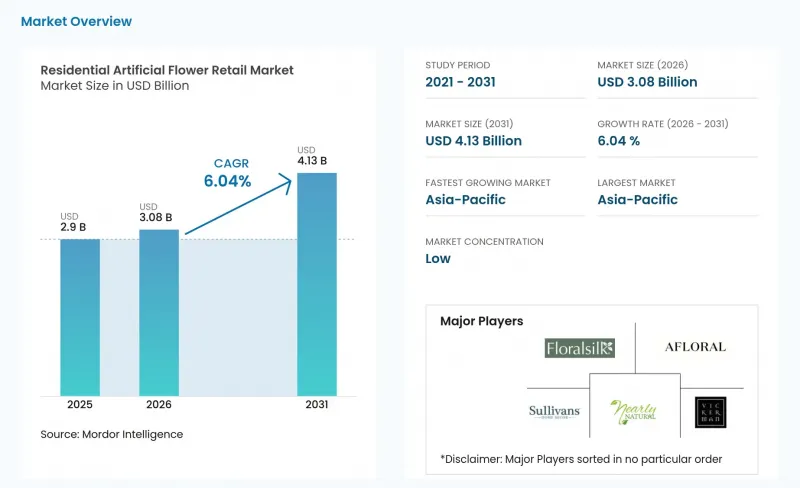
According to Mordor Intelligence, the global residential artificial flower retail market was valued at USD 2.90 billion in 2025 and estimated to grow from USD 3.08 billion in 2026 to reach USD 4.13 billion by 2031, at a CAGR of 6.04% during the forecast period (2026-2031).
Global Residential Artificial Flower Retail Market Trends and Insights
Shift Toward Low-Maintenance and Long-Lasting Home Decor Solutions
The global residential artificial flower retail market is growing due to a lasting consumer preference for low-maintenance decor items. Households are increasingly selecting furnishings and decorations that remain functional during moves and room redesigns, a trend reinforced by smaller living spaces. A decline in the average home size in the United States underscores the rising demand for compact, practical decorative solutions. Consumers now prioritize durability as a key factor in purchasing decisions, shifting away from viewing it as a secondary feature. This has led to a clear distinction between low-cost disposable products and higher-quality options designed for extended use and outdoor suitability. Companies focusing on product lifespan, material safety, and quality assurance are effectively meeting this demand, driving increased residential sales.
Rising Premiumization of Interior Styling and Aesthetic Gifting
The global residential artificial flower retail market is growing as consumers increasingly incorporate artificial botanicals into coordinated interior designs rather than using them as simple decor. Arrangements with aesthetic appeal and low maintenance are becoming popular for gifting. Williams-Sonoma introduced Pottery Barn's first United Kingdom digital storefront in September 2025, featuring artificial botanicals alongside furniture and home decor. This development highlights the growing demand for design-focused retail outside North America. Such presentations help establish higher price points for realistic floral decor and promote faux floral arrangements as occasion gifts. Formats combining flowers with ceramic pots, woven containers, or styled vessels are particularly appealing. This trend is narrowing the gap between artificial decorative products and fresh floral gifting.
Perceived Lack of Natural Aesthetic Compared to Fresh Flowers
The appeal of fresh flowers continues to challenge the global residential artificial flower retail market, particularly in regions where live botanicals hold cultural significance in gifting and home decor. Even high-quality artificial flowers face skepticism as consumers often prioritizes fragrance, natural variations, and tactile authenticity. This challenge is more pronounced in segments where buyers seek products with an organic feel, such as preserved or dried flowers. Manufacturers have made advancements using real-touch latex, improved polyester surfaces, and detailed petal designs to narrow the visual gap. However, the mass market still struggles to replicate the sensory experience of fresh flowers, making it difficult to convert consumers who value authenticity over convenience. Brands that integrate realistic materials with tailored designs are better positioned to address this challenge, though the restraint is expected to persist throughout the forecast period.
Other drivers and restraints analyzed in the detailed report include:
- Growth of Seasonal, Event-Based, and DIY Personalization Trends
- Expansion of E-Commerce and Social Commerce Platforms
- Price Sensitivity in Mass-Market Home Decor Segments
For complete list of drivers and restraints, kindly check the Table Of Contents.
Segment Analysis
Bouquets and Arrangements accounted for 35% of the Global residential artificial flower retail market in 2025, making them the largest product category for residential purchases. Their popularity stems from their ready-to-display convenience, which allows them to be placed on dining tables, shelves, or as gifts without assembly. This convenience supports both personal and occasion-driven spending. Their broad aesthetic compatibility ensures they suit modern, traditional, and seasonal decor with minimal effort. Single Stems appealed to DIY buyers, Garlands and Wreaths saw seasonal demand, and Potted Artificial Flowers remained popular for apartment-friendly decor.
Wall and Hanging Floral Decor is expected to grow at an 8.50% CAGR through 2031, making it the fastest-growing segment in the Global residential artificial flower retail market. Shrinking home sizes are driving a shift in decorative focus from floor spaces to walls, balconies, and suspended features. The median United States home size decreased to 2,150 sq ft in 2024, highlighting the need for space-efficient decor. Nearly Natural's Spring 2026 collection introduced UV-resistant hanging hydrangea and hibiscus formats for indoor and outdoor use, reflecting this trend. As urban households prioritize visual impact while conserving floor space, vertical floral decor is set to remain a preferred choice in the market.
Complete Report Scope:
- By Product Type
- Single Stems
- Bouquets and Arrangements
- Garlands and Wreaths
- Potted Artificial Flowers
- Wall and Hanging Floral Decor
- By Material
- Silk
- Plastic
- Latex
- Fabric Blends
- Foam and Mixed Materials
- By Distribution Channel
- Specialty Stores and Home Decor Stores
- Supermarkets and Hypermarkets
- E-commerce
- Direct-to-Consumer Brands
- By Geography
- North America
- United States
- Canada
- Mexico
- South America
- Brazil
- Peru
- Chile
- Argentina
- Rest of South America
- Europe
- United Kingdom
- Germany
- France
- Spain
- Italy
- BENELUX (Belgium, Netherlands, and Luxembourg)
- NORDICS (Denmark, Finland, Iceland, Norway, and Sweden)
- Rest of Europe
- Asia-Pacific
- India
- China
- Japan
- Australia
- South Korea
- South East Asia (Singapore, Malaysia, Thailand, Indonesia, Vietnam, and Philippines)
- Rest of Asia-Pacific
- Middle East and Africa
- United Arab Emirates
- Saudi Arabia
- South Africa
- Nigeria
- Rest of Middle East and Africa
- North America
Geography Analysis
Asia-Pacific accounted for 30% of the global residential artificial flower retail market share in 2025 and is expected to grow at a regional CAGR of 8.00% through 2031. The region benefits from large-scale manufacturing and rising residential demand in China, India, and Southeast Asia. China plays a key role in supply and category development, with China's national artificial vegetation exports reaching USD 4.19 billion, anchored heavily by manufacturing hubs like Yiwu. India's urban household growth and the rise of compact homes drive demand for low-maintenance decorative products. The United Nations projects India's urban population to grow from 483 million in 2020 to 675 million by 2035, supporting long-term demand.
Southeast Asia contributes through increased middle-class spending and the adoption of personalized interior decor by urban households. Vietnam, Indonesia, and Thailand see rising demand for decorative accessories. Oceania, though smaller, is projected to grow at 5.60% through 2031, supported by design-focused demand in Australia. North America is expected to grow at 5.80% through 2031, with the United States dominating due to strong retail infrastructure and seasonal decorating trends. The reduction in median United States home size to 2,150 sq ft in 2024 supports demand for compact floral formats.
Europe is projected to grow at 5.20% through 2031, driven by demand for high-quality materials and designer assortments in the United Kingdom, Germany, and France. Russia's growth remains slower at 4.10% CAGR due to challenging import conditions. South America is expected to grow at 6.40% through 2031, led by urban middle-class spending in Brazil. The Middle East and Africa show growth rates of 6.70% and 7.10%, respectively, driven by urbanization, climate-related constraints on plant growth, and fragmented retail structures. The market offers opportunities for companies with localized strategies and efficient digital distribution.
- FLORALSILK
- Nearly Natural
- Afloral
- Winward Home
- Sullivans Home Decor
- Sagebrook Home
- Vickerman Company
- Bloomingville
- Kaemingk
- Michael's Stores, Inc.
- Hobby Lobby Stores, Inc.
- IKEA Systems B.V.
- Crate and Barrel
- At Home Group Inc.
- Target Corporation
- Walmart Inc.
- Williams-Sonoma, Inc.
- Aldik Home
- Jamali Garden
- Enesco
Additional Benefits:
- The market estimate (ME) sheet in Excel format
- 3 months of analyst support
TABLE OF CONTENTS
1 Introduction
- 1.1 Study Assumptions and Market Definition
- 1.2 Scope of the Study
2 Research Methodology
3 Executive Summary
4 Market Landscape
- 4.1 Market Overview
- 4.2 Market Drivers
- 4.2.1 Shift Toward Low-Maintenance and Long-Lasting Home Decor Solutions
- 4.2.2 Rising Premiumization of Interior Styling and Aesthetic Gifting
- 4.2.3 Growth of Seasonal, Event-Based, and DIY Personalization Trends
- 4.2.4 Expansion of E-Commerce and Social Commerce Platforms
- 4.2.5 Increasing Adoption of Sustainable and Reusable Decorative Products
- 4.2.6 Rising Urbanization and Compact Living Spaces Driving Artificial Decor Demand
- 4.3 Market Restraints
- 4.3.1 Perceived Lack of Natural Aesthetic Compared to Fresh Flowers
- 4.3.2 Price Sensitivity in Mass-Market Home Decor Segments
- 4.3.3 Quality Variation and Durability Concerns in Low-Cost Imports
- 4.3.4 Storage, Dust Accumulation, and Maintenance Challenges
- 4.4 Value/Supply-Chain Analysis
- 4.5 Regulatory Landscape
- 4.6 Technological Outlook
- 4.7 Porter's Five Forces Analysis
- 4.7.1 Threat of New Entrants
- 4.7.2 Bargaining Power of Buyers
- 4.7.3 Bargaining Power of Suppliers
- 4.7.4 Threat of Substitutes
- 4.7.5 Industry Rivalry
5 Market Size & Growth Forecasts (Value)
- 5.1 By Product Type
- 5.1.1 Single Stems
- 5.1.2 Bouquets and Arrangements
- 5.1.3 Garlands and Wreaths
- 5.1.4 Potted Artificial Flowers
- 5.1.5 Wall and Hanging Floral Decor
- 5.2 By Material
- 5.2.1 Silk
- 5.2.2 Plastic
- 5.2.3 Latex
- 5.2.4 Fabric Blends
- 5.2.5 Foam and Mixed Materials
- 5.3 By Distribution Channel
- 5.3.1 Specialty Stores and Home Decor Stores
- 5.3.2 Supermarkets and Hypermarkets
- 5.3.3 E-commerce
- 5.3.4 Direct-to-Consumer Brands
- 5.4 By Geography
- 5.4.1 North America
- 5.4.1.1 United States
- 5.4.1.2 Canada
- 5.4.1.3 Mexico
- 5.4.2 South America
- 5.4.2.1 Brazil
- 5.4.2.2 Peru
- 5.4.2.3 Chile
- 5.4.2.4 Argentina
- 5.4.2.5 Rest of South America
- 5.4.3 Europe
- 5.4.3.1 United Kingdom
- 5.4.3.2 Germany
- 5.4.3.3 France
- 5.4.3.4 Spain
- 5.4.3.5 Italy
- 5.4.3.6 BENELUX (Belgium, Netherlands, and Luxembourg)
- 5.4.3.7 NORDICS (Denmark, Finland, Iceland, Norway, and Sweden)
- 5.4.3.8 Rest of Europe
- 5.4.4 Asia-Pacific
- 5.4.4.1 India
- 5.4.4.2 China
- 5.4.4.3 Japan
- 5.4.4.4 Australia
- 5.4.4.5 South Korea
- 5.4.4.6 South East Asia (Singapore, Malaysia, Thailand, Indonesia, Vietnam, and Philippines)
- 5.4.4.7 Rest of Asia-Pacific
- 5.4.5 Middle East and Africa
- 5.4.5.1 United Arab Emirates
- 5.4.5.2 Saudi Arabia
- 5.4.5.3 South Africa
- 5.4.5.4 Nigeria
- 5.4.5.5 Rest of Middle East and Africa
- 5.4.1 North America
6 Competitive Landscape
- 6.1 Market Concentration
- 6.2 Strategic Moves
- 6.3 Market Share Analysis
- 6.4 Company Profiles (includes Global Level Overview, Market Level Overview, Core Segments, Financials as available, Strategic Information, Market Rank/Share, Products and Services, Recent Developments)
- 6.4.1 FLORALSILK
- 6.4.2 Nearly Natural
- 6.4.3 Afloral
- 6.4.4 Winward Home
- 6.4.5 Sullivans Home Decor
- 6.4.6 Sagebrook Home
- 6.4.7 Vickerman Company
- 6.4.8 Bloomingville
- 6.4.9 Kaemingk
- 6.4.10 Michael's Stores, Inc.
- 6.4.11 Hobby Lobby Stores, Inc.
- 6.4.12 IKEA Systems B.V.
- 6.4.13 Crate and Barrel
- 6.4.14 At Home Group Inc.
- 6.4.15 Target Corporation
- 6.4.16 Walmart Inc.
- 6.4.17 Williams-Sonoma, Inc.
- 6.4.18 Aldik Home
- 6.4.19 Jamali Garden
- 6.4.20 Enesco
7 Market Opportunities & Future Outlook
- 7.1 White-Space and Unmet-Need Assessment
- 7.2 Opportunity 1, Hyper-Realistic Premium Floral Decor for Small Urban Homes
- 7.3 Opportunity 2, Subscription-Based Seasonal Home Styling Bundles

