PUBLISHER: Mordor Intelligence | PRODUCT CODE: 2185023

PUBLISHER: Mordor Intelligence | PRODUCT CODE: 2185023
Neuromorphic Vision Sensors For Industrial Automation - Market Share Analysis, Industry Trends & Statistics, Growth Forecasts (2026 - 2031)
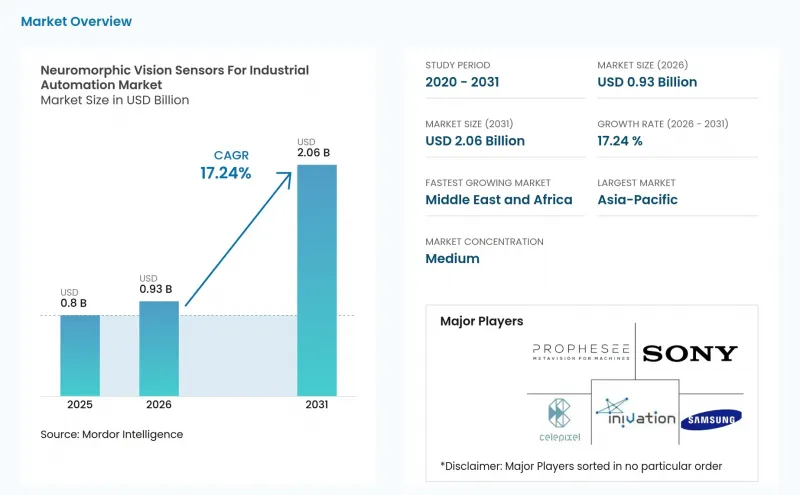
According to Mordor Intelligence, the neuromorphic vision sensors for Industrial Automation Market size is projected to expand from USD 0.80 billion in 2025 to USD 0.93 billion in 2026, and to USD 2.06 billion by 2031, registering a CAGR of 17.24% between 2026 and 2031.
Global Neuromorphic Vision Sensors For Industrial Automation Market Trends and Insights
Adoption of High-Speed Automated Inspection
High-speed inspection is increasing demand for Neuromorphic Vision Sensors in the Industrial Automation Market because many production lines run faster than frame cameras can reliably assess. At several meters per second, standard 60 fps cameras can introduce motion blur that weakens defect detection. A Khalifa University project reported a tactile roller sensor that scanned at 0.5 m/s with a mean absolute error below 100 µm, 11 times faster than comparable continuous tactile sensing. A 2025 study reported neuromorphic imaging across a 300-fold range of motion speeds and dynamic ranges above 10,000-fold. The performance suits wafer, OLED panel, and battery production inspection, where event data can flag changes without creating a complete frame at every interval. Camera suppliers are sourcing specialist sensors for industrial housings and familiar interfaces, helping integrators add capability without replacing wider factory controls.
Expansion of Vision-Guided Robotics and Autonomous Mobile Robots
Vision-guided robots and autonomous mobile robots are driving applications for Neuromorphic Vision Sensors in the Industrial Automation Market. Industrial robot installations exceeded 590,000 units in 2024, and annual installations are expected to exceed 900,000 by 2027. Electronics assembly, warehouses, and automotive plants need mobile systems that quickly identify obstacles and provide reliable proximity detection. Event-based sensing responds with sub-millisecond latency, supporting grasping and conveyor handling while objects remain in motion. The technology also works in cluttered, low-contrast settings where frame cameras may saturate or lose detail. Dynamic Vision Sensor devices produce sparse data from changes in pixels, favoring suppliers that offer validated motion detection and control software.
High Sensor and System Cost at Low Production Volumes
High component and integration costs limit wider adoption of Neuromorphic Vision Sensors in the Industrial Automation Market. Event-based sensors can cost several thousand USD per unit in low-volume procurement, which can be an order of magnitude higher than equivalent-resolution CMOS cameras. Specialized pixel arrays have not reached the production volumes needed for cost parity. Buyers, therefore, focus on high-value lines, including pharmaceutical blister packs and automotive airbag-sensor production, where missed defects carry high costs. Dedicated software and incompatible event-stream formats can further increase total system cost. A high-performing sensor can still face qualification delays when its software environment is not mature for full-line validation.
Other drivers and restraints analyzed in the detailed report include:
- Integration With Edge Artificial Intelligence and Neuromorphic Processing
- Demand for Low-Power, High-Dynamic-Range Sensing
- Limited Event-Data Engineering and Spiking-Neural-Network Skills
For complete list of drivers and restraints, kindly check the Table Of Contents.
Segment Analysis
The Dynamic Vision Sensor architecture accounted for 48.63% of revenue in 2025, reflecting its long commercial history and Sony-Prophesee IMX636 and IMX637 products. Dynamic Vision Sensor designs work well in vibration monitoring, particle counting, and fast defect flagging because these tasks depend on binary motion information. IDS Imaging Development Systems GmbH and LUCID Vision Labs Inc. have used these sensors in industrial camera lines, giving integrators a practical deployment route. Dynamic and Active Pixel Vision Sensor designs combine event data and grayscale frames where texture context is needed. The DAVIS 240C from SynSense Innovation maintained reliable operation for more than 2.5 years in low Earth orbit, according to a 2025 study.
Hybrid Event-and-Frame Sensors are projected to expand at a 22.87% CAGR through 2031 because factories increasingly use fusion algorithms. A 2024 Nature study found that a 20 fps RGB and event-sensor system could match the perceptual latency of a 5,000 fps camera while retaining 45 fps bandwidth. The combination provides time-sensitive data and richer scene context without a fully high-speed frame stream. Other event-based designs, including spiking retinal imagers and ferroelectric-pixel systems, remain i commercialization. Their patent activity points to further differentiation beyond current core architectures.
VGA-to-HD devices accounted for 54.72% of the Neuromorphic Vision Sensors for Industrial Automation Market size in 2025, making HD the practical baseline for many installations. This range balances spatial detail and event-rate throughput for vibration monitoring, motion analysis, and automotive inspection. It can operate with mid-tier edge processors without custom FPGA hardware for data reduction. HD resolution supports many production tasks while limiting system computing requirements. It is therefore suited to buyers who need established performance at a manageable processing load.
Above HD sensors are expected to expand at a 22.69% CAGR through 2031 as semiconductor inspection needs denser imaging. Wafer-edge review, bonding-wire alignment, and mask alignment need higher pixel density to identify small features at line speed. A 2025 Journal of Semiconductors article reported a 128X128 hybrid sensor with a maximum rate of 960 million events per second and a grayscale frame rate of 117,100 fps at 60.1 mW. QVGA and lower-resolution devices remain relevant for compact navigation, worker safety, and battery-powered equipment. Battery electrode coating lines also support the shift toward higher resolution, as very small coating voids are difficult to detect at speed.
Complete Report Scope:
- By Sensor Architecture
- Dynamic Vision Sensor (DVS)
- Dynamic and Active Pixel Vision Sensor (DAVIS)
- Hybrid Event-and-Frame Sensor
- Other Event-Based Architectures
- By Resolution
- QVGA and Below
- VGA to HD
- Above HD
- By Application
- High-Speed Inspection and Defect Detection
- Code Reading and OCR
- Counting, Gauging, Sorting, and Tracking
- Robotics and Machine Guidance
- Motion, Velocity, and Vibration Monitoring
- Process, Particle, and Fluid Monitoring
- Worker Safety and Privacy-Preserving Vision
- Other Applications
- By End-User Industry
- Automotive and Electric Vehicles
- Electronics and Semiconductors
- Batteries and Energy Storage
- Food, Beverage, and Packaging
- Pharmaceuticals and Medical Devices
- Metals, Machinery, and Heavy Industry
- Logistics and Warehousing
- Research, Testing, and Scientific Instrumentation
- Other End-User Industries
- By Geography
- North America
- United States
- Canada
- Mexico
- South America
- Brazil
- Argentina
- Rest of South America
- Europe
- Germany
- United Kingdom
- France
- Italy
- Spain
- Rest of Europe
- Asia-Pacific
- China
- Japan
- India
- South Korea
- Rest of Asia-Pacific
- Middle East and Africa
- Middle East
- Saudi Arabia
- United Arab Emirates
- Turkey
- Rest of the Middle East
- Africa
- South Africa
- Nigeria
- Rest of Africa
- Middle East
- North America
Geography Analysis
Asia-Pacific held 38.94% of revenue in 2025. China, South Korea, Japan, and Taiwan have large concentrations of electronics, semiconductor, and battery manufacturing. The region is both a production center and a source of sensor development. Sony Semiconductor Solutions Corporation manufactures the Sony-Prophesee IMX636 and IMX637 families in Japan for industrial camera makers. India offers pilot opportunities in printed circuit board and semiconductor-packaging inspection as electronics investment increases.
North America and Europe represent the second- and third-largest revenue pools in the Neuromorphic Vision Sensors for Industrial Automation Market. North America benefits from a growing semiconductor equipment base, including planned capacity in Arizona, particularly in Phoenix. Advanced-node production requires inspection tools that can assess fast processes with great detail. Germany is central to Europe because of its automotive original equipment manufacturers and Tier 1 supplier network. In March 2026, IDS Imaging Development Systems GmbH and Prophesee signed a Letter of Intent at Embedded World in Nuremberg to expand industrial-vision work.
France has a concentrated neuromorphic intellectual property cluster around Prophesee, while the United Kingdom and the Netherlands support logistics and port automation integration. The Middle East and Africa are projected to expand at a 22.47% CAGR through 2031. Saudi Arabia and the UAE are developing greenfield advanced-manufacturing sites that can specify event sensing from the initial design stage. South Africa and Nigeria have smaller manufacturing bases but are evaluating mining and agricultural processing, while South America is smaller, with Brazil leading activity in electronics and automotive production.
- PROPHESEE S.A.
- iniVation AG
- CelePixel Technology Co., Ltd.
- Sony Semiconductor Solutions Corporation
- Samsung Electronics Co., Ltd.
- LUCID Vision Labs Inc.
- IDS Imaging Development Systems GmbH
- IMAGO Technologies GmbH
- FRAMOS GmbH
- OpenMV, LLC
- XIMEA GmbH
- Allied Vision Technologies GmbH
- Basler AG
- Datalogic S.p.A.
- SynSense AG
- DVSense Technology Co., Ltd.
- Centeye, Inc.
- AlpsenTek Inc.
- Oculi Inc.
- Neuromorphyx, Inc.
Additional Benefits:
- The market estimate (ME) sheet in Excel format
- 3 months of analyst support
TABLE OF CONTENTS
1 INTRODUCTION
- 1.1 Study Assumptions and Market Definition
- 1.2 Scope of the Study
2 RESEARCH METHODOLOGY
3 EXECUTIVE SUMMARY
4 MARKET LANDSCAPE
- 4.1 Market Overview
- 4.2 Market Drivers
- 4.2.1 Adoption of High-Speed Automated Inspection
- 4.2.2 Expansion of Vision-Guided Robotics and Autonomous Mobile Robots
- 4.2.3 Integration With Edge Artificial Intelligence and Neuromorphic Processing
- 4.2.4 Demand for Low-Power, High-Dynamic-Range Sensing
- 4.2.5 Need for Privacy-Preserving Worker and Process Monitoring
- 4.2.6 Expansion of Semiconductor, Electronics, and Battery Manufacturing
- 4.3 Market Restraints
- 4.3.1 High Sensor and System Cost at Low Production Volumes
- 4.3.2 Limited Event-Data Engineering and Spiking-Neural-Network Skills
- 4.3.3 Immature Interoperability and Industrial Communication Standards
- 4.3.4 Lower Static-Scene and Absolute-Intensity Performance Than Frame Cameras
- 4.4 Impact of Macroeconomic Factors on the Market
- 4.5 Industry Supply-Chain Analysis
- 4.6 Technology Outlook
- 4.7 Regulatory Landscape
- 4.8 Porter's Five Forces Analysis
- 4.8.1 Threat of New Entrants
- 4.8.2 Bargaining Power of Suppliers
- 4.8.3 Bargaining Power of Buyers
- 4.8.4 Threat of Substitutes
- 4.8.5 Intensity of Competitive Rivalry
5 MARKET SIZE AND GROWTH FORECASTS (VALUE)
- 5.1 By Sensor Architecture
- 5.1.1 Dynamic Vision Sensor (DVS)
- 5.1.2 Dynamic and Active Pixel Vision Sensor (DAVIS)
- 5.1.3 Hybrid Event-and-Frame Sensor
- 5.1.4 Other Event-Based Architectures
- 5.2 By Resolution
- 5.2.1 QVGA and Below
- 5.2.2 VGA to HD
- 5.2.3 Above HD
- 5.3 By Application
- 5.3.1 High-Speed Inspection and Defect Detection
- 5.3.2 Code Reading and OCR
- 5.3.3 Counting, Gauging, Sorting, and Tracking
- 5.3.4 Robotics and Machine Guidance
- 5.3.5 Motion, Velocity, and Vibration Monitoring
- 5.3.6 Process, Particle, and Fluid Monitoring
- 5.3.7 Worker Safety and Privacy-Preserving Vision
- 5.3.8 Other Applications
- 5.4 By End-User Industry
- 5.4.1 Automotive and Electric Vehicles
- 5.4.2 Electronics and Semiconductors
- 5.4.3 Batteries and Energy Storage
- 5.4.4 Food, Beverage, and Packaging
- 5.4.5 Pharmaceuticals and Medical Devices
- 5.4.6 Metals, Machinery, and Heavy Industry
- 5.4.7 Logistics and Warehousing
- 5.4.8 Research, Testing, and Scientific Instrumentation
- 5.4.9 Other End-User Industries
- 5.5 By Geography
- 5.5.1 North America
- 5.5.1.1 United States
- 5.5.1.2 Canada
- 5.5.1.3 Mexico
- 5.5.2 South America
- 5.5.2.1 Brazil
- 5.5.2.2 Argentina
- 5.5.2.3 Rest of South America
- 5.5.3 Europe
- 5.5.3.1 Germany
- 5.5.3.2 United Kingdom
- 5.5.3.3 France
- 5.5.3.4 Italy
- 5.5.3.5 Spain
- 5.5.3.6 Rest of Europe
- 5.5.4 Asia-Pacific
- 5.5.4.1 China
- 5.5.4.2 Japan
- 5.5.4.3 India
- 5.5.4.4 South Korea
- 5.5.4.5 Rest of Asia-Pacific
- 5.5.5 Middle East and Africa
- 5.5.5.1 Middle East
- 5.5.5.1.1 Saudi Arabia
- 5.5.5.1.2 United Arab Emirates
- 5.5.5.1.3 Turkey
- 5.5.5.1.4 Rest of the Middle East
- 5.5.5.2 Africa
- 5.5.5.2.1 South Africa
- 5.5.5.2.2 Nigeria
- 5.5.5.2.3 Rest of Africa
- 5.5.5.1 Middle East
- 5.5.1 North America
6 COMPETITIVE LANDSCAPE
- 6.1 Market Concentration
- 6.2 Strategic Moves
- 6.3 Market Share Analysis
- 6.4 Company Profiles (includes Global Level Overview, Market Level Overview, Core Segments, Financials as available, Strategic Information, Market RankandShare, Products and Services, Recent Developments)
- 6.4.1 PROPHESEE S.A.
- 6.4.2 iniVation AG
- 6.4.3 CelePixel Technology Co., Ltd.
- 6.4.4 Sony Semiconductor Solutions Corporation
- 6.4.5 Samsung Electronics Co., Ltd.
- 6.4.6 LUCID Vision Labs Inc.
- 6.4.7 IDS Imaging Development Systems GmbH
- 6.4.8 IMAGO Technologies GmbH
- 6.4.9 FRAMOS GmbH
- 6.4.10 OpenMV, LLC
- 6.4.11 XIMEA GmbH
- 6.4.12 Allied Vision Technologies GmbH
- 6.4.13 Basler AG
- 6.4.14 Datalogic S.p.A.
- 6.4.15 SynSense AG
- 6.4.16 DVSense Technology Co., Ltd.
- 6.4.17 Centeye, Inc.
- 6.4.18 AlpsenTek Inc.
- 6.4.19 Oculi Inc.
- 6.4.20 Neuromorphyx, Inc.
7 MARKET OPPORTUNITIES AND FUTURE OUTLOOK
- 7.1 White-Space and Unmet-Need Assessment

