PUBLISHER: Mordor Intelligence | PRODUCT CODE: 2185052

PUBLISHER: Mordor Intelligence | PRODUCT CODE: 2185052
Next Generation Centrifuge - Market Share Analysis, Industry Trends & Statistics, Growth Forecasts (2026 - 2031)
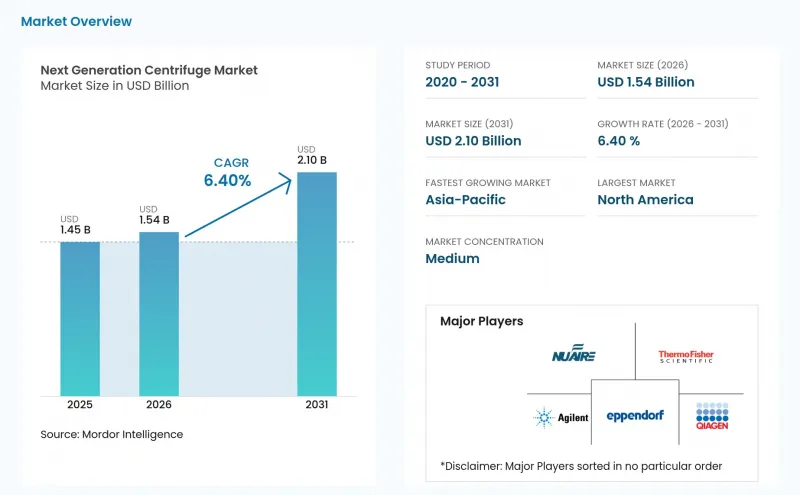
According to Mordor Intelligence, the next generation centrifuge market size was valued at USD 1.45 billion in 2025 and is estimated to grow from USD 1.54 billion in 2026 to reach USD 2.10 billion by 2031, at a CAGR of 6.40% during the forecast period (2026-2031).
Global Next Generation Centrifuge Market Trends and Insights
Expansion of Cell and Gene Therapy Manufacturing
Cell and gene therapy manufacturing has transformed centrifugation from a routine laboratory activity into a controlled production process. Cell isolation, density-gradient fractionation, spinoculation, post-transduction washing, and final formulation require defined centrifuge settings under GMP controls. A 2025 study reported transduction efficiency of 83.4% using an automated closed-system centrifuge, compared with 72.8% for conventional bag centrifugation and 35.7% for static incubation. These performance differences can affect yield and batch acceptance at commercial scale, supporting demand in the next-generation centrifuge market for systems with validated parameters, electronic records, and closed tubing connections.
Growth of High-Throughput Molecular Diagnostics and Omics Workflows
Centrifugal microfluidics is expanding the application of centrifugation in diagnostic workflows. A single drive unit can perform fluid movement, separation, and mixing across more than 30 sample wells, reducing manual pipetting in complex processes. A 2025 study described a centrifugal microfluidic chip that integrated 30-plex nucleic acid purification and ELISA on a single lab-on-disc platform. This integration supports demand for compatible drive systems and diagnostic cartridges in the next-generation centrifuge market.
High Capital Cost and Total Cost of Ownership
Advanced floor-standing centrifuges for GMP bioprocessing require acquisition costs ranging from USD 80,000 to more than USD 300,000. Over a 10-year operating life, rotor replacements, preventive maintenance, recertification, validated consumable kits, and energy consumption can raise total ownership costs to more than three times the list price. These high costs limit equipment upgrades among smaller laboratories and emerging organizations.
Large CDMOs and pharmaceutical manufacturers can absorb these expenses more readily, while academic spinouts and early-stage cell therapy developers may retain existing equipment longer. Qualification and process validation add further costs, as IQ, OQ, and PQ documentation for a GMP-grade installation can require three to six months of engineering work. Cost-sensitive buyers may select certified pre-owned systems, available at 30-50% of new-instrument prices, for standard separation requirements.
Other drivers and restraints analyzed in the detailed report include:
- Adoption of Automated, Connected, and Traceable Laboratory Workflows
- Increasing Use of Closed and Single-Use Separation Systems in Bioprocessing
- Long Replacement Cycles and Availability of Refurbished Equipment
For complete list of drivers and restraints, kindly check the Table Of Contents.
Segment Analysis
Equipment is projected to account for 76.12% of the Next Generation Centrifuge Market in 2025. Purchases of clinical-grade and GMP-certified systems by hospitals, CDMOs, and pharmaceutical companies support this position. Both floor-standing and benchtop formats contribute to equipment revenue. Service and lifecycle support are also becoming increasingly important as suppliers offer multiyear service contracts. These contracts generate recurring revenue and help suppliers retain key accounts, resembling the reagent-rental models used in in-vitro diagnostics.
Accessories and consumables are forecast to grow at a CAGR of 9.22% through 2031. Single-use separation sets, validated tubeset assemblies, and RFID-chipped rotor adapters often require replacement after each production batch, helping prevent cross-contamination in cell therapy cleanrooms. Instant Systems' CentriLoc cell therapy tubes provide an example of validated tubeset assemblies. In high-utilization GMP operations, consumables revenue can exceed the initial equipment purchase. Suppliers are therefore competing through validated consumables ecosystems in addition to instrument performance.
Benchtop centrifuges are projected to hold 61.30% of the Next Generation Centrifuge Market in 2025. Their position reflects widespread use across clinical laboratories, research institutes, and biotechnology discovery operations. Footprint, versatility, and lower upfront costs remain key selection criteria. In 2025, Haier Biomedical is expected to launch the LX-155T750R, a 3-liter refrigerated system that reaches speeds of 15,500 rpm and 26,322 X g for molecular biology, clinical research, and biobanking workflows.
Floor-standing centrifuges are forecast to grow at a CAGR of 8.67% through 2031, driven by the shift toward larger-scale, continuous-duty separation in commercial bioprocessing. In April 2025, Thermo Fisher is expected to launch the BIOS A and 16 centrifuges featuring GreenCool Technology. The company reports that the systems will have a global warming potential of 1 and consume 15% less energy than the preceding systems. Ultracentrifuges and microcentrifuges remain specialized categories for virology, nanoparticle characterization, and subcellular fractionation applications requiring speeds above 100,000 X g.
Complete Report Scope:
- By Product Type
- Equipment
- Accessories and Consumables
- Service and Lifecycle Support
- By Model
- Benchtop Centrifuges
- Floor-Standing Centrifuges
- Others
- By Application
- Clinical Diagnostics
- Biotechnology & Pharmaceutical Research
- Cell & Gene Therapy
- Genomics & Proteomics
- Blood Component Separation
- Bioprocessing
- Academic & Research
- Other
- By End User
- Hospitals and Diagnostic Laboratories
- Biotechnology and Pharmaceutical Companies
- Contract Research Organizations
- Contract Development and Manufacturing Organizations
- Academic and Research Institutes
- Blood Banks and Transfusion Centers
- Others
- By Geography
- North America
- United States
- Canada
- Mexico
- Europe
- Germany
- United Kingdom
- France
- Italy
- Spain
- Rest of Europe
- Asia-Pacific
- China
- India
- Japan
- Australia
- South Korea
- Rest of Asia-Pacific
- Middle East and Africa
- GCC
- South Africa
- Rest of Middle East and Africa
- South America
- Brazil
- Argentina
- Rest of South America
- North America
Geography Analysis
North America is projected to hold a 38.10% share of the Next Generation Centrifuge Market in 2025. The United States has a large regulated base of approved cell and gene therapies, supported by hospitals, reference laboratories, and biopharmaceutical networks. Canada is expanding biomanufacturing capacity, while Mexico is strengthening clinical diagnostics and pharmaceutical manufacturing capabilities.
North American growth through 2031 is forecast to remain steady, supported by compliance-driven replacements and cell therapy investments. In Europe, Regulation (EU) 2024/573 is driving equipment replacement as quota reductions for high-global-warming-potential refrigerants begin in 2025. Thermo Fisher Scientific introduced the Cryofuge, BIOS, and LYNX lines to meet EU F-gas and U.S. EPA SNAP requirements, with Germany, the United Kingdom, and France leading demand.
Asia-Pacific is forecast to record an 8.95% CAGR through 2031, the highest among regional markets. China, South Korea, Japan, and India are expanding biopharmaceutical capacity, while AGC Biologics has a commercial agreement for production at its Yokohama site. TheraNym Biologics announced a USD 150-175 million investment in a mammalian cell culture biologic drug substance facility for Merck. The Middle East and Africa and South America continue to benefit from healthcare investment, regulatory modernization, laboratory consolidation, and biopharmaceutical activity.
- Agilent Technologies
- Andreas Hettich
- Benchmark Scientific, Inc.
- Bio-Rad Laboratories
- Centurion Scientific Limited
- Danaher
- Eppendorf
- Haier Biomedical
- Hanil Scientific Inc.
- HERMLE Labortechnik
- KUBOTA
- Labnet International
- NuAire, Inc.
- QIAGEN
- Remi Group
- Sartorius
- Sigma Laborzentrifugen
- Thermo Fisher Scientific
Additional Benefits:
- The market estimate (ME) sheet in Excel format
- 3 months of analyst support
TABLE OF CONTENTS
1 INTRODUCTION
- 1.1 Study Assumptions and Market Definition
- 1.2 Scope of the Study
2 RESEARCH METHODOLOGY
3 EXECUTIVE SUMMARY
4 MARKET LANDSCAPE
- 4.1 Market Overview
- 4.2 Market Drivers
- 4.2.1 Expansion of Cell and Gene Therapy Manufacturing
- 4.2.2 Growth of High-Throughput Molecular Diagnostics and Omics Workflows
- 4.2.3 Adoption of Automated, Connected, and Traceable Laboratory Workflows
- 4.2.4 Increasing Use of Closed and Single-Use Separation Systems in Bioprocessing
- 4.2.5 Expansion of Biopharmaceutical and Contract Manufacturing Capacity in Asia-Pacific
- 4.2.6 Demand for Energy-Efficient Refrigeration and Advanced Rotor Platforms
- 4.3 Market Restraints
- 4.3.1 High Capital Cost and Total Cost of Ownership
- 4.3.2 Long Replacement Cycles and Availability of Refurbished Equipment
- 4.3.3 Shortage of Qualified Service Engineers and Centrifugation Specialists
- 4.3.4 Validation, Biosafety, and Rotor-Integrity Requirements
- 4.4 Value/Supply-Chain Analysis
- 4.5 Regulatory Landscape
- 4.6 Technological Outlook
- 4.7 Porter's Five Forces Analysis
- 4.7.1 Bargaining Power of Suppliers
- 4.7.2 Bargaining Power of Buyers
- 4.7.3 Threat of New Entrants
- 4.7.4 Threat of Substitutes
- 4.7.5 Competitive Rivalry
5 MARKET SIZE AND GROWTH FORECASTS (VALUE, USD)
- 5.1 By Product Type
- 5.1.1 Equipment
- 5.1.2 Accessories and Consumables
- 5.1.3 Service and Lifecycle Support
- 5.2 By Model
- 5.2.1 Benchtop Centrifuges
- 5.2.2 Floor-Standing Centrifuges
- 5.2.3 Others
- 5.3 By Application
- 5.3.1 Clinical Diagnostics
- 5.3.2 Biotechnology & Pharmaceutical Research
- 5.3.3 Cell & Gene Therapy
- 5.3.4 Genomics & Proteomics
- 5.3.5 Blood Component Separation
- 5.3.6 Bioprocessing
- 5.3.7 Academic & Research
- 5.3.8 Other
- 5.4 By End User
- 5.4.1 Hospitals and Diagnostic Laboratories
- 5.4.2 Biotechnology and Pharmaceutical Companies
- 5.4.3 Contract Research Organizations
- 5.4.4 Contract Development and Manufacturing Organizations
- 5.4.5 Academic and Research Institutes
- 5.4.6 Blood Banks and Transfusion Centers
- 5.4.7 Others
- 5.5 By Geography
- 5.5.1 North America
- 5.5.1.1 United States
- 5.5.1.2 Canada
- 5.5.1.3 Mexico
- 5.5.2 Europe
- 5.5.2.1 Germany
- 5.5.2.2 United Kingdom
- 5.5.2.3 France
- 5.5.2.4 Italy
- 5.5.2.5 Spain
- 5.5.2.6 Rest of Europe
- 5.5.3 Asia-Pacific
- 5.5.3.1 China
- 5.5.3.2 India
- 5.5.3.3 Japan
- 5.5.3.4 Australia
- 5.5.3.5 South Korea
- 5.5.3.6 Rest of Asia-Pacific
- 5.5.4 Middle East and Africa
- 5.5.4.1 GCC
- 5.5.4.2 South Africa
- 5.5.4.3 Rest of Middle East and Africa
- 5.5.5 South America
- 5.5.5.1 Brazil
- 5.5.5.2 Argentina
- 5.5.5.3 Rest of South America
- 5.5.1 North America
6 COMPETITIVE LANDSCAPE
- 6.1 Market Concentration
- 6.2 Market Share Analysis
- 6.3 Company Profiles (includes Global Level Overview, Market Level Overview, Core Segments, Financials as available, Strategic Information, Market Rank/Share, Products and Services, Recent Developments)
- 6.3.1 Agilent Technologies, Inc.
- 6.3.2 Andreas Hettich GmbH & Co. KG
- 6.3.3 Benchmark Scientific, Inc.
- 6.3.4 Bio-Rad Laboratories, Inc.
- 6.3.5 Centurion Scientific Limited
- 6.3.6 Danaher Corporation
- 6.3.7 Eppendorf SE
- 6.3.8 Haier Biomedical
- 6.3.9 Hanil Scientific Inc.
- 6.3.10 HERMLE Labortechnik GmbH
- 6.3.11 KUBOTA Corporation
- 6.3.12 Labnet International, Inc.
- 6.3.13 NuAire, Inc.
- 6.3.14 QIAGEN N.V.
- 6.3.15 Remi Group
- 6.3.16 Sartorius AG
- 6.3.17 Sigma Laborzentrifugen GmbH
- 6.3.18 Thermo Fisher Scientific Inc.
7 MARKET OPPORTUNITIES AND FUTURE OUTLOOK
- 7.1 White-Space and Unmet-Need Assessment

