PUBLISHER: Mordor Intelligence | PRODUCT CODE: 2185054

PUBLISHER: Mordor Intelligence | PRODUCT CODE: 2185054
Vietnam Mechanical, Electrical, and Plumbing (MEP) Services - Market Share Analysis, Industry Trends & Statistics, Growth Forecasts (2026 - 2031)
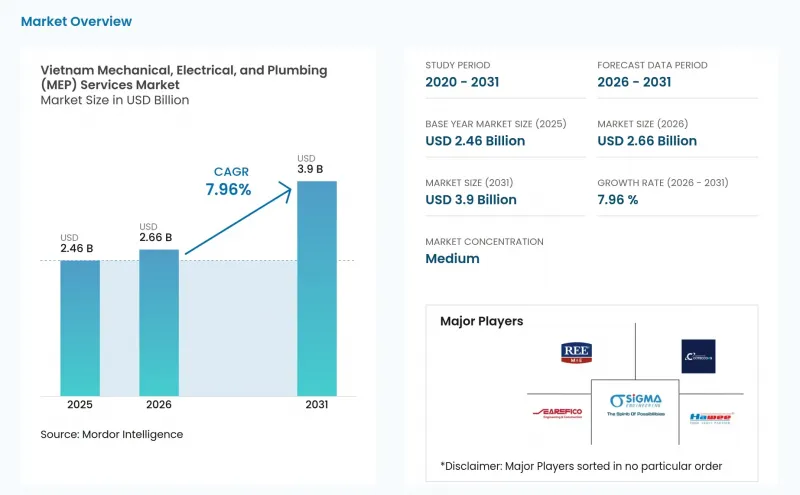
According to Mordor Intelligence, the Vietnam mechanical, electrical, and plumbing services market size is expected to grow from USD 2.46 billion in 2025 to USD 2.66 billion in 2026 and is forecast to reach USD 3.9 billion by 2031 at 7.96% CAGR over 2026-2031.
Vietnam Mechanical, Electrical, and Plumbing (MEP) Services Market Trends and Insights
Public Investment in Transport, Urban Development, and Energy Infrastructure
Public investment is a major source of project demand for the Vietnam mechanical, electrical, and plumbing (MEP) services market. The 2026-2030 public investment envelope is more than double the preceding five-year plan, and the 2026 allocation is 41.7% higher than the prior year's initial allocation. Airports, metro systems, roads, and energy facilities need electrical, ventilation, drainage, pumping, and fire-protection packages. Long Thanh International Airport Phase 1 and the planned North-South high-speed railway add complex technical work for qualified contractors. Contractors with infrastructure experience are therefore better placed to pursue this expanding pipeline.
Manufacturing Foreign Direct Investment and Industrial-Park Expansion
Manufacturing investment is increasing the demand for specialized building and industrial systems. Realized foreign direct investment reached USD 27.6 billion in 2025, and manufacturing and processing received USD 22.9 billion, or 82.8% of the total. New industrial parks create requirements for power, cooling, process water, wastewater, and fire-protection systems. Electronics and semiconductor facilities also need cleanroom cooling, protected electrical systems, and ultra-pure water connections. These requirements favor contractors that can meet formal technical specifications.
Skilled Mechanical, Electrical, and Plumbing Labor and Commissioning-Capability Shortages
Labor constraints can slow contract execution in the Vietnam mechanical, electrical, and plumbing (MEP) services market. Construction job postings rose nearly 172% year on year in the second quarter of 2025, while applications fell by more than 42%. The Ministry of Construction reported that 75% of the construction workforce remained unskilled or untrained. The shortage is most serious for commissioning, controls, fire verification, and precision cooling work. Fixed-price packages remain exposed when qualified labor is scarce.
Other drivers and restraints analyzed in the detailed report include:
- Data-Center, Cloud, and Digital-Infrastructure Construction
- Green-Building and Energy-Efficiency Requirements
- Permitting, Fire-Safety Approval, and Regulatory Coordination Delays
For complete list of drivers and restraints, kindly check the Table Of Contents.
Segment Analysis
Mechanical Services held 42.3% of the Vietnam mechanical, electrical, and plumbing (MEP) services revenue share in 2025. The segment benefits from cooling, ventilation, and fire-suppression requirements in commercial towers and industrial facilities. Heating, ventilation, and air conditioning (HVAC) systems remain a major part of building services expenditure in Vietnam. Fire-suppression work adds a separate compliance requirement in many projects. Electrical Services benefit from the need for stable power and controls. Plumbing Services are supported by drainage, water treatment, and flood-resilience investment.
Integrated MEP Services is forecast to grow at an 8.67% CAGR through 2031. Decree 217/2026/ND-CP requires building information modeling for eligible Grade II and higher works from July 1, 2026. The requirement applies to privately funded projects as well as public works. Vietnam also adopted International Organization for Standardization 19650 through national standards numbered 14177-1:2024 and 14177-2:2024. Integrated contractors can coordinate mechanical, electrical, and plumbing designs before installation begins. This can reduce clashes between separate systems and improve control of handover documentation.
Unicons uses building information modeling within its mechanical and electrical workflow. Sigma Engineering used an integrated management system and building information modeling at the Senique Ocean Park project in Hanoi. Decision 2597/QD-TTg also supports digital construction models for major public investment and infrastructure projects. Open Industry Foundation Classes format data requirements increase the value of structured project information. Contractors with coordinated delivery systems can use this capability across repeat projects. Single-trade providers face greater pressure to work within larger digital workflows.
Complete Report Scope:
- By Type
- Mechanical Services
- Electrical Services
- Plumbing Services
- Integrated MEP Services
- By Service Type
- Design and Engineering
- Installation, Testing, and Commissioning
- Maintenance, Repair, and Retrofit
- Managed / Performance-Based Services
- By End-User Industry
- Residential
- Commercial
- Infrastructure
- By Key Cities
- Ho Chi Minh City
- Hanoi
- Quang Ninh
- Da Nang
List of Companies Covered in this Report:
- R.E.E Mechanical & Electrical Engineering JSC
- Coteccons Construction Joint Stock Company
- SEAREFICO Engineering and Construction JSC
- Sigma Engineering JSC
- Hawee Mechanical and Electrical JSC
- Newtecons Investment Construction JSC
- SOL E&C Investment Construction JSC
- Unicons Investment Construction Co., Ltd.
- Ricons Construction Investment JSC
- NLT Group
- HVC Group JSC
- MEC International Co., Ltd.
- ION Mechanical & Electrical JSC
- Trieu Minh Engineering Technology Co., Ltd.
- Meco Vietnam Engineering and Construction JSC
- Lusac Group Vietnam
- Top Engineering Vietnam Co., Ltd.
- Aurecon Group
- Arup Group
- Meinhardt Group International Limited
- WSP Global Inc.
- AECOM
Additional Benefits:
- The market estimate (ME) sheet in Excel format
- 3 months of analyst support
TABLE OF CONTENTS
1 INTRODUCTION
- 1.1 Study Assumptions and Market Definition
- 1.2 Scope of the Study
2 RESEARCH METHODOLOGY
3 EXECUTIVE SUMMARY
4 MARKET INSIGHTS AND DYNAMICS
- 4.1 Market Overview
- 4.2 Market Drivers
- 4.2.1 Public Investment in Transport, Urban Development, and Energy Infrastructure
- 4.2.2 Manufacturing FDI and Industrial-Park Expansion
- 4.2.3 Data-Center, Cloud, and Digital-Infrastructure Construction
- 4.2.4 Green-Building and Energy-Efficiency Requirements
- 4.2.5 Flood-Resilient Water, Drainage, and Climate-Adapted Infrastructure
- 4.2.6 Rising Demand for Integrated Design-Build MEP Delivery
- 4.3 Market Restraints
- 4.3.1 Skilled MEP Labor and Commissioning-Capability Shortages
- 4.3.2 Permitting, Fire-Safety Approval, and Regulatory Coordination Delays
- 4.3.3 Imported Equipment Lead Times and Price Volatility
- 4.3.4 Contractor Cash-Flow Pressure and Extended Payment Cycles
- 4.4 Value / Supply-Chain Analysis
- 4.5 Regulatory Landscape
- 4.6 Technological Outlook
- 4.7 Industry Attractiveness - Porter's Five Forces Analysis
- 4.7.1 Bargaining Power of Suppliers
- 4.7.2 Bargaining Power of Consumers
- 4.7.3 Threat of New Entrants
- 4.7.4 Threat of Substitutes
- 4.7.5 Intensity of Competitive Rivalry
- 4.8 Cost Structure Analysis
5 VIETNAM MECHANICAL, ELECTRICAL, AND PLUMBING (MEP) SERVICES MARKET, MARKET SIZE & GROWTH FORECASTS (VALUE IN USD) - 2020-2031
- 5.1 By Type
- 5.1.1 Mechanical Services
- 5.1.2 Electrical Services
- 5.1.3 Plumbing Services
- 5.1.4 Integrated MEP Services
- 5.2 By Service Type
- 5.2.1 Design and Engineering
- 5.2.2 Installation, Testing, and Commissioning
- 5.2.3 Maintenance, Repair, and Retrofit
- 5.2.4 Managed / Performance-Based Services
- 5.3 By End-User Industry
- 5.3.1 Residential
- 5.3.2 Commercial
- 5.3.3 Infrastructure
- 5.4 By Key Cities
- 5.4.1 Ho Chi Minh City
- 5.4.2 Hanoi
- 5.4.3 Quang Ninh
- 5.4.4 Da Nang
6 COMPETITIVE LANDSCAPE
- 6.1 Market Concentration
- 6.2 Strategic Moves
- 6.3 Market Share Analysis
- 6.4 Company Profiles (includes Global Level Overview, Market Level Overview, Core Segments, Financials as available, Strategic Information,Products and Services, Recent Developments)
- 6.4.1 R.E.E Mechanical & Electrical Engineering JSC
- 6.4.2 Coteccons Construction Joint Stock Company
- 6.4.3 SEAREFICO Engineering and Construction JSC
- 6.4.4 Sigma Engineering JSC
- 6.4.5 Hawee Mechanical and Electrical JSC
- 6.4.6 Newtecons Investment Construction JSC
- 6.4.7 SOL E&C Investment Construction JSC
- 6.4.8 Unicons Investment Construction Co., Ltd.
- 6.4.9 Ricons Construction Investment JSC
- 6.4.10 NLT Group
- 6.4.11 HVC Group JSC
- 6.4.12 MEC International Co., Ltd.
- 6.4.13 ION Mechanical & Electrical JSC
- 6.4.14 Trieu Minh Engineering Technology Co., Ltd.
- 6.4.15 Meco Vietnam Engineering and Construction JSC
- 6.4.16 Lusac Group Vietnam
- 6.4.17 Top Engineering Vietnam Co., Ltd.
- 6.4.18 Aurecon Group
- 6.4.19 Arup Group
- 6.4.20 Meinhardt Group International Limited
- 6.4.21 WSP Global Inc.
- 6.4.22 AECOM
7 MARKET OPPORTUNITIES AND FUTURE OUTLOOK
- 7.1 White-Space and Unmet-Need Assessment

