PUBLISHER: Mordor Intelligence | PRODUCT CODE: 2185111

PUBLISHER: Mordor Intelligence | PRODUCT CODE: 2185111
DDR6 and CXL Memory Expansion Technology - Market Share Analysis, Industry Trends & Statistics, Growth Forecasts (2026 - 2031)
According to Mordor Intelligence, the DDR6 and CXL memory expansion technology market size is projected to expand from USD 0.42 billion in 2025 and USD 0.59 billion in 2026 to USD 6.78 billion by 2031, registering a CAGR of 62.96% between 2026 to 2031.
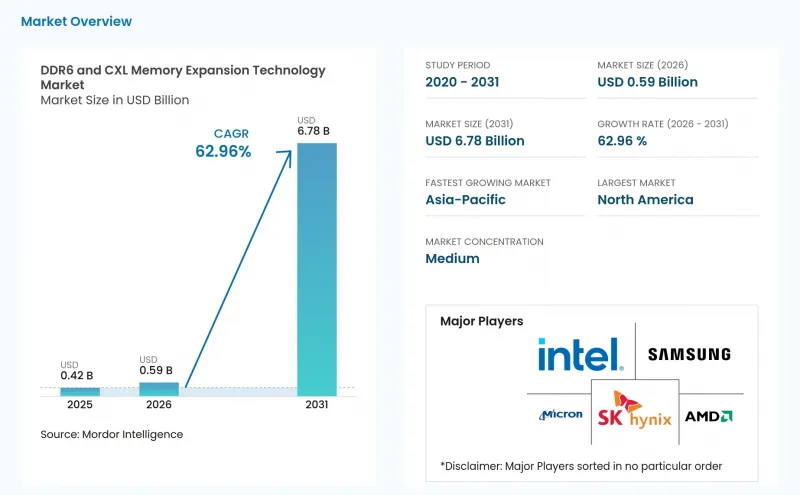
Global DDR6 and CXL Memory Expansion Technology Market Trends and Insights
Rising AI, GenAI, and Machine Learning Inference Demand
The DDR6 and CXL memory expansion technology market is being driven by a memory bottleneck that arises when AI inference runs at scale. Long-running context-transformer workloads need the full KV-cache to remain active, which pushes memory demand beyond what HBM and local DDR can handle on their own. A peer-reviewed IEEE study found that CXL-pooled memory achieved much higher throughput than HBM-only, recompute, and distributed DDR setups once the context length exceeded the HBM-fit range of 100,000 tokens. SK hynix reported in 2026 that its IMTE architecture, which places CXL hybrid memory between DDR and SSD, improved AI inference efficiency by 35.7%. As AI agents, recommendation models, and long context systems expand, CXL memory is shifting from a cost tool into a functional requirement for deployment.
Memory Overprovisioning Reduction Via CXL Disaggregation
The DDR6 and CXL memory expansion technology market is also gaining support from the need to reduce wasted DRAM across server fleets. Traditional server design fixes memory to each host, so spare capacity often sits idle even when other systems are constrained. Meta demonstrated this at ISCA 2026, where its Vistara deployment used a custom CXL ASIC to connect decommissioned DDR4 memory to new AMD EPYC Turin servers and reduced the need for AI inference servers. The same deployment lowered out-of-memory failures and distributed cache latency across millions of production servers. This makes CXL useful not only for efficiency and capital control but also for extending memory life during server refresh cycles.
High Integration and Validation Costs for CXL Platforms
The DDR6 and CXL memory expansion technology market still faces heavy validation demands before large enterprise rollouts can become routine. CXL deployments require testing across protocol compliance, PCIe link integrity, NUMA behavior, firmware combinations, and operating system page placement. A 2026 IEEE Transactions on Computers study found that CPU and DRAM internals, rather than the CXL protocol itself, dominated latency and variability, but it also stressed the need for structured qualification around link errors, interference, and failure behavior. Samsung disclosed that it had supplied CXL 2.0 samples to more than 40 companies, including major cloud and server vendors, underscoring the breadth of the validation workload remaining before scaled deployment. This favors hyperscalers with dedicated hardware teams and slows adoption in enterprise data centers that rely on packaged and prequalified infrastructure.
Other drivers and restraints analyzed in the detailed report include:
- Native CXL Enablement in New Server CPU Platforms
- DDR6 Transition and High-Bandwidth DRAM Demand
- Legacy Server Compatibility Constraints
For complete list of drivers and restraints, kindly check the Table Of Contents.
Segment Analysis
CXL Memory Expansion held 43.1% of the DDR6 and CXL memory expansion technology market share in 2025, making it the largest technology segment at the start of commercialization. Hyperscale customers adopted this layer first because single-host expansion solves immediate capacity gaps without needing the full complexity of shared fabrics. Micron's CZ122 module, described as the first CXL 2.0-compliant product, was integrated by AIC into the SB201-SU storage server platform with Intel in May 2025. That rollout showed how the early DDR6 and CXL memory expansion technology industry formed around server vendors, CPU suppliers, and module developers working in tandem.
CXL Memory Pooling and Sharing is forecast to grow at a 64.3% CAGR through 2031, making it the fastest-growing technology segment in the DDR6 and CXL memory expansion technology market. This shift points to a move away from isolated server upgrades and toward rack-level memory allocation across multiple hosts. XConn Technologies and MemVerge demonstrated a 100 TiB commercial CXL memory pool at the OCP Global Summit 2025, providing the market with a visible example of a larger shared-fabric deployment. The infrastructure layer for that transition is also expanding, with Marvell launching the Structera S 30260 in 2026 as a 260-lane CXL 3.0 switch designed for up to 48 TB of shared memory across 16 to 32 hosts.
Hardware held 76.6% of the DDR6 and CXL memory expansion technology market size in 2025, reflecting the capital-heavy nature of module design, switch silicon, controllers, and retimers in an early-stage buildout. The lead is large because initial deployments require specialized devices that still carry premium pricing relative to standard DRAM. Services remained the smallest component segment, largely tied to deployment support, platform qualification, and enterprise integration. Software, however, is forecast to grow at a 64.8% CAGR through 2031, which makes it the fastest-growing component area in the DDR6 and CXL memory expansion technology market.
This pattern matters because the hardware value proposition depends on how well memory tiering, page placement, and orchestration are handled in production environments. Micron's Xeon 6 testing showed that CXL expansion can add meaningful bandwidth and application gains, but those gains still need system-level control to remain stable under real workloads. Astera Labs positioned its Leo CXL Smart Memory Controllers for Microsoft Azure M-series virtual machines in 2025, targeting in-memory databases, AI inference, and KV-cache workloads. That is why the DDR6 and CXL memory expansion technology industry is starting to reward vendors that combine silicon with software-aware deployment models instead of selling hardware in isolation.
Complete Report Scope:
- By Technology
- DDR6 Memory
- CXL Memory Expansion
- CXL Memory Pooling and Fabric
- CXL Controllers, Switches, and Retimers
- By Component
- Hardware
- Software
- Services
- By Application
- AI and Machine Learning
- High-Performance Computing
- Cloud and Hyperscale Data Centers
- In-Memory Databases and Analytics
- Enterprise IT and Virtualization
- Edge and Telecom Infrastructure
- By End User
- Hyperscale Cloud Service Providers
- Enterprise Data Centers
- Colocation and Managed Service Providers
- Server OEMs and System Integrators
- Research and Academic Institutions
- Government and Defense
- Telecom Operators
- By Geography
- North America
- Europe
- Asia Pacific
- China
- Japan
- South Korea
- Taiwan
- Rest of Asia Pacific
- Rest of the World
Geography Analysis
North America held 53.9% of the DDR6 and CXL memory expansion technology market share in 2025, which made it the clear leading region. The region benefits from the largest concentration of hyperscale data center capacity and a deep vendor base across controllers, software, and systems integration. The DDR6 and CXL memory expansion technology market in North America is also supported by close links between platform developers and cloud buyers, which shortens pilot cycles. Astera Labs' 2025 Azure deployment provided a strong commercial signal that CXL-attached memory had moved beyond lab testing and into cloud infrastructure. The presence of companies such as Astera Labs, MemVerge, GigaIO, and Liqid also strengthens the regional ecosystem around software and fabric-level architecture.
Asia Pacific is projected to grow at a 63.9% CAGR through 2031, making it the fastest-growing region in the DDR6 and CXL memory expansion technology market. Growth is being supported by the region's strength in DRAM manufacturing, packaging, substrate supply, and domestic AI infrastructure programs. Samsung and SK hynix intensified competition in 2026 around CXL 3.2-based memory modules, with both companies focusing on higher-bandwidth next-generation products. Montage Technology also launched its CXL 3.1 MXC chip in 2025 and confirmed bulk supply that year, which points to a rising domestic controller ecosystem in China. Taiwan remains important through substrate manufacturers, while Japan is advancing integration work that connects CXL with broader distributed infrastructure models.
Europe and the Rest of the World hold smaller shares, but both remain strategically relevant to the DDR6 and CXL memory expansion technology market. In Europe, early evaluation is centered on database expansion and memory-intensive enterprise workloads, especially where high memory per core matters. Rest of the World in 2026 remained more dependent on hyperscale cloud access than on direct ownership of advanced CXL infrastructure. Over time, sovereign AI buildouts and new data center investment could create a wider buyer base once platform compatibility and software maturity improve.
- Samsung Electronics Co., Ltd.
- SK hynix Inc.
- Micron Technology, Inc.
- Intel Corporation
- Advanced Micro Devices, Inc.
- Astera Labs, Inc.
- Marvell Technology, Inc.
- Rambus Inc.
- Montage Technology Co., Ltd.
- Renesas Electronics Corporation
- Microchip Technology Incorporated
- SMART Modular Technologies, Inc.
- Dell Technologies Inc.
- Hewlett Packard Enterprise Company
- Super Micro Computer, Inc.
- Lenovo Group Limited
- GigaIO, Inc.
- Liqid Inc.
- MemVerge, Inc.
- Synopsys, Inc.
- Cadence Design Systems, Inc.
- Kioxia Holdings Corporation
- Xconn Technologies Co., Ltd.
- Teledyne Technologies Incorporated
Additional Benefits:
- The market estimate (ME) sheet in Excel format
- 3 months of analyst support
TABLE OF CONTENTS
1 INTRODUCTION
- 1.1 Study Assumptions and Market Definition
- 1.2 Scope of the Study
2 RESEARCH METHODOLOGY
3 EXECUTIVE SUMMARY
4 MARKET LANDSCAPE
- 4.1 Market Overview
- 4.2 Market Drivers
- 4.2.1 Rising AI, GenAI, and HPC Memory Bandwidth Demand
- 4.2.2 Memory Overprovisioning Pressure in GPU-Accelerated and Cloud Servers
- 4.2.3 Native CXL Enablement in Next-Generation Server CPUs
- 4.2.4 DDR6 Transition, Higher Pin Speed, and Platform Refresh Cycle
- 4.2.5 Software-Defined Memory Tiering Improves Rack Utilization and Power Efficiency
- 4.2.6 Disaggregated Memory Pooling Lowers Total Cost of Ownership
- 4.3 Market Restraints
- 4.3.1 High Integration and Validation Complexity Across Hardware, Firmware, and Operating Systems
- 4.3.2 Legacy Server Compatibility Limits Brownfield Adoption
- 4.3.3 Software Ecosystem Immaturity for Memory Tiering and Workload Placement
- 4.3.4 Latency Sensitivity Restricts Use in Real-Time Workloads
- 4.4 Value Chain Analysis
- 4.5 Regulatory Landscape
- 4.6 Technological Outlook
- 4.7 Porter's Five Forces Analysis
- 4.7.1 Threat of New Entrants
- 4.7.2 Bargaining Power of Suppliers
- 4.7.3 Bargaining Power of Buyers
- 4.7.4 Threat of Substitutes
- 4.7.5 Industry Rivalry
5 MARKET SIZE AND GROWTH FORECASTS
- 5.1 By Technology
- 5.1.1 DDR6 Memory
- 5.1.2 CXL Memory Expansion
- 5.1.3 CXL Memory Pooling and Fabric
- 5.1.4 CXL Controllers, Switches, and Retimers
- 5.2 By Component
- 5.2.1 Hardware
- 5.2.2 Software
- 5.2.3 Services
- 5.3 By Application
- 5.3.1 AI and Machine Learning
- 5.3.2 High-Performance Computing
- 5.3.3 Cloud and Hyperscale Data Centers
- 5.3.4 In-Memory Databases and Analytics
- 5.3.5 Enterprise IT and Virtualization
- 5.3.6 Edge and Telecom Infrastructure
- 5.4 By End User
- 5.4.1 Hyperscale Cloud Service Providers
- 5.4.2 Enterprise Data Centers
- 5.4.3 Colocation and Managed Service Providers
- 5.4.4 Server OEMs and System Integrators
- 5.4.5 Research and Academic Institutions
- 5.4.6 Government and Defense
- 5.4.7 Telecom Operators
- 5.5 By Geography
- 5.5.1 North America
- 5.5.2 Europe
- 5.5.3 Asia Pacific
- 5.5.3.1 China
- 5.5.3.2 Japan
- 5.5.3.3 South Korea
- 5.5.3.4 Taiwan
- 5.5.3.5 Rest of Asia Pacific
- 5.5.4 Rest of the World
6 COMPETITIVE LANDSCAPE
- 6.1 Market Concentration
- 6.2 Strategic Moves
- 6.3 Market Share Analysis
- 6.4 Company Profiles (includes Global Level Overview, Market Level Overview, Core Segments, Financials as available, Strategic Information, Market Rank/Share, Products and Services, Recent Developments)
- 6.4.1 Samsung Electronics Co., Ltd.
- 6.4.2 SK hynix Inc.
- 6.4.3 Micron Technology, Inc.
- 6.4.4 Intel Corporation
- 6.4.5 Advanced Micro Devices, Inc.
- 6.4.6 Astera Labs, Inc.
- 6.4.7 Marvell Technology, Inc.
- 6.4.8 Rambus Inc.
- 6.4.9 Montage Technology Co., Ltd.
- 6.4.10 Renesas Electronics Corporation
- 6.4.11 Microchip Technology Incorporated
- 6.4.12 SMART Modular Technologies, Inc.
- 6.4.13 Dell Technologies Inc.
- 6.4.14 Hewlett Packard Enterprise Company
- 6.4.15 Super Micro Computer, Inc.
- 6.4.16 Lenovo Group Limited
- 6.4.17 GigaIO, Inc.
- 6.4.18 Liqid Inc.
- 6.4.19 MemVerge, Inc.
- 6.4.20 Synopsys, Inc.
- 6.4.21 Cadence Design Systems, Inc.
- 6.4.22 Kioxia Holdings Corporation
- 6.4.23 Xconn Technologies Co., Ltd.
- 6.4.24 Teledyne Technologies Incorporated
7 MARKET OPPORTUNITIES AND FUTURE OUTLOOK
- 7.1 White-Space and Unmet-Need Assessment

